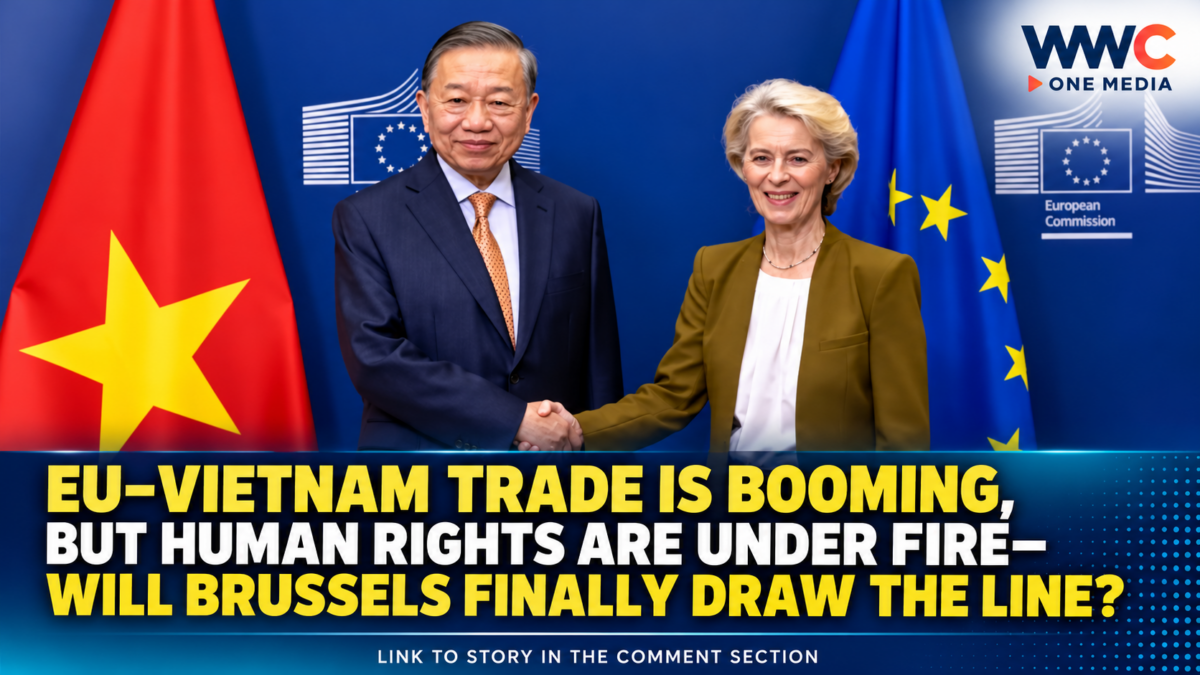
The European Union is facing renewed scrutiny over its growing relationship with Vietnam, as human rights organizations urge European leaders to hold Hanoi accountable for alleged abuses while economic, diplomatic and security cooperation continues to expand.
The debate intensified in October 2026 during Vietnamese President and Communist Party General Secretary To Lam’s visit to Brussels. Rights advocates called on European leaders to address restrictions on political expression, independent journalism, civil society and workers’ rights, raising questions about whether the EU is enforcing the commitments tied to its trade partnership with Vietnam.
The controversy presents a difficult challenge for Brussels: Can the EU strengthen its economic and strategic position in Asia without compromising its stated commitment to human rights?
A trade partnership worth billions
The EU–Vietnam Free Trade Agreement (EVFTA), which entered into force on August 1, 2020, has become a major pillar of economic relations between the two sides.
According to the European Commission, bilateral trade in goods reached €76 billion in 2025, making Vietnam the EU’s largest goods-trading partner within the Association of Southeast Asian Nations (ASEAN). However, the EU recorded a €51.7-billion goods trade deficit with Vietnam that year.
Vietnam’s exports to Europe include machinery and electrical equipment, footwear, clothing and textiles. European exports to Vietnam include machinery, chemicals and transport equipment.
For European policymakers, Vietnam also offers an increasingly important manufacturing base and an opportunity to diversify supply chains away from excessive dependence on China.
But critics argue that the economic benefits must be weighed against the EU’s responsibility to uphold labor protections and fundamental freedoms.
Sources: European Commission; Deutsche Welle (DW), October 22, 2026.
Human rights groups demand stronger action
Human Rights Watch (HRW) has called on EU leaders to use To Lam’s European visit to press for concrete improvements in Vietnam’s human rights record.
In an October 19 statement, HRW said Vietnam continued to restrict basic freedoms and had failed to fulfill important commitments associated with its trade and partnership agreements with Europe.
The organization reported that at least 160 political prisoners remained imprisoned under laws it considers inconsistent with fundamental rights. It also documented convictions and arrests involving activists during the first nine months of 2026.
These figures are findings reported by HRW, rather than independently established totals from an international judicial body.
The organization has urged European governments to demand meaningful reforms and make clear that continued violations could have consequences for political and trade relations.
In a joint letter issued ahead of To Lam’s Brussels visit, human rights groups also called for the release of people detained for peaceful expression and activism, reforms to restrictive laws, and stronger protections for independent labor organizations.
Sources: Human Rights Watch, October 19 and 16, 2026.
The labor rights issue at the center of the dispute
One of the most contentious issues is Vietnam’s commitment to improve workers’ rights under the EVFTA.
The agreement includes labor and sustainable-development provisions. Vietnam also pledged to ratify International Labour Organization Convention No. 87, which protects freedom of association and the right to organize.
However, HRW says Vietnam has yet to ratify the convention and has not established a system allowing independent trade unions to operate freely in practice.
The organization argues that these shortcomings undermine the labor protections that European officials cited when supporting closer trade relations.
In September 2025, HRW similarly argued that the trade agreement had failed to deliver the promised human rights improvements. The group called on the EU to use the agreement’s mechanisms to address alleged violations.
The issue matters beyond politics. Workers’ ability to organize, negotiate collectively and raise concerns about working conditions is central to determining whether the benefits of export-driven economic growth reach employees as well as businesses.
The EU says human rights remain part of the partnership
The EU has not publicly abandoned its human rights agenda in Vietnam.
Following the EU–Vietnam Human Rights Dialogue in Brussels on July 2, 2026, the European External Action Service said both sides discussed civil and political rights, labor protections, judicial reforms and international human rights obligations.
The EU also reiterated the importance of Vietnam implementing its labor commitments under the EVFTA, including its pledge concerning ILO Convention No. 87.
At the same time, both sides agreed to continue their human rights dialogue as part of their broader partnership.
In January 2026, the EU and Vietnam upgraded their bilateral relationship to a Comprehensive Strategic Partnership, reflecting the growing importance of cooperation in trade, investment, technology, energy and regional security.
The EU’s position therefore combines two objectives: deepening cooperation with Vietnam while continuing to raise concerns about fundamental freedoms.
The key question is whether diplomatic discussions will produce measurable changes on the ground.
Source: European External Action Service, July 17, 2026.
Why Europe continues to pursue closer ties
Vietnam has become strategically important to Europe as governments and companies seek to diversify production and strengthen economic resilience.
Closer relations also support cooperation on clean energy, infrastructure, technology and security in the Indo-Pacific, a region increasingly important to European foreign policy.
However, the benefits of trade liberalization are not distributed equally. Deutsche Welle reported that large foreign-invested manufacturers and established exporters are often better positioned than smaller domestic businesses to benefit from lower tariffs and access to European markets.
Vietnamese exporters must also navigate increasingly demanding European requirements involving sustainability, deforestation and carbon emissions.
This creates a dual challenge: Vietnam must remain competitive in global markets while addressing labor and environmental standards, and the EU must decide how firmly to enforce the commitments attached to its economic partnerships.
Will the EU turn its commitments into consequences?
The dispute ultimately concerns the credibility of the EU’s approach to trade and human rights.
Critics say repeated diplomatic dialogues are insufficient if alleged abuses continue without meaningful consequences. HRW has urged European governments to consider using the EVFTA’s available mechanisms when responding to violations of the agreement.
Such measures would require careful assessment of the agreement’s provisions and the relevant procedures. They should not be confused with an automatic suspension of trade benefits.
The European Commission’s official trade figures also show that the relationship is economically significant for both sides. Any major policy shift could therefore have implications for exporters, manufacturers, workers and investors.
For now, the EU and Vietnam continue to pursue closer cooperation while publicly reaffirming their commitment to human rights.
Whether that commitment leads to concrete reforms remains the central issue.
The bottom line: Europe’s relationship with Vietnam is no longer just a story about trade and investment. It is also a test of whether economic partnerships can deliver prosperity without sidelining workers’ rights, freedom of expression and political accountability.
The question facing Brussels is increasingly difficult to avoid: If human rights commitments are part of the price of a trade partnership, what happens when critics say those commitments are not being met?