LOS ANGELES / SAN FRANCISCO / MANILA — November 8, 2026 | WWC ONE MEDIA | Global Technology, Artificial Intelligence, Child Online Safety and Legal Affairs
The world’s biggest technology companies are facing intensifying legal pressure over how their products affect children, with Snapchat’s parent company settling a high-profile mental health lawsuit just as Google confronts new allegations involving artificial intelligence in schools.
Snap Inc. has reached a confidential settlement with two young plaintiffs who alleged that Snapchat’s design encouraged compulsive use and contributed to serious psychological and emotional harm.
The agreement, reached on November 2 during jury selection in Los Angeles, prevented a closely watched trial from moving forward.
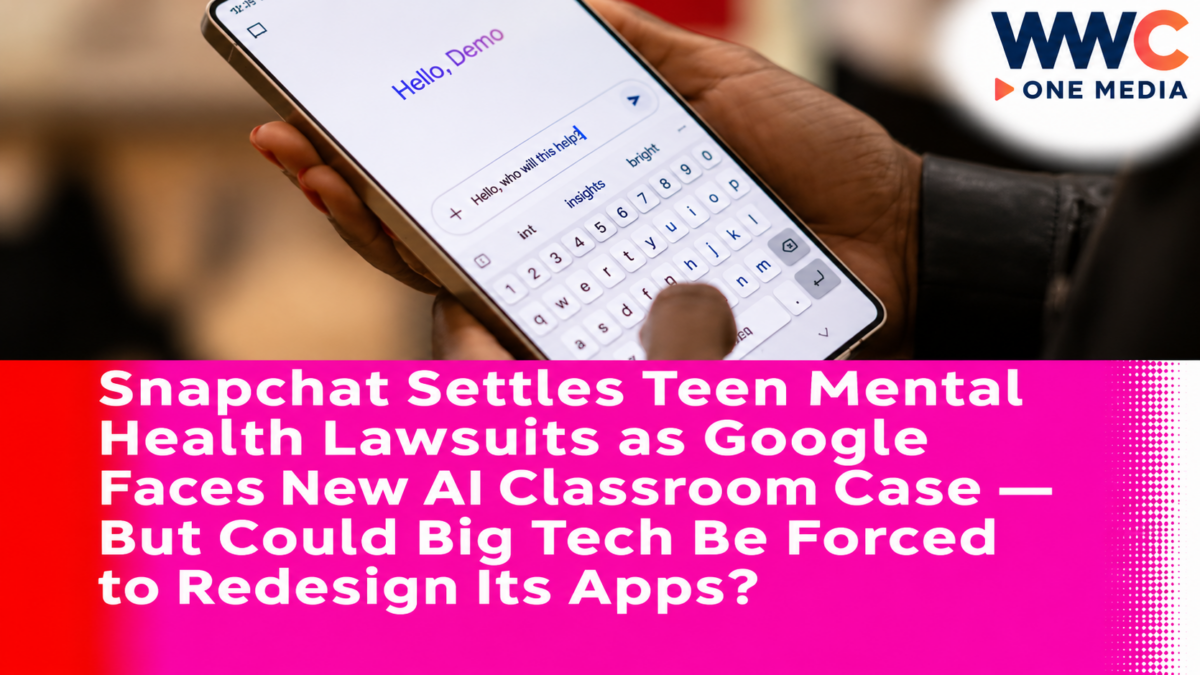
Meanwhile, Google has been sued by the parents of a teenager who allegedly experienced a serious mental health crisis after using the company’s Gemini artificial intelligence technology on a school-issued Chromebook.
According to CNBC’s November 7 report, the developments are raising urgent questions about whether technology companies are developing increasingly powerful digital products faster than they can establish adequate protections for younger users.
The legal pressure comes as social media and AI companies invest heavily in new features, compete for users and seek enormous market valuations.
But the issue is no longer limited to whether children spend too much time looking at screens.
Families and advocates are increasingly questioning whether platform design, recommendation systems, AI conversations and safety controls expose vulnerable users to foreseeable risks.
Could the latest lawsuits force Silicon Valley to fundamentally redesign how children interact with social media and artificial intelligence—or will confidential settlements allow the industry’s most controversial practices to continue?
Snap Settles Teen Addiction Lawsuit Before Trial
Snap reached an agreement with two plaintiffs whose cases had been selected for an important test trial in Los Angeles County Superior Court.
The plaintiffs were identified in court records as S.J., a 16-year-old from Illinois, and K.D.B., an 18-year-old from Mississippi.
They alleged that years of compulsive social media use contributed to conditions including depression, anxiety and eating disorders.
Their complaints challenged design features that they argued encouraged young people to remain engaged with social media for extended periods.
The features discussed in the litigation included Snapchat’s Snapstreaks, Snapscores, filters and notifications.
Snap disputed the allegations and maintained that it had developed tools intended to protect younger users.
The agreement was reached shortly before the case was scheduled to proceed to opening arguments.
According to Reuters, the settlement avoided a trial in which Snap Chief Executive Evan Spiegel had been expected to testify.
The parties did not disclose financial terms.
That means the public cannot determine how much, if anything, Snap agreed to pay the two plaintiffs.
The settlement resolved these particular claims without a jury deciding whether Snapchat was legally responsible for the alleged injuries.
Meta, TikTok and YouTube Also Settled Claims in the Same Case
Snap was not the only company involved in the litigation.
The plaintiffs had also pursued claims against Meta Platforms, TikTok and Google’s YouTube.
Those companies reached separate settlements before Snap resolved the remaining case.
The agreements followed a broader wave of litigation alleging that technology companies designed social media products to encourage excessive engagement among children and teenagers.
Plaintiffs have argued that certain product features contribute to compulsive use and other harmful experiences.
Technology companies have challenged those claims and emphasized their investments in safety tools, parental controls and educational resources.
The latest settlements illustrate how complicated these cases have become.
They involve questions about the responsibilities of technology companies, the effects of digital product design and the legal standards needed to establish causation.
A settlement may allow a company and plaintiff to resolve a dispute without the expense and uncertainty of a full trial.
It does not automatically establish that the company admits wrongdoing.
An Earlier Jury Awarded $6 Million Against Meta and YouTube
The latest Snap agreement follows a significant court verdict earlier in 2026.
In a separate bellwether case, a Los Angeles jury found Meta and Google’s YouTube negligent in connection with claims involving social media’s effects on a young plaintiff.
The jury awarded $6 million in damages.
Snap and TikTok had settled their involvement in that earlier case before trial.
The verdict became an important milestone because it demonstrated that some claims focused on social media product design could succeed before a jury.
But the litigation remains contested.
The companies involved have challenged the findings and pursued appellate options.
The $6-million award should therefore be reported as a jury verdict in that specific case, not as a universal determination that every social media platform causes psychological harm.
It also does not represent damages awarded against Snap in the November settlement.
The distinction is important as similar lawsuits continue across the United States.
Thousands of Social Media Claims Remain Pending
The legal battle extends far beyond the two cases Snap has just settled.
Families, young users, school districts and public authorities have brought numerous lawsuits involving social media companies.
Some cases allege that platform features contributed to compulsive engagement or mental health difficulties.
Others involve claims about harmful interactions, exploitation or inadequate warnings.
Attorneys have selected certain cases as bellwether trials.
These are early cases intended to test legal arguments and evidence that may be relevant to a larger group of lawsuits.
Their outcomes can influence future settlement negotiations.
However, resolving a bellwether case does not automatically dispose of all related litigation.
Additional trials are expected in March 2027.
Snap’s latest settlement therefore reduces its exposure in two particular cases without ending the wider legal challenge.
In its latest regulatory filing, Snap acknowledged multiple ongoing legal proceedings and investigations related to youth safety and platform design.
The company said it believes it has substantial defenses but also warned that unfavorable legal outcomes could materially affect its business.
New Lawsuits Accuse Snapchat of Failing to Protect Minors
The legal pressure intensified again on November 5.
The Social Media Victims Law Center announced additional lawsuits against Snap in Washington and Pennsylvania.
The lawsuits were filed on behalf of six children who were between eight and 14 years old when the alleged harms occurred.
The complaints accuse Snapchat of facilitating harmful contact between minors and adult predators.
They identify features such as friend recommendations, disappearing messages and location-sharing functions as part of the alleged safety failures.
These are serious allegations.
However, filing a lawsuit does not establish that Snap knowingly facilitated abuse or violated the law.
The company has previously defended its safety systems and said it cooperates with law enforcement and child-protection experts.
The new cases raise a different legal issue from claims about compulsive social media use.
They focus more directly on whether platform features and safety practices adequately protect minors from dangerous interactions.
Together, the lawsuits illustrate the range of legal challenges confronting digital platforms.
Snap Says It Continues Strengthening Safety Features
Snap has defended its approach to protecting younger users.
Following the November 2 settlement, the company emphasized that it had introduced safeguards, safety tutorials and partnerships with experts.
It also said protecting the privacy, safety and well-being of its users remains an ongoing responsibility.
The company has argued that Snapchat differs from traditional social media services because it opens directly to a camera rather than a conventional public content feed.
Snap has also introduced family supervision tools and account protections.
However, the availability of safety features does not by itself establish that they are effective in every circumstance.
The legal disputes concern whether the company’s product design and safeguards met the applicable standards of care.
Those questions require evidence and case-specific evaluation.
For parents, the challenge is understanding not only what controls exist but also what risks remain after those controls are activated.
Google’s Gemini Faces a New Lawsuit Involving a Student
While Snap was resolving one major dispute, Google faced another involving its artificial intelligence products.
Parents in North Carolina filed a lawsuit alleging that their daughter experienced a serious mental health crisis after interacting extensively with Google’s Gemini AI technology.
The teenager began using the technology when she was 13, according to Reuters and Bloomberg.
The parents said the interactions occurred on a school-issued Chromebook and involved Google’s AI tools, including Gemini and AI features integrated into Search.
The complaint alleges that the technology responded inadequately to the student’s expressions of emotional distress.
The family also claims Google did not provide sufficient warnings to parents and educators about the potential risks.
Google told Reuters that it was reviewing the claims.
The company said it had worked with medical professionals and academic experts to develop features intended to direct younger users toward appropriate support and trusted resources.
The lawsuit alleges that Google’s technology contributed to the crisis. A court has not established that the AI caused the student’s condition.
That distinction is especially important in reporting on sensitive health-related allegations.
AI in Schools Raises New Questions About Responsibility
The Google case brings a new dimension to the child-safety debate.
Social media lawsuits have often focused on features designed to keep users engaged.
Generative AI introduces additional questions because a chatbot can produce individualized responses to a user’s messages.
Those responses may vary according to the context and wording of the conversation.
For students, AI tools can support learning by explaining difficult subjects, organizing information and assisting with research.
But interactions involving emotional distress or other sensitive subjects require stronger safeguards.
Children may interpret responses differently from adults.
They may also attribute more authority or understanding to a chatbot than the technology actually possesses.
Developmental psychologist Kate Blocker, director of research and programs at the nonprofit Children and Screens, told CNBC that children’s developmental safety should be considered during product design rather than only after concerns emerge.
Her argument reflects a growing demand for safety by design.
Instead of treating safeguards as an optional feature added after launch, companies would assess potential risks throughout development, testing and deployment.
Google Changes Its Approach to Student AI Access
Google has also been reviewing how its AI features are made available through educational services.
Reuters reported that the company planned to disable Gemini by default for school student accounts.
However, questions remain about the integration of AI-generated features into Google Search and other widely used tools.
That creates a challenge for educational institutions.
Schools may want students to benefit from search technology and digital learning resources without automatically exposing younger users to every available AI feature.
Administrators also need clear information about settings, supervision and the handling of student data.
The Google lawsuit does not establish that all classroom AI applications are unsafe.
But it underscores why school technology procurement should involve more than assessing convenience and academic usefulness.
Student welfare, privacy, parental communication and clear escalation procedures are also important.
California’s New Child-Safety Law Faces Legal Challenges
Governments are responding to the broader debate through new regulations.
California approved legislation in September intended to restrict certain engagement features on social media platforms for users younger than 16.
The law is scheduled to take effect on January 1, 2027.
It targets features including endless scrolling, autoplay and certain personalized content feeds.
But Google, Meta and TikTok have filed lawsuits seeking to block the measure.
The companies argue that its restrictions violate constitutional protections and interfere with the way digital services organize and present content.
California officials say they intend to defend the law.
The legal dispute illustrates the difficulty of balancing child protection with freedom of expression, privacy and parental authority.
Stronger regulation may help address particular risks.
But lawmakers must also ensure that rules are clear, proportionate and legally enforceable.
A law’s stated objective is not proof that the measure will achieve the desired safety outcome.
Meta’s Multibillion-Dollar Settlement Shows the Financial Stakes
The commercial implications are enormous.
In August, Meta agreed to a major multistate settlement over allegations involving the effects of its platforms on younger users.
The arrangement involves payments of up to approximately $18 billion over a multiyear period, with some amounts linked to additional conditions.
The agreement also included commitments relating to teen safety.
As WWC ONE MEDIA reported on the possible international implications of Meta’s teen-safety settlement, the case has implications beyond American courts.
The settlement may influence expectations about age verification, default safety settings and the responsibilities of digital platforms.
However, the maximum settlement figure should not be confused with an immediate cash payment.
Nor does Meta’s settlement establish liability for Snap, Google or TikTok in their separate cases.
Each legal proceeding has its own facts, defendants and applicable legal standards.
Snapchat’s Business Faces Pressure Beyond the Courtroom
The lawsuits arrive during a difficult period for Snap’s business.
The company has also been facing questions about user growth, advertising performance and competition.
As WWC ONE MEDIA reported on Snapchat’s recent quarterly results, Snap reported approximately 495 million daily active users during the third quarter of 2026.
The figure fell short of analysts’ expectations.
The business must continue competing with Meta, TikTok, YouTube and other platforms for advertising spending and audience attention.
At the same time, litigation creates additional financial uncertainty.
Legal expenses, settlements and potential changes to product design can affect operating decisions.
But the exact cost of Snap’s November 2 settlement has not been disclosed.
It would therefore be misleading to assign a specific financial loss to the company from that agreement.
Investors will need to evaluate future regulatory filings and financial statements for additional information.
What the Controversy Means for the Philippines
The growing international scrutiny is particularly relevant to the Philippines, where children and teenagers routinely use social media, gaming platforms and digital educational services.
Philippine policymakers have also been examining stronger rules for child online protection.
As WWC ONE MEDIA reported on Iloilo’s initiative involving Meta, TikTok, Roblox and government agencies, local officials have been working to improve awareness and strengthen online safeguards.
The initiative involves regulators, educators, child-rights advocates and representatives of major digital services.
The US lawsuits do not automatically change Philippine law.
But the allegations raise questions that are relevant to Filipino families.
How do platforms verify the ages of their users?
What happens when a child encounters harmful content or contact?
Are parents clearly informed about available controls?
And how quickly do companies respond to credible reports involving children?
These questions apply regardless of which country a platform operates in.
Philippine Lawmakers Are Debating Social Media Age Limits
The Philippines is also considering legislation that could restrict children’s access to certain online platforms.
As WWC ONE MEDIA reported on the Senate’s earlier child online-safety proposal, lawmakers have examined minimum-age requirements, parental controls and platform accountability.
Since that earlier report, the legislative debate has advanced and proposals have evolved.
The Senate and House have approved different versions of proposed child online-safety legislation, leaving unresolved questions about age limits, exemptions and enforcement.
Those measures are separate from the American court cases.
However, the international litigation demonstrates why lawmakers are examining product design rather than relying solely on restrictions against individual users.
A minimum age can be one element of protection.
But effective safeguards may also require safer default settings, clearer reporting procedures and limits on harmful features.
The challenge is strengthening protection without unnecessarily blocking access to education and useful information.
Three Possible Outcomes for Big Tech’s Child-Safety Battle
Scenario 1: Companies introduce stronger safeguards.
Technology businesses could redesign certain platform features, improve age-appropriate defaults and strengthen supervision tools to reduce legal and regulatory risks.
Scenario 2: Litigation continues despite settlements.
Additional families, school districts and public authorities could pursue claims, while unresolved cases move toward further trials.
Scenario 3: Governments impose tougher requirements.
Regulators could introduce or expand rules involving age assurance, platform accountability and safety testing for AI products used by minors.
These scenarios are possibilities, not announcements that every technology company will implement the same measures.
The Bigger Question: Will Silicon Valley Change How It Designs Products for Children?
The latest lawsuits reveal a growing confrontation between the technology industry and those demanding stronger protections for younger users.
Snap has settled a closely watched case involving allegations of compulsive social media use.
Google is defending itself against claims involving AI technology accessed through a school-issued device.
Meta, TikTok and YouTube face continuing scrutiny over their roles in the digital lives of children.
Governments are introducing new laws, even as technology companies challenge some restrictions in court.
And developers are expanding AI tools into educational settings where children may interact with increasingly sophisticated systems.
The central issue is not whether social media and artificial intelligence can provide benefits.
They can support learning, communication, creativity and access to information.
The challenge is determining whether product design adequately accounts for the risks faced by younger users.
The allegations against Snap and Google are not interchangeable, and settling a lawsuit does not establish legal responsibility. But together, the cases demonstrate that child safety has become a major legal, regulatory and business issue for the world’s largest technology companies.
For Silicon Valley, the question is whether changes will come primarily through voluntary safeguards, new government rules or costly litigation.
And as parents, educators and lawmakers demand stronger accountability, one question could define the future of digital technology:
Will Big Tech finally redesign social media and AI products around children’s safety—or could another wave of lawsuits reveal that the industry’s most important protections are still arriving only after families report serious harm?