WASHINGTON / BEIJING / MANILA — November 7, 2026 | WWC ONE MEDIA | Global Business, US-China Trade, Geopolitics and Financial Markets
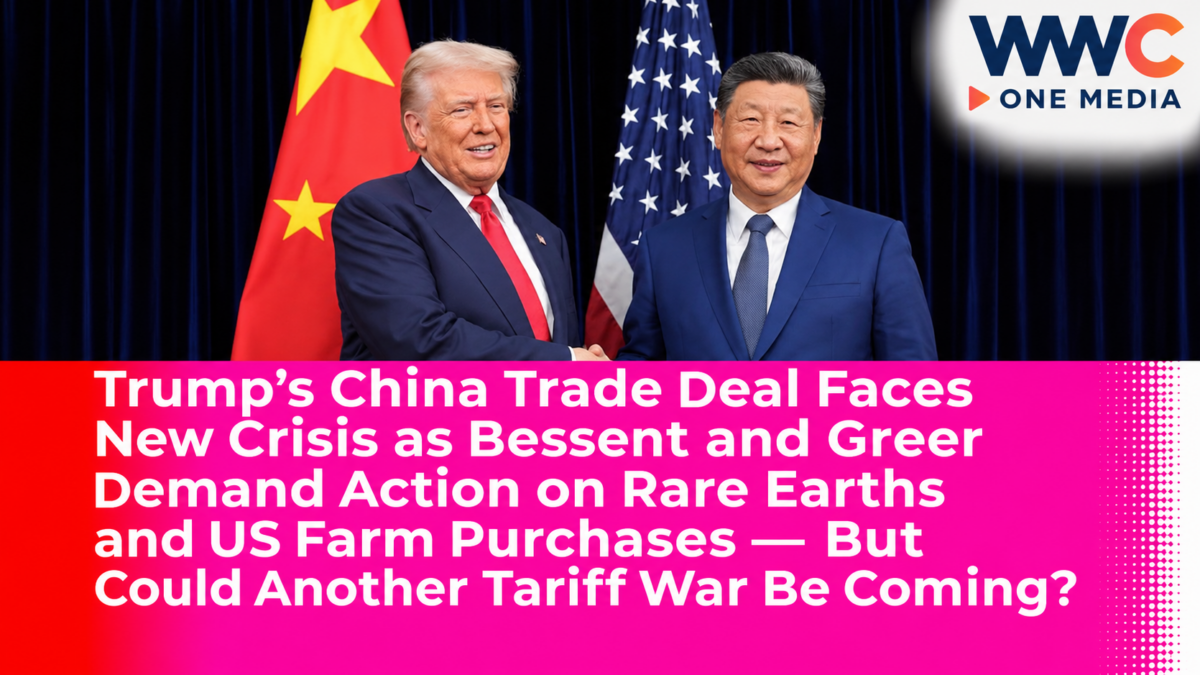
A fragile trade agreement between the United States and China is facing renewed pressure after two of President Donald Trump’s most senior economic officials warned Beijing that its promises on agricultural purchases and critical mineral exports must be translated into concrete action.
US Treasury Secretary Scott Bessent and US Trade Representative Jamieson Greer delivered the warning during a November 6 videoconference with Chinese Vice Premier He Lifeng, raising concerns about China’s implementation of commitments reached under the Busan trade arrangement.
The message came just weeks before the leaders of the world’s two largest economies are expected to meet again, and roughly two months before the current tariff truce expires.
According to Bloomberg and Reuters, Washington is increasingly frustrated over the pace of Chinese purchases of American agricultural goods and continuing difficulties faced by manufacturers seeking rare earths and other strategic minerals.
The two sectors are central to the relationship.
American farmers depend on international buyers for important agricultural exports, while rare earths are essential to industries ranging from electric vehicles and electronics to aerospace and defense equipment.
But China’s response reveals the fundamental disagreement.
Beijing says it is willing to expand purchases of American agricultural products if both sides implement reciprocal tariff reductions that remain unfinished.
The result is a high-stakes diplomatic standoff.
Washington wants China to demonstrate compliance before making further concessions. Beijing wants Washington to follow through on tariff relief and reduce barriers to trade.
Could the dispute force Trump and Chinese President Xi Jinping into another round of tariff confrontation—or will their upcoming meetings produce the breakthrough both economies need?
Bessent and Greer Warn China to Honor Its Trade Promises
The November 6 talks were confirmed by the US Treasury Department and the Office of the US Trade Representative.
The meeting involved Bessent, Greer and Chinese Vice Premier He Lifeng, who has been central to Beijing’s economic negotiations with Washington.
The Treasury Department said Bessent raised concerns over recent Chinese actions and stressed that progress depended on measurable implementation of previous commitments.
Greer’s office identified three particularly important areas: American agricultural purchases, rare-earth exports and other critical minerals.
The administration also said it would closely monitor China’s implementation of the Busan arrangement.
The language was diplomatic but firm.
Washington is no longer focused only on announcing agreements. It is demanding evidence that the commitments have been fulfilled.
However, neither agency’s November 6 statement announced a new blanket tariff increase.
Nor did the statements formally terminate the existing trade arrangement.
The discussions reflect growing dissatisfaction within an ongoing negotiation rather than confirmation that the agreement has collapsed.
What Is the Busan Trade Agreement?
The current dispute centers on a trade understanding reached by Trump and Xi in Busan, South Korea, in 2025.
The arrangement helped reduce tensions after an earlier period of escalating tariffs and trade restrictions.
It created commitments involving agricultural commerce, critical minerals and other economic issues.
The agreement was subsequently extended as Washington and Beijing continued negotiations.
Its current expiration date is January 10, 2027.
As WWC ONE MEDIA previously reported on the US-China decision to extend the trade truce until January, both governments have strong incentives to prevent another disruptive tariff escalation.
But an extension is not the same as a comprehensive settlement.
The two governments continue disagreeing about market access, export restrictions, technology controls and agricultural trade.
Those unresolved issues are now threatening to overshadow the diplomatic progress achieved earlier in the year.
Rare Earths Become Washington’s Biggest Security Concern
One of the most sensitive disputes involves rare-earth minerals.
These materials are used in powerful magnets, electric motors, industrial machinery, electronics and defense systems.
China dominates important stages of the global rare-earth supply chain, particularly processing and magnet manufacturing.
That gives Beijing considerable influence over industries dependent on reliable mineral supplies.
The Financial Times reported that US officials believe China has delivered only about two-thirds of certain promised rare-earth supplies.
That is a reported American assessment, not a jointly verified compliance figure.
China disputes accusations that it has failed to honor its trade commitments.
For American manufacturers, the concern is straightforward.
Even if factories have sufficient investment and customer demand, a shortage of essential materials can delay production.
Companies manufacturing vehicles, advanced electronics and defense equipment may be particularly vulnerable.
The uncertainty also complicates investment planning because businesses cannot assume that export licenses or shipments will arrive on schedule.
As WWC ONE MEDIA reported on China’s rare-earth supply arrangements with Europe, Beijing has been managing critical-mineral access through licensing arrangements that can differ among trading partners.
The broader issue is not simply the availability of minerals.
It is whether companies can obtain them predictably and without prolonged regulatory delays.
American Farmers Face Uncertainty Over China’s Purchases
Agricultural trade is another major sticking point.
China is one of the world’s most important buyers of agricultural commodities.
For American farmers, access to Chinese demand can influence prices, export volumes and farm income.
The Trump administration has said Beijing committed to purchasing substantial quantities of American agricultural goods.
According to Reuters, Washington previously described a commitment involving $17 billion in annual purchases of US agricultural products, beginning in 2026, in addition to a separate soybean arrangement.
The 2026 non-soybean target is subject to a prorated calculation, and its precise implementation remains unclear.
China has made considerable progress on soybean purchases.
But the purchase pace for other American agricultural products has raised concern.
Reuters reported that China imported approximately $7.2 billion in non-soybean US farm products from January through September 2026, the lowest comparable level since 2019.
That figure measures recorded purchases during the period.
It should not automatically be treated as the amount China failed to buy under the agreement, because the exact timetable and coverage of the purchasing commitment matter.
Still, the slower activity helps explain why Washington is pressing for results.
Soybeans Are Progressing, but Other Farm Goods Lag
Soybeans deserve special attention because they have long been a central issue in US-China trade negotiations.
China uses imported soybeans extensively in animal-feed production and food processing.
American producers compete with suppliers including Brazil and Argentina.
The White House has described a Chinese commitment to purchase 25 million metric tons of American soybeans during 2026, with further commitments in subsequent years.
Market reporting indicates China is approaching the current-year soybean target.
However, other agricultural products have experienced weaker demand.
These include commodities covered by the proposed tariff-reduction framework.
As WWC ONE MEDIA previously reported on China’s decision to exclude whole soybeans from a proposed agricultural tariff-cut list, even negotiations that appear to expand agricultural cooperation can leave significant disagreements unresolved.
The distinction between soybean purchases and broader agricultural commitments is essential.
Progress in one commodity does not establish that every part of the trade agreement has been implemented.
Beijing Says the United States Must Cut Tariffs Too
China has not accepted Washington’s interpretation without objection.
On November 5, China’s Ministry of Commerce said it remained open to purchasing more American agricultural products.
But the ministry tied additional purchases to implementation of a reciprocal tariff-cutting arrangement.
Spokesperson Huang Ling said both governments needed to create better conditions for agricultural trade.
That would involve reducing tariffs, addressing non-tariff barriers and improving market access.
The proposed framework covers approximately $30 billion worth of imports on each side, or about $60 billion in combined trade.
The agreement would lower tariffs on many of the covered products, subject to completing the necessary domestic procedures.
But the reductions have not been fully implemented.
That creates a difficult negotiating problem.
Washington argues that China should fulfill previous commitments before expecting additional concessions.
Beijing argues that lowering trade barriers is necessary to make expanded purchases commercially viable.
Both governments therefore maintain that the other must take meaningful action.
The result is a dispute over implementation, sequencing and reciprocity.
China Also Raises Concerns About US Trade Restrictions
The November 6 talks were not a one-sided exchange.
China’s own account emphasized its concerns over American restrictions on Chinese companies and products.
Beijing has repeatedly criticized US export controls, tariffs and restrictions affecting advanced technology.
The Chinese government argues that some American measures interfere with legitimate commercial activity.
Washington maintains that restrictions on selected technologies and strategic products are necessary to protect national security and domestic industries.
The disagreement affects sectors beyond agriculture.
Advanced semiconductors, industrial robots, power equipment and critical minerals have all become sensitive areas of competition.
Both governments want access to commercial opportunities while limiting vulnerabilities in strategic industries.
That makes a lasting trade settlement more difficult than simply agreeing on tariff percentages.
AI Chips Add Another Source of Tension
The broader US-China technology relationship is also complicated by advanced artificial intelligence chips.
Reuters reported on November 5 that approximately 600,000 Nvidia H200 AI processors had accumulated in Hong Kong while awaiting approval for larger-scale shipments into mainland China.
Beijing has been cautious about allowing extensive imports of the chips even as Chinese technology companies seek additional computing capacity.
The situation reflects competing priorities.
Chinese companies want access to advanced AI technology.
The Chinese government also wants to encourage domestic semiconductor development and reduce reliance on foreign suppliers.
Washington has its own restrictions and conditions governing advanced technology exports.
The Nvidia dispute is separate from the November 6 Busan compliance discussion.
But it illustrates why the relationship remains fragile even when the two sides maintain a trade truce.
Agricultural purchases, technology restrictions and critical minerals are increasingly interconnected components of the economic relationship.
January 10 Could Become a Major Trade Deadline
The existing US-China tariff truce is scheduled to expire on January 10, 2027.
That gives the two governments a limited period to resolve the most important disagreements.
Some individual US tariff exclusions face a nearer November 10 deadline.
Those exclusions should not be confused with expiration of the broader trade truce.
The distinction matters for businesses planning imports and exports.
Companies may face uncertainty over particular products before the wider agreement reaches its deadline.
Meanwhile, Trump and Xi are expected to have opportunities for further discussions during upcoming international meetings.
An anticipated meeting connected with the APEC summit in Shenzhen could become an important moment for trade diplomacy.
The leaders may also have an opportunity to meet around the G20 summit in Miami.
However, no comprehensive new agreement should be considered finalized until official terms are announced.
The same applies to any proposed tariff reductions.
Discussion of an agreement is not equivalent to implementation.
Could the US Impose New Tariffs on China?
The administration has multiple tools available to exert trade pressure.
These can include tariffs, trade investigations, export controls and other restrictions authorized under applicable law.
However, each instrument operates under its own legal framework.
Trump cannot be assumed to have imposed new tariffs simply because senior officials criticized China’s actions.
As of the November 6 Treasury and USTR statements, Washington had not announced a new general tariff escalation arising directly from the latest call.
The immediate strategy appears focused on demanding compliance and maintaining pressure ahead of further talks.
But if negotiations deteriorate, the risk of additional restrictions could increase.
Beijing could respond through its own trade measures or changes to export licensing.
Such developments could affect businesses in both countries.
That is why investors are monitoring whether the two governments choose escalation or further compromise.
The Risks Extend Beyond the United States and China
The consequences of renewed trade tensions would not remain confined to the two countries.
Global manufacturers depend on international supply chains spanning raw materials, intermediate products and finished goods.
A disruption involving rare-earth minerals could affect vehicle manufacturers, electronics producers and industrial suppliers in multiple economies.
Changes in agricultural trade could influence prices and shipping patterns.
Technology restrictions could alter where companies manufacture products or purchase advanced components.
Businesses may attempt to diversify their suppliers.
But establishing alternative sources often requires investment, infrastructure and time.
As WWC ONE MEDIA previously reported in its analysis of the Trump-Xi trade truce, neither government can easily separate its economy from the other without significant commercial consequences.
That economic interdependence is one reason the two sides continue negotiating even amid serious disagreements.
What the Dispute Means for the Philippines
The Philippines could be affected indirectly if US-China trade tensions intensify.
The country participates in regional manufacturing and electronics supply chains.
Philippine exporters and businesses may face changes in demand, sourcing costs or investment decisions if major international companies shift production.
The electronics sector is particularly relevant because many advanced products depend on critical minerals and semiconductor components.
However, the November 6 dispute does not establish that Philippine manufacturers are already experiencing new shortages attributable to the latest negotiations.
Any specific impact would require supporting industry or trade data.
For Philippine consumers, changes in international trade can eventually influence the cost of imported goods.
But a direct effect on local inflation, fuel prices or the peso should not be assumed from the diplomatic statements alone.
The wider implication is that businesses in the Philippines may benefit from monitoring US-China policy developments and maintaining flexible supply chains.
Three Possible Outcomes for the US-China Trade Deal
Scenario 1: China increases shipments and agricultural purchases.
Beijing could accelerate deliveries of critical minerals and expand purchases of US farm goods.
That would provide Washington with evidence of progress and improve the outlook for extending the trade arrangement.
Scenario 2: Both sides reach a limited tariff agreement.
The governments could complete parts of the proposed $30-billion-per-side tariff-reduction package.
That might improve market access while leaving more difficult technology and security disputes unresolved.
Scenario 3: Compliance disagreements deepen.
If Washington remains dissatisfied and Beijing continues demanding reciprocal concessions, negotiations could stall.
The January deadline could then become a more serious source of trade uncertainty.
None of these scenarios is guaranteed.
The actual outcome will depend on government decisions, trade volumes, export approvals and the progress of diplomatic negotiations.
The Bigger Question: Can Trump and Xi Save Their Fragile Trade Truce?
The November 6 discussion between Scott Bessent, Jamieson Greer and He Lifeng demonstrates that the US-China trade relationship remains unsettled.
Washington wants evidence that China is honoring commitments involving agricultural purchases and strategic minerals.
Beijing wants reciprocal tariff reductions and fewer American restrictions.
Both sides recognize the importance of maintaining communication.
But continued talks do not eliminate the underlying conflict.
For American farmers, the stakes involve export demand and income.
For manufacturers, the concern is reliable access to critical materials.
For China, the negotiations involve market access, economic security and the ability to develop strategic industries.
For global financial markets, the question is whether the world’s two largest economies can avoid another damaging confrontation.
The trade truce remains in place, and the latest warning does not mean a new tariff war has already begun. But Washington’s growing frustration shows that significant commitments are still being contested.
As Trump and Xi prepare for further diplomatic engagement, the stakes are rising.
Will China deliver enough agricultural purchases and rare-earth supplies to satisfy Washington—or could another breakdown in trust push the United States and China back toward tariffs, export restrictions and a fresh global trade shock?