WASHINGTON / HAVANA / PARIS / BEIJING / MANILA — November 7, 2026 | WWC ONE MEDIA | World News, Geopolitics, Trade and Global Business
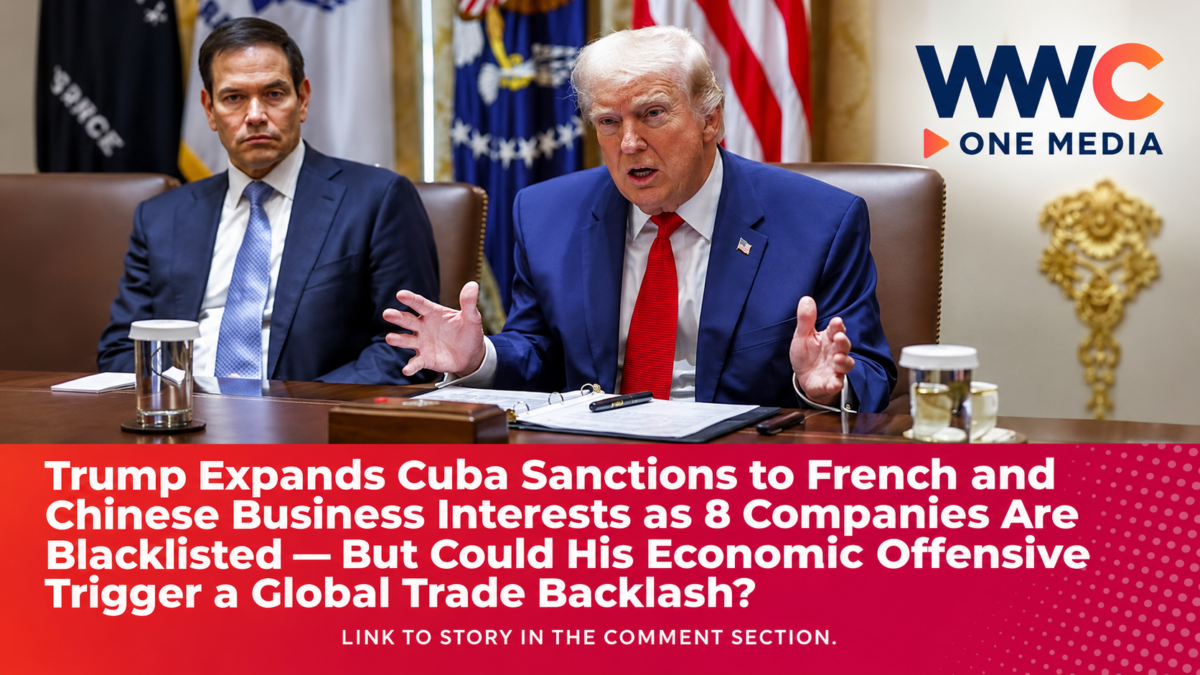
President Donald Trump has launched another sweeping economic offensive against Cuba, expanding American sanctions authority over four critical sectors of the island’s economy and placing foreign companies with commercial interests in Havana under greater scrutiny.
The new measures, announced November 5, target eight entities and two individuals while identifying five vessels as blocked property.
But the implications extend far beyond Cuba.
French businesses, Chinese technology suppliers, international shipping operators and foreign investors could all face greater risks as Washington expands its campaign against Havana.
According to Bloomberg’s November 6 report, the latest measures could affect companies operating in Cuba’s electronics, manufacturing, maritime and technology industries.
The expansion is particularly significant because it allows US authorities to consider sanctions against foreign companies operating in those sectors, even when they are headquartered outside the United States.
One prominent example is French drinks producer Pernod Ricard, whose Cuban partnership manufactures Havana Club rum.
Although Pernod Ricard was not named among the latest sanctioned companies, analysts believe its operations could fall within the expanded scope of Washington’s sanctions authority.
The United States has also directly targeted two Chinese technology suppliers accused of providing military-related equipment to Cuba.
Beijing has condemned the measures and warned that it will defend the interests of Chinese businesses.
The confrontation comes as Cuba suffers severe electricity shortages, declining tourism and deep economic distress.
But the larger question is whether Trump’s strategy can pressure Havana into political concessions—or whether escalating sanctions against foreign companies will create a confrontation involving France, China and other major trading partners.
Trump Expands Cuba Sanctions to Four More Industries
The US Treasury Department’s Office of Foreign Assets Control, or OFAC, issued a new determination on November 5 under Executive Order 14404.
The decision expands the range of Cuban economic activities that can provide a basis for sanctions.
The four additional sectors are:
- Manufacturing
- Technology
- Electronics
- Marine activities
These industries join sectors already covered under the administration’s Cuba sanctions framework, including energy, defense-related activities, metals and mining, financial services and security.
The expansion gives US authorities additional grounds for designating individuals and companies operating in those industries.
But the legal distinction is important.
Operating in one of the four newly covered sectors does not automatically mean a business has been sanctioned.
A company or individual must be subject to an applicable designation or other legal restriction before the corresponding blocking measures apply.
The new authority nevertheless creates significant uncertainty for foreign investors.
Businesses must now assess whether their existing Cuban operations could expose them to sanctions, restrictions on US financial transactions or additional compliance requirements.
For companies with international operations, the commercial consequences could extend well beyond Cuba.
French Drinks Giant Pernod Ricard Faces New Questions Over Havana Club
One of the most striking potential consequences involves Pernod Ricard, the French beverage company behind major international spirits brands.
Pernod Ricard has a longstanding commercial presence in Cuba through Havana Club International.
The partnership, established during the 1990s, produces and markets Havana Club rum in international markets.
Bloomberg highlighted the company because its Cuban manufacturing activities could become relevant under the newly expanded sanctions authority.
John Kavulich, president of the US-Cuba Trade and Economic Council, suggested that forcing a French company to reconsider its Havana Club involvement would create political and commercial consequences extending into France and the European Union.
Such an action could place Washington at odds with a major European business.
However, there is no verified announcement that Pernod Ricard has been newly designated under the November 5 measures.
The company was identified as a potential example of exposure, not as a confirmed target of the latest company-specific sanctions.
Bloomberg reported that Pernod Ricard had not immediately responded to a request for comment.
Whether Washington eventually takes action involving the company remains uncertain.
But the possibility demonstrates how broadly the new measures could affect international business decisions.
Two Chinese Technology Companies Are Directly Sanctioned
Unlike Pernod Ricard, two Chinese technology suppliers were specifically included in the latest US action.
They are:
China National Electronic Import and Export Company (CEIEC)
Washington accuses the company of involvement in supplying components associated with military equipment to Cuba.
Beijing H&C Technologies Co., Ltd.
The United States alleges that the company participated in supplying military-related equipment through a Cuban procurement network.
According to the State Department, both companies were involved in transactions with Sociedad Mercantil Duna S.A., a Cuban entity previously sanctioned over military procurement activities.
The US government alleges that the transactions supported Cuba’s armed forces.
CEIEC had already faced US restrictions under another sanctions program, while the November action added a Cuba-related designation.
Beijing H&C Technologies was also designated under the Cuba sanctions authority.
These measures are more concrete than the potential risks facing other foreign manufacturers.
For designated entities, US sanctions generally block property and interests in property subject to US jurisdiction and restrict transactions involving US persons unless authorized or exempt.
The Chinese companies’ inclusion makes the latest sanctions package a direct issue in US-China relations.
China Condemns Washington’s Measures and Warns of a Response
Beijing reacted strongly to the sanctions.
Chinese Foreign Ministry spokesperson Guo Jiakun criticized the measures on November 6, arguing that unilateral American sanctions and extraterritorial restrictions lack a sufficient basis in international law.
China says its normal commercial cooperation with Cuba should not be subject to unilateral American interference.
The Chinese government also warned that it would take measures to protect the legitimate rights and interests of its companies.
However, Beijing did not announce a specific new retaliatory tariff or sanctions package in the reviewed November 6 statements.
The response highlights a longstanding dispute between Washington and Beijing.
The United States argues that certain Chinese businesses support governments or military organizations that threaten American national security interests.
China rejects the use of US sanctions to restrict transactions involving third countries.
The disagreement has emerged in previous disputes involving Iran and Russia.
As WWC ONE MEDIA previously reported on Trump’s attempts to intensify sanctions against Iranian economic networks linked to China, American efforts to pressure foreign governments can become more complicated when Chinese companies are involved.
The Cuba case presents a similar geopolitical challenge.
Washington wants to restrict Havana’s access to military and financial support.
Beijing wants to protect its commercial relationships and resist American economic pressure.
Whether the dispute escalates will depend on future US enforcement decisions and China’s response.
Why Washington Is Targeting Cuba’s Shipping Industry
Another major part of the November 5 action involves maritime businesses.
The State Department identified an oil-shipping network that Washington says helps move Cuban petroleum.
The designated companies include businesses registered in Cuba, Panama and Cyprus.
Among them are Caroil Transport Marine, Tentacool Commercial, Internacional Marítima and Petróleos Marítimos del Caribe, also known as Petromarca.
Five vessels were identified as blocked property:
- Esperanza
- Gloria C
- María Cristina
- Emilia
- Lourdes
The maritime measures matter because Cuba relies on shipping to receive petroleum, industrial supplies and other essential imports.
Restricting companies involved in oil transportation could make certain transactions more difficult to finance, insure or execute.
Banks and international shipping companies may become more cautious about dealing with vessels or counterparties associated with the sanctions.
However, identifying five vessels as blocked property does not mean all international shipping to Cuba has been prohibited.
Legal outcomes depend on the identity of the vessel, the transaction, the parties involved and applicable sanctions rules.
Cuba’s State-Owned Technology Firms Also Face Restrictions
The sanctions package also included Cuban state-owned businesses involved in electronics and technical services.
Among the companies designated were Cubaelectrónica and Tecnosime.
These businesses operate in sectors Washington considers connected to Cuba’s state-controlled commercial system.
Their designation may complicate procurement and financial transactions involving affected activities.
For Cuba, the issue is particularly sensitive because technology and industrial equipment are needed across the economy.
Businesses depend on imported components, machinery, communications equipment and maintenance supplies.
When companies or suppliers become subject to sanctions, arranging purchases and payments can become more complicated.
That does not mean every import of electronics into Cuba has automatically become illegal.
But the latest measures increase compliance risks for companies operating in the affected sectors.
Trump Is Expanding a Sanctions Campaign That Began Months Ago
The November announcement is not an isolated action.
Trump signed Executive Order 14404 on May 1, 2026, establishing additional authority to impose sanctions connected to Cuba.
The administration subsequently expanded the sanctions framework through several rounds of designations.
In June, Washington sanctioned Cuba’s state-owned petroleum company Unión Cuba-Petróleo, commonly known as CUPET.
The designation targeted a central institution in the island’s energy system.
As WWC ONE MEDIA previously reported on Washington’s sanctions against CUPET, restrictions involving Cuba’s petroleum infrastructure can complicate international transactions and energy distribution.
The administration later targeted additional Cuban businesses and individuals connected to energy, finance and mining.
On September 3, sanctions were announced against several companies and a member of the Castro family.
Those earlier measures show how Washington’s approach has expanded from individual entities toward a broader effort to isolate important parts of Cuba’s economy.
The latest addition of four sectors significantly increases the range of potential future targets.
Marco Rubio Says Cuba’s Military Elite Is Benefiting While Ordinary People Suffer
US Secretary of State Marco Rubio defended the November 5 measures.
Rubio accused Cuba’s leadership of directing scarce economic resources toward military-connected institutions and politically influential networks.
The administration argues that sanctions can restrict financial benefits reaching the Cuban government and organizations associated with repression.
Washington also alleges that Cuba maintains relationships with foreign actors it considers threats to US national security.
Those allegations form part of the administration’s stated justification for expanding sanctions.
But Havana strongly disputes Washington’s interpretation of Cuba’s economic crisis.
Cuban authorities argue that American restrictions are damaging the country’s ability to import fuel, operate businesses and obtain essential supplies.
The competing positions reflect a longstanding disagreement.
The US government says economic pressure can encourage political reform.
Cuba says the restrictions undermine national sovereignty and worsen living conditions for ordinary citizens.
The question is whether additional sanctions will meaningfully change the decisions of Cuba’s political leadership.
Cuba’s Economic Crisis Is Deepening
Cuba is already experiencing severe economic hardship.
Fuel shortages, aging infrastructure and limited access to foreign currency have disrupted electricity generation and transportation.
The island has suffered repeated nationwide power-grid failures during 2026.
Many communities have experienced prolonged blackouts.
Reuters and the Associated Press have reported that power shortages are being worsened by restricted fuel availability and difficulties maintaining aging infrastructure.
The crisis has affected households, hospitals, businesses and public services.
Tourism, historically an important source of foreign currency, has also faced serious disruption.
Bloomberg reported that Cuban authorities said more than 73% of hotels had closed and more than 20,000 hotel workers had lost their jobs.
Those are figures attributed to Cuban authorities and should not be treated as independently audited totals.
The economic damage has intensified concerns about how the island can maintain essential services.
Sanctions are one factor in Cuba’s financial difficulties.
Other factors include domestic economic policies, infrastructure deterioration, limited investment and longstanding productivity problems.
Reducing the crisis to a single cause would misrepresent the complexity of the country’s situation.
Cuba Announces 176 Economic Reforms — But Refuses Political Change
The Cuban government has responded to growing economic pressure by announcing measures intended to attract investment and support private enterprise.
According to Bloomberg, the island has announced 176 reforms aimed at liberalizing parts of its economy.
These changes are designed to make it easier for private businesses and foreign investors to operate.
They could affect tourism, commercial activity and access to financial services.
However, Havana continues to reject demands for changing its political system.
This creates a difficult contradiction.
Cuba wants additional private investment and stronger international commercial relationships.
But the Trump administration is expanding restrictions on businesses that remain active in the country.
The result is a more complicated environment for potential investors.
Even businesses interested in Cuba’s reforms may hesitate if operating on the island exposes them to US sanctions risks.
Analysts cited by Bloomberg suggested that the growing uncertainty could persuade international companies to leave rather than expand.
The long-term economic effects will depend partly on whether Cuba can attract alternative investment and establish reliable commercial arrangements.
Could France and the European Union Challenge Trump?
The expanded authority creates a potential source of friction between Washington and European governments.
French businesses operate internationally and must consider both European law and restrictions imposed by other jurisdictions.
For companies with Cuban operations, US sanctions could create difficult compliance decisions.
A firm may wish to continue a commercially viable investment while also protecting access to American banks and markets.
That dilemma is particularly relevant to businesses operating across multiple countries.
But possible commercial tension is not equivalent to a confirmed diplomatic confrontation.
France has not been shown in the reviewed reporting to have announced a specific retaliatory measure over the potential exposure of Pernod Ricard.
Likewise, there is no confirmed November 5 designation of Pernod Ricard in the OFAC action.
The issue remains one of prospective sanctions risk.
Nevertheless, a future designation involving a major French company could increase pressure on the European Union to respond.
Trump’s Sanctions Strategy Could Create Wider Trade Risks
The latest measures illustrate how American sanctions policy can influence companies far beyond the country being targeted.
US financial restrictions can affect transactions involving banks, payment systems, investments and internationally traded goods.
Foreign companies may decide that the commercial risks of maintaining operations in a sanctioned market outweigh the potential returns.
This can make sanctions economically powerful even when specific firms are not formally designated.
However, broader pressure also creates diplomatic consequences.
Countries may object when American authorities seek to restrict activities conducted by companies outside the United States.
As WWC ONE MEDIA reported on Washington’s expanded authority to target countries purchasing Russian energy, sanctions and secondary pressure can create difficult choices for America’s trading partners.
The legal frameworks governing Russia and Cuba are different.
But both cases illustrate how restrictions aimed at one government can affect third-country businesses.
For multinational companies, sanctions compliance is becoming an increasingly important element of commercial risk management.
What the Cuba Crackdown Means for the Philippines
The latest Cuba sanctions have no confirmed immediate, direct effect on ordinary Philippine businesses or consumers.
However, the measures demonstrate a broader trend relevant to Philippine companies engaged in international trade.
Businesses importing equipment, using international shipping networks or dealing with overseas financial institutions may need to evaluate their exposure to sanctions.
This is especially important when transactions involve entities or vessels specifically listed by US authorities.
Philippine businesses with US operations or transactions involving US persons can face additional compliance considerations.
However, the existence of a US sanctions determination does not automatically prohibit every Philippine business from dealing with Cuba.
The applicable rules depend on the particular parties, products, activities and jurisdictional connections involved.
The wider economic concern is that geopolitical disputes can make international trade more expensive and difficult.
For the Philippines, which depends on imported fuel and participates in global supply chains, continued sanctions disputes involving energy transportation and major economies warrant attention.
But any claimed direct effect on Philippine inflation or fuel prices would require additional evidence.
Three Possible Outcomes for Trump’s Cuba Strategy
Scenario 1: More international companies reduce their Cuban exposure.
Foreign businesses could decide that the risk of future US sanctions makes existing investments commercially unattractive.
That could further restrict Cuba’s access to foreign capital and technology.
Scenario 2: China and European businesses challenge Washington’s approach.
Governments or companies could use diplomatic, commercial or legal channels to oppose restrictions they consider excessive.
The impact would depend on the specific sanctions and the measures adopted in response.
Scenario 3: Economic pressure increases without producing major political reform.
Cuba could continue adapting its trade networks and introducing limited economic reforms while retaining its political system.
Under this scenario, the population could face continuing hardship even as Washington expands pressure on the government.
None of these scenarios is guaranteed.
The next important developments will involve additional OFAC designations, foreign government responses and Cuba’s efforts to stabilize its economy.
The Bigger Question: Can Trump Force Political Change Without Isolating America’s Trading Partners?
Trump’s latest Cuba sanctions represent another escalation in Washington’s effort to pressure Havana.
Eight entities and two individuals have been targeted, while five vessels have been identified as blocked property.
Four additional economic sectors now fall within the scope of US sanctions authority.
Chinese suppliers have been directly sanctioned.
French companies operating in Cuba face questions about future exposure.
And international businesses must consider whether their involvement in the island could create risks elsewhere.
For Washington, the strategy is intended to restrict resources available to the Cuban government and encourage political change.
For Havana, the measures represent additional pressure on an economy already weakened by shortages, aging infrastructure and limited access to investment.
For international businesses, the question is whether maintaining operations in Cuba remains commercially viable.
The new measures do not mean every French or Chinese company in Cuba is already sanctioned. But they significantly expand Washington’s ability to target foreign firms in the future.
That may be the most consequential part of the announcement.
Trump is no longer relying solely on pressure against Cuban state companies.
His administration is also increasing the risks facing foreign businesses that continue to operate on the island.
And as French manufacturers weigh their exposure and Beijing warns against American interference, one question could determine the next chapter: Will Trump’s widening sanctions campaign force Havana to make concessions—or could his effort to economically isolate Cuba ignite a new trade and diplomatic confrontation with China and Europe?