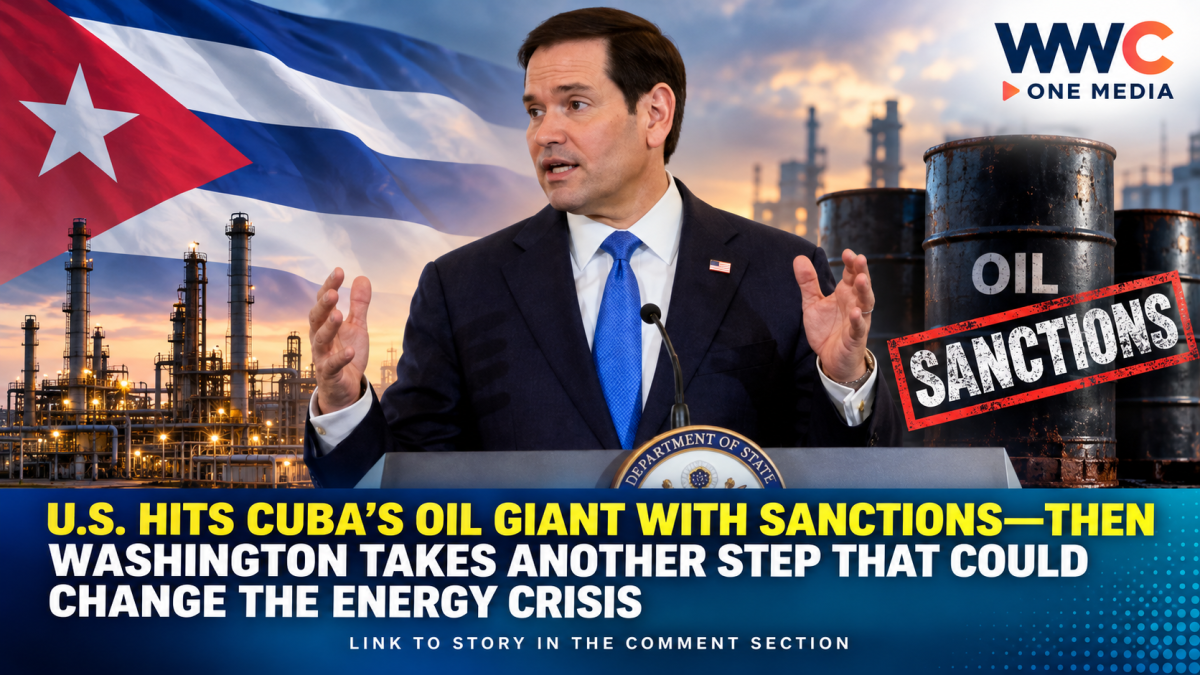
WASHINGTON/HAVANA — The United States has imposed sanctions on Cuba’s state-owned oil and gas company, Unión Cuba-Petróleo, known as CUPET, sharply increasing pressure on Havana’s already strained energy system and complicating the island’s ability to obtain and distribute fuel.
The measure, announced on June 11, 2026, placed CUPET on the U.S. Treasury Department’s Specially Designated Nationals list. Under the designation, property and interests in property belonging to CUPET that are subject to U.S. jurisdiction are blocked, while U.S. persons are generally prohibited from conducting transactions with the sanctioned entity.
The action was taken under Executive Order 14404, signed by President Donald Trump on May 1, which expanded the U.S. government’s authority to sanction individuals and entities connected to specified sectors and activities involving Cuba, including the country’s energy sector.
The Treasury Department identified CUPET as a Cuban state-owned enterprise operating in the energy sector.
Why CUPET Matters
CUPET is not simply another state-owned company. It occupies a central position in Cuba’s energy infrastructure, with responsibilities spanning oil production, refining, fuel distribution and other parts of the petroleum system.
Bloomberg reported that Cuba produces roughly 40,000 barrels of oil per day, covering only a portion of the island’s overall energy requirements, while CUPET oversees much of the infrastructure used to process and distribute petroleum products.
That makes the sanctions significant beyond the company itself.
Restrictions involving CUPET can create additional complications for companies, banks, shippers and other businesses considering transactions involving Cuba’s petroleum system, even when those businesses are not themselves U.S. entities.
The United States has also warned that foreign companies and financial institutions should exercise caution when dealing with sanctioned Cuban entities.
Washington’s Case Against CUPET
U.S. Secretary of State Marco Rubio said the Cuban government has used energy resources as an instrument of political control and accused officials of diverting or reselling scarce fuel while ordinary Cubans face shortages and blackouts.
The Trump administration also argues that some assets connected to CUPET were originally taken from American owners.
The sanctions are part of a broader U.S. strategy aimed at restricting the Cuban government’s access to financial resources and economic sectors Washington says support repression and the country’s political establishment.
The administration maintains that the ultimate objective is to pressure Havana toward political and economic changes.
Havana Rejects the U.S. Claims
Cuban officials strongly rejected the allegations.
Foreign Minister Bruno Rodríguez condemned the sanctions and accused Washington of further tightening what Havana describes as a long-standing U.S. economic and energy blockade.
Cuban authorities have repeatedly argued that U.S. sanctions worsen shortages of fuel, food and other essential goods and place the burden on ordinary citizens rather than exclusively on government officials.
The competing explanations are central to the dispute: Washington attributes Cuba’s economic deterioration largely to government policies, corruption and the structure of the Cuban state, while Havana points to the U.S. embargo and sanctions as major causes of its economic difficulties.
The Timing Was Particularly Sensitive
The CUPET sanctions came as Cuba was already experiencing severe fuel shortages and recurring electricity blackouts.
The measure also raised questions about attempts to expand private-sector fuel imports.
Before the sanctions, U.S. policy had created pathways for some Cuban private businesses to obtain petroleum products from U.S. suppliers. A fuel-storage and distribution arrangement involving Florida-based Vanguard Energy was also expected to facilitate shipments to Cuba’s private sector and humanitarian organizations.
Bloomberg reported that the CUPET designation could complicate those arrangements because CUPET controls important elements of Cuba’s petroleum infrastructure.
That created an unusual policy tension: efforts to increase private fuel access could become more difficult if private suppliers still need to interact with infrastructure controlled by a sanctioned state company.
Analysts cited by The Associated Press warned that restricting access to CUPET could worsen an already serious energy crisis. Others argued that the measure could increase pressure on Havana by limiting the government’s ability to control energy resources.
Cuba’s Energy Crisis Has Continued to Escalate
The consequences of the wider energy crisis have become increasingly visible.
Cuba experienced another major nationwide power-grid collapse in July, followed by widespread outages and protests in Havana. Reuters reported that fuel shortages and the country’s aging power infrastructure were contributing to severe pressure on the electricity system.
Then, on September 18, 2026, Cuba suffered another nationwide grid collapse. Reuters reported that the country’s energy ministry attributed the breakdown to a combination of aging infrastructure and persistent fuel shortages, while also pointing to the impact of the U.S. oil blockade.
The developments underline why CUPET remains strategically important: restrictions on Cuba’s petroleum system can have effects far beyond gasoline availability, reaching transportation, electricity generation, industry and basic services.
Washington Has Continued Expanding the Pressure
The June CUPET action was not the end of the sanctions campaign.
On September 3, the U.S. Treasury Department added several additional Cuban entities to its sanctions list, including Comercial CUPET S.A., a fuel and lubricant wholesaler linked to Cuba’s petroleum sector.
Other entities designated in that round included Banco Exterior de Cuba, ABAPET, CEXNI and NICAROTEC, while Fidel Ernesto Castro Calis, a grandson of former Cuban leader Raúl Castro, was also sanctioned.
The September action demonstrates that Washington’s Cuba policy has continued to expand beyond CUPET itself, targeting financial channels, fuel distribution and other economic infrastructure.
On September 17, the United States imposed another round of sanctions against Cuban entities connected to nickel resources and military enterprises, further broadening the pressure campaign.
What Happens Next?
The immediate question is how Cuba will secure, transport and distribute enough fuel while its state petroleum infrastructure faces increasing restrictions.
Cuba remains dependent on imported energy, while its domestic production covers only part of national demand. The island is also dealing with aging power plants, limited foreign currency and an increasingly fragile distribution system.
For Washington, the sanctions represent another mechanism for pressuring the Cuban government and restricting resources that U.S. officials say support the state apparatus.
For Havana, the measures represent another layer of economic pressure that Cuban officials say is worsening conditions for the population.
What remains uncertain is whether the sanctions will produce the political and economic changes Washington seeks—or whether the immediate consequence will be deeper disruption to Cuba’s already fragile energy system.
That question has become harder to separate from the island’s humanitarian situation as fuel shortages, blackouts and infrastructure failures continue to affect daily life.
For millions of Cubans, the issue is no longer simply a dispute between Washington and Havana. It is increasingly a question of whether the island can keep its electricity, transportation and essential services operating as pressure on its energy system continues to mount.