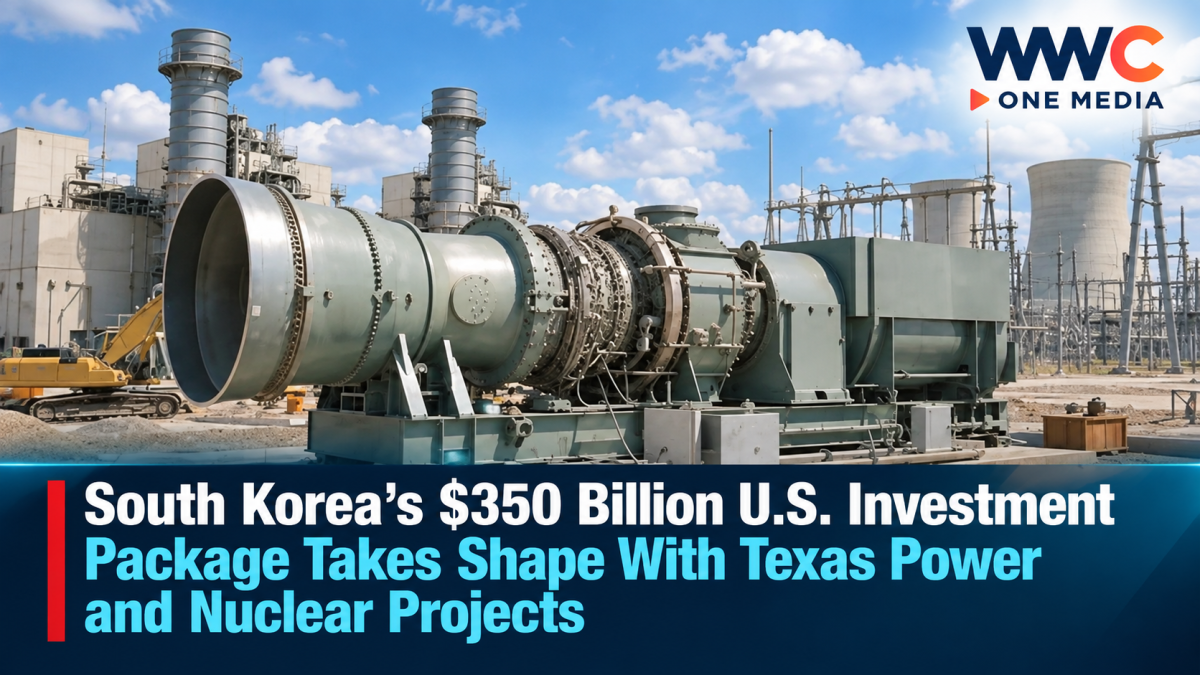
South Korea and the United States are pushing toward an agreement on how Seoul will carry out its $350 billion U.S. investment commitment, with a multibillion-dollar Texas power project and as many as eight nuclear reactors emerging as major components under discussion.
The investment package stems from a trade agreement reached last year that reduced the U.S. tariff on South Korean imports to 15%. Of the $350 billion commitment, $150 billion is designated for shipbuilding, while another $200 billion covers strategic investments, including energy and other industries.
But despite reports that the two countries are nearing an agreement, South Korean President Lee Jae Myung said commercial viability remains a major issue in negotiations. Seoul is seeking provisions addressing returns, profit-sharing and how losses from investments would be handled.
$22.3 billion Texas power project moves to the center
One of the most advanced proposals is a $22.3 billion, 6.3-gigawatt combined-cycle gas power project in Encinal, Texas.
The facility is intended to supply electricity to the state’s rapidly expanding AI data-center and semiconductor industries, which are driving demand for reliable power.
According to Reuters and Korean media reports, the project could be developed in stages. The initial phase would involve approximately 1.4 GW of gas-turbine capacity, followed by another 4.9 GW of combined-cycle capacity.
South Korean media have reported that the project would be financed through a bilateral investment structure, although the precise implementation arrangements remain subject to final negotiations.
The location is significant because Texas has become a major destination for data centers and advanced semiconductor manufacturing. The resulting surge in electricity demand has made new large-scale generation capacity increasingly important.
Eight nuclear reactors could account for a huge share
The nuclear component could be even larger.
South Korea and the United States are discussing the construction of up to eight large nuclear reactors in the United States, with each reactor estimated at roughly $15 billion.
That puts the potential value of the nuclear program at approximately $120 billion if all eight units proceed.
Reuters reports that the proposal under discussion would involve six reactors using Westinghouse technology and two using South Korean technology. If the Korean-designed units are ultimately approved, they would be the first South Korean-designed reactors built on U.S. soil.
Korean media have reported that the country’s APR-1400 reactor design is being considered for two of the proposed units.
The nuclear plan, however, remains a proposal rather than a finalized construction program.
Westinghouse stake is another sticking point
The negotiations also reportedly include South Korea’s potential acquisition of an equity stake in Westinghouse, the U.S. nuclear technology company.
Reuters reported that Seoul has sought approximately 15% ownership, potentially giving it a board seat, while the U.S. side has offered a smaller stake of around 5% to 10%, according to media reports.
The eventual value of any investment would depend on Westinghouse’s valuation and the final terms.
The issue matters because South Korean companies have extensive experience in nuclear engineering and construction, while Westinghouse owns important U.S. nuclear technology and intellectual property.
A negotiated arrangement could therefore affect how future U.S. nuclear projects are structured and shared between American and Korean companies.
Alaska LNG also remains under consideration
Another project being discussed is the $44 billion Alaska LNG development, a long-delayed proposal involving natural-gas production, a roughly 1,300-kilometer pipeline and an LNG export terminal at Nikiski.
South Korea has approached the project cautiously because of questions surrounding its commercial viability.
Korea JoongAng Daily reported that Seoul had agreed in principle to keep Alaska LNG on the table but had not made a binding investment commitment.
That distinction is important: being included among projects under discussion does not mean South Korea has committed the full amount required to build Alaska LNG.
Why AI is driving the energy negotiations
The common thread connecting several of these projects is the enormous amount of electricity required by the AI boom.
Data centers consume large quantities of electricity around the clock, while semiconductor fabrication facilities also require highly reliable power supplies.
The proposed Texas gas project is therefore being positioned as an energy investment tied directly to the expansion of AI infrastructure and advanced manufacturing in the United States.
The nuclear proposals could serve a longer-term purpose by adding large amounts of firm, low-carbon electricity to the U.S. power system.
South Korean construction and engineering companies have also been closely watching the negotiations because major American power projects could create opportunities for engineering, procurement and construction contracts. Korea Times reported that Korean construction stocks had risen amid expectations surrounding possible U.S. nuclear and power-plant projects.
Seoul is not simply accepting every proposal
The size of the projects being discussed helps explain why negotiations have become complicated.
The Texas project, eight nuclear reactors and Alaska LNG could collectively represent a very large portion of the strategic-investment allocation.
Seoul Economic Daily reported that the projects being sought by Washington could exceed the $200 billion strategic-investment ceiling, forcing South Korea to consider which projects to include and how much capital to allocate to each.
President Lee has also emphasized that investments must be commercially reasonable.
Reuters reported that Lee said the two countries were still negotiating over how investments would generate returns, how profits would be shared and how losses would be handled.
That means the headline numbers being discussed should not be interpreted as finalized spending commitments for every individual project.
The $350 billion package is still not fully finalized
The timing of the agreement has already slipped.
South Korea postponed a planned parliamentary briefing on the investment package because procedural issues were still being worked out. Reuters reported that the briefing was tentatively rescheduled for September 22.
Foreign Minister Cho Hyun also met U.S. Secretary of State Marco Rubio on September 18, with the two sides discussing the delayed investment commitments and continued consultations.
Meanwhile, Korea Herald reported that Seoul had been preparing to unveil its first project under the $200 billion strategic-investment program.
So while the broad framework is becoming clearer, the final list of projects, financing mechanisms, ownership structures and implementation schedules remain subject to negotiations and approvals.
What could change if the projects move forward?
If finalized, the package would represent a major expansion of South Korean investment in U.S. energy infrastructure.
The Texas project could add substantial generation capacity for AI and semiconductor facilities. The nuclear program could create a large pipeline of work for American and Korean nuclear companies. A Westinghouse investment could deepen industrial ties between the two countries, while Alaska LNG would give South Korean companies another potential role in a major U.S. energy development.
For Washington, the projects would help translate Seoul’s $350 billion investment pledge into physical projects and industrial capacity.
For Seoul, the challenge is ensuring that those investments produce commercially viable returns while expanding opportunities for Korean companies.
The biggest question now is not whether billions of dollars are being discussed — but which projects will ultimately survive the final negotiations and become binding commitments.