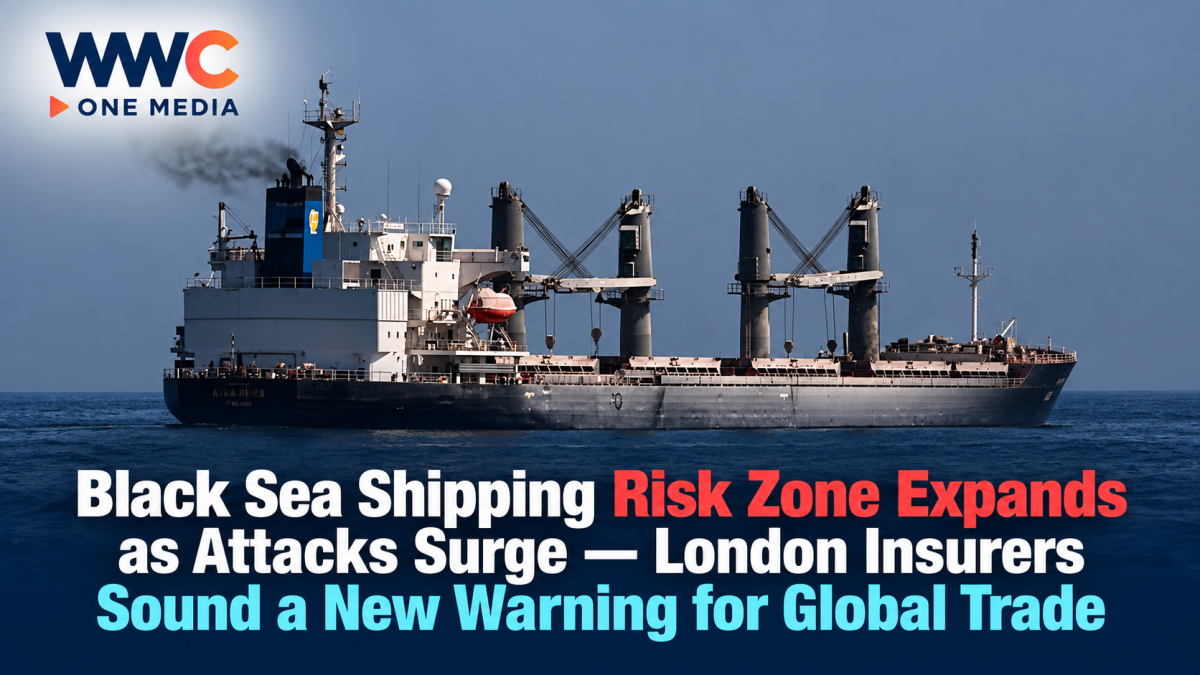
The Black Sea is entering a new phase of maritime risk after London’s marine insurance market expanded the area subject to heightened war-risk reporting requirements, bringing much of the entire Black Sea basin under increased scrutiny.
The decision comes as attacks involving commercial vessels, ports and energy infrastructure have intensified amid the continuing Russia-Ukraine war.
The Joint War Committee (JWC), which includes representatives from the Lloyd’s Market Association and the London insurance market, issued updated guidance this week expanding Black Sea reporting requirements beyond the Russian and Ukrainian coastal waters that were already listed.
The change is significant because London is one of the world’s most important centers for marine insurance. JWC guidance can influence how underwriters assess war exposure and price coverage for ships operating in areas affected by military conflict.
The entire Black Sea is now under closer scrutiny
Previously, the JWC’s listed high-risk area focused on the coastal waters of Russia and Ukraine.
The updated guidance expands reporting requirements to the wider Black Sea.
Neil Roberts, head of marine and aviation at the Lloyd’s Market Association and secretary of the JWC, said the reporting requirements had been extended to the whole Black Sea area, while voyages inside the territorial waters of neighboring countries still do not require notification under the new guidance.
The Black Sea is bordered by Russia, Ukraine, Bulgaria, Georgia, Romania and Turkey, making the expanded designation particularly important for international shipping.
Importantly, the change does not prohibit ships from sailing through the Black Sea.
Instead, it gives insurers a wider area in which they may require additional information, assess exposure and potentially apply war-risk pricing.
Why insurers are making the move now
The expansion follows a sharp increase in attacks involving commercial shipping.
Reuters reported that Russia and Ukraine have intensified attacks against each other’s commercial shipping during the past two months, adding a new dimension to a war that has already severely affected regional maritime trade.
Lloyd’s List likewise reported that attacks have increasingly involved merchant vessels, ports and energy infrastructure, with more than 50 seafarer deaths reported since Russia’s full-scale invasion in February 2022.
The maritime danger is therefore no longer concentrated only around the immediate approaches to Ukrainian and Russian ports.
Ships traveling through broader portions of the Black Sea can face risks associated with missiles, drones, naval activity, mines and misidentification.
War-risk insurance is becoming a major cost for shipowners
For shipping companies, the practical consequence could be expensive.
War-risk insurance is generally separate from ordinary marine coverage and is designed to protect vessels and cargoes against risks associated with armed conflict.
As the perceived risk increases, insurers can charge more for voyages through affected areas.
Reuters reported that war-risk premiums have surged in recent weeks and can add hundreds of thousands of dollars to the cost of a seven-day voyage in the region.
That additional cost does not necessarily stay with the shipowner.
Higher insurance and security expenses can feed into freight rates and ultimately increase the cost of moving commodities.
The Black Sea is a critical food and energy corridor
The stakes are enormous because the Black Sea is one of the world’s most important routes for grain, crude oil and refined petroleum products.
Russia and Ukraine are major agricultural exporters, while Black Sea ports handle substantial volumes of commodities destined for markets in Europe, the Middle East, Africa and elsewhere.
Reuters reported in August that the increase in attacks on ships, ports and export terminals was already disrupting global supplies of grain and oil.
The Guardian similarly reported that attacks during the summer had significantly reduced Russian and Ukrainian grain exports, raising concerns about additional pressure on global food prices.
That means a security problem at sea can quickly become a problem for food importers thousands of kilometers away.
Attacks are moving beyond the ports
One of the reasons the expanded risk zone matters is that the danger is no longer necessarily confined to vessels sitting inside or approaching ports.
Maritime security analysts cited by The Guardian said attacks have extended beyond ports and their immediate approaches, increasing the potential exposure of merchant vessels operating farther out in the Black Sea.
Lloyd’s List reported that a Liberian-flagged bulk carrier, Golden Leo, was struck by three Russian cruise missiles shortly after leaving Odesa in July.
The continuing attacks have increased the challenge for shipping companies trying to assess whether a particular route remains commercially viable.
The risks include more than missiles and drones
The threat environment also includes the possibility of mines, unexploded ordnance and misidentification.
The U.S. Maritime Administration has warned that commercial vessels operating in the Black Sea and Sea of Azov have been struck by projectiles and exposed to explosions, drones and unmanned vehicles.
The agency has also warned of reports involving naval mines and drifting mines and advises U.S.-flagged commercial vessels to conduct risk assessments and review relevant maritime security warnings before operating in the region.
These risks can complicate voyage planning even when a particular ship is not the intended target.
The IMO has condemned attacks on merchant vessels
The International Maritime Organization has also raised concerns.
In July, IMO Secretary-General Arsenio Dominguez condemned a series of attacks on civilian merchant ships in the Black Sea and Sea of Azov.
The IMO said attacks on commercial shipping endanger seafarers, threaten freedom of navigation and disrupt global supply chains. It called on parties involved in conflicts to refrain from actions that endanger merchant shipping and to protect civilian seafarers.
The warning underlines the difference between military objectives and civilian commercial shipping: merchant crews are not parties to the conflict, yet they can be exposed to its consequences simply by doing their jobs.
Filipino seafarers are among those affected
The developments also have direct implications for the Philippines, one of the world’s largest sources of seafarers.
The Philippine Department of Migrant Workers reported in July that nine commercial vessels carrying 139 Filipino crew members had been affected by drone strikes in the northern Black Sea.
The department said two Filipino seafarers had died and 12 had been injured in the incidents covered by its report, while the government was coordinating medical assistance, repatriation and support for affected workers and their families.
The DMW also said the northern Black Sea remained designated as a high-risk and warlike zone and directed shipping companies and manning agencies to observe protective measures, including rerouting vessels away from designated danger areas whenever feasible.
The department reiterated that Filipino seafarers have the right to decline sailing into warlike areas before departure without discrimination and are entitled to applicable contractual protections and repatriation under the government’s rules.
The insurance change does not mean Black Sea shipping has stopped
One important distinction is crucial.
The JWC’s expansion of its listed area is not a declaration that commercial shipping through the Black Sea has been prohibited.
Rather, it gives insurers a broader geographic area in which war-risk exposure can be considered.
Industry reporting indicates that the inclusion of an area in the listed zones can allow insurers to require separate war-risk coverage or additional premiums depending on the vessel, route and circumstances.
The actual price of coverage can therefore vary considerably between ships and voyages.
The financial impact could spread through global trade
The consequences extend well beyond shipping companies.
If war-risk premiums rise, shipowners may pass higher costs into freight rates.
If freight becomes more expensive, exporters and importers may eventually face higher logistics bills.
And if ships avoid particularly dangerous routes, longer voyages may become necessary, increasing fuel consumption and transit times.
For commodities such as wheat, corn, oil and refined petroleum products, transportation costs are ultimately part of the delivered price.
That creates a potential chain reaction:
attacks → higher insurance costs → higher shipping costs → higher commodity costs → pressure on consumers and businesses.
The extent of that effect will depend on how long the heightened security situation persists and how much shipping continues to operate through the affected areas.
The Black Sea is becoming part of a wider global shipping-risk problem
The latest development also highlights how geopolitical conflicts are reshaping maritime insurance worldwide.
Shipping companies are already dealing with elevated risks in several strategic waterways, including the Red Sea and the Strait of Hormuz.
Lloyd’s List has reported that insurers are increasingly assessing exposure beyond traditionally listed danger zones as attacks and geopolitical tensions spread across major shipping corridors.
For global trade, that creates a difficult environment in which insurance costs, voyage planning and security assessments can change rapidly.
What happens next?
The immediate question is whether the increase in Black Sea attacks continues.
If maritime attacks decline, insurers could eventually reassess their exposure and pricing.
If attacks continue or expand farther into the basin, shipping companies could face higher premiums, more expensive security measures and potentially greater pressure to reroute vessels.
The stakes are particularly high because the Black Sea remains an important export corridor for food and energy commodities.
For the Philippines, there is an additional human dimension: Filipino seafarers remain part of the international crews operating in these waters, making maritime security a labor and welfare issue as well as a trade issue.
London’s decision does not close the Black Sea to commercial shipping. But it sends a powerful signal that insurers now see the risk as broader than a problem confined to Russia’s and Ukraine’s immediate coastlines.
And if attacks continue spreading across the basin, the next pressure point may not be the battlefield—it could be the cost of moving food, fuel and other essential goods around the world.