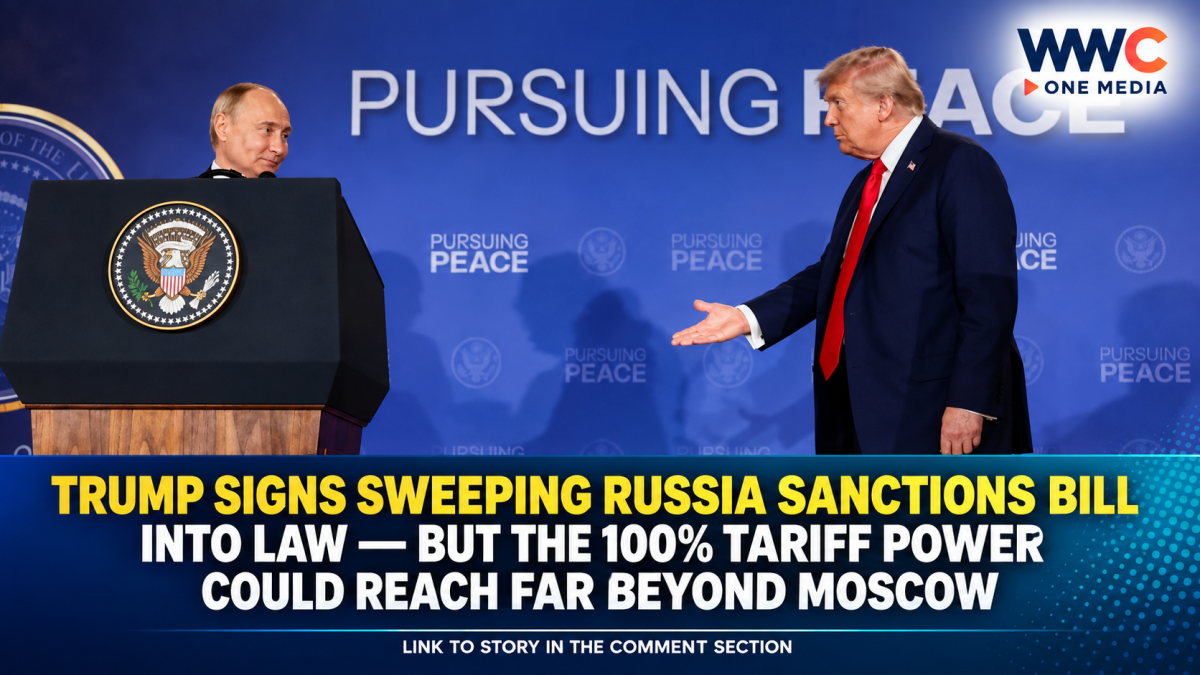
WASHINGTON — U.S. President Donald Trump has signed a sweeping Russia sanctions bill into law, opening a new phase of economic pressure on Moscow while giving the White House expanded authority to target countries that continue buying Russian energy.
Trump signed the legislation on Friday, September 18, after it cleared both chambers of Congress with substantial bipartisan support. The law, officially named the Lindsey O. Graham Sanctioning Russia and Iran Act of 2026, expands sanctions against Russia and extends existing U.S. sanctions on Iran. The White House confirmed the signing.
The legislation targets key parts of Russia’s economy, including its energy and defense sectors, Russian officials and financial networks, and the so-called “shadow fleet” of tankers used to move Russian oil while circumventing existing sanctions. The broader objective is to restrict revenue that Moscow uses to finance its war in Ukraine.
A new tariff weapon
One of the most consequential provisions gives Trump authority to impose tariffs of up to 100% on major buyers of Russian oil and natural gas, as well as on countries that help Russia evade sanctions.
Reuters reported that the legislation specifically creates the possibility of tariffs targeting the top five buyers of Russian energy, while also allowing action against major facilitators of sanctions evasion. The law therefore reaches beyond Russia itself and could affect countries deeply involved in the global energy trade.
AP reported that the legislation includes an exception for countries importing less than 15% of Russia’s natural-gas exports that have taken significant steps to reduce those imports.
The measure does not, however, mean that a blanket 100% tariff has automatically been imposed on China, India or other Russian energy customers. Rather, the law gives the president substantial authority to determine how and against whom the tariff provisions are implemented.
Why China and India are watching closely
The legislation could have consequences well beyond the U.S.-Russia relationship because some of the world’s largest buyers of Russian energy could potentially face additional U.S. trade measures.
Reuters said the law gives Trump considerable discretion over which countries are targeted and the level of tariffs imposed. Critics have warned that this could create uncertainty for global trade and potentially expose U.S. allies as well as Russia’s major commercial partners to additional tariffs.
The Guardian similarly reported that the legislation allows tariffs of up to 100% on countries purchasing Russian energy, including China, while giving the president broad discretion over implementation and possible waivers.
That makes the law potentially significant for international energy markets, global trade and countries attempting to balance relationships with both Washington and Moscow.
Congress moved the bill forward after months of uncertainty
The legislation had been under consideration for more than a year. It was originally introduced by the late Republican Senator Lindsey Graham and was subsequently named in his honor following his death in July.
The Senate passed the measure in August by 86-11, according to Reuters and AP. The House then approved it on September 16 by 262-159, sending it to Trump’s desk. Reuters reported that 58 House Democrats joined most Republicans in supporting the measure.
The legislation’s bipartisan support was notable, but the bill also generated criticism from lawmakers who argued that it gives the president too much authority over tariffs.
House Democratic Leader Hakeem Jeffries was among those who opposed the measure, arguing that its expanded tariff authority could have economic consequences beyond Russia. Other critics also questioned the breadth of presidential discretion over sanctions and tariff implementation.
Moscow warned the sanctions could complicate peace efforts
Before Trump signed the legislation, the Kremlin warned that additional U.S. sanctions could make efforts to reach a peace agreement over Ukraine more difficult.
Russia said the proposed measures could complicate negotiations rather than facilitate them, while supporters of the legislation argued that increasing economic pressure on Moscow could strengthen efforts to push Russia toward negotiations. Those are competing assessments rather than established outcomes.
What happens next?
The immediate question is how aggressively the Trump administration will use the new powers.
The law provides a significantly expanded statutory framework for sanctions and tariffs, but its practical impact will depend on subsequent decisions by the administration, including which Russian entities and foreign countries are targeted and whether tariff authorities are actually invoked.
For Russia, the legislation adds pressure on energy revenues, financial networks, defense-related activity and the shadow tanker fleet.
For major purchasers of Russian energy, the more consequential question may be whether Washington eventually uses the law’s up-to-100% tariff authority — and, if so, against whom.
That means the signing is not necessarily the end of the story. The next phase will be watching how Trump chooses to use the powers Congress has now put into law — and how Russia, China, India, Europe and global energy markets respond.