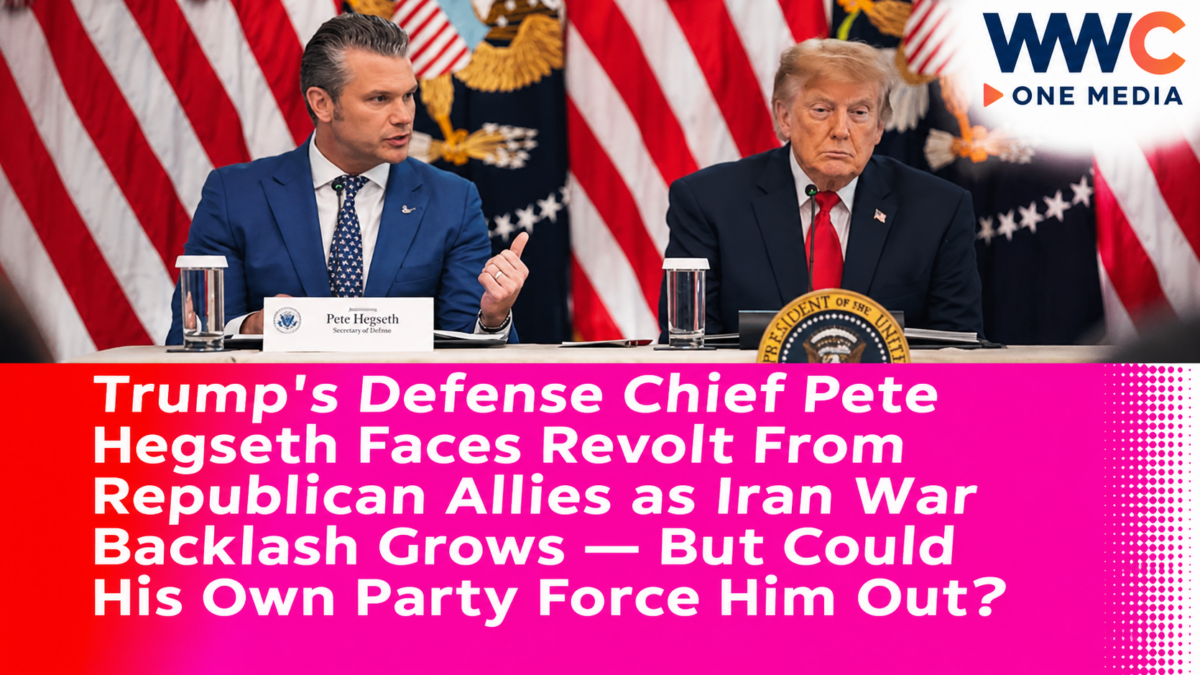
WASHINGTON, D.C. / MANILA — November 7, 2026 | WWC ONE MEDIA | US Politics, Defense, Iran War and Global Affairs
US Defense Secretary Pete Hegseth is facing mounting pressure from within President Donald Trump’s own political coalition, as anger over the prolonged Iran war threatens to turn one of the administration’s most prominent officials into a casualty of the Republican Party’s devastating midterm election defeat.
The controversy intensified on November 6 when prominent Republican lawmakers questioned Hegseth’s handling of the conflict and whether he should continue leading the Pentagon.
Among them was House Oversight Committee Chairman James Comer, a longtime Trump ally who declined to explicitly support Hegseth when asked whether the president should replace him.
Comer said lawmakers remained deeply concerned about the administration’s strategy for ending the war, which has continued for more than eight months.
Meanwhile, Republican Representative Thomas Massie of Kentucky is preparing another attempt to impeach the defense secretary, potentially forcing a House vote as early as next week.
According to Bloomberg’s November 6 reporting, the widening criticism also reflects opposition among figures associated with Trump’s America First foreign-policy movement, which has traditionally emphasized avoiding costly overseas military commitments.
The developments have placed Hegseth at the center of a growing political confrontation.
Republicans have just lost control of both chambers of Congress in elections shaped partly by dissatisfaction with the Iran war and its economic consequences.
Vice President JD Vance has publicly identified the conflict as a major reason for the party’s defeat.
Yet Trump continues defending his defense secretary, who has vowed to remain in office and resist efforts to remove him.
Could Hegseth survive mounting pressure from Democrats and Republicans alike—or will the Iran war ultimately force Trump to choose between loyalty to his Pentagon chief and the political survival of his administration?
Trump Ally James Comer Questions Hegseth’s Future
One of the most significant developments came from Representative James Comer of Kentucky.
Comer chairs the House Oversight Committee and has been among Trump’s most prominent defenders in Congress.
His criticism is therefore politically important.
During a November 6 interview with NewsNation, Comer declined to say whether Hegseth should be replaced.
Instead, he emphasized that the decision belonged to the president.
But Comer acknowledged that lawmakers had substantial questions about the defense secretary and the administration’s direction in Iran.
He said congressional Republicans lacked a clear understanding of the strategy for concluding the conflict.
The criticism reflects a concern that has grown during months of fighting.
Lawmakers want to know the administration’s military objectives, how those objectives can be achieved and what conditions would allow the United States to end its involvement.
The war’s duration has made those questions more urgent.
The administration initially presented the military campaign as a way to prevent Iran from obtaining nuclear weapons and reduce threats to American security.
But the continuing conflict, casualties, financial costs and energy-market disruptions have created increasing political pressure.
Comer’s remarks do not mean he has formally endorsed Hegseth’s impeachment or demanded his removal.
They show that even influential Republican allies are increasingly unwilling to give the defense secretary unconditional political support.
Thomas Massie Prepares Another Impeachment Attempt
The most direct threat to Hegseth comes from Republican Representative Thomas Massie.
Massie told Bloomberg that he intends to reintroduce articles of impeachment when Congress resumes its legislative session next week.
The Kentucky lawmaker previously pursued impeachment efforts over the administration’s handling of the Iran war.
He argues that Hegseth participated in military operations without obtaining the congressional authorization he believes the Constitution and applicable war-powers legislation require.
Massie’s allegations extend to other disputed military actions and decisions by the defense secretary.
Hegseth rejects the accusations.
The legal and constitutional dispute involves the allocation of military authority between Congress and the president.
Under the Constitution, Congress possesses the power to declare war and controls federal appropriations.
The president serves as commander in chief.
The War Powers Resolution also establishes requirements concerning the deployment of US armed forces into hostilities.
However, disputes over presidential military authority are complex, and the administration contests the argument that its operations were unlawful.
Massie’s impeachment proposal represents a political and constitutional accusation—not a court finding that Hegseth committed a crime.
A successful House impeachment vote would not automatically remove Hegseth.
Under the Constitution, the Senate would conduct a trial, and conviction would require a two-thirds vote of senators present.
Whether the proposed articles will pass either chamber remains uncertain.
Trump’s November Midterm Defeat Changes Everything
The political pressure follows the November 3 elections, when Democrats won control of the incoming House and Senate.
The Republican defeat has triggered difficult questions about Trump’s leadership, government spending and the unpopular conflict with Iran.
As WWC ONE MEDIA reported on the Democratic takeover of Congress, the election fundamentally changed the balance of power in Washington.
Republicans retain control of the current Congress until the transition in January 2027.
But the incoming Democratic majority is preparing to investigate the administration’s conduct and challenge its policies.
Hegseth has become a particularly prominent target.
Critics accuse him of advocating an aggressive military strategy while failing to provide convincing explanations of how the war will end.
Some Republicans also believe his confrontational relationship with Congress has made it harder to secure support for defense priorities.
The political stakes are considerable.
If Hegseth remains in office, he will face a new Congress with stronger incentives and greater authority to investigate the Pentagon.
If Trump replaces him, the president must identify a successor capable of winning Senate confirmation.
That task could become more difficult after Democrats assume control of the Senate.
JD Vance Blames Iran War for Republican Election Losses
Vice President JD Vance has intensified the administration’s internal debate.
Following the midterm elections, Vance publicly argued that the Iran war was a central reason Republicans lost.
His criticism focused on voters who had supported Trump in 2024 but became dissatisfied with the conflict and its economic consequences.
Rising gasoline prices and the prolonged military campaign became important sources of public frustration.
Trump acknowledged that the conflict had damaged his party politically.
However, he continued defending the decision to use military force against Iran.
As WWC ONE MEDIA examined in its report on Trump’s acknowledgment of the war’s electoral consequences, the president argues that preventing Iran from acquiring nuclear weapons justified the operation despite its political costs.
The disagreement is not necessarily about whether the war contributed to Republican losses.
Both Trump and Vance have acknowledged that it did.
The deeper disagreement concerns whether the military strategy should change.
Hegseth remains one of the administration’s strongest public defenders of the conflict.
That has made him particularly vulnerable to criticism from Republicans who favor ending America’s involvement.
Hegseth Fires Back: He Will Not Resign
Hegseth has responded defiantly.
In a video released November 5 and filmed outside the Pentagon, the defense secretary defended his performance and criticized lawmakers seeking his removal.
He praised Trump’s defense policies, changes to military leadership and efforts to dismantle diversity, equity and inclusion programs.
He also defended the Iran campaign as necessary to protect American national security.
Hegseth rejected Massie’s impeachment effort as politically motivated.
His remarks made clear that he intends to remain in office rather than voluntarily resign.
The video was also designed to reinforce the administration’s call for greater congressional defense funding.
Hegseth emphasized the importance of maintaining military readiness and strengthening American defense capabilities.
However, the video generated additional controversy.
The Washington Post reported on November 6 that government watchdog organizations questioned whether the use of Pentagon personnel and government resources to produce a politically charged video complied with federal restrictions on partisan activity.
Hegseth’s office confirmed that Defense Department employees had helped produce the video.
Watchdog organizations raised concerns involving the Hatch Act and other restrictions.
Those concerns are allegations about legal compliance, not established findings of a statutory violation.
No final enforcement determination was identified in the reviewed reporting.
Trump’s $1.5-Trillion Defense Budget Faces a Political Test
The controversy has implications for one of the administration’s largest spending priorities.
The Pentagon is seeking congressional support for a defense budget of approximately $1.5 trillion.
Supporters argue that substantial funding is needed to maintain military readiness, expand weapons production and sustain operations.
But lawmakers are questioning the costs and objectives of the Iran war.
Some Republicans worry that the administration is asking Congress to approve enormous spending without offering a credible strategy for concluding the conflict.
Others believe the military must receive sufficient resources to meet existing commitments.
Democrats are preparing to scrutinize the administration’s proposed spending and military operations.
The political environment has made negotiations more difficult.
Congress controls appropriations, and the executive branch cannot assume that every proposed expenditure will be authorized.
A defense budget request is not the same as enacted funding.
Hegseth must therefore maintain working relationships with lawmakers even as some call for his removal.
That creates a significant challenge for a defense secretary who has publicly attacked several of his congressional critics.
Republican Criticism Goes Beyond Thomas Massie
Massie is not the only Republican expressing concern.
Senator Thom Tillis of North Carolina criticized Hegseth’s use of government resources for his public video.
Representative Austin Scott of Georgia questioned the Pentagon chief’s ability to build the political support necessary for military funding and a successful conclusion to the war.
Representative Don Bacon of Nebraska has also raised concerns about Hegseth’s leadership.
The lawmakers differ in their positions.
Some are criticizing the war itself.
Others support its stated objectives but question its execution or the defense secretary’s ability to work with Congress.
These distinctions matter.
Disagreement over military management does not necessarily mean opposition to every US operation against Iran.
Likewise, criticism of Hegseth does not automatically translate into support for impeachment.
Nevertheless, the growing number of Republican critics suggests that his political difficulties extend beyond the Democratic opposition.
Democrats Prepare Major Pentagon Investigations
The incoming Democratic majority is preparing a much more aggressive approach to congressional oversight.
Defense policy, military spending and the conduct of the Iran war are expected to be central issues.
Representative Adam Smith of Washington, a senior Democrat on the House Armed Services Committee, has called for stronger supervision of the Pentagon.
Democratic lawmakers are also expected to examine personnel decisions, military operations and possible questions about executive authority.
As WWC ONE MEDIA reported on the incoming Democratic Congress’s five-front oversight agenda, lawmakers are preparing investigations into several areas of the administration’s policies.
The Iran war is among the most consequential.
Congressional committees may request records, hold hearings and subpoena witnesses within their lawful authority.
But investigations are not the same as convictions or findings of wrongdoing.
Hegseth and other officials would have opportunities to respond to allegations and defend their decisions.
Disputes over classified information and executive privilege could also complicate congressional inquiries.
The next Congress will therefore possess more oversight power, but the practical outcomes remain uncertain.
The Iran War Has Become an Economic Crisis as Well as a Military Conflict
The conflict has affected more than the administration’s political standing.
Military operations and instability around the Strait of Hormuz have disrupted international energy markets.
Higher shipping costs and concerns about petroleum supplies have contributed to volatility in gasoline, diesel and crude oil prices.
That has created economic pressure for households and businesses.
As WWC ONE MEDIA reported on the choices facing Trump after the midterm defeat, the administration faces pressure to pursue diplomacy while maintaining its stated national-security objectives.
The available options involve difficult trade-offs.
A negotiated settlement could reduce the duration and economic burden of the conflict.
Maintaining military and economic pressure might preserve leverage over Tehran but prolong uncertainty.
Renewed escalation could create additional security and energy-market risks.
No comprehensive peace agreement has been announced.
The unresolved conflict is one reason Hegseth faces continued scrutiny.
Critics argue that military strategy must be evaluated not only by battlefield outcomes but also by its economic and political consequences.
Why Oil Prices Matter to Hegseth’s Political Future
Fuel prices have become an important connection between the Iran conflict and American domestic politics.
Disruption of a major international oil-shipping route can increase transportation expenses and affect petroleum supply expectations.
That can influence the prices of gasoline and diesel, which are highly visible expenses for consumers.
In the days following the midterm elections, oil prices fell sharply as investors considered the possibility of a more diplomatic US approach.
As WWC ONE MEDIA reported on the oil-market reaction to Trump’s electoral defeat, Brent crude experienced a substantial one-day decline amid changing expectations about the conflict.
But lower oil prices do not establish that the war is ending.
Markets frequently react to expectations before governments reach actual agreements.
An escalation or disruption to oil supplies could reverse those price movements.
For Hegseth, this means the military campaign has consequences beyond the Pentagon.
The war’s effect on household finances could continue influencing public opinion and Republican political calculations.
Can Trump Replace Hegseth Before Democrats Take Control?
Trump has publicly rejected calls to remove Hegseth.
The president has praised his defense secretary and said he intends to keep him in office.
However, media reports indicate that Trump has also heard complaints about Hegseth and discussed his future with advisers.
Those discussions do not establish that a replacement decision has been made.
The timing of any personnel change would matter.
Republicans retain their existing Senate majority until January 2027.
If Trump nominated a replacement during the remaining congressional session, the current Senate could consider the nomination.
After the transition, Democrats would control the chamber.
That could make confirmation of a controversial nominee more difficult.
But any nomination would still require the applicable Senate procedures and sufficient support.
There is also no guarantee that Republicans could confirm a replacement before January simply because they currently hold the majority.
The remaining legislative calendar is limited.
Trump must therefore weigh political pressure against the practical complications of replacing a Cabinet official during a military conflict.
What the Crisis Means for the Philippines and Asia
The political confrontation in Washington has implications for countries that depend on stability in the Middle East.
The Philippines imports substantial quantities of petroleum and refined fuel products.
Disruptions to international energy supplies can affect domestic transportation expenses, electricity costs and inflation.
A prolonged war could also influence shipping costs and business confidence.
Changes in American defense policy may affect broader international security priorities.
However, Hegseth’s political difficulties do not automatically change US security commitments to the Philippines.
No specific revision to bilateral defense arrangements has been confirmed as a result of the November 6 criticism.
The more immediate concern for Philippine businesses is the direction of the Iran conflict and its consequences for global energy prices.
A sustainable diplomatic settlement could ease certain pressures.
Further military escalation could increase them.
But those outcomes remain uncertain.
Three Possible Outcomes for Hegseth
Scenario 1: Trump keeps Hegseth despite mounting criticism.
The president could continue defending his defense secretary, while Hegseth attempts to secure defense funding and respond to congressional investigations.
That would preserve continuity at the Pentagon but leave the administration facing continued political pressure.
Scenario 2: Hegseth resigns or is replaced.
Trump could decide that a leadership change would help restore political support or improve relations with Congress.
A new nominee would need to navigate Senate confirmation.
Replacing the defense secretary would not automatically resolve disagreements over the Iran war.
Scenario 3: The House advances impeachment proceedings.
Massie’s proposed articles could receive sufficient support for a House vote.
If the House adopted articles of impeachment, the Senate would determine whether to convict and remove Hegseth.
Conviction would require a two-thirds vote of senators present.
This remains a possible constitutional process, not an outcome already established.
The Bigger Question: Has the Iran War Made Hegseth a Political Liability?
Pete Hegseth’s political troubles have intensified after Republicans’ November 3 election defeat.
The defense secretary continues defending the Iran war and his management of the Pentagon.
Trump continues expressing confidence in him.
But Republican criticism is expanding, and Democratic lawmakers are preparing to use their incoming congressional majority to investigate the administration.
The debate now involves multiple questions.
Has the administration established clear and achievable military objectives?
Can it justify the financial and human costs of the conflict?
Will lawmakers provide the requested defense funding?
And can Hegseth continue leading the Pentagon while facing growing opposition from members of the president’s own party?
The latest criticism from James Comer shows that even loyal Trump allies are questioning whether the administration has a credible exit strategy.
Massie’s impeachment effort presents a more direct challenge.
Hegseth remains defense secretary, and the accusations against him have not resulted in impeachment or removal. But his growing political isolation has become difficult for the White House to ignore.
Trump must now decide whether continued loyalty to Hegseth strengthens his administration or adds another obstacle to resolving the conflict.
And as Republicans prepare for a possible impeachment showdown, one question hangs over Washington: Will Donald Trump stand by Pete Hegseth through the Iran war backlash—or could pressure from his own America First allies force the president into one of the most consequential Cabinet decisions of his second term?