SAN FRANCISCO / WASHINGTON / NEW YORK / MANILA — November 7, 2026 | WWC ONE MEDIA | Global Economy, Federal Reserve, Wall Street and Financial Markets
America’s battle against inflation is far from over, and the Federal Reserve may need to raise interest rates again even as global stock markets struggle with a painful selloff in artificial intelligence-related companies.
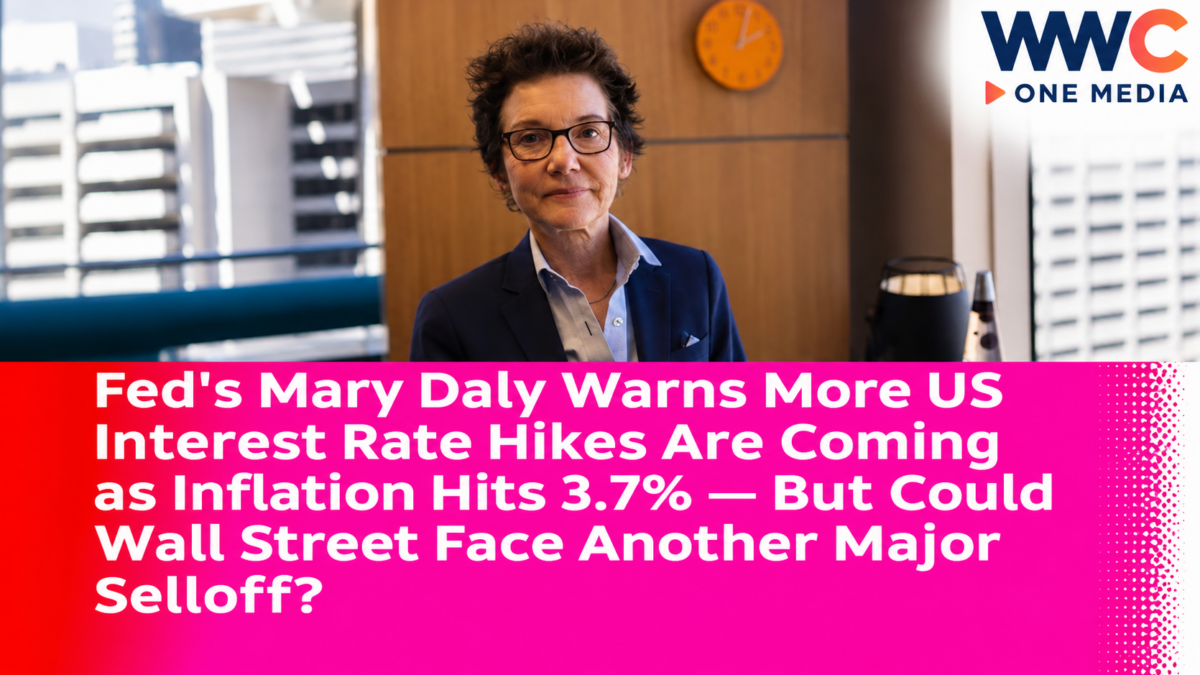
That warning came on Friday, November 6, from Mary Daly, president of the Federal Reserve Bank of San Francisco, who said she expects additional monetary tightening will probably be necessary to bring inflation under control.
Her remarks came just hours after the United States reported stronger-than-expected employment growth, giving policymakers fresh evidence that the economy may be resilient enough to withstand higher borrowing costs.
According to Bloomberg and Reuters, Daly believes the central bank still has work to do before inflation can sustainably return to its 2% target.
But she stopped short of endorsing a specific date or size for the next rate increase.
The comments have added another layer of uncertainty to financial markets already shaken by falling AI stock valuations, volatile energy prices and concerns about the cost of living.
The central question now is whether the Fed can reduce inflation without causing significant damage to employment, consumer spending or financial markets.
And with December’s interest-rate decision approaching, could another increase in borrowing costs push Wall Street’s technology selloff into a deeper financial downturn?
Mary Daly Says More Federal Reserve Tightening Is Likely
During a November 6 interview on CNBC, Daly said her expectation is that monetary policy will need to become more restrictive.
She emphasized that the timing and size of future rate changes would depend on incoming economic information.
Her position reflects growing concern that inflation remains too high despite the Federal Reserve’s earlier tightening efforts.
Daly also stressed the importance of proceeding gradually.
The global economy faces multiple sources of uncertainty, including geopolitical tensions, rapid technological change and volatile financial markets.
For that reason, she believes policymakers should gather more evidence before deciding how much further interest rates must rise.
Her comments amount to a warning about the likely direction of policy, not a formal announcement of another rate increase.
The Federal Open Market Committee, rather than any individual regional Fed president, makes decisions on the benchmark federal funds rate.
Federal Reserve Holds Rates at 3.75%–4.00%
The Federal Reserve’s current target range is 3.75% to 4.00%.
The central bank raised rates by 25 basis points on September 16, its first increase since 2023.
At its October 28 meeting, the Fed chose to hold rates steady.
That decision passed by a 10–2 vote.
Federal Reserve Governor Lisa Cook and Cleveland Fed President Beth Hammack dissented because they preferred another quarter-point increase.
The split demonstrated that policymakers disagreed about how quickly to respond to inflation.
As WWC ONE MEDIA previously reported on the Federal Reserve’s September rate increase, officials had already warned that additional tightening could be necessary before the end of the year.
The October pause did not reverse that policy direction.
Instead, it gave the central bank additional time to evaluate employment, inflation and market conditions.
Daly supported both decisions: the September increase and the October pause.
That combination reflects her preference for gradual action rather than an immediate series of aggressive hikes.
US Economy Adds 165,000 Jobs, Surprising Wall Street
Daly’s comments followed an unexpectedly strong US employment report.
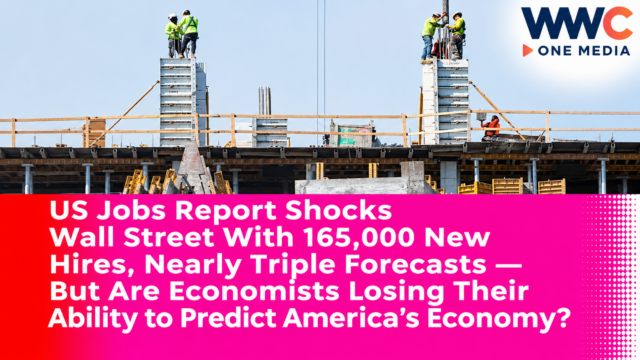
The Bureau of Labor Statistics announced on November 6 that employers added 165,000 nonfarm payroll jobs in October.
That considerably exceeded forecasts near 65,000.
The unemployment rate also fell from 4.2% in September to 4.1%.
The figures suggest that the labor market remains resilient despite higher interest rates and economic uncertainty.
Healthcare, professional and business services, transportation and other sectors contributed to employment growth.
The government also revised previously reported job gains upward, improving the picture of recent hiring.
For the Federal Reserve, a relatively stable labor market provides more flexibility to focus on inflation.
If unemployment were rising rapidly, additional rate increases could create greater concern about job losses.
But continued hiring makes it easier for policymakers to argue that the economy can tolerate some additional tightening.
That does not mean employment conditions are strong for everyone.
Some workers continue to struggle to find full-time positions, and long-term unemployment remains a concern.
The Fed must therefore consider both the positive headline employment figures and underlying weaknesses.
Inflation Remains at 3.7%, Far Above the Fed’s Target
Inflation is the main reason Daly expects further action.
The latest available consumer price index report showed prices rising 3.7% over the 12 months through September.
That is substantially above the Federal Reserve’s 2% inflation objective.
Although the Fed formally targets 2% inflation using the personal consumption expenditures price index rather than CPI, the consumer price index remains an important indicator of household price pressures.
Energy costs have contributed to recent inflation.
Businesses are also facing challenges involving transportation, imported materials and other operating expenses.
As WWC ONE MEDIA reported in its coverage of US inflation reaching 3.7%, higher energy prices have intensified the financial burden on American households.
The persistence of inflation creates a difficult political and economic environment.
Lower inflation does not necessarily mean prices return to their previous levels.
It means the overall pace of price increases slows.
For families already struggling with expensive groceries, transportation and housing, that distinction matters.
Wage Growth Isn’t Keeping Pace With Prices
October’s jobs report contained another warning.
Average hourly earnings increased approximately 3.1% over the preceding 12 months.
That was below September’s 3.7% annual CPI inflation rate.
The figures cover different ending months, so they should not be treated as a precise calculation of October’s real-wage change.
Nevertheless, they illustrate the purchasing-power pressure Daly described.
Workers may receive nominal pay increases without experiencing equivalent improvements in their ability to afford everyday expenses.
Daly characterized Americans as trapped on a prolonged high-inflation treadmill.
The problem is especially important for lower-income households, which often spend a larger proportion of earnings on essential goods and services.
The Fed’s challenge is therefore not simply generating employment.
It is restoring price stability so that wages can translate into more sustainable purchasing power.
AI Stock Selloff Creates Another Problem for the Fed
Daly’s remarks came during a turbulent period for global technology stocks.
Investors have been reassessing whether the enormous sums committed to artificial intelligence infrastructure will generate sufficient financial returns.
Major AI-related companies have experienced sharp price declines.
Semiconductor manufacturers, data-center operators and technology investors have been affected.
According to Reuters, Daly described the decline in technology valuations as painful but orderly so far.
She did not suggest that the correction had already created a systemic financial crisis.
Instead, she viewed the selloff as a reassessment of market risks.
As WWC ONE MEDIA reported on the estimated $3.2-trillion selloff in US equities associated with AI concerns, investors have become increasingly concerned about valuations and the sustainability of technology spending.
The broader question for the Federal Reserve is whether declining asset prices could reduce demand and economic growth.
A prolonged stock-market downturn can affect confidence, investment plans and household wealth.
If financial conditions tighten significantly without additional Fed action, policymakers may need to reconsider how much further they should raise interest rates.
But a short-term market correction does not automatically justify changing monetary policy.
AI Investment Could Also Create Inflation Pressure
Artificial intelligence is influencing inflation through a different channel.
The expansion of data centers is increasing demand for electricity, advanced chips, memory, construction materials and specialized equipment.
If demand grows faster than supply, some prices may rise.
In October, Axios reported that Daly was concerned about the possibility that AI investment, tariffs and energy costs could combine to create persistent inflation pressures.
These forces can affect multiple industries.
For example, stronger demand for advanced computing components may create shortages that influence the prices of electronics and industrial equipment.
Large-scale data-center construction can also increase local demand for power and infrastructure.
However, AI could eventually improve productivity and reduce costs in some parts of the economy.
That means its overall inflation impact is uncertain and may change over time.
The Federal Reserve must assess whether the current investment boom is creating temporary price increases or more persistent pressure.
The distinction could influence future interest-rate decisions.
Other Federal Reserve Officials Also Expect Higher Rates
Daly is not the only policymaker discussing additional tightening.
Richmond Fed President Thomas Barkin indicated on November 5 that further increases may be necessary, although he did not specify their timing.
The Federal Reserve’s September meeting minutes also showed that many policymakers considered another increase before the end of 2026 appropriate.
However, the October decision to hold rates demonstrated that the committee was not unanimous about the urgency of another move.
The next decision will depend on new data.
Inflation developments, labor-market conditions and financial-market stability will all matter.
For investors, the central uncertainty concerns whether the Fed raises rates at its December meeting or prefers to wait longer.
Neither outcome has been predetermined.
Higher Interest Rates Could Hit American Borrowers
Another increase in the federal funds rate could affect households and businesses through borrowing costs.
Credit card interest rates are often variable and may respond to changes in short-term benchmarks.
Some business loans and other floating-rate products can also become more expensive.
Mortgage rates are influenced by longer-term Treasury yields and market expectations, so they do not necessarily move in lockstep with each Fed decision.
However, tighter monetary conditions can make financing more expensive for prospective homebuyers.
Businesses may also reconsider investment projects if borrowing costs increase.
As WWC ONE MEDIA reported on the recent $27.8-billion increase in US consumer borrowing, household credit has become an important area to monitor.
Higher borrowing can reflect consumer spending and access to credit.
But rapidly increasing debt balances can create repayment difficulties when interest rates remain elevated.
For the Fed, this presents a difficult trade-off.
Higher rates may help reduce inflation.
They can also increase the financial burden on borrowers already struggling with rising living costs.
What This Means for the Philippine Peso and BSP
Federal Reserve policy can influence financial conditions beyond the United States.
The Philippines is affected through international interest rates, capital flows and foreign-exchange markets.
If US interest rates rise, dollar-denominated assets may become more attractive to global investors.
That can place pressure on emerging-market currencies, including the Philippine peso, depending on other economic conditions.
Higher US borrowing costs can also affect companies seeking dollar financing.
For the Bangko Sentral ng Pilipinas, Fed decisions are one consideration when assessing domestic monetary conditions.
But the BSP does not automatically match every Federal Reserve rate increase.
Philippine inflation, domestic economic activity, financial stability and exchange-rate conditions also influence its decisions.
The practical impact on the Philippines will depend on the size and timing of any future Fed increase and how global investors respond.
There is no confirmed new Federal Reserve rate hike arising from Daly’s November 6 comments alone.
What Investors Should Watch Before December
The Federal Reserve’s next scheduled policy meeting is December 8–9, 2026.
Several developments will influence the discussion.
The October consumer price index is scheduled for release on November 10.
That report will help determine whether inflation is accelerating, stabilizing or beginning to ease.
The November employment report, scheduled for December 4, will provide another view of the labor market.
Investors will also monitor the technology stock market, energy prices and statements from other Fed officials.
Three broad possibilities remain.
A further inflation increase alongside resilient hiring could strengthen the argument for another rate hike.
Easing inflation could allow the Fed more time to assess the economy.
A sharper deterioration in financial markets or employment could complicate the case for additional tightening.
The decision will ultimately be made by the FOMC using the information available at the time.
The Bigger Question: Can the Fed Beat Inflation Without Triggering Another Market Crisis?
Mary Daly’s latest warning highlights the difficult position facing America’s central bank.
Inflation remains above target.
The labor market continues adding jobs.
Consumers are struggling with high prices.
And investors are reconsidering the extraordinary valuations attached to artificial intelligence companies.
The Fed must respond to persistent price pressures without unnecessarily destabilizing employment or financial markets.
Daly believes more tightening will probably be required, but she wants policymakers to move deliberately.
The October pause demonstrated that the committee is willing to wait for additional information.
The stronger jobs report now gives inflation-focused officials another reason to consider raising borrowing costs.
But the AI stock selloff introduces a competing risk.
The Federal Reserve has not announced another rate increase. Daly’s comments signal the possibility of additional tightening, not a final policy decision.
As December approaches, households, businesses and investors face an increasingly important question:
Will the Fed raise interest rates again to bring inflation under control—or could the combination of expensive borrowing, fragile technology stocks and slowing consumer purchasing power push America’s economy toward a more dangerous downturn?