WASHINGTON / NEW YORK / MANILA — November 7, 2026 | WWC ONE MEDIA | Global Banking, US Supreme Court, Consumer Finance and Legal Affairs
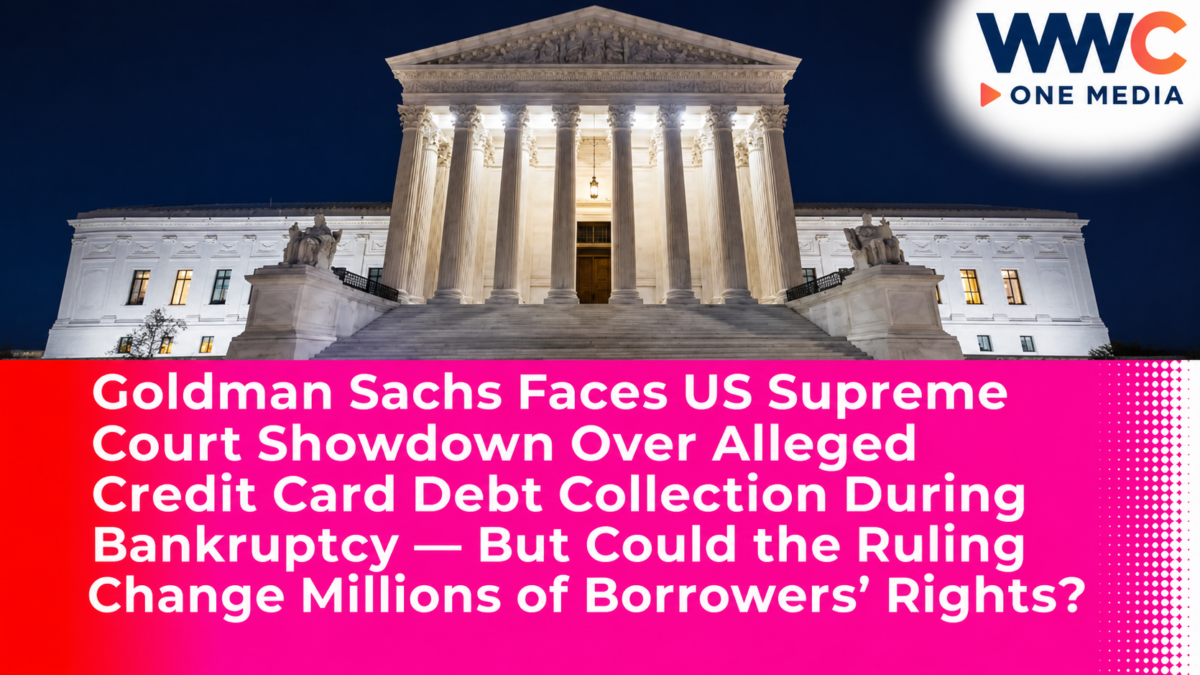
Wall Street banking giant Goldman Sachs is taking a high-stakes legal battle to the US Supreme Court in a dispute that could reshape how American banks and other creditors handle debt collection against people seeking bankruptcy protection.
The nation’s highest court agreed on November 6 to review Goldman Sachs Bank USA’s attempt to enforce arbitration agreements in a lawsuit brought by two former Apple Card customers.
The borrowers allege that the bank continued trying to collect credit card debts after they filed for bankruptcy, despite federal protections designed to suspend most collection activity.
Goldman Sachs denies that the dispute should proceed in bankruptcy court and argues that the customers agreed to resolve qualifying disputes through private arbitration.
The case, Goldman Sachs Bank USA v. Brown, No. 25-1408, presents a major question about the relationship between two important federal laws: the Federal Arbitration Act and the US Bankruptcy Code.
According to Bloomberg Law and Reuters, the justices will consider whether bankruptcy courts can refuse to enforce an otherwise valid arbitration agreement when borrowers seek damages for alleged violations of bankruptcy’s automatic stay.
The decision could influence disputes involving banks, credit card issuers, consumer lenders and other creditors whose contracts contain arbitration provisions.
But it could also affect individuals attempting to obtain financial relief through bankruptcy.
Will the Supreme Court reinforce the power of arbitration clauses in financial contracts—or preserve bankruptcy judges’ authority to decide whether creditors violated court-protected debt-collection restrictions?
Supreme Court Agrees to Hear Goldman Sachs’ Appeal
The Supreme Court agreed on November 6 to take up Goldman Sachs’ appeal following a defeat in the Fourth US Circuit Court of Appeals.
The March 18 appellate ruling allowed two bankruptcy debtors to pursue their alleged automatic-stay violations in bankruptcy court rather than forcing them into private arbitration.
Goldman Sachs argues that the decision conflicts with federal law favoring enforcement of arbitration agreements.
The bank also contends that federal appeals courts have reached inconsistent conclusions about whether bankruptcy claims can be moved into arbitration.
The Supreme Court’s decision to hear the case creates an opportunity to clarify those rules.
However, accepting the appeal does not mean the justices agree with Goldman Sachs.
Nor does it indicate that the borrowers have already established liability.
The Court will examine the legal rules governing the appropriate forum for the dispute.
A final decision is expected before the Supreme Court’s term concludes in mid-2027, although the precise timetable remains subject to the Court’s schedule.
How Two Apple Card Customers Sparked the Legal Battle
The dispute began with two borrowers, Rhea Ann Brown and Gregory Kevin Maze.
Both had obtained Apple Card credit accounts issued by Goldman Sachs Bank USA.
Brown filed for Chapter 13 bankruptcy protection in June 2023.
Maze filed for Chapter 7 bankruptcy protection in November 2023.
Their bankruptcy filings triggered protections under federal bankruptcy law.
One of the most important protections is the automatic stay, which generally stops creditors from pursuing covered collection actions after a bankruptcy petition is filed.
But the borrowers alleged that Goldman Sachs continued sending communications involving outstanding Apple Card balances after their bankruptcy filings.
They contended that those actions violated the automatic stay.
Their lawsuit sought damages and other relief under the Bankruptcy Code.
They also attempted to pursue the case on behalf of a proposed nationwide class of similarly situated borrowers.
Goldman Sachs responded by invoking arbitration provisions in the customers’ card agreements.
The bank argued that the dispute should be resolved through the arbitration process the customers had contractually accepted.
That disagreement ultimately reached the federal appeals courts and now the Supreme Court.
What Is Bankruptcy’s Automatic Stay?
For Americans facing serious financial difficulties, the automatic stay can be one of the most important protections available under bankruptcy law.
Under Section 362 of the US Bankruptcy Code, filing a qualifying bankruptcy petition generally creates an immediate legal restriction on many debt-collection activities.
The stay is intended to give debtors breathing room while their financial affairs are addressed through bankruptcy proceedings.
It also helps ensure that creditors follow an organized legal process rather than racing to collect assets individually.
Depending on the circumstances, prohibited conduct may include collection lawsuits, certain collection calls, attempts to obtain payment on pre-bankruptcy debts and other actions covered by the statute.
The protection is not unlimited.
Some proceedings and obligations are exempt, and creditors may request relief from the stay through the bankruptcy court.
But when a creditor willfully violates the automatic stay, an injured individual may be entitled to recover actual damages, including costs and attorneys’ fees, under Section 362(k).
Punitive damages may also be available in appropriate circumstances.
The availability of compensation depends on the applicable legal requirements and the evidence presented.
The borrowers in the Goldman Sachs case argue that enforcement of those protections should remain under the supervision of the bankruptcy court.
Goldman Sachs argues that the contractual arbitration arrangement should be respected.
The central issue is not whether bankruptcy protections exist. It is who has authority to adjudicate a claim that those protections were violated.
Goldman Sachs Says Federal Arbitration Law Must Be Enforced
Goldman Sachs bases its appeal on the Federal Arbitration Act.
The law generally requires courts to enforce valid arbitration agreements according to their terms, subject to applicable exceptions and legal defenses.
Arbitration is a dispute-resolution process in which parties present their cases to one or more arbitrators rather than having the dispute decided through an ordinary court trial.
Banks and other businesses frequently include arbitration provisions in consumer contracts.
Supporters argue that arbitration can provide a more efficient and less expensive method for resolving disputes.
It may also reduce the need for lengthy litigation.
However, arbitration can involve different procedures from public court proceedings.
The availability of appeals, discovery, collective claims and other procedural rights may differ depending on the arbitration agreement and governing law.
Goldman Sachs argues that Congress did not clearly eliminate arbitration rights for the type of bankruptcy claim involved in this case.
The bank says that allowing bankruptcy courts to override valid arbitration agreements without sufficient legal justification creates uncertainty for businesses and consumers.
It is asking the Supreme Court to clarify when, if ever, bankruptcy law permits a court to decline enforcement of an arbitration agreement covering Section 362(k) claims.
Fourth Circuit Rejects Goldman’s Attempt to Force Arbitration
The Fourth Circuit ruled against Goldman Sachs on March 18, 2026.
A majority of the three-judge panel concluded that compelling arbitration would conflict with important purposes of bankruptcy law.
Bankruptcy courts have specialized responsibilities involving debtor protection, creditor treatment and the administration of bankruptcy proceedings.
The majority reasoned that enforcement of the automatic stay is closely connected to those responsibilities.
It therefore concluded that the bankruptcy court had discretion to deny Goldman Sachs’ motion to compel arbitration.
But the ruling was not unanimous.
Judge Robert B. King dissented.
He argued that the claims could be handled through arbitration without necessarily undermining the bankruptcy system’s central objectives.
The disagreement reflected a larger split among federal appellate courts.
In a 2006 decision involving MBNA America Bank, the Second Circuit permitted arbitration of an automatic-stay damages claim under circumstances that Goldman Sachs says are comparable.
The Fourth Circuit’s decision takes a different approach.
That conflict is one reason the Supreme Court agreed to review the dispute.
A ruling could establish clearer national standards for bankruptcy courts considering similar arbitration requests.
A September Court Decision Adds an Important Twist
There is another significant development in the case that has received less public attention.
On September 10, 2026, the US Bankruptcy Court for the Western District of Virginia granted Goldman Sachs’ motion to dismiss the borrowers’ complaint without prejudice.
The court allowed the plaintiffs an opportunity to file an amended complaint.
In its written decision, the court concluded that the borrowers had sufficiently alleged a willful violation of the automatic stay for pleading purposes.
However, it determined that they had not adequately pleaded actual damages necessary to proceed with their claims under Section 362(k).
The court examined allegations involving emotional distress, lost time, threatened credit reporting and legal expenses.
It concluded that the complaint did not contain enough factual detail to establish the required injury.
This ruling is important for two reasons.
First, it shows that the underlying damages case remains contested.
Second, it does not resolve the separate legal question before the Supreme Court.
A dismissal without prejudice permits the possibility of an amended complaint and does not amount to a final judgment establishing that Goldman Sachs committed no violation.
The Supreme Court may therefore examine the arbitration question even though the borrowers’ damages allegations have encountered a separate procedural setback.
The bankruptcy court’s September ruling did not award damages against Goldman Sachs, and the Supreme Court has not yet ruled on the arbitration dispute.
American Bankers Association Backs Goldman Sachs
The banking industry is closely watching the case.
The American Bankers Association submitted an amicus curiae brief supporting Goldman Sachs’ request for Supreme Court review.
An amicus brief allows an organization that is not a direct party to a case to present legal arguments or information it believes could assist the court.
The association’s participation demonstrates the wider industry’s interest in obtaining clarity on arbitration agreements.
For banks, contractual certainty is important when managing consumer accounts and potential legal claims.
If different federal circuits apply different rules, financial institutions may face varying litigation requirements depending on where a case is filed.
The industry argues that clear arbitration standards can reduce uncertainty and help companies design consistent dispute-resolution procedures.
Consumer advocates, however, may emphasize the importance of bankruptcy courts in enforcing debtor protections.
They may also argue that requiring individual arbitration could complicate the pursuit of certain claims.
The Supreme Court will need to address the legal relationship between the two federal statutes rather than simply determine which process one side prefers.
Could the Ruling Change Consumer Credit Card Disputes?
The broader consequences could be significant.
Credit card agreements frequently contain arbitration clauses.
These provisions may affect how disputes over account charges, collection practices and contractual obligations are resolved.
However, the Goldman Sachs case concerns a specific category of bankruptcy claim.
The Supreme Court is not being asked to decide the validity of every arbitration clause used by American banks.
Nor is it reviewing whether all consumer debt disputes must be arbitrated.
Its question concerns whether bankruptcy courts may override otherwise valid arbitration agreements for automatic-stay damages claims under Section 362(k).
A ruling favoring Goldman Sachs could strengthen the ability of financial institutions to enforce such agreements in qualifying bankruptcy disputes.
A ruling favoring the borrowers could preserve greater discretion for bankruptcy courts to keep those claims within bankruptcy proceedings.
Either outcome could affect litigation strategy.
But the precise consequences will depend on the reasoning and scope of the eventual decision.
The Case Arrives as Consumer Borrowing Remains Under Pressure
The Supreme Court dispute comes at a time when consumer debt and borrowing costs remain important economic concerns.
Higher interest rates can increase the expense of carrying revolving credit card balances.
Unexpected job losses, medical expenses or financial emergencies can also leave borrowers unable to meet their obligations.
When financial distress becomes severe, bankruptcy may provide a legal mechanism for resolving qualifying debts.
However, bankruptcy can involve significant consequences, including effects on credit records, assets and future borrowing opportunities.
The legal protections available during bankruptcy are therefore particularly important for vulnerable households.
An automatic stay can prevent qualifying collection efforts from disrupting the legal process.
The Goldman Sachs case concerns how violations of those protections should be adjudicated.
For borrowers, the practical question is whether the court supervising their bankruptcy should also decide related claims against creditors.
For banks, it is whether preexisting arbitration agreements should continue to govern those disputes.
Goldman Sachs Faces Scrutiny Despite Strong Wall Street Performance
The legal dispute comes as Goldman Sachs remains one of the world’s most influential financial institutions.
Its activities include investment banking, trading, asset management and wealth management.
The group also has experience operating consumer financial products, including the Apple Card program involved in this lawsuit.
The bankruptcy arbitration case is separate from its broader investment-banking operations.
As WWC ONE MEDIA previously reported on Goldman Sachs’ strong demand for artificial intelligence-related megadeals, the bank continues participating in substantial corporate financing and advisory activity.
The Supreme Court dispute does not establish that those businesses face a financial or operational crisis.
But it highlights a different challenge for major financial institutions.
Banks must navigate complex consumer-protection requirements alongside contractual rights and legal obligations.
Even disputes involving individual customers can eventually produce precedents relevant to the wider financial industry.
America’s Bankruptcy System Is Already Facing Major Corporate Cases
The Goldman Sachs dispute also arrives during a period of prominent bankruptcy and restructuring activity.
Financially distressed businesses have been seeking court protection, negotiating with creditors and exploring asset sales.
As WWC ONE MEDIA reported on Redeemer Health’s Chapter 11 bankruptcy involving approximately $441 million in liabilities, bankruptcy proceedings can provide a framework for preserving operations while organizations attempt to resolve financial obligations.
These corporate cases are fundamentally different from the individual bankruptcy proceedings behind Goldman Sachs’ Supreme Court appeal.
The Goldman Sachs dispute involves Chapter 7 and Chapter 13 debtors and claims under Section 362(k).
The cited business restructurings involve Chapter 11 proceedings.
Nevertheless, all demonstrate why bankruptcy courts play a specialized role in resolving financial disputes.
The Supreme Court’s decision could clarify the intersection of bankruptcy court authority and arbitration law, although the precise ruling may be limited to the particular type of claim presented.
Why Arbitration Can Be Controversial
Arbitration is widely used in commercial and consumer contracts.
Its supporters emphasize efficiency, flexibility and contractual freedom.
Parties can sometimes resolve disputes without the delay and cost of conventional court proceedings.
But critics argue that mandatory arbitration can create disadvantages for consumers.
Individual borrowers may lack the resources available to large financial institutions.
Some arbitration clauses also limit collective proceedings, depending on the agreement and applicable law.
Public court proceedings can establish precedent and make information about disputes available through court records.
Arbitration may operate with different confidentiality and procedural arrangements.
However, it would be inaccurate to claim that arbitration always favors banks or that consumers can never receive meaningful remedies through arbitration.
The fairness and effectiveness of any particular process depend on its rules, costs, available remedies and circumstances.
The Supreme Court must decide whether the policies underlying bankruptcy law justify keeping certain disputes in bankruptcy court despite contractual arbitration provisions.
How a Supreme Court Ruling Could Affect Future Cases
The decision could influence how lower courts approach arbitration agreements in bankruptcy-related litigation.
If the justices favor Goldman Sachs, courts may have less discretion to decline arbitration in qualifying automatic-stay disputes.
Banks and creditors could gain greater confidence that arbitration clauses will be enforced.
However, the Supreme Court could also adopt a narrower standard that preserves exceptions under particular circumstances.
If the justices favor the borrowers, bankruptcy judges may retain authority to decide when arbitration conflicts with the purposes of bankruptcy proceedings.
That could strengthen the central role of bankruptcy courts in supervising alleged stay violations.
The decision could also clarify the relationship between the Fourth and Second Circuits’ conflicting approaches.
But a ruling on Section 362(k) would not automatically determine the treatment of every other type of bankruptcy claim.
Other provisions of bankruptcy law raise different questions and may require separate analysis.
What the Case Means for the Philippines
The Goldman Sachs appeal also offers lessons for the Philippines, where consumer borrowing, financial regulation and insolvency law remain important issues.
Philippine banks and lenders operate under domestic rules established by legislation and financial regulators.
The country also has its own mechanisms for debt restructuring and insolvency, including the Financial Rehabilitation and Insolvency Act.
American bankruptcy law does not automatically govern disputes involving Philippine borrowers or financial institutions.
Likewise, a US Supreme Court ruling on the Federal Arbitration Act would not directly rewrite Philippine arbitration or insolvency legislation.
Nevertheless, the dispute raises a question relevant to legal systems around the world.
When consumers enter insolvency proceedings, how should courts balance contractual dispute-resolution agreements against protections designed to ensure an orderly process?
For borrowers, the concern is access to effective remedies.
For lenders, it is consistency in enforcing valid contractual arrangements.
For regulators and policymakers, it is ensuring that financial systems remain predictable while protecting parties experiencing financial distress.
Three Possible Outcomes in the Supreme Court
Scenario 1: Goldman Sachs wins.
The Court could conclude that the arbitration agreement should be enforced under the circumstances presented, limiting bankruptcy courts’ ability to refuse arbitration of qualifying automatic-stay claims.
Scenario 2: The borrowers prevail.
The justices could uphold the Fourth Circuit’s reasoning and confirm that bankruptcy courts have discretion to retain certain stay-violation claims when arbitration would conflict with bankruptcy law’s core purposes.
Scenario 3: The Court adopts a narrower rule.
The justices could establish a more specific test for determining when arbitration must be enforced, potentially leaving some disputes in bankruptcy court and others in arbitration.
The eventual ruling may not follow any of these scenarios exactly.
Its scope will depend on the questions the justices decide and the legal reasoning they adopt.
The Bigger Question: Will Wall Street or Bankruptcy Courts Gain More Power?
The Goldman Sachs appeal places two important principles of American law in direct tension.
One favors enforcing valid contractual arbitration agreements.
The other gives bankruptcy courts specialized authority to supervise insolvency proceedings and protect debtors from prohibited collection activity.
Both serve important legal purposes.
The Supreme Court must now clarify how they interact when an individual claims that a creditor violated bankruptcy’s automatic stay.
Goldman Sachs argues that the Federal Arbitration Act requires enforcement of its contractual rights.
The borrowers argue that bankruptcy judges must retain authority to enforce essential protections under the Bankruptcy Code.
The lower courts have reached different conclusions about where the dispute belongs.
And a September procedural ruling concerning the adequacy of the borrowers’ damages allegations adds another layer of complexity.
For now, Goldman Sachs has not been found liable for the alleged collection violations, and the Supreme Court has not ruled on the merits of its arbitration appeal.
But the eventual decision could influence how banks and consumers resolve similar bankruptcy-related disputes across the United States.
As the justices prepare to examine the conflict between arbitration rights and bankruptcy protections, a question hangs over Wall Street and the nation’s courts:
Will the Supreme Court give financial institutions greater power to move bankruptcy-related disputes into private arbitration—or reinforce the authority of judges to protect Americans seeking relief from overwhelming debt?