WASHINGTON / NEW YORK / MANILA — November 7, 2026 | WWC ONE MEDIA | US Politics, Public Health, Healthcare Policy and Global News
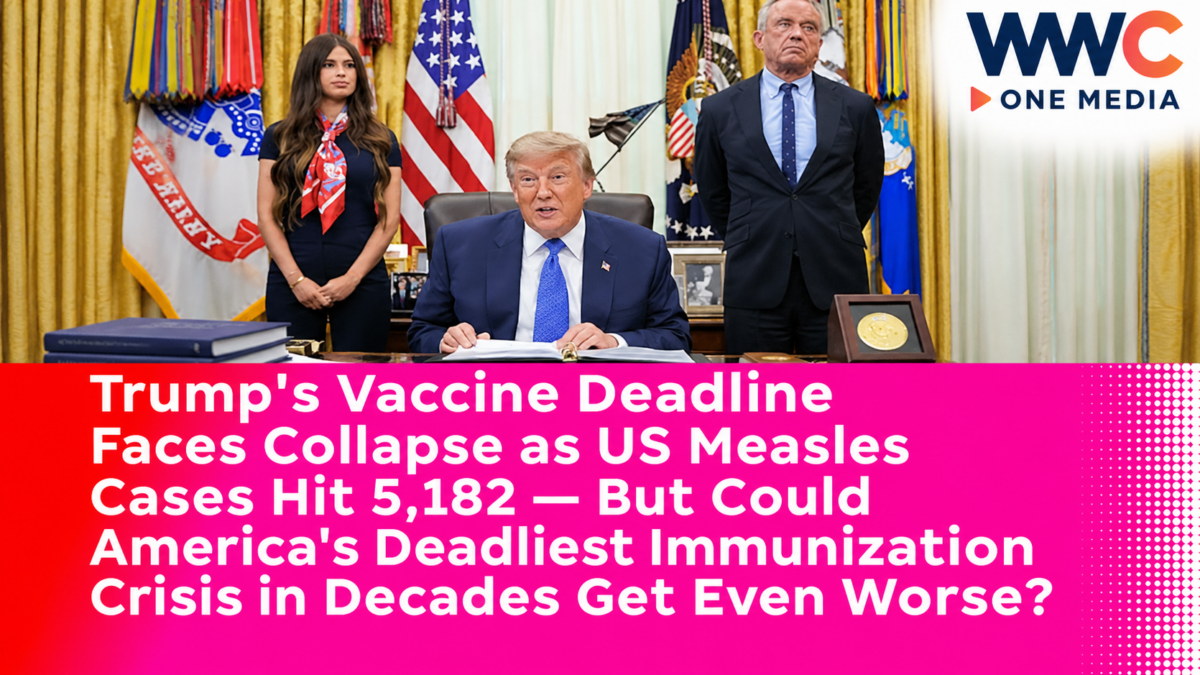
President Donald Trump’s ambitious effort to overhaul America’s childhood vaccination recommendations is facing a major setback, with senior health officials reportedly preparing to miss a November 8 deadline as the United States battles its largest measles outbreak in decades.
The delay threatens to intensify an already contentious debate over childhood vaccines, medical evidence and the future of federal public-health policy.
According to Bloomberg’s November 6 report, officials at the Department of Health and Human Services (HHS) are not expected to deliver the final recommendations within the 90-day period established by Trump’s August 10 executive order.
The directive requires federal health officials to develop plans for offering separate measles, mumps and rubella vaccines, reassess the timing of childhood immunizations, examine alternative vaccine ingredients and strengthen safety-monitoring systems.
Health Secretary Robert F. Kennedy Jr. had promised that officials would complete the work by November 8.
But people familiar with the process told Bloomberg that the administration was likely to miss that target.
A draft has reportedly been submitted to the White House, although its complete contents have not been publicly released.
The timing is particularly sensitive.
The Centers for Disease Control and Prevention reported 5,182 confirmed measles cases nationwide in 2026, the highest annual total recorded in 35 years.
More than 560 patients have been hospitalized, and deaths have been reported in multiple states.
The situation is also raising questions about whether the United States can retain its long-standing measles-elimination status.
With the administration’s vaccine overhaul approaching a critical deadline and measles continuing to spread, could political uncertainty over immunization recommendations make an already serious public-health emergency more difficult to control?
Trump’s November 8 Vaccine Deadline Is Approaching
On August 10, Trump signed Executive Order 14420, titled Delivering Gold Standard Childhood Vaccine Recommendations for Americans.
The order instructed HHS, through the Task Force on Safer Childhood Vaccines, to submit plans within 90 days.
The directive covers several areas of vaccine policy.
One involves providing options for administering individual measles, mumps and rubella vaccines instead of relying exclusively on the combined MMR shot.
Another concerns the timing and sequencing of recommended childhood immunizations.
The administration also wants additional research into alternatives to aluminum-containing vaccine adjuvants, ingredients used in certain vaccines to strengthen immune responses.
The order further calls for continuing evaluation of vaccine safety and improvements in public transparency.
Kennedy publicly committed to meeting the deadline.
However, Bloomberg reported on November 6 that the task force’s work was not expected to be finalized in time.
The department has reportedly submitted a draft to the White House, suggesting that some preparation has been completed.
An HHS spokesperson said the agency remains engaged in implementing the president’s directive and emphasized the need for scientific review.
As of November 7, the deadline has not yet passed. The administration is facing a reported expected delay, rather than a confirmed failure to meet a deadline that has already expired.
That distinction is important when assessing the latest developments.
Why Trump Wants to Change America’s Childhood Vaccine Schedule
Trump and Kennedy have argued that federal vaccination policy should provide parents with greater flexibility and more information about medical decisions.
Their administration has sought to align America’s childhood immunization schedule with selected practices in other developed countries.
In January, federal officials announced changes that moved several vaccines away from universal recommendations and into categories based on individual risk or clinical decision-making.
A subsequent federal court ruling blocked key elements of the overhaul.
The administration returned to the issue through executive orders in May and August.
The August order recognizes routine childhood immunization against 11 diseases, compared with the broader range covered under the federal recommendations in late 2024.
It distinguishes immunizations recommended for all children from those recommended for specific populations or through shared clinical decision-making.
The White House says the approach is intended to strengthen parental choice and public confidence.
Major medical organizations, however, have challenged the changes.
They warn that reducing routine recommendations without sufficient scientific justification could create confusion and leave children vulnerable to preventable diseases.
The debate has therefore become about more than administrative scheduling.
It concerns how medical evidence should be evaluated, who should determine national immunization recommendations and how governments communicate risk to parents.
The Most Controversial Proposal: Splitting the MMR Vaccine
One of the administration’s most disputed proposals involves the combined measles, mumps and rubella vaccine.
The MMR vaccine protects against three infectious diseases through a single combination shot.
It has been widely used for decades.
Trump’s August executive order calls for developing options to administer the three components separately once appropriate single-disease products become domestically available.
The directive also expresses a preference for administering childhood immunizations at separate medical visits where feasible.
Supporters argue that separating doses could provide parents with additional choices.
But pediatricians and infectious-disease specialists have raised significant concerns.
The combined MMR vaccine reduces the number of appointments and injections needed to protect children.
Separating the components could require additional visits, potentially increasing costs and making it harder for families to complete recommended vaccination schedules.
More appointments can also create logistical difficulties for working parents, rural families and households with limited access to healthcare.
Importantly, separate measles, mumps and rubella vaccines are not currently available as routine, individually marketed products in the United States.
The administration’s order therefore calls for a development and implementation plan rather than an immediately available alternative to the combined vaccine.
The order also explicitly calls for continued availability of combination vaccines.
The proposed policy does not establish that the existing MMR vaccine has been banned or that families should stop using it.
Medical Studies Do Not Support Claims That MMR Vaccines Cause Autism
The debate has been intensified by statements from Trump and Kennedy questioning whether childhood vaccines may be connected to autism.
These claims have attracted substantial criticism from medical researchers.
Large, well-designed studies have found no evidence that the MMR vaccine increases autism risk.
A Danish study involving more than 650,000 children found no association between MMR vaccination and autism.
Other research examining children with family histories of autism reached similar conclusions.
The World Health Organization and major professional medical organizations continue to support vaccination as a highly effective method of preventing serious infectious diseases.
FactCheck.org reviewed claims made during the August executive order signing and identified multiple misleading statements about vaccine schedules, vaccine volumes and autism.
Researchers also emphasize that changing the timing of vaccination without reliable evidence of benefit can expose children to preventable infections for longer periods.
At the same time, vaccine safety monitoring remains important.
Vaccines, like other medical products, can cause adverse reactions, and the balance of benefits and risks should continue to be evaluated.
But proposals for additional research should not be interpreted as evidence that established vaccines cause autism.
The scientific evidence supports the safety and effectiveness of the MMR vaccine, and research has not demonstrated a causal relationship between MMR vaccination and autism.
America’s Measles Outbreak Reaches 5,182 Confirmed Cases
The administration’s expected deadline delay comes during a particularly serious measles outbreak.
On November 6, the CDC reported 5,182 confirmed cases for 2026, based on reports received through November 5.
That was an increase of 330 cases from the previous weekly update.
The total is more than double the 2,289 cases reported throughout 2025.
According to Reuters, 562 people had been hospitalized, representing approximately 11% of reported cases.
The CDC also recorded 43 outbreaks.
Approximately 96% of confirmed cases were associated with outbreaks, demonstrating how clusters of infection have driven the increase.
The vaccination figures are particularly concerning.
About 96% of patients were unvaccinated or had an unknown vaccination status.
That combined category should not be interpreted to mean that all those individuals were confirmed unvaccinated.
Nevertheless, the data underscores the importance of maintaining high levels of population immunity.
Measles is among the most contagious human infectious diseases.
An infected person can spread the virus through the air, and exposure can occur even after the infected individual has left an enclosed space.
Complications can include pneumonia, inflammation of the brain, hospitalization and death.
Children who are too young to be vaccinated and people with certain medical vulnerabilities can face particularly serious risks.
Pennsylvania Becomes the Epicenter of the Outbreak
Pennsylvania has experienced the largest reported concentration of measles cases in the United States during 2026.
Reuters reported approximately 1,487 cases in the state, along with 287 hospitalizations and six measles-associated deaths recorded by state authorities.
Other states, including South Carolina, Utah and Wisconsin, have also experienced substantial outbreaks.
New York and Wisconsin recently announced additional measles-associated deaths.
The federal and state death totals are not identical.
Reuters reported that the CDC’s national count listed four deaths, while some state authorities had reported additional cases.
The discrepancy reflects differences in reporting and classification procedures, including ongoing work to standardize how measles-associated deaths are counted.
It would therefore be inaccurate to combine every reported figure without explaining the differing methods.
The broader picture, however, is clear.
The United States is experiencing unusually widespread measles transmission, with serious consequences for families and healthcare systems.
The outbreak has renewed concern about falling immunization coverage and the vulnerability of communities where too few people are adequately protected.
Could America Lose Its Measles-Elimination Status?
Another major development is approaching.
The Pan American Health Organization is expected to convene an expert review to determine whether the United States still qualifies as a country that has eliminated endemic measles transmission.
The US received measles-elimination status in 2000.
That designation does not mean the country never experiences measles cases.
Imported cases and outbreaks can still occur.
Elimination means that continuous endemic transmission has been interrupted for at least 12 months within a defined geographic area.
If sustained transmission continues beyond that threshold, a country can lose its elimination designation.
The current outbreak has raised questions about whether the United States still meets the criteria.
However, a loss of elimination status has not been established as of November 7.
The expert review and its findings remain pending.
The consequences would be significant for America’s public-health reputation.
Measles elimination was achieved through decades of vaccination, disease surveillance and outbreak-control programs.
Losing that status would indicate that domestic transmission had become sustained again.
It would also increase pressure on federal and state authorities to improve vaccination coverage and control outbreaks.
Vaccine Policy Faces Legal and Scientific Challenges
The anticipated delay is not happening in isolation.
The administration’s effort to change federal immunization recommendations has encountered legal challenges.
Earlier in 2026, a federal judge blocked important parts of the government’s attempted childhood vaccine-schedule overhaul.
The dispute also involved changes to the CDC’s Advisory Committee on Immunization Practices, the expert panel that traditionally evaluates evidence and advises federal officials on vaccine policy.
The legal proceedings have complicated the government’s ability to implement some proposed changes.
Major medical organizations have continued issuing their own recommendations, sometimes differing from the administration’s preferred approach.
The American Academy of Pediatrics has been among the most prominent critics.
The organization argues that childhood vaccination schedules should reflect strong scientific evidence and the practical need to protect children before they encounter serious infectious diseases.
It has also warned that splitting combination vaccines and increasing the number of appointments could create unnecessary barriers.
The administration maintains that its approach is designed to improve transparency and parental choice.
The disagreement highlights a fundamental policy question.
Should national recommendations be revised primarily through the executive branch’s chosen review process, or should changes continue to rely heavily on established independent medical advisory mechanisms?
The answer carries implications for public confidence, medical practice and future legal disputes.
What Happens to Children if the Deadline Is Missed?
An important distinction is often lost in discussions about the deadline.
The November 8 requirement concerns plans that federal health officials must submit to the president.
It does not require every proposed vaccine change to become operational by that date.
Missing the deadline would not automatically cancel existing vaccines, prohibit healthcare providers from administering MMR or alter state school-entry immunization requirements.
Nor would it immediately establish a new national schedule.
The practical consequences would depend on subsequent decisions by federal officials, regulatory agencies, courts and state authorities.
For parents, the most important consideration remains obtaining reliable advice about their children’s immunization needs.
Doctors can assess age, health conditions, vaccination history and exposure risks.
Families should not assume that a proposed federal policy has already replaced the applicable clinical guidance.
Any changes in vaccine availability or recommended schedules need to be confirmed through authoritative healthcare sources.
The Vaccine Debate Could Intensify After the US Midterms
The expected delay comes immediately after the November 3 midterm elections.
The political environment has changed substantially, with Democratic victories giving the party control of the incoming Congress.
Healthcare policy, including federal vaccine recommendations, is likely to face intensified scrutiny when the new Congress convenes in January 2027.
As WWC ONE MEDIA reported in its analysis of the growing number of doctors and public-health professionals entering American politics, candidates with medical and scientific backgrounds won notable races during the election cycle.
Some have criticized Kennedy’s handling of vaccination policy and federal scientific agencies.
Congressional committees could seek documents, conduct hearings and question officials about the evidence supporting the administration’s decisions.
However, the incoming Congress does not automatically control the executive branch’s healthcare recommendations.
Trump remains president, and Kennedy continues serving as health secretary.
Legislation reversing administration policies could face presidential opposition or legal complications.
The result could be another prolonged confrontation between Congress and the White House over federal public-health policy.
Measles Outbreaks Beyond America Show the Wider Risks
The current US crisis is part of a broader international challenge.
In several countries, gaps in immunization coverage have allowed measles to return or spread rapidly.
Bangladesh provides a particularly serious example.
As WWC ONE MEDIA previously reported on Bangladesh’s severe measles outbreak, disruption of routine vaccination services, supply shortages and missed immunizations have contributed to major transmission.
The outbreak has placed enormous pressure on healthcare facilities and exposed vulnerable children to serious complications.
The comparison does not mean the United States and Bangladesh have identical health systems or outbreak conditions.
But both situations illustrate the importance of sustained immunization coverage.
When large groups of children remain unprotected, highly contagious infections can spread quickly.
That is why public-health agencies emphasize not only vaccine availability but also timely administration, reliable access and public trust.
What the US Vaccine Controversy Means for the Philippines
For the Philippines, the American debate offers an important reminder about the need for evidence-based immunization programs.
The Philippine Department of Health has been implementing supplemental measles-rubella vaccination campaigns to close immunity gaps.
As WWC ONE MEDIA reported on Vigan City’s campaign targeting 2,779 children, local health authorities have emphasized preventing outbreaks even in communities without reported infections.
That approach reflects a basic public-health principle.
Vaccination programs aim to protect populations before widespread disease transmission occurs.
Waiting for infections to surge can place children and healthcare systems at unnecessary risk.
Meanwhile, WWC ONE MEDIA reported on Oriental Mindoro’s free measles-rubella immunization campaign, which was designed to reach young children across communities and improve protection against both diseases.
These Philippine initiatives operate under domestic public-health policies and regulations.
Changes proposed by the Trump administration do not automatically apply to the Philippines.
Philippine parents should continue following guidance from the Department of Health and qualified healthcare professionals.
Nevertheless, misinformation circulating internationally can influence public perceptions of vaccines.
Clear communication about benefits, known risks and recommended schedules remains essential.
Will Trump’s Vaccine Overhaul Ultimately Go Ahead?
Several issues remain unresolved as the November 8 deadline approaches.
First, the administration has not publicly released the complete plan reportedly submitted in draft form to the White House.
Second, the proposed separation of MMR vaccines would require suitable products to become commercially and regulatorily available.
Third, existing legal proceedings could affect how federal officials implement changes.
Fourth, medical organizations may continue opposing revisions they believe lack adequate scientific support.
Finally, the worsening measles outbreak is increasing pressure on authorities to maintain reliable vaccination access and clear guidance.
A delayed plan does not necessarily mean the administration has abandoned its objectives.
HHS could submit revised recommendations after the deadline.
Officials could also develop the proposals in stages, depending on scientific, legal and operational considerations.
But the timing may affect public confidence in the administration’s ability to implement its promises.
The next official announcement will be important in determining whether the task force’s recommendations are ready for public evaluation.
The Bigger Question: Can Washington Restore Trust While Measles Spreads?
The Trump administration says its vaccine policy is intended to improve transparency, strengthen scientific review and give families greater choice.
Its critics argue that the changes could weaken established vaccination practices and create confusion at a dangerous moment for public health.
Both sides acknowledge the importance of public trust, but they disagree sharply about how that trust should be built.
The scientific evidence, meanwhile, continues to support timely vaccination against measles.
The combined MMR vaccine remains an established and highly effective protection against the disease.
Two recommended doses provide approximately 97% protection against measles.
At the same time, the United States has reported more than 5,000 measles cases in a single year, with hundreds of hospitalizations and multiple deaths.
The administration’s proposed overhaul is therefore unfolding against a backdrop of real and measurable disease transmission.
For parents, the priority is clear information and reliable access to preventive healthcare.
For policymakers, the challenge is ensuring that any change in recommendations is supported by sound evidence and does not create avoidable gaps in protection.
The November 8 deadline may come and go without a completed public plan. But the consequences of delayed protection against preventable diseases do not follow political timetables.
And as the United States confronts one of its most serious measles outbreaks in decades, a critical question remains:
Will Trump and Robert F. Kennedy Jr. deliver a vaccine policy capable of strengthening public confidence—or could another round of uncertainty leave American families navigating a dangerous public-health crisis with even more confusion?