WASHINGTON, UNITED STATES / MANILA, PHILIPPINES — November 5, 2026 | WWC ONE MEDIA | Global Politics, Public Health, Science and Healthcare Policy
America’s public-health community is celebrating an extraordinary political comeback after doctors, scientists and medical professionals won major victories in the 2026 US midterm elections, helping Democrats capture both chambers of Congress and intensifying pressure on President Donald Trump’s controversial healthcare agenda.
The dramatic election results have been described as a “revenge of the nerds” moment for medical and scientific experts who have spent years confronting political attacks, vaccine controversies, government research cuts and growing distrust in public-health institutions.
According to Bloomberg’s November 4 report, Public Health Experts Cheer ‘Revenge of the Nerds’ Midterm Rout, the sweeping Democratic victory is bringing a new generation of medical professionals into federal and state government at a critical moment for American healthcare.
The results include historic victories by pediatrician Annie Andrews in South Carolina, physician and epidemiologist Abdul El-Sayed in Michigan, and former Ohio health director Amy Acton.
Their victories occurred as Democrats regained control of Congress, creating new opportunities to investigate the Trump administration’s health policies and challenge decisions involving vaccines, Medicaid and scientific research.
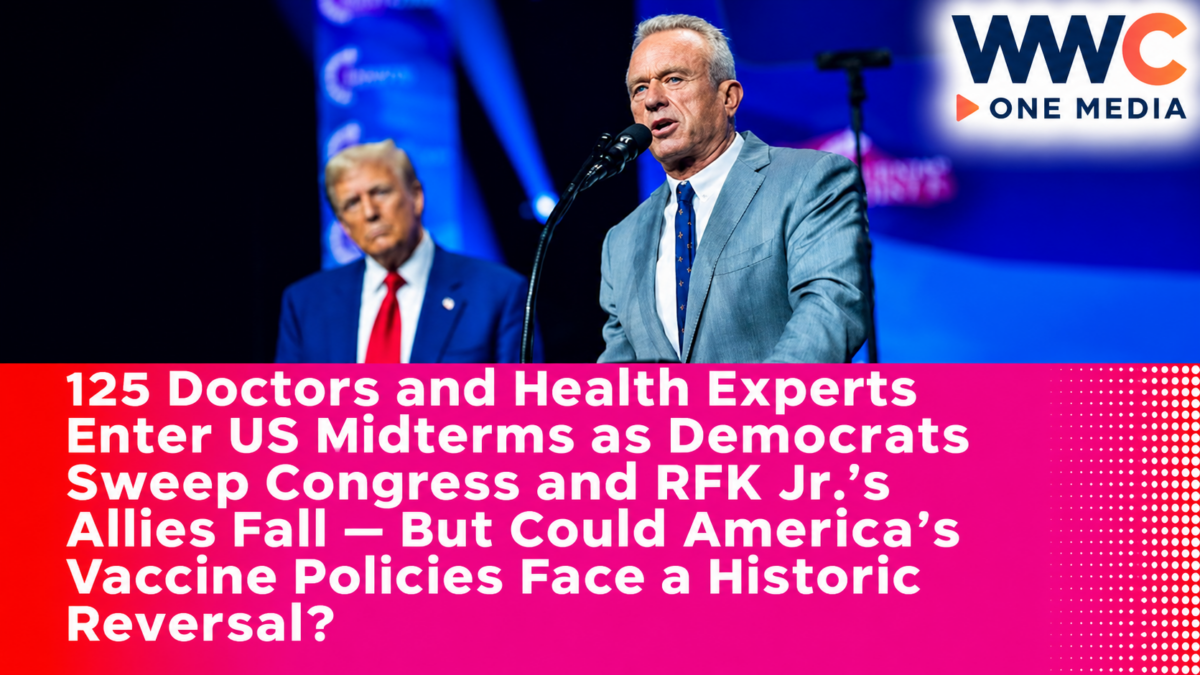
CNN reported that at least 125 doctors, nurses and public-health experts were candidates in the November 3 elections.
The science-focused political organization 314 Action spent more than $30 million backing candidates with medical, scientific and other technical backgrounds.
But the political movement faces a complicated future.
Although the election has strengthened the position of lawmakers who support evidence-based public health, Robert F. Kennedy Jr. remains secretary of Health and Human Services, and Trump retains presidential authority.
The question now is whether America’s newly elected medical professionals can transform an extraordinary electoral victory into meaningful changes in healthcare — or whether political gridlock will prevent them from reversing the policies they opposed.
America’s Doctors and Scientists Score Major Midterm Victories
The 2026 elections produced one of the most significant waves of medical and scientific candidates in recent American political history.
Democratic doctors, nurses, researchers and other professionals won races at the federal, state and local levels.
The results coincided with widespread dissatisfaction over healthcare affordability, government policy and the rising cost of living.
STAT reported that Democratic medical professionals achieved important victories in the Senate, House of Representatives and state governorships.
Among them were Annie Andrews, Abdul El-Sayed and Amy Acton.
Their successes were notable because medical professionals in Congress have historically been more commonly associated with the Republican Party.
The election suggests that professional experience in healthcare has become a potentially valuable political credential for Democratic candidates.
However, the results do not establish that voters universally preferred candidates simply because they were doctors.
Economic concerns, individual campaign strategies and opposition to the incumbent administration also influenced election outcomes.
Annie Andrews Wins Historic South Carolina Senate Race
One of the night’s most remarkable victories came in South Carolina.
Democrat Annie Andrews, a pediatrician, won the state’s US Senate election, defeating Republican Darline Graham.
The seat had previously been held by Republican Senator Lindsey Graham, who died earlier in 2026.
Andrews’ victory was historic for a state that had not elected a Democratic US senator since 1998.
Her campaign emphasized healthcare affordability, access to vaccines and the future of medical services in underserved communities.
She also used her professional experience treating children to explain her policy priorities.
During the campaign, Andrews criticized changes to federal vaccine policy and argued for stronger protection of access to healthcare.
South Carolina’s measles outbreak provided a particularly visible example of the public-health issues facing the state.
Her victory is being interpreted by public-health advocates as evidence that medical expertise can resonate with voters even in traditionally Republican territory.
But Andrews will still need to navigate a politically divided federal government to turn campaign proposals into legislation.
Abdul El-Sayed Becomes a Major Voice for Public Health
Michigan delivered another historic result.
Democrat Abdul El-Sayed won the state’s open Senate seat, becoming the first Muslim elected to the US Senate.
El-Sayed previously served as Detroit’s health director and built his political career around public health, economic inequality and healthcare access.
He completed medical training and pursued a career in epidemiology and public-health administration rather than clinical medical practice.
His campaign supported Medicare for All, a proposal for broad government-funded health coverage.
El-Sayed also criticized the Trump administration’s treatment of scientific institutions and federal health agencies.
According to STAT, he intends to use his Senate position to scrutinize Kennedy’s leadership of the Department of Health and Human Services.
He has discussed preparing the groundwork for rebuilding federal public-health institutions under a future administration.
His election gives advocates of universal healthcare a prominent new voice in Washington.
However, Medicare for All has not been enacted, and Democratic control of Congress does not guarantee its passage.
Amy Acton Defeats Vivek Ramaswamy in Ohio’s Governor Race
Ohio delivered another major political surprise.
Former state health director Amy Acton defeated Republican entrepreneur Vivek Ramaswamy in the state’s gubernatorial election.
Acton became widely known for her role in Ohio’s early response to COVID-19.
Her public-health decisions attracted strong support from some residents and intense criticism from others.
Ramaswamy, who received Trump’s endorsement, made Acton’s pandemic-era leadership a major campaign issue.
But voters chose Acton, making her Ohio’s first woman elected governor and ending two decades without a Democratic gubernatorial victory.
WWC ONE MEDIA previously examined this result in Democrat Amy Acton Defeats Trump-Backed Vivek Ramaswamy in Historic Ohio Governor Race — But Could This Political Earthquake Reshape the 2028 Election?.
Acton’s campaign focused on healthcare access, medical debt, prescription-drug affordability and reducing expenses for working families.
Her victory is significant for public-health professionals who have faced political criticism since the pandemic.
Nevertheless, her ability to implement major reforms will depend partly on cooperation with Ohio lawmakers.
Why Public-Health Advocates Are Calling It a “STEM Wave”
The organization 314 Action, which recruits and supports Democratic candidates with scientific and technical backgrounds, celebrated the election as a major breakthrough.
The group’s name refers to the mathematical constant pi.
It has worked to increase the number of doctors, scientists, engineers and other technical professionals holding elected office.
According to NPR, 314 Action invested more than $30 million in Democratic candidates during the 2026 election cycle, including support for 48 physicians.
The organization also reported receiving more than 700 applications from prospective candidates, compared with roughly 200 during a typical cycle.
That increase suggests growing political interest among professionals who traditionally focused on medicine, research or technical work rather than electoral politics.
314 Action President Shaughnessy Naughton argued that voters were responding to candidates who offered professional expertise and practical solutions to healthcare problems.
However, 314 Action is a political advocacy organization, not a neutral election administrator.
Its conclusions about the causes of Democratic victories should be understood as the organization’s interpretation.
Robert F. Kennedy Jr.’s Health Agenda Faces New Political Pressure
The election result could have substantial implications for Health Secretary Robert F. Kennedy Jr.
Kennedy has promoted the Make America Healthy Again movement, commonly known as MAHA.
The movement has emphasized chronic disease, food safety, chemical exposure and concerns about the pharmaceutical industry.
Supporters argue that these issues have been neglected by traditional public-health authorities.
Critics contend that Kennedy’s approach to vaccines and other established medical practices has weakened confidence in evidence-based healthcare.
His leadership has become particularly controversial over changes to vaccine recommendations, scientific advisory processes and staffing at federal health agencies.
The Democratic victory may increase congressional scrutiny of those decisions.
However, Kennedy has not been removed from office.
His future remains a matter of political and administrative decision-making rather than a confirmed consequence of the election.
Two High-Profile MAHA Allies Lose Their Elections
Some of the election’s most notable Republican defeats involved candidates associated with Kennedy’s MAHA movement.
In Kansas, Republican Senator Roger Marshall lost his reelection campaign to Democrat Adam Hamilton.
Marshall, a physician, helped establish the congressional MAHA Caucus.
The Kansas contest involved multiple issues, including economic concerns and scrutiny of Marshall’s professional conduct.
In Iowa, Republican gubernatorial candidate Zach Lahn also lost.
Lahn had received support from Kennedy and MAHA-aligned political organizations.
His campaign emphasized agricultural chemicals, chronic disease and opposition to certain vaccine policies.
According to STAT, a MAHA-aligned political committee invested approximately $1 million in his campaign.
The defeats weakened the movement’s position within the incoming political landscape.
But it would be inaccurate to conclude that all MAHA supporters have abandoned Kennedy or that the movement has ceased to exist.
Different factions continue to disagree about the administration’s priorities and progress.
Democrats Regain Congress and Gain New Investigative Powers
The broader election outcome is essential to understanding the public-health community’s optimism.
Democrats captured both the House of Representatives and the Senate, ending unified Republican control of Congress.
WWC ONE MEDIA examined the national result in Democrats Capture Both Houses of Congress in Sweeping Midterm Victory — Trump Faces Major Political Setback With Two Years Left in Office.
Control of Congress will allow Democrats to lead committees responsible for reviewing federal spending and overseeing government departments.
That could create opportunities to investigate decisions involving the Centers for Disease Control and Prevention, the National Institutes of Health, the Food and Drug Administration and the Department of Health and Human Services.
Lawmakers can request documents, conduct hearings and use subpoenas through established congressional procedures.
Senator Ron Wyden, a leading Democratic voice on healthcare policy, signaled an aggressive approach to oversight immediately after the election.
Still, the new Congress will not convene until January 2027.
The ability to investigate an administration should also be distinguished from the ability to remove officials or reverse executive policies automatically.
Medicaid Cuts Could Become a Major Congressional Battleground
Healthcare affordability emerged as an important election issue.
Democratic candidates criticized Medicaid funding reductions passed under Republican control in 2025.
They also campaigned on preserving access to health insurance and strengthening support for hospitals and patients.
Medicaid provides health coverage for eligible low-income Americans and other qualifying populations.
Cuts to federal funding can affect state budgets, healthcare providers and access to services.
The incoming Democratic majority may seek to reverse or reduce some of those changes.
However, any major legislative revision would have to navigate the president’s veto authority and applicable Senate procedures.
It is therefore premature to say that Medicaid cuts have already been reversed.
The election has changed the political balance, not automatically rewritten federal healthcare law.
Georgia’s Historic Election Adds Momentum to Medicaid Expansion
The healthcare debate also extends to state governments.
Georgia elected Democrat Keisha Lance Bottoms as governor, a historic result that ended decades of Republican control of the governor’s office.
Bottoms campaigned on expanding Medicaid coverage to additional low-income residents.
WWC ONE MEDIA reported on the implications in Keisha Lance Bottoms Makes US History, Wins Georgia Governor’s Race — First Black Woman Elected to Lead a US State.
The governor-elect’s proposals could improve access to healthcare if implemented.
However, Georgia’s legislature will play an important role in determining which reforms can proceed.
The election illustrates how healthcare policy may change through state-level politics as well as federal legislation.
Scientists and Healthcare Workers Win Seats in the US House
The medical and scientific wave extended beyond the Senate.
Among the Democratic House winners identified by STAT and NPR were medical professionals and candidates with backgrounds in scientific or technical work.
They included pediatrician Richard Pan in California and nurse Mitchell Berman in Wisconsin.
New Jersey also elected physician Adam Hamawy, while other victorious candidates brought experience in healthcare administration, scientific research and environmental policy.
Colorado’s Manny Rutinel was another candidate supported by organizations promoting science-informed government.
WWC ONE MEDIA examined his victory in Democrat Manny Rutinel Flips Colorado’s Key Republican House Seat in Major Blow to Trump — But Could This Victory Hand Democrats Control of Congress?.
Rutinel’s professional background includes environmental law and public policy.
His result reflects the broader success of candidates presenting technical experience as a qualification for elected office.
The new members will bring diverse expertise, but their professional backgrounds do not guarantee agreement on every policy.
Scientific evidence can inform legislation while elected officials continue making decisions about costs, priorities and competing public interests.
Vaccine Policy Could Face Stronger Congressional Scrutiny
Vaccination policy has become one of the most contentious areas of the American healthcare debate.
Many medical organizations argue that recommended vaccines are essential tools for reducing serious infectious diseases.
Kennedy’s critics have accused the administration of creating uncertainty around vaccine recommendations and federal health communications.
Several newly elected Democratic lawmakers have made vaccine access and public trust central to their campaigns.
South Carolina’s Annie Andrews, for example, discussed measles and the importance of preventive healthcare.
With Democrats leading Congress, vaccine-related decisions may receive more intensive review.
Lawmakers could investigate how advisory committees were selected, what evidence supported policy changes and whether established scientific procedures were followed.
However, congressional control alone does not automatically reinstate previous vaccine recommendations.
Decisions involving federal health agencies, courts and executive authority remain subject to separate legal processes.
Medical Research Funding Becomes Another Priority
Scientists have also expressed concern about reductions in federal research funding.
The National Institutes of Health supports medical research across universities, hospitals and laboratories.
The CDC conducts disease surveillance and provides public-health guidance.
The FDA evaluates medicines, vaccines and medical devices within its statutory responsibilities.
Funding reductions and staffing changes can affect these institutions’ ability to perform their work.
Professional organizations have warned that weakened research capacity could slow scientific progress and undermine preparedness for future health emergencies.
The new Congress may examine whether funding should be restored or increased.
But a major budget change will require negotiations between lawmakers and the administration.
The election does not itself authorize new appropriations.
Public Trust in Doctors Becomes an Election Issue
Research cited by 314 Action suggests that voters place substantial trust in medical professionals.
Polling by Data for Progress, promoted by the organization, found that 86% of respondents trusted doctors to help shape healthcare policy, compared with approximately 40% who expressed trust in Kennedy.
Those figures offer insight into public attitudes.
But they should not be interpreted as proof that the election results were caused by voter attitudes toward one official.
Polls depend on survey methodology, question wording and the people included in the sample.
Election outcomes also reflect economic conditions, candidates’ qualifications and other political issues.
The strongest conclusion is that healthcare professionals’ credibility appears to have become an important asset in several Democratic campaigns.
Why the Election Was Not Only About Healthcare
Despite the celebration among public-health advocates, the national election involved much more than medical policy.
Reuters and the Associated Press identified inflation, household expenses, gasoline prices and the conflict involving Iran as major influences on voters.
Many Americans were concerned about the broader direction of the economy.
Others were motivated by opposition to Trump or dissatisfaction with Republican governance.
Healthcare affordability contributed to that environment, but it was not the only issue.
The 2026 Democratic victory should therefore be understood as a combination of political and economic pressures.
For newly elected doctors and scientists, the challenge will be demonstrating that their professional expertise can help address concerns beyond the healthcare system.
What the Results Mean for the Philippines and Global Health
American healthcare policy has implications beyond the United States.
The country plays an important role in medical research, pharmaceutical innovation, global disease monitoring and international health cooperation.
Changes involving federal research grants, scientific agencies and vaccine programs can influence institutions and partnerships elsewhere.
For the Philippines, reliable scientific information and international disease-surveillance cooperation remain important to public-health planning.
However, the US midterm elections do not automatically change Philippine vaccination schedules, medical guidelines or public-health regulations.
Those remain matters for Philippine authorities operating under domestic laws and scientific guidance.
The broader lesson is that public trust, transparency and evidence-informed decision-making are important components of healthcare policy in every country.
Can Democrats Actually Reverse Trump’s Healthcare Changes?
The answer is more complicated than the election results suggest.
Democrats will control Congress beginning in January 2027.
They can propose legislation, conduct oversight, influence federal spending and challenge administration decisions through lawful congressional mechanisms.
But Trump will remain president.
He can veto legislation, subject to Congress’s constitutional power to override a veto by a two-thirds vote in both chambers.
Federal agencies will also continue operating under existing laws and executive authority.
Some healthcare reforms may attract bipartisan support.
Others, including major funding changes and broad insurance reforms, could encounter serious political resistance.
The practical outcome will depend on specific legislative proposals, negotiations and implementation decisions.
For public-health advocates, electoral success is therefore the beginning of a policy struggle rather than its conclusion.
The Bigger Question: Is American Science Entering a Political Comeback?
The 2026 midterm elections delivered a remarkable political breakthrough for healthcare professionals.
At least 125 doctors, nurses and public-health experts appeared on ballots nationwide.
A science-focused political organization reported investing more than $30 million in candidates.
Democratic medical professionals won historic Senate races in Michigan and South Carolina.
Ohio elected a former public-health director as governor.
And Democrats captured Congress, creating new opportunities to challenge federal healthcare policies.
For scientists and physicians who have become increasingly concerned about political interference in medicine, the outcome is being celebrated as a major victory.
But the next challenge may be harder than winning elections.
Healthcare policy involves complex questions about scientific evidence, government spending, individual rights, economic costs and public trust.
Medical qualifications can help elected officials evaluate those issues.
They do not automatically resolve every political disagreement.
The new Democratic majority must now show whether it can translate professional expertise and electoral support into effective governance.
As America’s doctors, scientists and public-health advocates celebrate a historic midterm comeback, one question could determine the future of US healthcare: Will the new Democratic Congress restore confidence in vaccines, medical research and public-health institutions — or will Washington’s next political battle leave the country’s healthcare system even more divided?