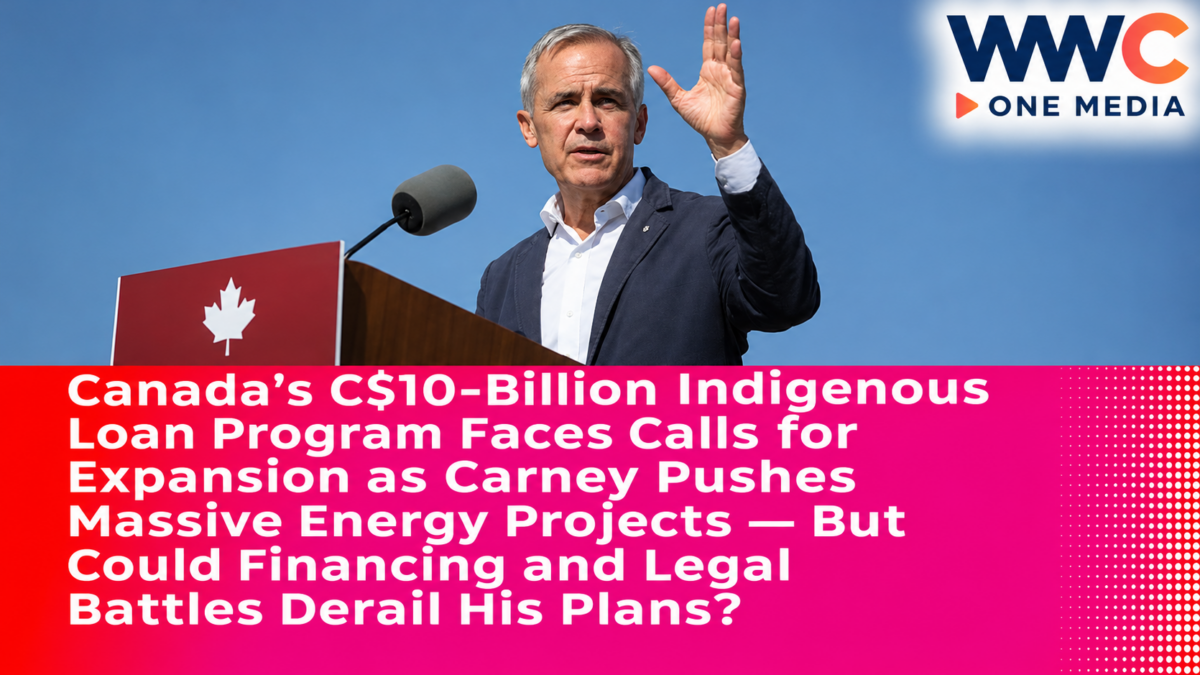
OTTAWA, CANADA / MANILA, PHILIPPINES — November 5, 2026 | WWC ONE MEDIA | Global Business, Infrastructure, Energy and Indigenous Economic Development
Canada’s business community is urging Prime Minister Mark Carney to expand a C$10-billion financing program designed to help Indigenous communities acquire ownership stakes in major infrastructure and energy projects, warning that the country’s ambitious investment plans could outgrow the financial support available.
The call comes as Ottawa accelerates plans for pipelines, electricity infrastructure, critical-mineral developments and other large-scale projects intended to strengthen Canada’s economy and reduce its dependence on the United States.
According to Bloomberg’s November 4 report, Canada Chamber Urges Boost to Carney’s Indigenous Loan Program, Canadian Chamber of Commerce President Candace Laing believes the size of the federal loan-guarantee program should better reflect the scale of energy projects being pursued.
The intervention highlights a growing financial challenge.
Canada wants Indigenous communities to become meaningful owners of major projects rather than receive only employment opportunities or negotiated benefits.
But buying an equity stake in a multibillion-dollar pipeline, power station or other infrastructure asset can require hundreds of millions of dollars in financing.
Carney has already doubled the federal Indigenous Loan Guarantee Program from C$5 billion to C$10 billion and broadened eligibility beyond energy and natural resources.
Now, Canada’s business community is arguing that further expansion could be necessary.
The debate is unfolding amid legal challenges involving First Nations, concerns about accelerated infrastructure approvals and questions about how governments should distribute financial risk.
The critical question is whether a larger loan-guarantee program can unlock a new era of Indigenous wealth creation—or whether Canada risks creating bigger financial obligations without resolving the deeper disputes surrounding land, consultation and development.
Canadian Chamber of Commerce Calls for Bigger Indigenous Financing Program
Candace Laing, president of the Canadian Chamber of Commerce, is pressing Ottawa to reconsider the scale of its Indigenous loan-guarantee initiative.
Bloomberg reported that Laing wants the program strengthened to match the size of Canada’s expanding energy-development ambitions.
The Chamber represents a business community interested in improving investment conditions, accelerating major projects and building more reliable infrastructure.
For companies pursuing projects that cross or affect Indigenous territories, meaningful relationships with First Nations, Inuit and Métis communities can be essential.
Those relationships may include consultation, environmental protections, employment, revenue-sharing arrangements and equity ownership.
A loan guarantee addresses one part of the challenge: access to financing.
But it does not automatically provide a community with the capital, technical information or legal certainty needed to make an investment decision.
Nor does it establish consent to a particular project.
The Chamber’s request adds pressure on the federal government to determine whether the existing C$10-billion program is sufficient for the next wave of Canadian infrastructure investment.
A precise new funding target from Laing was not independently confirmed in the sources reviewed.
What Is Canada’s C$10-Billion Indigenous Loan Guarantee Program?
The Indigenous Loan Guarantee Program is a federal initiative intended to help Indigenous groups purchase equity interests in major commercial projects.
It is administered by the Canada Indigenous Loan Guarantee Corporation, a subsidiary of the federally owned Canada Development Investment Corporation.
The program began with a C$5-billion commitment before being expanded to C$10 billion in March 2025.
It can provide guarantees ranging from C$20 million to C$1 billion for eligible transactions.
The program supports investments in sectors including energy, natural resources, transportation, trade and infrastructure.
Its principal purpose is to reduce financial barriers that can make it difficult for Indigenous communities to participate as owners.
Historically, many communities have faced higher borrowing costs and limited access to conventional forms of collateral.
Those difficulties can prevent participation in major investments even when a community is interested and the underlying project has commercial potential.
A federal guarantee can make lenders more willing to provide financing on favorable terms.
But eligibility still depends on the program’s rules and the financial and commercial characteristics of a proposed transaction.
Why a Loan Guarantee Is Different From a Government Grant
One of the most important distinctions concerns how the program works.
A loan guarantee is not the same as the federal government giving away C$10 billion in cash.
Instead, the government agrees to back eligible borrowing obligations under specified conditions.
The participating Indigenous entity still borrows money and remains responsible for repaying its loan.
The guarantee can help reduce the cost of borrowing because a lender receives additional protection against qualifying credit losses.
For a long-lived infrastructure asset, even a relatively modest reduction in interest rates can generate substantial savings.
However, guarantees also expose the government to contingent liabilities.
If a borrower defaults and the applicable guarantee conditions are met, public funds may be required to satisfy the government’s obligations.
That makes project selection, financial analysis and risk management essential.
The C$10-billion program ceiling describes guarantee capacity, not an amount already paid out or lost by taxpayers.
Canada’s First Major Loan Guarantee Helped Finance a Gas Pipeline Stake
One example of the program’s potential came from a transaction involving Enbridge’s Westcoast natural gas pipeline system.
In 2025, a partnership representing 38 First Nations in British Columbia arranged to acquire a 12.5% interest in the system.
The investment was supported by a C$400-million federal loan guarantee.
According to the federal program administrator, the transaction involved an investment valued at approximately C$736 million.
The arrangement provided participating communities with an ownership interest in an operating energy infrastructure business.
Ownership can create opportunities to receive distributions from an asset’s operations.
It can also provide a more direct role in business decisions, depending on the relevant agreements.
However, returns are not guaranteed.
Infrastructure investments can be affected by operating costs, financing terms, regulatory decisions and changes in demand.
The Westcoast transaction demonstrates how loan guarantees can support substantial Indigenous investments while also illustrating why financial due diligence is necessary.
Nuclear Energy Deal Shows the Program Is Expanding Beyond Pipelines
The federal government announced another significant transaction on June 23, 2026.
Seven First Nations participating in the Williams Treaties First Nations partnership are being supported in acquiring a significant minority interest in Ontario’s Darlington New Nuclear Project.
The transaction involves approximately C$715 million in financing backed jointly by federal and provincial loan-guarantee programs.
The federal Indigenous Loan Guarantee Program provides half the guarantee support, while Ontario’s Indigenous Opportunities Financing Program provides the other half.
The arrangement is intended to facilitate Indigenous participation in a major nuclear energy development.
Darlington’s expansion includes small modular reactor technology, which Canada views as a potential source of reliable low-carbon electricity.
For the participating communities, the investment could provide long-term revenue opportunities.
But the project’s future financial performance will depend on construction, operating expenses, electricity demand and financing costs.
The transaction demonstrates that Indigenous equity ownership is expanding into increasingly complex and capital-intensive sectors.
It also shows why business leaders may believe the current loan-guarantee ceiling will face pressure as additional major projects seek financing.
Carney’s C$1-Trillion Investment Ambition Raises the Stakes
The loan-guarantee debate is part of Carney’s much broader economic strategy.
His government wants to attract C$1 trillion in investment over five years through infrastructure construction, energy development, industrial expansion and stronger international trade relationships.
The strategy includes pipelines, critical minerals, transportation systems, electricity infrastructure and advanced manufacturing.
WWC ONE MEDIA previously examined the ambitious plan in Canada Is Borrowing From the Emerging-Market Playbook — And Its $1 Trillion Investment Bet Is Getting Serious.
The report explored how Ottawa is using tax incentives, infrastructure policy and investment promotion to reshape Canada’s economic model.
However, the C$1-trillion figure is a government investment ambition, not money already spent or secured.
Turning that target into operating projects will require private capital, permits, engineering, skilled workers and agreements with affected communities.
Indigenous participation could become a major part of that development model.
But the financial scale of the proposed investments raises questions about whether existing support programs are large and flexible enough.
Carney Announces More Measures to Expand Indigenous Economic Participation
On October 26, Carney convened First Nations leaders and provincial and territorial premiers to discuss economic development and the future of federal-Indigenous relations.
The government announced plans to amend the First Nations Fiscal Management Act to expand the First Nations Finance Authority’s lending powers.
The proposed change would allow eligible Indigenous-owned special-purpose vehicles to access financing through the authority.
These vehicles can be useful when several communities want to participate collectively in a large project.
The government also committed C$260 million over four years to establish a Partnerships for Indigenous Workforce Readiness Fund.
The initiative is intended to connect Indigenous workers with employment opportunities created by major infrastructure projects.
Ottawa is also exploring a potential First Nations Sovereign Wealth Fund.
That proposed fund would aim to give communities a longer-term stake in wealth generated by major developments.
However, the wealth fund has not yet been finalized, and its structure and capitalization remain to be determined.
These measures form part of the government’s broader approach to economic reconciliation.
They do not replace the separate Indigenous Loan Guarantee Program.
Canada Wants Indigenous Communities to Become Owners, Not Just Stakeholders
Historically, major energy and resource developments have often proceeded through arrangements in which Indigenous communities received employment opportunities, compensation or other negotiated benefits.
Equity ownership can create a different economic relationship.
An ownership stake may allow a community to participate in financial returns over an asset’s operating life.
It may also provide governance rights, depending on the ownership structure.
Those benefits can potentially support housing, infrastructure, education, healthcare and other community priorities.
But owning an asset also introduces financial responsibilities.
Borrowing to purchase equity creates repayment obligations.
A project’s value can decline.
Operating revenue may fall below expectations.
And ownership does not necessarily provide control over every operating decision.
For Indigenous communities, the quality of the investment is therefore as important as the availability of financing.
A larger government-guarantee program could increase opportunities, but it must also preserve communities’ freedom to accept or reject particular investments.
A C$43-Billion Pipeline Dispute Exposes the Limits of Financing Incentives
Canada’s proposed Pacific Link oil pipeline provides a major example of the competing pressures surrounding infrastructure development.
The project is intended to transport approximately one million barrels of crude oil per day from Alberta toward British Columbia’s Pacific coast.
Government estimates and reporting suggest that it could cost between C$35.2 billion and C$42.7 billion.
But the proposal is facing legal challenges from First Nations concerned about consultation and environmental impacts.
WWC ONE MEDIA examined the dispute in Carney’s $43-Billion Oil Pipeline Faces Eight Legal Challenges From B.C. First Nations — But Could Indigenous Rights Derail Canada’s Energy Superpower Plan?.
The report detailed court applications seeking review of Ottawa’s decision to designate the project as a national-interest development.
The government has proposed an Indigenous ownership opportunity in the pipeline, supported by financing arrangements.
But some affected communities argue that the consultation process has been insufficient.
The dispute demonstrates an essential principle: an equity-financing opportunity cannot substitute for meaningful consultation or compliance with Indigenous rights.
Even a more generous loan-guarantee program would not automatically resolve the lawsuits.
Indigenous Leaders Warn Economic Participation Must Respect Rights
Not all Indigenous leaders agree that Carney’s infrastructure strategy adequately addresses reconciliation.
Wilton Littlechild, a former co-chair of Canada’s Truth and Reconciliation Commission, has criticized approaches that emphasize economic participation without equally prioritizing recognition of Indigenous rights.
Other Indigenous policy experts have raised concerns that financial incentives could create pressure to support projects before communities receive sufficient information about their potential impacts.
The concerns reflect a distinction between the opportunity to invest and the right to make informed decisions.
A community might welcome ownership in one project while opposing another.
Different First Nations may also have different priorities, environmental concerns and economic objectives.
The federal government argues that expanded financing and new revenue-sharing mechanisms can support greater self-determination.
Critics respond that economic benefits must be developed alongside, rather than instead of, meaningful protection of rights.
Both the financing structure and the underlying project-approval process will therefore be important in determining whether Ottawa’s strategy succeeds.
Why Business Leaders Want Indigenous Investment to Accelerate
For companies developing major projects, Indigenous equity participation can potentially strengthen long-term partnerships.
A community that chooses to invest may gain an ongoing economic interest in the success of an asset.
That can create opportunities for cooperation over employment, procurement, environmental management and operations.
But commercial partnerships require sufficient financing and clear contractual arrangements.
Large projects may involve multiple Indigenous communities, each with distinct decision-making processes and priorities.
Developing an investment consortium can take time and require extensive legal and financial work.
The Canadian Chamber of Commerce’s call for more loan-guarantee capacity reflects the growing financial scale of these opportunities.
Still, faster financing should not be confused with automatic project approval.
Business certainty depends on a combination of adequate capital, consultation, regulatory compliance and credible commercial arrangements.
The Financial Risks of Expanding Government Guarantees
Increasing the federal loan-guarantee ceiling could allow more Indigenous groups to participate in larger projects.
But expansion would also increase the amount of potential government exposure.
A guarantee may never result in a cash payment if the borrower meets its obligations.
However, a default could require the government to honor its contractual commitments.
The size of that risk depends on the underlying loans, assets, guarantees and recovery arrangements.
Energy and infrastructure projects can face substantial uncertainty.
Construction costs may exceed forecasts.
Commodity prices can change.
Operating expenses can rise.
And regulatory or legal proceedings can affect project schedules.
That makes independent financial analysis essential.
A larger guarantee program should be accompanied by transparent eligibility criteria, appropriate risk assessment and clear information for participating communities.
The program’s success should ultimately be judged by sustainable financial benefits, not simply the total value of guarantees announced.
Canada Is Seeking New Customers Beyond the United States
The loan-guarantee debate is also connected to Canada’s efforts to diversify trade.
Tariff disputes with Washington have encouraged Ottawa to seek additional markets and investment partnerships.
Carney has promoted closer economic cooperation with Europe and stronger access to Asian markets.
WWC ONE MEDIA explored those efforts in Canada and EU Push Historic New Alliance as Carney and Macron Challenge US Dominance — But Could Europe’s Internal Divisions Derail the Deal?.
The report examined opportunities involving energy security, infrastructure, critical minerals and industrial development.
Many of the assets required to serve those markets would involve substantial investment within Canada.
Some could affect Indigenous territories or create opportunities for Indigenous ownership.
That makes the financing program relevant not only to reconciliation policy but also to Canada’s broader economic competitiveness.
Trump’s Tariffs Add Pressure to Canada’s Infrastructure Strategy
Canada’s economic relationship with the United States remains enormous.
North American factories, transportation systems and energy markets have developed around decades of cross-border trade.
Changes to tariffs can affect investment decisions and supply chains.
WWC ONE MEDIA examined those vulnerabilities in The Great Lakes Built a $376 Billion Trade Lifeline — Trump’s Tariffs Are Now Putting It Under Pressure.
The report described the economic importance of cross-border industrial transportation and the risks created by unpredictable trade barriers.
Carney’s infrastructure strategy aims partly to provide more options for Canadian businesses.
Expanded pipelines, ports, electricity systems and trade corridors could make it easier to reach additional markets.
But those benefits depend on projects being financed and completed.
Loan guarantees could help Indigenous investors participate in that development, although they do not directly eliminate tariffs or guarantee new export contracts.
What This Means for the Philippines and Asian Investors
Canada’s investment strategy could eventually have implications for Asian commodity and infrastructure markets.
Canadian energy, minerals and other natural resources are relevant to countries seeking diversified supplies.
New infrastructure could influence how those commodities reach international customers.
Carney also announced on November 4 that he plans to visit the Philippines, among other destinations, during a November 11–19 international trip.
The visit is part of Canada’s efforts to strengthen trade and investment partnerships.
However, no verified announcement connects that trip to a specific new Philippine investment under the Indigenous Loan Guarantee Program.
For Philippine policymakers and businesses, the broader lesson concerns how governments can use financial guarantees to improve access to infrastructure investment.
Such tools may help mobilize capital, but they also require oversight and careful management of public financial risk.
Canada’s experience illustrates that financing, community participation and project approvals must work together.
What Happens Next to Canada’s C$10-Billion Program?
The immediate policy question is whether Ottawa will propose an additional expansion of the federal guarantee ceiling.
The Canadian Chamber of Commerce is advocating a larger program.
But the amount of any additional capacity and the timing of a decision have not been independently established.
The government will also need to continue implementing existing changes.
These include the expanded sector eligibility and proposed amendments allowing eligible Indigenous-owned investment vehicles to access First Nations Finance Authority lending.
Officials will need to assess demand for guarantees and the financial characteristics of potential transactions.
Meanwhile, First Nations and other Indigenous groups will evaluate proposed investments according to their own priorities.
Future budget announcements could provide additional details, but there is no basis to describe a further increase as already approved.
The Bigger Question: Can Canada Build an Energy Superpower That Indigenous Communities Actually Own?
Canada’s C$10-billion Indigenous Loan Guarantee Program represents an important change in how governments support participation in major infrastructure investments.
It is designed to help communities overcome financing barriers and become owners of assets that may generate revenue for decades.
Transactions involving the Westcoast pipeline system and the Darlington nuclear project show that the approach can support substantial investments.
But Carney’s broader development strategy is much larger.
His government is targeting C$1 trillion in investment while pursuing major energy, transportation and industrial projects.
That ambition has prompted business leaders to question whether the current guarantee program is large enough.
At the same time, legal disputes and concerns about Indigenous rights demonstrate why financing cannot be the only measure of progress.
The ultimate goal is not simply to increase the number of projects involving Indigenous investors.
It is to create opportunities for communities to make informed decisions, retain meaningful control over their participation and build lasting economic benefits.
As Canada’s business leaders call for more than the existing C$10 billion in Indigenous loan-guarantee capacity, one question could shape Carney’s entire investment strategy: Will expanded financing give First Nations a stronger stake in Canada’s economic future—or could rushed development, mounting financial risks and unresolved rights disputes undermine the promise of Indigenous ownership?