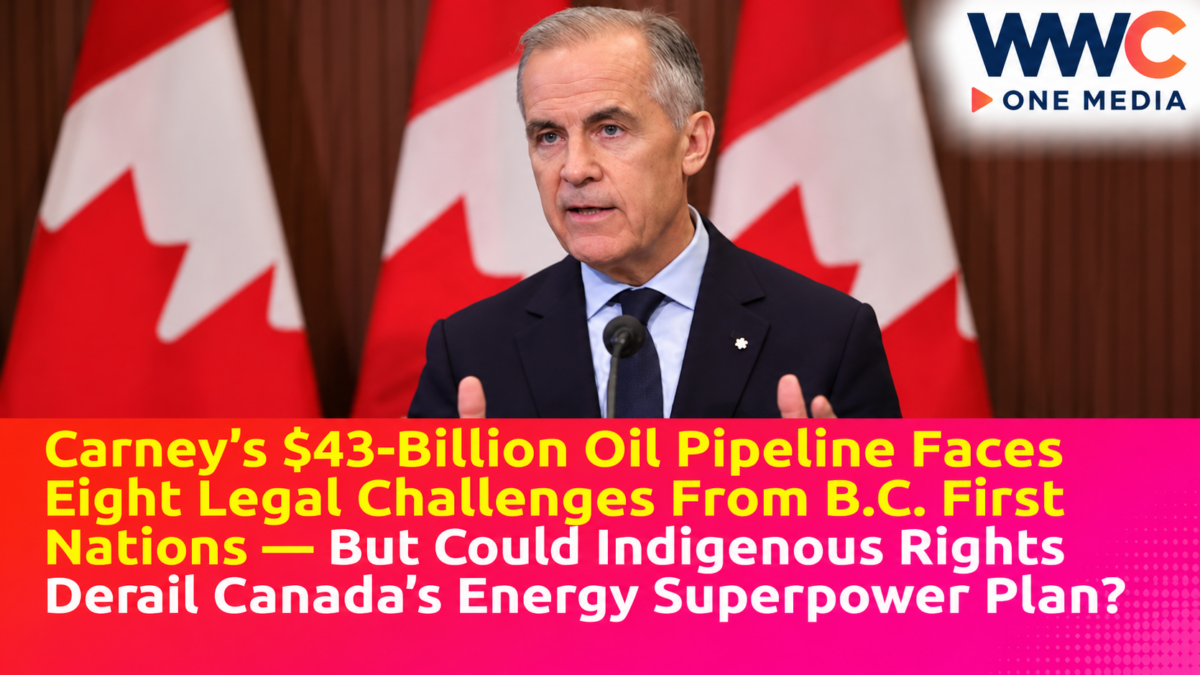
OTTAWA / VANCOUVER / MANILA — November 3, 2026. Canadian Prime Minister Mark Carney’s ambitious plan to build a new oil pipeline from Alberta to the Pacific Ocean is facing a growing legal rebellion, as Indigenous communities challenge his government’s decision to accelerate approval of one of Canada’s most controversial energy infrastructure projects.
Eight Federal Court applications involving nine First Nations in British Columbia are seeking to overturn Ottawa’s decision to classify the proposed Pacific Link pipeline as a project of national interest.
The classification, announced on October 1, allows the federal government to streamline the project’s regulatory process under the Building Canada Act.
Carney wants the pipeline to transport approximately one million barrels of oil per day from Alberta to British Columbia’s Pacific coast, opening additional export routes to Asian markets and reducing Canada’s heavy dependence on the United States.
But Indigenous leaders argue that Ottawa moved too quickly, failed to provide sufficient project information and did not meaningfully consult communities whose traditional territories, fisheries and cultural resources could be affected.
The project could cost between C$35.2 billion and C$42.7 billion, according to estimates reported by The Canadian Press.
Its route would largely follow the existing Trans Mountain pipeline corridor toward the Vancouver region.
The federal government maintains that the project will bring economic opportunities, strengthen Canada’s energy security and include Indigenous communities as investment partners.
However, the growing legal challenges are raising questions about whether Carney’s fast-track strategy can comply with the government’s constitutional obligations.
As Canada races to build a new Pacific oil-export corridor, will the government secure the Indigenous partnerships required to move forward — or could the courts force Ottawa to reconsider its entire approach?
Nine First Nations Challenge the Pacific Link Pipeline
The legal opposition intensified on November 2 when First Nations in British Columbia announced a series of Federal Court applications challenging Ottawa’s national-interest designation.
The Canadian Press reported eight separate applications involving nine First Nations.
They include the Tsartlip, Cheam, Boston Bar, Lower Nicola, Kwantlen and Kwikwetlem First Nations, along with the Skeetchestn Indian Band.
The St’at’imc Nation and T’Sou-ke First Nation filed a joint application.
The communities are situated along or near potential pipeline and marine transportation routes, or rely on waterways that could be affected by the project.
Several applicants argue that the government’s consultations were insufficient to understand potential effects on their constitutionally protected rights.
The legal actions seek judicial review of the designation decision.
They do not constitute a final judgment that the government’s actions were unlawful.
The courts will need to consider the evidence and legal arguments before determining whether the designation should stand.
Tsartlip First Nation Calls the Process Rushed
Tsartlip First Nation, located on Vancouver Island, filed an application asserting that Ottawa had failed to provide adequate information about the pipeline’s potential impacts.
Adam Olsen, a spokesperson for Tsartlip and former British Columbia legislator, criticized the decision-making process.
He argued that the consultation period was too short for communities to understand the environmental, economic and cultural consequences of a major oil-export development.
According to The Canadian Press, Olsen said the government had not properly fulfilled its consultation obligations.
Tsartlip is concerned about the waters surrounding Vancouver Island, including fishing areas and marine ecosystems.
An increase in tanker traffic could create additional risks associated with vessel accidents, oil spills and disruptions to marine habitats.
However, those risks require project-specific assessment.
The existence of potential environmental impacts does not mean a spill has occurred or that every proposed mitigation measure will fail.
The First Nation’s immediate legal challenge concerns the process by which the national-interest designation was made.
Cheam First Nation Says Ottawa Withheld Critical Information
Cheam First Nation filed a separate application asking the Federal Court to set aside the October 1 decision.
Reuters reported that Cheam alleges the federal government did not provide enough information for the community to assess how the proposed pipeline could affect its rights.
The First Nation also argues that consultations were constitutionally inadequate.
The case raises an important distinction between consultation and consent.
Canada’s constitutional framework requires meaningful consultation with Indigenous rights holders when government action may adversely affect Aboriginal or treaty rights.
The precise scope of that duty depends on the circumstances.
It does not automatically mean every project requires unanimous agreement from every affected group.
However, consultation must be meaningful and cannot simply be treated as a procedural formality.
A court reviewing Cheam’s application could examine what information the government supplied, when consultation occurred and whether affected rights were adequately considered before the designation.
Fraser River Salmon Become a Central Environmental Concern
For several First Nations, the legal battle is about more than the pipeline’s construction.
It is also about protecting the Fraser River and its salmon populations.
The St’at’imc Chiefs Council, representing 11 communities along the Lillooet and Fraser rivers, has challenged the federal government’s designation.
The council argues that the project could threaten fishing rights and cultural practices tied to salmon.
According to The Canadian Press, the proposed project could involve more than 500 river crossings, including two additional crossings in the Fraser River area.
Indigenous leaders say an oil spill or construction-related disturbance could have serious consequences for fish habitats and local communities.
The Fraser River is one of British Columbia’s most important salmon systems.
Its fisheries support Indigenous traditions, local economies and ecological networks.
The government and project developers will need to evaluate potential effects on waterways, fish populations and emergency-response capacity.
The final route and engineering details remain important because they will influence the actual level and location of environmental risk.
What Is the Pacific Link Pipeline?
Pacific Link is a proposed crude-oil transportation project connecting Alberta’s oil-producing region with an export terminal on British Columbia’s Pacific coast.
The pipeline is expected to have a capacity of approximately one million barrels per day.
The proposed route would largely follow the existing Trans Mountain corridor.
Development is being led by the federally owned Trans Mountain Corporation, with participation from Pembina Pipeline Corporation.
Ottawa and Alberta have also agreed to share ownership of the project.
The government has outlined an opportunity for Indigenous communities to acquire a minimum 10% ownership interest, supported by loan-guarantee arrangements.
The project aims to increase Canada’s access to overseas markets, particularly in Asia.
But major details remain under development.
These include the final route, construction arrangements, financing structure, environmental protections and agreements with prospective oil shippers.
The reported cost range is an estimate, not a final amount already approved or spent.
Why Carney Wants a New Pipeline to the Pacific
Canada is one of the world’s major crude-oil producers.
However, much of its oil-export infrastructure has historically been oriented toward the United States.
This dependence has become politically sensitive amid trade disputes with Washington.
Carney wants Canadian exporters to have more options.
A new Pacific pipeline could allow producers to send larger volumes directly to Asian buyers, potentially reducing dependence on a single export destination.
That strategy is part of a broader economic diversification agenda.
WWC ONE MEDIA previously examined the initiative in Canada Is Borrowing From the Emerging-Market Playbook — And Its $1 Trillion Investment Bet Is Getting Serious.
The report explored Carney’s goal of attracting C$1 trillion in investment over five years through infrastructure development, industrial policies and expanded international trade.
Pacific Link fits into that strategy.
But the government’s ambitious investment target is not money already invested.
Likewise, the economic benefits of Pacific Link will depend on construction costs, financing, demand for Canadian crude and future commodity prices.
Trump’s Tariffs Strengthen Canada’s Case for Diversification
Canada’s relationship with the United States provides much of the economic context for the project.
The two countries have deeply integrated energy, manufacturing and transportation systems.
But trade tensions have increased uncertainty for Canadian businesses.
The Trump administration’s tariffs have encouraged Ottawa to look for additional markets.
WWC ONE MEDIA previously examined the consequences in The Great Lakes Built a $376 Billion Trade Lifeline — Trump’s Tariffs Are Now Putting It Under Pressure.
The article highlighted the importance of Canadian-American trade and the difficulty of reorganizing supply chains built over many decades.
For oil producers, improved access to the Pacific coast could create more flexibility in choosing customers.
However, diversifying exports does not mean abandoning the American market.
The United States remains Canada’s dominant crude-oil customer.
A new pipeline would provide an additional route, not eliminate the economic importance of existing cross-border connections.
Carney Uses the Building Canada Act to Accelerate Development
On October 1, Carney designated Pacific Link a project of national interest under the Building Canada Act.
The law was introduced to accelerate major infrastructure projects deemed important to the country’s economic resilience, security and competitiveness.
The designation gives Pacific Link access to a streamlined federal review process.
The government has set a goal of completing that process by September 1, 2027, with construction potentially beginning later that month.
But the designation does not mean construction has begun.
Nor does it remove all legal obligations.
The project must still satisfy applicable conditions, including those relating to environmental protection and Indigenous consultation.
The legal challenges now focus on whether Ottawa complied with those obligations before granting the designation.
If a court sets aside the decision, the government could face delays or be required to conduct additional consultation.
The outcome is not yet known.
Indigenous Leaders Say Consultation Was Too Short
A central dispute concerns how much time communities received to assess the proposal.
The Canadian Press reported that the government’s initial consultation period was approximately one month.
It was subsequently extended to roughly two months following concerns from Indigenous leaders.
The federal government says its Major Projects Office engaged extensively with affected communities.
Its October 1 announcement referred to consultations involving more than 130 Indigenous communities near or along potential routes.
A government consultation summary also described numerous meetings and written submissions.
But the number of meetings alone does not establish that consultation was legally sufficient.
Some First Nations say they were asked to evaluate the national-interest designation without complete route, engineering, environmental and marine-shipping information.
Government officials argue that additional consultation and technical assessment can take place as the project develops.
The courts may now be asked to determine whether that approach satisfies the applicable legal requirements.
Ottawa Offers Indigenous Communities a Minimum 10% Ownership Stake
The federal and Alberta governments have proposed allowing Indigenous communities to hold at least a 10% ownership interest in Pacific Link.
The stake would be supported through loan-guarantee programs.
Supporters argue that Indigenous equity participation could create long-term financial benefits, employment opportunities and greater involvement in major energy infrastructure.
Some Indigenous communities elsewhere in Canada have participated successfully in energy projects through ownership agreements.
But financial participation does not automatically resolve questions about environmental impacts or constitutional rights.
Communities may hold different positions regarding a proposed project.
Some may favor the economic benefits.
Others may oppose the route or believe the risks to their territories are unacceptable.
The proposed ownership arrangement remains part of the government’s strategy, not proof that every affected First Nation has consented.
A Separate Alberta Legal Challenge Adds to the Pressure
The British Columbia lawsuits are not the only legal challenges.
Cold Lake First Nations in Alberta filed an earlier application seeking judicial review of the national-interest designation.
Bloomberg reported on that challenge in October.
The community alleges that Ottawa failed to meet its constitutional obligation to consult before advancing the pipeline.
Its concerns include the potential impacts on traditional territory and the relationship between the pipeline and other energy developments.
The Alberta case is distinct from the eight applications reported in British Columbia.
Together, they suggest the dispute is expanding across multiple parts of the proposed energy corridor.
However, the existence of multiple applications does not mean a court has decided in favor of the challengers.
Their claims remain subject to judicial review.
British Columbia Faces Greater Tanker Traffic
Pacific Link is expected to increase Canada’s capacity to ship crude oil from the Pacific coast.
That could provide new opportunities for exporters.
But it would also increase the volume of oil moving through marine transportation corridors.
The Salish Sea and nearby waters support fisheries, marine mammals, coastal communities and commercial shipping.
First Nations and environmental groups have raised concerns about the implications of additional tanker traffic.
Potential issues include spill response, vessel movements, habitat disruption and cumulative environmental impacts.
Carney’s government has pledged additional marine protections and says the proposed southern route will avoid sensitive areas along British Columbia’s northern coast.
Nevertheless, the marine transportation component remains an important part of the project assessment.
The question is not merely whether an oil pipeline can be engineered safely.
It is whether the full system, including terminals and tankers, can operate while protecting affected communities and ecosystems.
Trans Mountain Shows Both the Opportunity and the Risk
Canada already has a major west-coast crude-oil pipeline.
The expanded Trans Mountain system began operating in 2024, increasing capacity to approximately 890,000 barrels per day.
It provides an important route for exporting Canadian oil to the Pacific.
However, the expansion experienced substantial cost increases, delays and legal controversies.
Those experiences are relevant to Pacific Link because major pipeline projects can encounter unexpected engineering, environmental, financing and consultation challenges.
The proposed project is not identical to Trans Mountain.
Its route and technical design remain under development.
Nevertheless, previous infrastructure experience demonstrates why early cost estimates and proposed schedules should be treated cautiously.
For Ottawa, the challenge is avoiding the delays it seeks to overcome without weakening legally required scrutiny.
Could the Courts Delay Construction Beyond 2027?
Carney’s government wants to finish the regulatory process by September 1, 2027.
But the lawsuits introduce uncertainty.
A court could reject the applications, allowing the designation to remain in place.
Alternatively, it could find that additional consultation or a reconsideration of the designation is necessary.
The timing would depend on court proceedings, evidence and potential appeals.
Legal challenges do not automatically suspend a project unless a court issues an applicable order.
But unresolved litigation can make financing, construction planning and contractual commitments more difficult.
Investors may hesitate to commit capital when regulatory and legal conditions remain uncertain.
As a result, the court proceedings could become important to the project’s commercial feasibility even before a final judgment is issued.
Canada Is Also Seeking New Partners in Europe and Asia
Pacific Link forms part of Canada’s broader effort to strengthen international economic relationships.
Beyond energy exports to Asia, Carney is pursuing closer commercial and strategic cooperation with Europe.
WWC ONE MEDIA recently covered those efforts in Canada and EU Push Historic New Alliance as Carney and Macron Challenge US Dominance — But Could Europe’s Internal Divisions Derail the Deal?.
The report described Canada’s efforts to diversify trade, investment, energy and industrial partnerships.
A pipeline to the Pacific would serve a different export market from the proposed European initiatives.
But the underlying economic objective is similar.
Canada wants greater freedom to sell its resources and products outside the United States.
That strategy could strengthen economic resilience.
However, building physical infrastructure involves legal, environmental and financial challenges that cannot be solved through diplomacy alone.
What This Means for Asian Energy Markets
Asian economies are major consumers of imported crude oil.
Countries including China, Japan, South Korea and India purchase energy from international suppliers.
An additional Canadian Pacific export route could eventually create another source of crude oil for some Asian refiners.
But the pipeline has not yet been constructed.
Its projected capacity should not be treated as additional barrels already available to the market.
Nor can a specific future reduction in Asian oil prices be predicted from the proposal.
Future market effects would depend on production levels, transport costs, global crude prices and refinery demand.
For the Philippines, any impact would be indirect.
The proposed Canadian project does not establish a specific new crude supply agreement with Philippine companies.
Its significance lies in the broader possibility of more diversified international energy supply routes.
Indigenous Rights and Economic Development Are Not Necessarily Opposites
The dispute is often framed as a conflict between economic growth and environmental protection.
But the legal challenge also concerns who participates in decisions affecting land, resources and traditional livelihoods.
Some First Nations support infrastructure development when projects include meaningful consultation, fair economic participation and credible environmental protections.
Others oppose particular projects because of unacceptable risks or unresolved rights concerns.
It would be inaccurate to describe all Indigenous communities as holding a single position.
Likewise, the federal government’s promise of economic benefits does not eliminate its legal obligations.
The practical challenge is creating a decision-making process that can accommodate development while respecting constitutionally protected Indigenous rights.
The outcome of Pacific Link’s legal challenges may influence how future national-interest projects are reviewed.
What Happens Next?
The immediate focus will be the Federal Court proceedings.
The applicants are asking judges to review the government’s October 1 decision and determine whether it complied with required consultation duties.
Ottawa may argue that its engagement was sufficient for the designation stage and that further consultation will occur during the subsequent regulatory process.
The First Nations challenging the decision contend that important considerations were addressed too late or without adequate information.
Meanwhile, project developers must continue assessing engineering, route selection, financing and environmental safeguards.
The government remains committed to its proposed 2027 regulatory timetable.
But that target will depend on the outcomes of legal proceedings and the progress of project planning.
There is currently no verified final court decision canceling Pacific Link.
There is also no basis to describe construction as already underway.
The Bigger Question: Can Carney Build an Energy Superpower Without a Legal Showdown?
Pacific Link represents one of Mark Carney’s biggest infrastructure ambitions.
The project promises to move approximately one million barrels of oil per day toward Asian markets and reduce Canada’s dependence on US buyers.
Its estimated cost could approach C$43 billion.
The government believes the pipeline could support jobs, investment and economic sovereignty.
But Indigenous communities are asking whether the project has been advanced at the expense of their constitutional rights.
Eight British Columbia court applications involving nine First Nations, together with an earlier Alberta challenge, have turned the government’s accelerated approval strategy into a major legal test.
The courts have not yet determined whether Ottawa acted unlawfully.
But the lawsuits expose the difficulty of reconciling rapid infrastructure development with meaningful consultation and environmental protection.
As Carney attempts to fast-track Canada’s largest new Pacific oil-export proposal, will Ottawa find a lawful path that earns Indigenous trust and investor confidence — or could the legal backlash turn its energy superpower ambitions into years of delays, mounting costs and political confrontation?