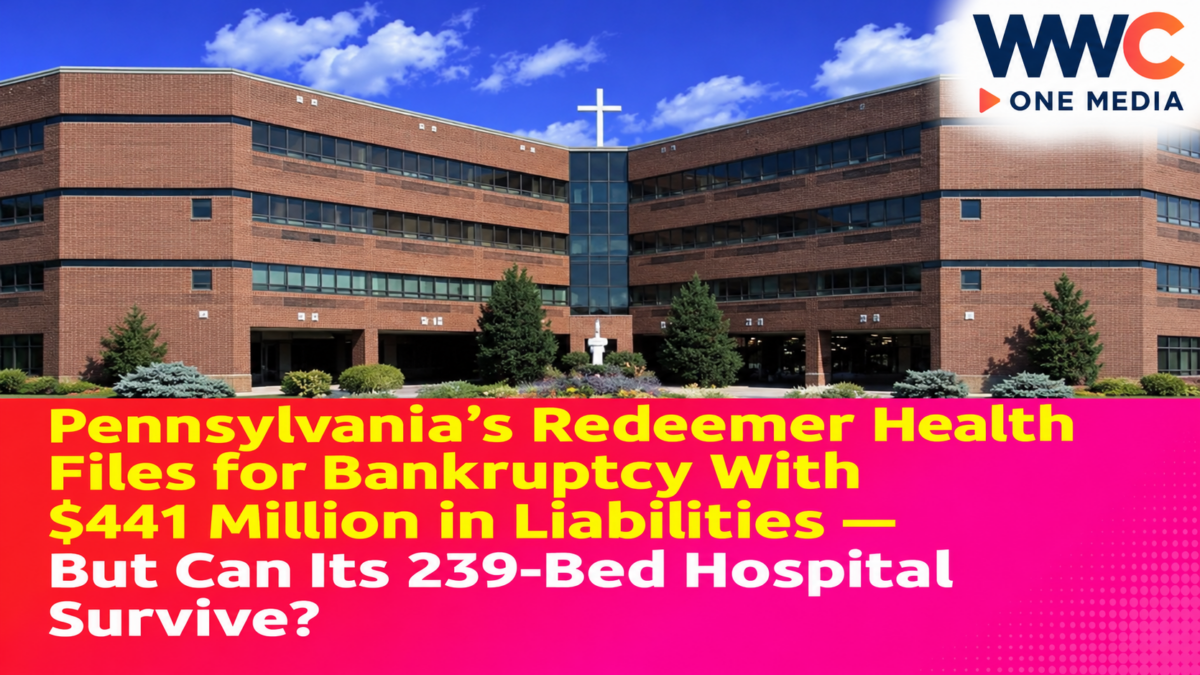
PHILADELPHIA, PENNSYLVANIA / MANILA — November 3, 2026. A Catholic healthcare system serving communities outside Philadelphia has filed for Chapter 11 bankruptcy protection after years of financial losses, missed debt payments and unsuccessful efforts to stabilize its operations.
Redeemer Health, which operates Holy Redeemer Hospital and a network of senior-care and community services, entered bankruptcy proceedings on November 1 in the US Bankruptcy Court for the Eastern District of Pennsylvania.
The filing was reported publicly on November 2.
According to Bloomberg, the hospital system sought protection from creditors as its financial troubles intensified.
Court reporting by Law360 indicates that the broader restructuring involves approximately $441 million in liabilities.
At the center of the crisis is Holy Redeemer Hospital, a 239-bed acute-care facility in Abington Township, Montgomery County.
The healthcare network also operates nursing facilities, residential care programs and social services.
The bankruptcy raises serious questions about the future of the hospital and the thousands of employees and patients who depend on the organization.
But Redeemer’s leadership insists that services will continue while restructuring proceeds.
As the healthcare system enters bankruptcy with hundreds of millions of dollars in liabilities, can it secure a buyer or restructuring agreement that preserves patient care — or will another Pennsylvania community face the loss of a hospital?
Redeemer Health Files for Chapter 11 Bankruptcy
Redeemer Health and 11 affiliated entities filed Chapter 11 petitions on November 1, according to bankruptcy docket records.
The cases are being handled in the Eastern District of Pennsylvania.
The affiliated filings include Holy Redeemer Health System, the entity associated with the organization’s principal hospital operations.
Chapter 11 allows an organization to continue operating while working through a court-supervised restructuring process.
For a healthcare provider, that can create an opportunity to negotiate with creditors, arrange financing, sell assets or pursue a reorganization plan.
However, bankruptcy protection does not automatically eliminate financial obligations.
Creditors retain legal rights, and important transactions may require court approval.
The filing also does not guarantee that the hospital will survive in its current form.
Redeemer must identify a financially viable path for its facilities and services.
That could involve restructuring existing operations, transferring assets or reaching agreements with other healthcare organizations.
Court Reporting Points to $441 Million in Liabilities
Law360 reported that Redeemer’s Chapter 11 cases involve approximately $441 million in liabilities.
Bloomberg’s initial report placed Holy Redeemer Health System’s estimated assets and liabilities within the broad $100 million to $500 million ranges disclosed in its bankruptcy petition.
These figures are not contradictory.
The bankruptcy petition’s ranges provide a broad estimate for a particular filing entity, while the larger liability figure comes from more detailed reporting on the broader proceedings.
They should not be added together.
The final amounts of allowed claims, recoverable assets and creditor distributions will depend on the bankruptcy process.
A company can have substantial assets and still become unable to meet financial obligations as they come due.
That distinction is particularly important for hospitals, which may own valuable properties and equipment but lack enough readily available cash to pay creditors.
Years of Operating Losses Push Redeemer Toward Bankruptcy
Redeemer’s difficulties did not emerge overnight.
The Philadelphia Inquirer reported that the healthcare system had recorded operating losses every year since 2017.
Its latest available financial report to bondholders showed a $29-million operating loss on approximately $332 million in revenue during the nine months ended March 31, 2026.
The hospital system also reported approximately $119 million in long-term debt at that date.
Earlier efforts to improve financial performance were insufficient to restore long-term stability.
Redeemer engaged healthcare consulting firm Kaufman Hall in 2024 to assist with financial turnaround planning.
But the organization’s financial pressures persisted.
The recurring losses demonstrate a central problem: generating hundreds of millions in annual revenue does not ensure profitability when operating costs exceed income.
Healthcare providers face substantial expenses for personnel, medical supplies, technology, buildings and regulatory compliance.
These costs can be difficult to reduce without affecting patient care.
Missed Bond Payments Trigger a Deeper Financial Crisis
The bankruptcy followed problems servicing Redeemer’s outstanding debt.
The healthcare system missed required payments due in September and October 2026 on tax-exempt municipal bonds.
In October, Redeemer disclosed that approximately $87 million in bond principal was outstanding.
Moody’s Ratings downgraded the organization’s credit rating from B1 to Caa3 after the missed payments.
The rating agency cited elevated financial and governance risks, including uncertainty surrounding Redeemer’s ability to address its default.
The Philadelphia Business Journal reported that the Chapter 11 filing followed a missed September 1 payment associated with $71 million in bond debt.
These figures describe different debt measures and reporting contexts.
They should not be interpreted as separate debts that can simply be added together.
The missed payments were an important warning that Redeemer’s financial position had become increasingly difficult to sustain.
Holy Redeemer Hospital Will Remain Open During Restructuring
For patients, the immediate question is whether medical services will continue.
Redeemer Health has said that its hospital and related facilities remain operational.
Interim chief executive Jim Logue told employees and patients that the restructuring does not mean the organization is immediately shutting down.
Patients have been encouraged to keep scheduled appointments.
The organization also intends to continue services across its broader network while it pursues a solution.
The bankruptcy therefore should not be described as the hospital having permanently closed.
However, the long-term ownership and structure of its acute-care operations remain uncertain.
The organization is exploring support from other health systems.
Any sale, partnership or restructuring agreement would require additional negotiation and potentially court and regulatory approvals.
No completed transaction had been announced as of November 3.
Approximately 3,500 Workers Face an Uncertain Future
Redeemer’s financial troubles are especially significant for its workforce.
The Philadelphia Inquirer reported that approximately 3,500 employees are connected to the healthcare system.
These include clinical staff and workers supporting its hospital, residential care and community-service operations.
The bankruptcy creates uncertainty about future employment.
However, the organization has not announced an immediate mass layoff affecting all those workers.
Redeemer’s court filings include requests concerning wages, employee benefits, insurance and cash management.
Such requests are common in healthcare bankruptcies because organizations need to continue paying workers and maintaining services while proceedings move forward.
A request for court authority does not mean every proposed arrangement has already received final approval.
For employees, the next significant developments will involve court orders, operational decisions and any agreements with potential buyers or partners.
Could Holy Redeemer Hospital Be Sold?
One possible solution involves transferring the hospital to another healthcare organization.
Law360 reported that the restructuring includes plans to sell the hospital while addressing other medical and senior-care divisions.
The Philadelphia Inquirer separately reported that Redeemer had been discussing potential arrangements with major health systems in the surrounding region.
Redeemer officials have expressed encouragement about the interest and support received.
But they have not announced a finalized buyer.
A sale could allow the hospital to continue serving patients under different ownership.
Alternatively, a restructuring could change the hospital’s services or organizational model.
Any proposed transaction would have to address financing, regulatory requirements and other conditions.
A court-supervised sale should not be confused with a completed takeover.
Until agreements are approved, the hospital’s long-term future remains unresolved.
Why Smaller Hospitals Struggle Against Larger Health Networks
Redeemer faces a difficult competitive environment.
Its hospital operates near other major healthcare providers, including Jefferson Health’s Abington Hospital.
Large hospital systems can have advantages that smaller organizations struggle to match.
These can include broader physician networks, centralized purchasing, more extensive insurance arrangements and greater access to financing.
A larger system may also spread administrative and technology expenses across multiple facilities.
Independent hospitals may find those costs harder to absorb.
However, size alone does not determine a hospital’s financial health.
Large healthcare organizations can also experience operating losses and debt pressures.
Redeemer’s experience demonstrates how competition, reimbursement rates and sustained financial losses can combine to threaten a longstanding community institution.
America’s Healthcare Boom Has a Financial Contradiction
Redeemer’s bankruptcy comes during a period when the wider US healthcare sector continues expanding.
Healthcare spending has grown substantially as medical technology advances, populations age and demand for services increases.
But rising expenditure does not necessarily translate into strong financial results for every hospital.
WWC ONE MEDIA examined this contradiction in America’s Healthcare Economy Is Booming — But Patients Are Paying the Price.
That report highlighted how the United States spent approximately $5.3 trillion on healthcare in 2024 while patients, insurers and employers continued facing rising costs.
Hospitals are part of this broader financial system.
They receive payments from private insurers, Medicare, Medicaid and patients.
But those payments do not always increase at the same pace as operating expenses.
For financially vulnerable hospitals, the difference can accumulate into recurring losses.
Redeemer’s bankruptcy illustrates the difficulty of providing essential services while maintaining enough income to cover costs and debt obligations.
Chapter 11 Does Not Automatically Mean a Hospital Closure
Bankruptcy can have very different outcomes depending on the organization.
Some companies use Chapter 11 to negotiate lower debt payments or sell assets while continuing operations.
Others cannot achieve a sustainable restructuring and eventually close.
The distinction is familiar in other industries.
WWC ONE MEDIA previously reported on Wendy’s Franchise Operator Behind 314 US Restaurants Files for Bankruptcy — What Happens to the Stores Next?.
That article explained how a large restaurant operator sought bankruptcy protection while intending to continue serving customers and paying employees.
The restaurant and hospital cases are not financially or operationally equivalent.
Hospitals have additional responsibilities involving patient safety, treatment continuity and healthcare regulation.
Nevertheless, the comparison illustrates an important legal principle.
Filing Chapter 11 does not automatically mean a business has stopped operating.
The outcome depends on whether a viable restructuring or sale can be achieved.
Previous Pennsylvania Hospital Bankruptcies Raise Concerns
Pennsylvania has experienced several significant healthcare failures.
Hahnemann University Hospital closed in 2019 following its operator’s financial collapse.
Crozer Health’s bankruptcy and hospital closures in 2025 also raised concerns about access to medical care in the Philadelphia region.
St. Christopher’s Hospital for Children survived earlier financial problems through a separate ownership arrangement.
These cases demonstrate that bankruptcy does not produce one inevitable result.
Some hospitals find new owners.
Others lose essential services or close permanently.
Redeemer’s situation is different in several respects.
It operates in a relatively competitive healthcare market with other hospitals nearby.
But the existence of alternative providers does not mean the closure of a community hospital would have no consequences.
Patients may face longer journeys or changes to established treatment relationships.
Employees could lose jobs.
Other hospitals may need to accommodate patients seeking care elsewhere.
Those risks make preserving continuity of care particularly important.
Catholic Healthcare and Community Services Are Also at Stake
Redeemer’s history extends beyond hospital treatment.
The Sisters of the Holy Redeemer established the institution in the 1950s.
Over time, the organization expanded into nursing facilities, retirement services and programs supporting vulnerable residents.
Its network includes facilities for older adults and community services such as low-income housing and food assistance.
These activities make the bankruptcy more complicated than a restructuring involving a single hospital building.
Different services may have different funding arrangements, regulatory obligations and financial performance.
A restructuring could preserve some operations while changing others.
Any proposed sale or partnership must account for the continuity of care and support provided to residents and community members.
For the organization’s leadership, that is both a financial and social responsibility.
The Philippine Healthcare Perspective
Although Redeemer’s financial problems are taking place in the United States, they offer lessons for healthcare systems elsewhere.
In the Philippines, policymakers continue debating funding for hospitals, public insurance and healthcare infrastructure.
WWC ONE MEDIA examined the issue in DOH Budget Faces Massive Cut in 2027 — Now Lawmakers Want Congress to Put Billions Back.
The article discussed concerns about proposed Philippine health-sector budget reductions and their potential effect on hospitals and PhilHealth.
The financing arrangements differ substantially from those in Pennsylvania.
But both situations show why healthcare providers need reliable funding and effective financial oversight.
Expanding access to medical services is important.
Maintaining the financial sustainability of the institutions delivering those services is equally essential.
Hospital Expansion Must Be Matched With Financial Sustainability
Private investment can increase hospital capacity and introduce new medical technology.
But the construction of new facilities does not eliminate financial risks.
WWC ONE MEDIA recently examined a proposed Philippine healthcare development in Ayala’s AC Health and US Hospital Giant Plan Pasig Medical Campus With 3,000 Potential Jobs.
The project aims to expand advanced healthcare services and create potential employment opportunities.
That development is unrelated to Redeemer’s bankruptcy.
However, it illustrates a broader issue facing healthcare investors.
Hospitals require substantial upfront investment, experienced personnel, suitable reimbursement arrangements and ongoing operating resources.
New facilities can create opportunities.
But long-term success also depends on whether revenues can sustain the cost of providing care.
What Happens Next in Redeemer Health’s Bankruptcy?
The immediate focus will be the court-supervised restructuring process.
Redeemer and its affiliated entities have filed initial motions concerning employee compensation, cash management, utilities and insurance.
The organization must also provide further financial information as required by the court.
Creditors will have opportunities to assert their claims and participate in proceedings.
Any proposed sale of the hospital or restructuring agreement will require careful review.
Patients and employees will be watching for decisions affecting operations.
Potential healthcare partners may also evaluate whether they can preserve services under a financially sustainable arrangement.
The court process will determine how competing financial claims and operational needs are addressed.
For now, the hospital remains open.
The filing represents the beginning of a restructuring process, not its conclusion.
The Bigger Question: Can Redeemer Health Survive Bankruptcy?
Redeemer Health’s Chapter 11 filing marks a critical moment for a healthcare institution that has served Pennsylvania communities for decades.
The system faces approximately $441 million in reported liabilities, years of operating losses and debt-payment problems.
Its 239-bed hospital remains operational, and management says patients should continue using scheduled services.
But the organization’s long-term financial structure is uncertain.
A sale or partnership could preserve important healthcare services.
A successful restructuring might allow the system to continue under revised financial arrangements.
However, neither outcome is guaranteed.
The bankruptcy will test whether Redeemer can secure sufficient financial support while maintaining the services on which its patients, residents and employees depend.
As Redeemer Health enters Chapter 11 with hundreds of millions of dollars in liabilities, will another healthcare organization step in to save Holy Redeemer Hospital — or could years of financial losses ultimately force the disappearance of a longstanding Pennsylvania medical institution?