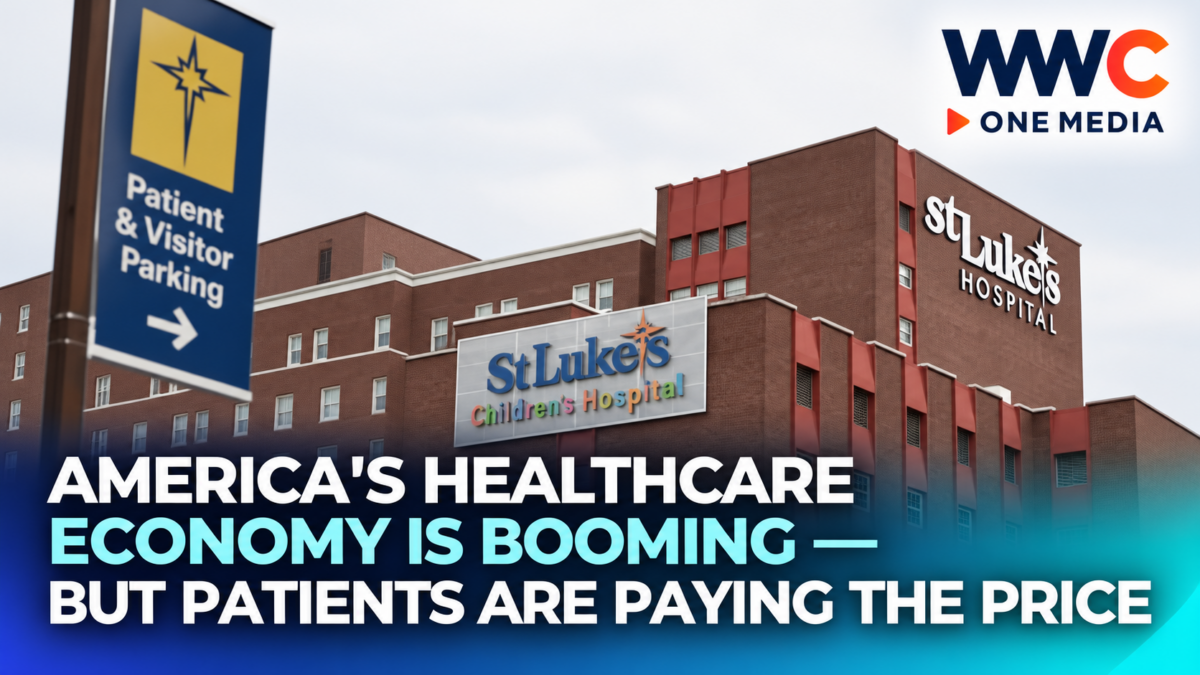
WASHINGTON — America’s healthcare industry is expanding faster than much of the rest of the economy, creating hundreds of thousands of jobs and generating trillions of dollars in spending. But for many patients, the boom increasingly feels like the opposite of progress.
The United States spent $5.3 trillion on healthcare in 2024, equivalent to about $15,474 for every person in the country and roughly 18% of gross domestic product. Federal projections say that share could climb to 20.6% of GDP by 2034, with total annual healthcare spending approaching $9 trillion.
Healthcare is also one of America’s most reliable engines of job creation.
Between March 2025 and March 2026, healthcare and social assistance added about 680,500 jobs, even as overall U.S. employment growth remained weak. The Bureau of Labor Statistics expects healthcare support and healthcare professional occupations together to account for almost one-third of all new jobs created between 2025 and 2035.
Yet the people financing this expanding system—patients, employers and taxpayers—are facing rapidly rising bills.
That is the contradiction at the center of the Financial Times investigation:
The U.S. healthcare economy is booming partly because Americans are spending more and more money on healthcare.
For patients, that is not necessarily good news.
One patient’s bill rose from under $100 to nearly $1,000
The FT begins with the case of Jason King Jones, a 50-year-old Pennsylvania resident who paid less than $100 when doctors removed a cancerous tumor in 2022.
Four years later, facing another cancer scare and undergoing broadly similar services, his bills approached $1,000.
Jones told the FT he spent hours fighting over reimbursements and felt that more of the burden had shifted onto patients.
His experience captures something millions of Americans increasingly recognize.
Having health insurance does not necessarily mean healthcare feels affordable.
A patient can still face:
higher deductibles;
larger co-payments;
coinsurance;
unexpected facility fees;
out-of-network bills;
and increasing premiums.
The result is a system in which coverage exists on paper while the amount a patient must actually pay keeps climbing.
Employer health coverage now costs nearly $27,000 per family
The scale of the problem is visible in employer insurance.
KFF found that the average annual premium for family health coverage reached $26,993 in 2025, up 6% in one year and 53% since 2015.
Workers themselves paid an average of about $6,850 toward those premiums, with employers covering most of the remainder.
But employer spending ultimately comes out of the broader compensation pool.
Money companies spend on health benefits is money that cannot necessarily go toward higher wages or other benefits.
That is why healthcare inflation affects workers even when an employer pays most of the insurance premium.
2027 could be even worse
There is little indication that the cost surge is ending.
Insurance broker Aon projects average employer healthcare costs will rise another 9.5% in 2027, pushing costs above $19,000 per employee before workers’ own contributions are included.
Aon says rising medical use, chronic disease, expensive specialty drugs and large insurance claims are among the biggest drivers.
That would mark a fourth consecutive year of near-double-digit cost increases.
If employers absorb those increases, corporate expenses rise.
If they pass them through, workers pay more.
Either way, the healthcare system gets a larger share of America’s economic output.
Obamacare patients suffered a particularly painful shock
People buying insurance through Affordable Care Act marketplaces experienced one of the sharpest increases in 2026.
Enhanced federal premium subsidies introduced during the pandemic expired at the end of 2025.
KFF found that among people who still enrolled for 2026 coverage, average monthly premium payments rose 58%, from roughly $113 to $178.
Patients tried to reduce those premium increases by switching to cheaper plans.
But that created another problem:
higher deductibles.
The average ACA marketplace deductible increased 37% in a single year, climbing by more than $1,000 to a record $3,786 per person.
So many consumers traded one form of healthcare cost for another.
Their monthly premium was lower than it otherwise would have been—
but they now have to spend much more before insurance begins paying for many services.
Millions may lose insurance altogether
KFF estimates effective ACA marketplace enrollment could fall from 22.3 million people in 2025 to around 17.5 million in 2026, with cost cited as one of the major reasons people dropped or changed coverage.
Federal policy changes could push the uninsured rate higher over the coming decade.
The Congressional Budget Office now estimates changes enacted through the 2025 reconciliation law will increase the number of Americans without health insurance by about 7.5 million in 2034, largely through Medicaid changes.
That can create another expensive feedback loop.
People without insurance frequently delay treatment.
Conditions become more serious.
Hospitals eventually provide emergency care.
And unpaid medical bills become uncompensated care that hospitals must absorb or recover elsewhere.
Hospitals say they are being squeezed too
Patients are not the only ones complaining.
Hospitals say their operating costs have surged.
According to the American Hospital Association, total hospital expenses increased 7.5% in 2025.
Workforce costs rose 5.6%.
Supply expenses jumped 9.9%.
Drug costs increased 13.6%.
Hospitals spent more than $1 trillion on workers in 2025, making labor by far their largest expense.
Executives argue that higher patient demand and continuing shortages of nurses and other medical professionals leave them with little choice but to spend more.
That means hospitals want larger payments from insurers.
Insurers push back.
Patients get caught in between.
This is how hospital-insurer fights reach patients
The FT describes the U.S. healthcare economy as increasingly at war with itself.
Large hospital systems negotiate with large insurers over what medical services should cost.
If they fail to agree, hospitals can leave an insurer’s network.
Patients then discover that a doctor or hospital they may have used for years is suddenly considered out-of-network.
That can force them to:
change physicians;
drive farther for treatment;
postpone procedures;
or pay significantly more themselves.
The patient usually has almost no role in the negotiations.
Yet the patient experiences the consequences directly.
Medicare Advantage networks are already getting narrower
That dynamic is now becoming more visible in Medicare.
UnitedHealthcare and CVS Health’s Aetna have said they will offer more plans with restricted provider networks in 2027 as they try to manage rising medical costs.
Aetna expects to lose roughly 950,000 Medicare Advantage members while shrinking geographic coverage.
Humana is also reducing the number of counties where it operates.
UnitedHealthcare says fewer members will have access to both its broader PPO plans and more restrictive HMO options.
The result can look strange to consumers.
A headline premium may remain low.
But the number of doctors and hospitals available under the plan can shrink.
Affordability and access are not always the same thing.
Hospital consolidation is one of the biggest reasons prices rise
Another major force identified by the FT is consolidation.
Over decades, independent hospitals and physician practices have increasingly merged into giant regional health systems.
Supporters argue consolidation can create efficiencies and prevent struggling hospitals from closing.
But substantial research shows that greater market power often leads to higher prices.
The U.S. Government Accountability Office found that hospital ownership of physician practices is associated with higher spending, in part because commercially insured patients can be charged more for services delivered inside hospital-owned facilities.
In one example cited by the GAO, a mammogram performed in a hospital outpatient clinic cost roughly one-third more than the same service performed in a physician’s office.
Colonoscopies could cost around twice as much.
The medical service may be essentially the same.
The ownership structure is different.
A hospital merger can increase negotiating power
This is why hospital consolidation matters so much.
A single small hospital negotiating with a giant insurer has limited bargaining power.
A regional system controlling most hospitals and doctors in a community can demand much higher reimbursement rates.
Insurers may ultimately agree because excluding the dominant hospital network could make their insurance plan unattractive to customers.
Those higher reimbursement costs then feed into future premiums.
Researchers reviewing decades of consolidation studies have found little evidence that bigger healthcare systems consistently deliver lower costs to consumers.
In some cases, integration has instead produced double-digit price increases.
Hospitals say consolidation can also preserve care
There is an important counterargument.
Not every hospital acquisition is driven primarily by pricing power.
Independent hospitals and physician practices face rising administrative expenses, staff shortages, technology costs and regulatory burdens.
The American Hospital Association argues that some acquisitions allow larger systems to preserve services that smaller providers could no longer sustain alone.
That can be particularly important in rural areas.
A hospital merger that raises negotiating power may simultaneously prevent a facility from closing.
The problem is that the U.S. system often struggles to distinguish necessary consolidation from anticompetitive consolidation.
Patients may receive more stable access to a hospital—
while paying more for the care delivered inside it.
Hospitals and insurers blame each other
The public argument has become predictable.
Hospitals say insurers:
deny claims;
delay payments;
demand prior authorizations;
and reimburse too little.
Insurers say hospitals:
consolidate;
demand excessive rates;
add facility fees;
and use their regional market power to raise prices.
The American Hospital Association says hospitals spent about $43 billion in 2025 trying to collect payments from insurers for care they had already delivered, including costs associated with denials, documentation and prior authorization.
Insurers counter that controlling hospital prices is necessary to keep premiums from rising even faster.
Both sides can point to genuine cost pressures.
The patient still pays.
The FTC now wants clearer prices
The opacity of American healthcare pricing has become serious enough for the Federal Trade Commission to intervene.
On October 5, the FTC sent letters to 24 major healthcare providers, warning them to comply with federal obligations to provide consumers with prompt and accurate pricing information.
The regulator said misleading or inaccessible price information could potentially constitute an unfair or deceptive practice.
That illustrates how unusual healthcare remains compared with almost every other major consumer industry.
Imagine buying a car without knowing the price until weeks later.
Or booking a hotel room and discovering after checkout that the actual charge depends on a private negotiation between the hotel and an insurer.
In American healthcare, versions of that experience remain common.
Even insured patients struggle to shop
Economists often argue that consumers can lower prices through competition.
Healthcare makes that difficult.
Patients frequently do not know:
the negotiated price;
whether every physician involved is in-network;
what a facility fee will be;
what insurance will ultimately approve;
or how much remains on their deductible.
Emergency care makes shopping almost impossible.
A person experiencing chest pain is not comparing hospital spreadsheets.
Even scheduled services can involve layers of billing that make simple comparison difficult.
That weakens one of the mechanisms normal markets use to control prices.
Expensive drugs are adding another layer
Prescription medicine is another major driver of healthcare inflation.
CMS expects retail prescription-drug spending to grow faster than most other major healthcare categories through 2034.
Hospitals say their drug expenses rose 13.6% in 2025 alone.
Specialty medicines, cancer treatments and GLP-1 drugs can be extremely expensive.
Some therapies provide life-changing medical benefits.
But even effective medicines create difficult financing questions when millions of patients may need them.
Employers and insurers increasingly respond by tightening eligibility or shifting part of the expense to patients.
Some Americans are simply bypassing insurance
The rising cost and complexity of insurance have created a new market for alternatives.
Amazon, GoodRx and other companies increasingly sell direct prescription subscriptions that allow consumers to buy selected generic medicines without relying on traditional insurance.
Reuters reported that GoodRx subscription revenue jumped 39% in the second quarter of 2026, while Amazon says use of its RxPass service has tripled since launch.
These services do not replace comprehensive insurance.
But their popularity says something important.
Consumers are sometimes finding it simpler to buy medicine outside the insurance system than navigate the insurance system itself.
Healthcare is booming partly because America is getting older
One reason the sector continues growing is demographic.
Older people use significantly more healthcare.
The U.S. population is aging as the baby-boom generation moves deeper into retirement.
CMS expects Medicare spending to grow an average 7.7% per year from 2025 through 2034, faster than private insurance or Medicaid spending.
This ensures healthcare will keep becoming a larger industry even if policymakers succeed in slowing price inflation.
More older Americans means:
more doctor visits;
more surgeries;
more nursing care;
more prescription drugs;
and greater demand for home health services.
That is one reason healthcare jobs are growing even when other sectors stagnate.
The healthcare boom is therefore economically strange
Normally, rapid industry growth is considered good news.
More semiconductor factories create more chips.
More housebuilding creates more homes.
More restaurants provide more places to eat.
Healthcare is different.
Rapid growth can mean people are receiving better treatment.
But it can also mean society is spending more simply because prices are rising, people are sicker, the population is older or administrative systems are becoming more expensive.
A larger healthcare economy is not automatically evidence of a healthier country.
That is the paradox.
Trump’s healthcare policies are adding another political layer
The issue is becoming more politically important ahead of the November 2026 midterm elections.
President Donald Trump’s administration has argued that tighter eligibility enforcement will reduce fraud and government waste.
Vice President JD Vance’s crackdown on suspected ACA enrollment fraud has already removed around 760,000 allegedly fraudulent or nonexistent enrollees, while another 400,000 cases are under review.
The administration argues those steps protect taxpayers.
Insurers warn that removing large numbers of healthier or low-cost enrollees could make the remaining insurance pool more expensive.
ACA insurers have already filed for a median 15% premium increase for 2027.
So a policy aimed at reducing waste could still indirectly raise premiums for legitimate customers.
Hospitals also worry about more uninsured patients
Hospital operators are already seeing the consequences of reduced insurance enrollment.
HCA Healthcare cut its 2026 profit forecast after reporting an increase in uninsured patients tied partly to the decline in ACA marketplace enrollment.
The company estimated a roughly $400 million negative impact in the second quarter from changes in its payer mix.
This demonstrates how healthcare costs travel through the system.
Someone loses insurance.
The hospital still treats them.
The hospital absorbs more unpaid care.
The hospital seeks higher reimbursement elsewhere.
Insurers raise premiums.
Employers and patients pay more.
Every part of the system is connected.
The U.S. spends more—but patients often feel less secure
This is what makes the FT story so politically potent.
America is not suffering from a lack of healthcare spending.
It is spending extraordinary amounts.
The problem is what consumers feel they receive in return.
Patients report:
larger bills;
more paperwork;
narrower networks;
higher deductibles;
and fights over claims.
Hospitals say they are financially strained.
Insurers say medical costs are too high.
Employers say health benefits are consuming an increasing share of compensation.
Governments say public programs are becoming too expensive.
If almost everyone inside the system feels financially squeezed while total spending keeps reaching records, something is structurally wrong.
Healthcare’s growth may actually be crowding out other priorities
CMS projects healthcare spending will grow faster than the overall economy for the next decade.
That has enormous opportunity costs.
For households, more money spent on medical care means less available for:
housing;
food;
education;
retirement;
and leisure.
For employers, it can mean slower wage growth.
For governments, healthcare competes with:
defense;
infrastructure;
education;
and debt servicing.
At 20.6% of GDP, roughly one dollar out of every five generated by the U.S. economy would flow into healthcare.
That is an extraordinary allocation of national resources.
Yet cutting spending is politically and medically difficult
This is why healthcare reform remains so hard.
Every dollar of healthcare spending is also someone else’s income.
It pays:
nurses;
physicians;
drug companies;
hospital systems;
insurance employees;
medical-device manufacturers;
pharmacies;
technology firms;
and investors.
Lowering healthcare spending therefore means reducing someone’s revenue.
That creates powerful resistance.
Patients want cheaper care.
Almost every major institution inside the system has an economic reason to protect at least part of the existing spending.
The biggest problem may be that no single villain exists
It is tempting to blame one side.
Hospitals.
Insurers.
Drug companies.
Government.
Employers.
Private equity.
But the current crisis is the result of multiple forces interacting:
an aging population;
expensive new technology;
staff shortages;
consolidation;
insurance complexity;
drug prices;
government policy;
and weak price transparency.
That is why simple solutions repeatedly fail.
Cut hospital payments too aggressively and facilities can close.
Raise reimbursements and premiums can rise.
Reduce insurance subsidies and more people become uninsured.
Expand subsidies without controlling underlying prices and public spending rises.
The system pushes costs from one participant to another without necessarily reducing them.
America has built a healthcare economy that almost everyone depends on—and almost everyone complains about
That may be the clearest conclusion from the FT report and the wider data.
Healthcare is becoming one of America’s biggest sources of jobs.
It is one of the largest destinations for investment.
It produces life-saving treatments.
It employs millions of people.
And it represents an increasing share of national wealth.
But patients increasingly experience that same growth as a financial burden.
A booming healthcare sector would normally sound like an economic success story.
In the United States, it increasingly comes with an uncomfortable question:
If healthcare companies, hospitals and employment are all growing—
why are so many patients paying more, losing access and feeling less protected than before?