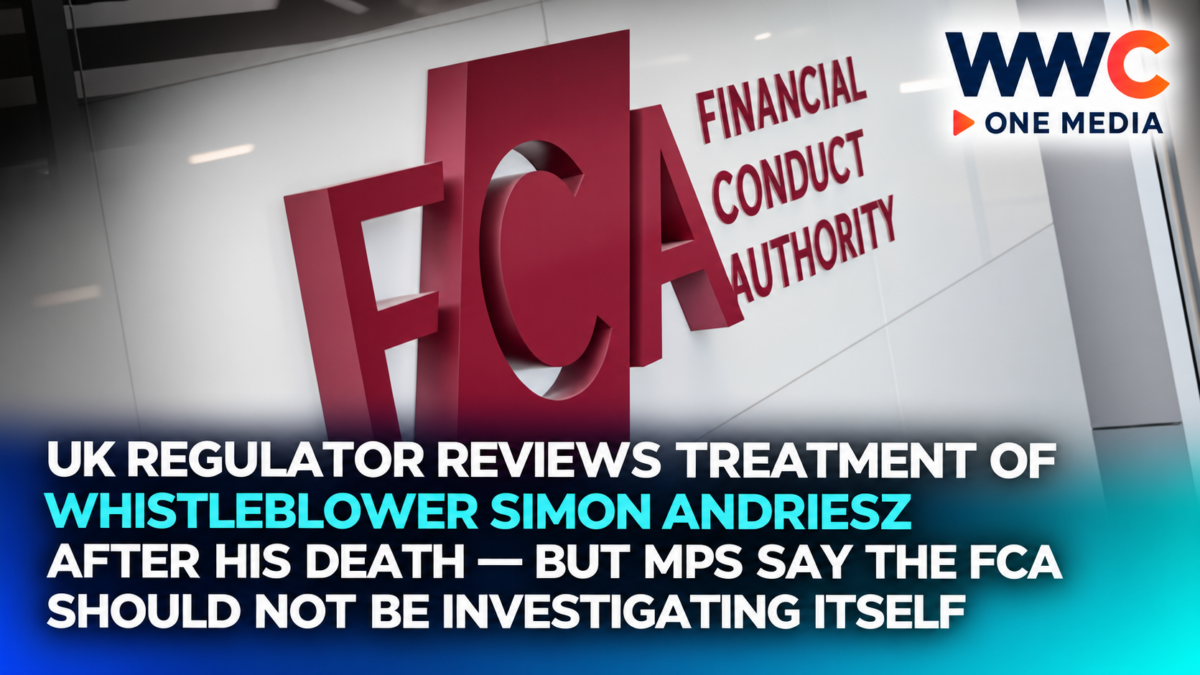
LONDON — Britain’s top financial regulator is reviewing how it treated whistleblower Simon Andriesz after the former Wall Street executive died by suicide, intensifying scrutiny over whether the UK adequately protects insiders who expose suspected wrongdoing in some of the world’s most powerful financial institutions.
The Financial Conduct Authority has asked Lea Paterson, a newly appointed FCA non-executive director and former Bank of England official, to examine the regulator’s interactions with Andriesz and identify lessons for the future.
The FCA intends to publish the results by the end of 2026.
But a cross-party group of British lawmakers says an internal review is not enough.
They are demanding an independent investigation, arguing that a regulator accused of failing a whistleblower should not be solely responsible for judging its own conduct.
The case is now becoming much bigger than one man’s dispute with one financial watchdog.
It is raising a fundamental question about the UK’s regulatory system:
If whistleblowers risk their careers, finances and health to expose misconduct, what protection can they realistically expect once they come forward?
Who was Simon Andriesz?
Andriesz, 57, spent more than three decades working in financial markets and became a managing director at BGC Group, formerly BGC Partners.
BGC is an interdealer brokerage historically controlled by Cantor Fitzgerald and was previously led by Howard Lutnick, who later became U.S. Commerce Secretary.
Andriesz began raising concerns internally around 2016 about accounting, compliance and other practices at the firm.
He subsequently reported information to regulators in the United States and United Kingdom.
BGC has disputed many of his allegations and denied retaliating against him.
The company has said his employment ended because he refused medical advice, declined essential duties, rejected accommodation and ultimately abandoned his role.
That distinction is important.
Andriesz alleged retaliation.
BGC denied it.
No court finding establishing that BGC caused his death or unlawfully retaliated against him should be inferred from the current reporting.
His disclosures did lead to real U.S. regulatory action
What makes Andriesz’s case particularly significant is that he was not simply making allegations that disappeared into a regulatory inbox.
Some of the information he provided contributed to enforcement action in the United States.
In November 2019, the U.S. Commodity Futures Trading Commission ordered BGC Financial to pay a $3 million civil penalty over supervision, reporting and recordkeeping violations spanning more than five years.
The CFTC said the firm had failed in areas including:
supervision;
transaction reporting;
recordkeeping;
and compliance controls.
BGC was also required to hire an outside consultant, improve its compliance systems and submit remediation reports to the regulator.
Andriesz later received a CFTC whistleblower award of about $420,000 after the regulator determined that information he supplied had significantly contributed to an enforcement action.
For supporters of stronger whistleblower protection, that fact is crucial.
It demonstrates that at least some of the material he reported was valuable enough for a U.S. regulator to reward him.
BGC had also faced other major U.S. penalties
The CFTC penalty was not BGC’s only regulatory problem.
In 2018, the U.S. Securities and Exchange Commission fined BGC Financial $1.25 million for failing to preserve requested audio recordings and for maintaining inaccurate books and records relating to compensation, travel and entertainment expenses.
The SEC said BGC deleted recordings requested during an investigation because the department responsible for retaining them had not been told to preserve them.
The regulator also found that the company incorrectly recorded substantial expenses—including sports tickets and personal travel—as business promotion costs.
Separately, the CFTC fined BGC $15 million in 2019 over fraudulent practices in emerging-market foreign-exchange options trading.
Another BGC entity, BGC Derivative Markets, later agreed to pay $1.9 million in 2022 over swap-reporting and core-principle violations.
These enforcement actions do not prove every allegation Andriesz made.
But they demonstrate that BGC businesses faced repeated regulatory problems in areas overlapping with the broader compliance concerns he had raised.
The FCA’s response is now under scrutiny
Andriesz also brought information to Britain’s Financial Conduct Authority.
He later said he felt deeply let down by the regulator and argued that most of his allegations were never properly investigated.
The FCA has said it did take action based on information he supplied and pointed to a supervisory measure imposed on the firm.
Andriesz characterized that response as little more than a regulatory “slap on the wrist.”
The dispute is therefore not whether the FCA did absolutely nothing.
It is whether what it did was adequate given the seriousness of the information Andriesz believed he had provided.
That distinction is now at the heart of the internal review.
The FCA acknowledges giving him incorrect advice
One of the most damaging elements of the controversy involves the regulator’s own guidance to Andriesz.
According to the FT and campaigners familiar with his case, an FCA official incorrectly told him that he had lost whistleblower protection after his identity became publicly known.
The FCA later acknowledged that advice was wrong, apologized and committed to improving staff training.
That error matters because whistleblower protection is often difficult enough for employees to understand even when advice is accurate.
Someone deciding whether to reveal internal misconduct must weigh:
career risk;
legal exposure;
financial cost;
reputational damage;
and personal safety.
Incorrect advice from the regulator responsible for handling that disclosure can dramatically increase uncertainty.
MPs say the regulator should not mark its own homework
Labour MP John McDonnell, who chairs the All-Party Parliamentary Group on Investment Fraud and Fairer Financial Services, has backed an external review.
The group argues that Andriesz’s death raises serious questions about whether whistleblowers are being listened to, protected and treated fairly by the FCA.
McDonnell described the case as deeply troubling and stressed that whistleblowers are essential to financial regulation.
That point is difficult to dispute.
Regulators cannot observe every conversation inside every bank or brokerage.
They depend heavily on insiders willing to expose conduct that official inspections may never uncover.
If employees conclude reporting wrongdoing will destroy their careers while producing little regulatory action, the entire enforcement system becomes weaker.
The FCA says whistleblower reports are increasingly important
The FCA’s own data show just how dependent the watchdog has become on whistleblowers.
Between April 2025 and March 2026, the regulator assessed 1,375 whistleblowing reports, up 22% from the previous year.
Those reports generated 4,375 individual allegations.
The FCA says whistleblower information resulted in 523 instances of direct regulatory action during that period.
Actions included:
enforcement proceedings;
formal information demands;
independent skilled-person reviews;
restrictions on firms;
and other supervisory interventions.
In the second quarter of 2026 alone, the FCA received another 333 whistleblower reports.
Those figures show that whistleblowing is not peripheral to the FCA’s work.
It is one of its major sources of intelligence.
Yet most cases do not lead to major enforcement
The same FCA figures reveal another side of the story.
Between April and June 2026, the regulator closed 395 whistleblower reports.
Only 56, or 14%, resulted in what the FCA classified as “significant action to manage harm.”
Another 114 resulted in less severe regulatory action.
Almost half—193 cases—were classified as information that helped inform the FCA’s work without producing direct action.
That does not mean the remaining reports were ignored.
Regulators receive large amounts of incomplete, duplicative or unprovable information.
But for a whistleblower who has sacrificed a career to report wrongdoing, the gap between providing evidence and seeing visible enforcement can feel enormous.
Andriesz repeatedly described that frustration.
He said whistleblowing had devastated his life
In public statements before his death, Andriesz said years of regulatory disputes, litigation and alleged retaliation had caused severe consequences for his career, finances and wellbeing.
He said his CFTC award—about $420,000—did not come close to compensating for the legal, medical and other costs he incurred.
He publicly called for an independent review of how his disclosures had been handled and questioned whether UK whistleblower law provided meaningful protection in practice.
Those were his claims and experiences.
They should not be converted into a definitive statement that any regulator or former employer caused his death.
The investigation into regulatory handling and the circumstances of his death are separate issues.
Then came the Howard Lutnick–Jeffrey Epstein disclosures
Andriesz became internationally known in 2026 for another set of disclosures.
He said he had found evidence showing previously undisclosed business links between former BGC chief executive Howard Lutnick and convicted sex offender Jeffrey Epstein.
Andriesz said he had previously raised concerns about those connections with the FBI in 2020 and 2021.
The FBI did not pursue the allegations at the time.
After U.S. authorities released additional Epstein-related documents, Andriesz located a 2018 email exchange involving an investment in digital advertising company Adfin.
The correspondence raised questions about Lutnick’s previous public statements concerning when his relationship with Epstein ended.
Lutnick has denied wrongdoing connected to Epstein
This portion of the story requires particular care.
The documents showed contact or investment overlap.
They do not establish that Lutnick participated in Epstein’s crimes.
Lutnick has not been accused of involvement in Epstein’s sexual offenses.
He has acknowledged visiting Epstein’s private island with his family in 2012 but has said the visit was brief and that he saw nothing improper.
He also told congressional investigators that he did not know until much later that Epstein had been a co-investor in Adfin.
Democrats on the U.S. House Oversight Committee later challenged his account and called for his resignation.
The Commerce Department rejected those allegations as politically motivated.
So the dispute remains political and evidentiary—not a proven criminal case against Lutnick.
The Epstein angle makes the case more explosive—but also more vulnerable to misinformation
Andriesz’s death has already generated intense online speculation.
That makes responsible wording especially important.
There is currently no publicly established evidence linking his death to Lutnick, Epstein, BGC, Cantor Fitzgerald or any retaliation connected with those disclosures.
The fact that someone made politically explosive disclosures and later died does not prove the two events are causally connected.
Conspiracy claims should therefore not be presented as fact.
The legitimate story is already significant without adding unsupported theories:
a veteran financial executive became a whistleblower;
some of his information contributed to regulatory action;
he repeatedly complained that the UK system failed to protect him;
and after his death, Britain’s regulator is now reviewing how it handled his case.
BGC says his retaliation allegations were false
BGC has consistently rejected Andriesz’s claims about retaliation.
The company told media outlets that his allegations lacked credibility and were “categorically false.”
It said investigations in several jurisdictions had failed to substantiate many of his accusations.
BGC has also maintained that his dismissal had nothing to do with whistleblowing.
Instead, it says his employment ended after disagreements involving medical advice, job duties and workplace accommodation.
Those denials must remain part of any fair account of the dispute.
The FCA review may eventually shed more light on what the regulator itself concluded about retaliation.
The broader UK whistleblower system is now under pressure
Britain protects certain whistleblowers through the Public Interest Disclosure Act, but campaigners have argued for years that the framework relies too heavily on workers bringing employment claims after retaliation has already occurred.
That is fundamentally different from a system that proactively protects the whistleblower while an investigation is taking place.
The Andriesz controversy is likely to intensify calls for a dedicated whistleblower authority or stronger statutory protections.
Supporters argue such a body could:
coordinate regulators;
protect confidentiality;
monitor retaliation;
give independent legal guidance;
and provide a single place for whistleblowers to seek help.
The current UK system disperses responsibilities among employers, regulators, courts and tribunals.
That fragmentation can make complex cases difficult to navigate.
The U.S. system offers financial rewards Britain generally does not
Andriesz’s CFTC award also highlights a major difference between the two countries.
U.S. regulators including the CFTC and SEC can pay whistleblowers a share of financial sanctions when their original information significantly contributes to successful enforcement.
That creates a financial incentive for insiders to report serious misconduct.
Britain generally does not offer comparable large regulatory rewards.
Supporters of the American model argue payments compensate whistleblowers for severe career risk.
Critics worry rewards can create incentives for opportunistic claims.
Andriesz’s own case complicates the debate.
Even after receiving roughly $420,000, he said his personal and financial losses were much greater.
Money alone cannot solve the problem
That may be the larger lesson.
A whistleblower may lose:
employment;
future career opportunities;
professional relationships;
savings;
privacy;
and years of personal stability.
A financial award years later may not repair those losses.
What matters just as much is whether the person believes institutions will:
take the evidence seriously;
protect their identity;
communicate honestly;
and respond when retaliation is alleged.
That is precisely what the FCA’s new review now needs to examine.
Lea Paterson’s review will face a credibility test
The regulator says Paterson’s review will focus on its interactions with Andriesz and lessons for future cases.
But MPs and campaigners argue that because Paterson now sits on the FCA’s own board, the process still lacks sufficient independence.
That creates a problem before the review even begins.
If the FCA clears itself, critics may dismiss the conclusion.
If it finds serious failings, questions will arise over why an external review was not commissioned immediately.
Either way, credibility will depend heavily on how much evidence and detail the regulator ultimately publishes.
This case could redefine how Britain treats financial whistleblowers
The implications stretch beyond Simon Andriesz.
The FCA says more people are reporting wrongdoing than ever.
Financial markets are becoming more complex.
Artificial intelligence, crypto assets, private markets and cross-border trading are creating new regulatory risks.
That means regulators need insiders more, not less.
But insiders will only speak if they believe doing so will not leave them isolated.
That is why the current controversy is so damaging.
The FCA does not merely need to determine whether its staff followed internal procedures.
It needs to answer a broader question:
Does Britain’s whistleblowing system actually work for the people whose evidence regulators depend on?
The scandal is no longer only about BGC or Lutnick
Andriesz’s disclosures touched powerful institutions and individuals.
Some led to enforcement.
Others remain disputed.
Some of his most politically sensitive claims involved Howard Lutnick and Jeffrey Epstein.
But focusing only on those famous names risks missing the bigger issue.
The story now confronting Britain is about institutional trust.
A whistleblower provided information.
Regulators acted on some of it.
He later said the system failed him badly.
The FCA admits it at least gave him incorrect advice.
MPs now say an internal review is insufficient.
And the person at the center of the case is no longer alive to participate in the investigation.
That makes the FCA’s coming review far more than a procedural exercise.
It will test whether Britain can convince future whistleblowers that speaking up is worth the risk.
Because the most damaging outcome would not simply be finding that one case was mishandled.
It would be thousands of people inside banks, brokers and financial firms looking at what happened to Simon Andriesz—
and deciding it is safer to stay silent.