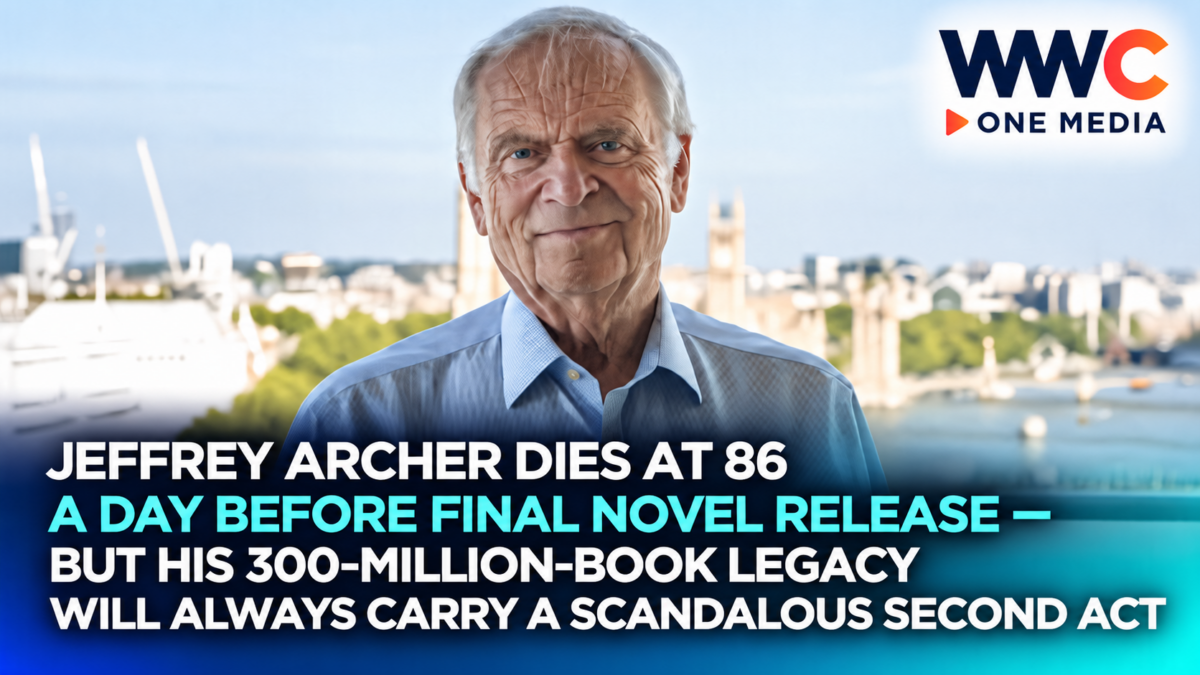
LONDON — Jeffrey Archer, one of Britain’s most commercially successful novelists and one of its most scandal-prone politicians, has died at 86—just one day before the release of what he had already said would be his final novel.
HarperCollins said Archer died “suddenly and peacefully” at his home on Monday, October 5, between writing sessions.
His final book, Adam and Eve, is due to be published on October 6.
That timing gives an almost novelistic ending to a career that repeatedly blurred the line between fiction, politics, ambition and scandal.
Archer sold more than 300 million books worldwide during a writing career spanning about five decades, making him one of Britain’s most successful popular storytellers.
But the same man who created international bestsellers such as Kane and Abel and Not a Penny More, Not a Penny Less also served time in prison after a jury found that he had lied during a high-profile libel case.
His life was therefore defined by two extraordinary narratives:
one about literary success;
and another about political ambition repeatedly collapsing under scandal.
He was still working almost until the moment he died
Archer’s death came as a shock partly because he remained highly active.
HarperCollins said he had been writing on the day he died.
Only the previous day, he had appeared at a sold-out event at London’s Leicester Square Theatre with broadcaster Gyles Brandreth, where he met fans and signed books.
Brandreth said Archer had been in exuberant form, joking with the audience and promoting the novel he had described as his last.
That image—an 86-year-old author still signing books and talking about storytelling one day before his death—fits the way Archer presented himself throughout his career.
He rarely behaved like a retired writer.
He treated publishing almost like competitive sport.
HarperCollins called him a “master storyteller”
Kate Elton, HarperCollins UK chief executive and Archer’s longtime editor, said working with him had been one of the great privileges of her publishing career.
She described him as a writer who revised obsessively and remained intensely committed to making every draft better.
That work ethic helped explain why Archer remained commercially relevant for decades even after his political reputation collapsed.
His novels were rarely praised for literary experimentation.
That was not their purpose.
Archer specialized in:
fast plots;
ambition;
money;
betrayal;
power;
revenge;
and dramatic reversals.
He understood what kept readers turning pages.
And hundreds of millions did.
Kane and Abel became his defining bestseller
Archer’s most famous novel, Kane and Abel, published in 1979, became an international phenomenon.
The FT says the book sold more than 30 million copies worldwide, making it the title most closely associated with Archer’s literary career.
The story follows two men from radically different backgrounds whose lives become locked in rivalry.
It contained many of the themes Archer returned to repeatedly:
wealth;
social mobility;
power;
status;
competition;
and personal ambition.
Those were not accidental interests.
They also defined Archer’s own life.
His first novel came after financial disaster
Archer did not begin his adult life as a novelist.
He entered politics.
He became a Conservative MP at just 29 years old, winning a by-election in 1969.
But his first parliamentary career collapsed after a disastrous investment pushed him close to bankruptcy.
In 1974, a Canadian industrial-cleaning company in which he had invested failed, leaving him in severe financial trouble and forcing him out of Parliament.
That disaster helped produce his first novel.
Not a Penny More, Not a Penny Less turned the idea of financial ruin and revenge into fiction.
It was published in the mid-1970s and became a commercial success.
A political setback had unexpectedly created a second career.
Writing made him rich again
Archer’s novels turned his personal financial collapse into one of the great commercial recoveries of British publishing.
He became a multimillionaire through books.
Titles including:
Kane and Abel;
First Among Equals;
A Matter of Honour;
The Prodigal Daughter;
the Clifton Chronicles;
and numerous short-story collections
built a global readership far beyond Britain.
Reuters says his books ultimately sold more than 300 million copies worldwide.
His success also allowed him to return to politics from a position of wealth and celebrity.
That second political ascent would eventually produce the scandal for which he became almost as famous as his books.
Margaret Thatcher brought him back to the heart of Conservative politics
By the mid-1980s, Archer had rebuilt enough status to become a senior Conservative figure.
Prime Minister Margaret Thatcher appointed him deputy chairman of the Conservative Party in 1985.
For a time, Archer looked like one of the party’s most charismatic political operators.
But just a year later, he resigned after revelations emerged that he had given money to a sex worker.
Archer insisted the money was intended to help her escape media attention rather than pay for sex.
The episode would eventually produce the legal case that destroyed his political career.
He sued a newspaper—and won
In 1987, Archer sued the Daily Star after the newspaper alleged he had slept with a sex worker.
He won.
The court awarded him £500,000 in damages, a substantial sum at the time.
For years, the verdict appeared to vindicate him.
His political standing recovered.
He later received a life peerage.
But the victory contained the seeds of his downfall.
Evidence later emerged that Archer had lied during the case and had relied on a false alibi.
He became Lord Archer in 1992
Prime Minister John Major recommended Archer for a life peerage in 1992, giving him a seat in the House of Lords.
By the end of the decade, Archer was preparing for an even more ambitious political role.
In 1999, he became the Conservative Party’s candidate for the newly created office of Mayor of London.
It looked like another remarkable comeback.
Then the old libel case returned.
His London mayor campaign collapsed
A former friend revealed that Archer had asked him to provide a false alibi connected with the 1987 Daily Star case.
The revelation destroyed Archer’s mayoral campaign.
He withdrew and was expelled from the Conservative Party.
The matter did not end with political humiliation.
It became a criminal case.
In 2001, he went to prison
Archer was tried at the Old Bailey for perjury and perverting the course of justice.
A jury found him guilty.
He was sentenced to four years in prison.
The conviction transformed him from disgraced politician into convicted criminal.
He served just over two years before being released on parole in 2003.
For many public figures, that would have ended everything.
For Archer, it became material.
He turned prison into another publishing project
Archer wrote a three-volume memoir based on his incarceration, collectively known as A Prison Diary.
That response captured something essential about him.
Almost every crisis in Archer’s life eventually became narrative.
Financial ruin became fiction.
Political ambition became fiction.
Prison became memoir.
Scandal became part of the brand.
His critics saw that as shameless self-promotion.
His readers often saw it as proof that Archer could turn almost anything into a story.
He returned to the House of Lords
Despite the conviction and imprisonment, Archer later resumed participation in the House of Lords.
He remained a life peer until retiring from the chamber in 2024.
That gave his political career an extraordinary shape:
young MP;
financial collapse;
literary comeback;
senior Tory official;
sex scandal;
peerage;
mayoral candidate;
criminal conviction;
prison;
and eventual return to public life.
It is difficult to separate Archer’s novels from the fact that his own biography often sounded like one of them.
His wife Mary remained beside him throughout
Archer is survived by his wife, Dame Mary Archer, a scientist and academic.
The couple had been married for 60 years.
Mary Archer stood by him during repeated controversies, including his criminal conviction.
She once famously remarked that their marriage had explored the outer limits of “for better and for worse.”
They had two sons and five grandchildren.
He had disclosed prostate cancer years earlier
Archer revealed in 2014 that he had been diagnosed with prostate cancer.
However, HarperCollins has not publicly linked his death to that diagnosis.
The publisher said only that he died suddenly and peacefully at home.
It would therefore be inaccurate to state a specific medical cause without further confirmation.
His final novel arrives after his death
The timing of Adam and Eve will inevitably shape how the book is received.
According to AP, the novel continues Archer’s long interest in power and inequality and touches on themes including class and gender.
He had already publicly described it as his last novel.
Now it becomes literally posthumous.
That gives the release a significance no publisher could have planned.
Readers picking up the book are not simply buying Archer’s newest thriller.
They are reading the final work of an author who was still writing until the day he died.
Archer’s commercial achievement is difficult to dismiss
Whatever critics thought of his prose—or his politics—300 million books is an extraordinary publishing achievement.
Very few writers ever achieve that scale.
Archer remained popular across multiple generations and international markets.
His success also survived technological changes that transformed publishing:
paperbacks;
airport bookstores;
television adaptations;
e-books;
online retail;
and digital audiobooks.
That longevity requires more than one lucky bestseller.
It requires readers repeatedly coming back.
But his legacy will never be purely literary
That is what makes Archer different from many other bestselling writers.
His obituary cannot simply list novels.
Any complete account has to include:
political ambition;
public scandal;
deception;
criminal conviction;
and prison.
His literary success did not erase those events.
Nor did the scandals erase his publishing career.
Both continued simultaneously.
That duality will shape how he is remembered.
Some readers separated the writer from the politician
One reason Archer’s career survived is that millions of readers apparently did not view his criminal conviction as disqualifying.
They continued buying the books.
That highlights an interesting divide in celebrity culture.
A person can become politically disgraced while remaining commercially successful in entertainment.
Archer understood that perhaps better than almost anyone.
His public reputation collapsed.
His audience did not.
His writing style was built for mass readership
Archer never pretended to write primarily for literary critics.
His books were designed to move.
Short chapters.
Frequent reversals.
Clear stakes.
Characters driven by money and ambition.
Plots that often stretched across decades.
That approach made the novels easy to translate and easy to consume internationally.
It also made Archer particularly successful in markets where English-language commercial fiction had huge audiences.
His stories often mirrored his own obsessions
Money mattered in Archer’s fiction because money mattered in his life.
Status mattered because political status mattered to him.
Revenge mattered because he spent much of his public career fighting enemies, newspapers and critics.
Comebacks mattered because Archer repeatedly staged them.
His fiction therefore often felt intensely personal even when the stories were invented.
Readers were buying thrillers.
They were also buying a version of Archer’s worldview.
His death marks the end of an unusual British public life
Very few modern British figures moved so completely between politics and commercial fiction.
Most politicians who write books produce memoirs.
Most novelists do not become senior party officials.
Archer did both.
And then he added a criminal trial to the story.
That made him permanently difficult to categorize.
Was he a politician who became a novelist?
A novelist who repeatedly returned to politics?
A disgraced peer?
A commercial publishing phenomenon?
The answer is all of them.
The scandal may fade faster than the books—or the opposite could happen
Legacy is unpredictable.
Some public figures are remembered primarily for their accomplishments.
Others become defined by the scandal that ended their careers.
Archer may remain suspended between the two.
Older readers may immediately remember Kane and Abel.
Political historians may remember the perjury case.
Publishing professionals may remember the staggering sales figures.
Future readers may encounter only the novels.
That uncertainty is part of what makes his life so unusual.
He died doing the thing that rescued him the first time
Perhaps the most striking detail in Archer’s death is the simplest.
He died between writing sessions.
Writing had originally saved him after financial disaster ended his first political career.
It made him rich.
It rebuilt his public identity.
It sustained him after prison.
And he was apparently still doing it at 86.
That gives the final chapter an almost suspiciously Archer-like quality.
The politician repeatedly failed.
The novelist repeatedly came back.
And the novelist was still working at the end.
Jeffrey Archer leaves behind more than 300 million books sold and one of the most extraordinary comeback stories in British public life.
But his reputation will always contain a second narrative running alongside the literary success:
the politician who won a libel case, was later exposed for lying about it, went to prison—and somehow continued selling millions of novels afterward.
His final book arrives one day after his death.
For a storyteller who spent five decades mastering dramatic timing, it is a final twist even he could not have written.