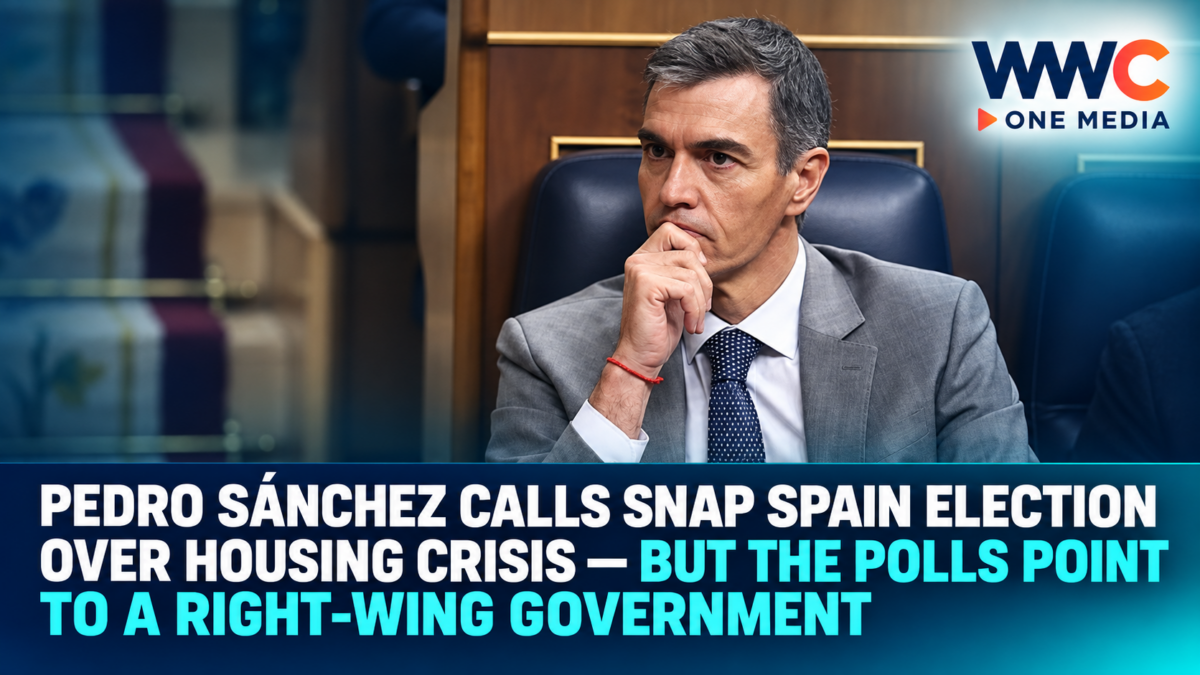
MADRID — Spanish Prime Minister Pedro Sánchez has called a snap general election for November 29, betting that public fury over soaring rents and evictions can rescue one of Europe’s last major left-wing governments — even though current polls suggest his gamble could instead hand power to the conservative People’s Party and the far-right Vox.
The election will take place roughly eight months earlier than originally expected, after Sánchez’s minority government suffered a major parliamentary defeat over emergency housing measures designed to strengthen tenant protections and limit evictions.
The Socialist leader is effectively asking voters to give him the parliamentary strength he has lacked throughout his eight years in office.
But the political arithmetic is brutal.
Reuters says Sánchez’s Spanish Socialist Workers’ Party, or PSOE, is polling around 28%, while parties further to the left are collectively near 8%. The conservative People’s Party, led by Alberto Núñez Feijóo, remains ahead, and a PP-Vox alliance is currently the only combination projected to command an absolute majority in Spain’s 350-seat Congress. Vox itself is polling around 18%, with particularly strong support among younger male voters.
That means Sánchez has chosen to hold the election at a moment when the polls say he could lose.
His calculation is that housing may change everything.
An 87-year-old woman became the symbol of Spain’s housing crisis
The political mood shifted dramatically after Maricarmen Abascal, 87, was evicted from the Madrid home where she had lived for roughly 70 years.
Her building had been acquired by an investment fund, and her case became a national symbol of anger over rents, property speculation and tenant insecurity.
The eviction triggered huge demonstrations and a protest encampment in Madrid’s Puerta del Sol.
Authorities said around 70,000 people marched in Madrid on one weekend, while organizers claimed the turnout was far larger. Tens of thousands also demonstrated in Barcelona.
That public anger created an opportunity for Sánchez.
Housing has become one of the few major issues where his preferred policies appear more popular than his party.
A 40dB poll cited by Reuters found 68% of Spaniards support rent caps, including majorities among voters who support the PP and Vox.
That is the gamble at the heart of the snap election:
Sánchez believes voters angry about housing may punish the right-wing parties that blocked his emergency measures—even if they remain dissatisfied with his government overall.
Parliament rejected Sánchez’s housing package
The immediate trigger came on October 2.
The PP, Vox and the right-wing Catalan separatist party Junts voted down two emergency decrees aimed at addressing the housing crisis.
The proposed package included measures to:
extend protections against evictions;
tighten rules around temporary rentals and room-by-room leasing;
reduce speculation;
and expand access to affordable housing.
Junts argued the measures could actually reduce rental supply and make housing more expensive.
The PP says Spain’s underlying problem is not insufficient regulation but insufficient construction.
That difference is likely to become one of the defining economic arguments of the election.
Spain really does have a severe affordability problem
The housing crisis is not merely a campaign slogan.
Official Spanish government documents show national home prices reached about €2,230 per square meter at the end of 2025, the highest nominal level recorded since the series began in 1995 and up 13.1% from a year earlier.
For market-rate renters, affordability remains especially difficult.
Government data citing Eurostat show 26.8% of Spanish households renting at market prices spent more than 40% of their income on housing in 2025, compared with about 18.6% across the EU.
AP reported that average Spanish rents have nearly doubled over the past decade.
The shortage is especially painful for younger Spaniards, many of whom remain living with their parents well into adulthood because buying or renting independently has become unaffordable.
That makes housing both an economic problem and a generational one.
Sánchez is trying to make the election a referendum on landlords and the right
Sánchez’s electoral strategy is increasingly clear.
He wants voters to see a simple choice:
a progressive government promising stronger tenant protections and expanded social spending;
or a conservative bloc that believes more private construction and fewer restrictions are the better solution.
Reuters political analysts said Sánchez appears to be trying to transform a concrete housing problem into a broader choice between left and right—essentially telling voters: “This is what I am trying to do, but the opposition is stopping me.”
That can be an effective campaign strategy.
But it also exposes Sánchez to an obvious counterattack:
he has already been prime minister since 2018.
His opponents can reasonably ask why Spain’s housing crisis became so severe during his own time in power.
The PP says building more homes—not rent caps—is the answer
Feijóo’s People’s Party is expected to argue that Spain needs a major increase in housing supply.
The right says price controls and aggressive tenant regulation can discourage landlords from renting properties and deter developers from building new housing.
The FT has separately argued that Spain’s deepest structural housing problem is chronic underbuilding, noting that the country has constructed fewer homes per capita than most wealthy nations over much of the past decade.
That does not mean rent protections are useless.
It means both supply and tenant protection matter.
The election will likely turn the housing debate into a stark ideological choice:
regulate the existing market more aggressively, or build much more housing.
Spain probably needs some combination of both.
Sánchez is also trying to escape several much worse political stories
Housing gives Sánchez an issue on which he can attack.
That matters because many of the other major campaign issues are far less favorable to him.
Reuters says the election is also likely to be dominated by:
immigration;
corruption allegations;
regional politics;
and the government’s handling of the summer migration crisis in Ceuta.
Around 72,000 migrants crossed into Ceuta in July, overwhelming local systems and creating intense political pressure.
Vox is expected to use the crisis to campaign for much tougher immigration controls.
Sánchez, by contrast, has been one of Europe’s most outspoken defenders of immigration as economically and socially beneficial.
That makes migration another issue where Spain’s election could become a proxy battle over Europe’s wider political direction.
Nearly one million undocumented migrants were granted legal status
Sánchez’s government has taken an unusually permissive approach compared with many European governments.
Reuters notes that Spain recently granted legal status to nearly one million undocumented migrants.
Supporters say immigration has helped Spain’s workforce, economic growth and aging demographics.
Opponents argue the government has lost control of the border and placed too much pressure on public services and housing.
Both arguments will now collide directly during the election campaign.
Corruption may be Sánchez’s most dangerous weakness
Housing may be the issue Sánchez wants to discuss.
Corruption is the issue the PP and Vox want to discuss.
Several investigations have involved senior figures close to the Socialist leader.
Sánchez himself has not been named as a defendant in the corruption cases, an important distinction.
But his wife, Begoña Gómez, was ordered by a judge in June to stand trial over allegations that she used her position to help secure business contracts.
She denies wrongdoing.
Sánchez has repeatedly described the cases surrounding his family and allies as politically motivated.
The opposition says they demonstrate a broader culture of corruption around his government.
Those competing narratives are likely to dominate campaign advertising.
His wife is not the only legal problem surrounding the government
Several people from Sánchez’s political circle have faced separate investigations involving alleged kickbacks and contracting irregularities.
Reuters has reported cases involving:
public works;
oil and gas contracts;
and procurement during the Covid pandemic.
Again, Sánchez has not personally been charged in those investigations.
But politically, proximity matters.
He originally came to power in 2018 after leading Spain’s first successful no-confidence vote against conservative Prime Minister Mariano Rajoy over a corruption scandal.
That history makes corruption allegations around his own political environment especially damaging.
Sánchez has survived impossible-looking situations before
Calling an early election when most polls predict defeat may look reckless.
For Sánchez, it is almost a political trademark.
Reuters describes him as a political gambler who has repeatedly survived situations that appeared likely to end his career.
He became prime minister through a no-confidence vote.
He returned to office after elections that appeared to favor his opponents.
And he has governed for eight years without ever winning an outright parliamentary majority.
His survival has depended on building complicated coalitions with regional and left-wing parties.
That skill earned him a reputation as one of Europe’s most resilient politicians.
November 29 may test that reputation more severely than anything before.
His 2023 coalition was built on Catalan support
After the July 2023 election, Sánchez remained prime minister only after securing support from Catalan separatist parties.
The most controversial part of that arrangement was an amnesty for people involved in the failed 2017 Catalan independence push.
The move outraged conservatives but gave Sánchez enough parliamentary support to form another government.
The problem is that those regional allies have not provided stable support.
Junts—which helped Sánchez return to office—joined the right-wing parties in defeating his housing measures last week.
That demonstrated how fragile his governing coalition has become.
Spain has not passed a new budget since 2023
The parliamentary deadlock has had practical consequences.
Sánchez’s minority coalition has struggled to move legislation through Congress and has not passed a new national budget since 2023.
That helps explain why he is calling an election now.
Even if he stayed in office until the originally scheduled election next year, the government could remain trapped in legislative paralysis for months.
A snap election creates enormous risk.
But it also offers the possibility—however uncertain—of breaking the deadlock.
The economy is actually one of Sánchez’s stronger arguments
The political crisis is unfolding against a somewhat unusual economic backdrop.
Spain has been one of the faster-growing large European economies in recent years. AP notes that its economy has outperformed much of the developed world under Sánchez.
Even this week, Spain’s services-sector purchasing managers’ index showed growth accelerating in September despite higher business costs.
That gives Sánchez a potentially strong campaign message:
the economy is growing;
employment has improved;
Spain has attracted investment;
and immigration has expanded the labor force.
Yet many voters may not feel that growth because housing costs have absorbed an increasingly large portion of household income.
That is the central contradiction of Spain’s economy.
The macro numbers can look strong while everyday affordability feels terrible.
Housing could erase the benefits of economic growth
This is why housing has become such a powerful political issue.
A young worker can receive a pay rise but still feel poorer if rent rises faster.
A family can have two incomes but remain unable to purchase a home.
A growing economy means little politically if large numbers of people believe the benefits are being captured by landlords, property investors or older homeowners.
That dynamic has already transformed politics in cities such as Barcelona, Madrid, Málaga and the Balearic Islands.
Tourism and foreign investment can create jobs.
They can also increase competition for scarce housing.
That makes Spain’s economic success politically complicated.
A PP-Vox government is now a realistic possibility
Current polling suggests this may be the most likely alternative to Sánchez.
The PP is expected to finish first.
But it may not have enough seats to govern alone.
That could make Vox, led by Santiago Abascal, the kingmaker.
Reuters says PP and Vox are currently the only combination projected to win enough seats for an outright majority.
If the two parties entered government together, Vox could potentially gain national cabinet positions.
That would represent a major shift in Spanish politics.
Vox has surged to around 18%
Vox’s support is now roughly 18%, according to polling summarized by Reuters.
The party has gained particularly strongly among younger male voters.
Its platform emphasizes:
tighter immigration;
Spanish national unity;
lower taxes;
opposition to progressive social policies;
and tougher law-and-order measures.
Housing has also entered Vox’s agenda through proposals that favor Spanish nationals in access to housing and public services.
That makes the November election about much more than one prime minister.
It could reshape Spain’s political centre of gravity.
The election has implications far beyond Spain
Sánchez has become one of Europe’s most internationally visible progressive leaders.
He has clashed repeatedly with U.S. President Donald Trump over:
NATO spending;
Iran;
migration;
and other foreign-policy issues.
Spain rejected Trump’s demand that NATO members increase defense spending to 5% of GDP.
Sánchez also resisted U.S. requests involving Spanish bases during the war with Iran.
A Sánchez defeat could therefore remove one of Europe’s loudest left-wing counterweights to Trump.
Europe’s broader political balance is already shifting right
Spain’s election comes during a period when right-wing and far-right parties are gaining influence across Europe.
Voters are increasingly focused on:
immigration;
living costs;
housing;
security;
and frustration with incumbent governments.
A PP-Vox victory would reinforce that trend.
A Sánchez comeback would send the opposite message:
that progressive parties can still survive by mobilizing voters around housing, public services and opposition to the far right.
That is why political strategists far beyond Madrid will watch the result closely.
Sánchez is framing the vote as a choice over Spain’s identity
In announcing the election, Sánchez cast the contest in sweeping terms.
He told voters they must decide whether Spain joins what he described as a broader far-right wave or remains committed to openness, social justice and environmental responsibility.
That rhetoric reflects his usual strategy.
He does not simply campaign against the PP.
He campaigns against the possibility of Vox entering power.
That approach has worked before.
The question is whether voters are still persuaded by it after eight years of Sánchez government.
The PP will frame the election very differently
Feijóo is expected to argue that the election is about competence rather than ideology.
The conservative message will likely focus on:
housing shortages;
corruption allegations;
the Ceuta migrant crisis;
parliamentary instability;
and voter fatigue after eight years of Sánchez.
The PP can also argue that Sánchez’s housing gambit is cynical:
the government had years to expand housing supply and is now blaming the opposition weeks before an election.
That could resonate with voters who support housing reform but no longer trust Sánchez to deliver it.
The left faces another problem: fragmentation
Sánchez does not need only PSOE voters.
He needs a broader progressive bloc capable of producing enough seats to form a government.
Reuters says parties to PSOE’s left are currently polling at around 8% combined.
Those parties are trying to consolidate enough support to avoid wasting votes under Spain’s electoral system.
If the left fragments across too many lists, it can lose seats even without a dramatic collapse in its total vote share.
That makes coalition coordination almost as important as PSOE’s own performance.
Regional parties may again decide everything
Spain’s parliamentary system means national vote totals do not necessarily produce clear governments.
Catalan, Basque and other regional parties can become decisive when neither left nor right wins an outright majority.
That happened in 2023.
It could happen again.
But current polling suggests the PP-Vox bloc may be closer to avoiding that dependence entirely.
For Sánchez, that raises the stakes.
A narrow loss might still leave coalition options.
A clear right-wing majority would end his government immediately.
November 29 could end one of Europe’s longest political survival stories
Sánchez is 54 and has led the Socialist Party since 2017.
He has served as prime minister since 2018 and is now Spain’s second-longest-serving leader since the country’s return to democracy.
He has survived internal party revolts.
Election disappointments.
Coalition breakdowns.
Catalan separatism.
Corruption scandals around allies.
And repeated predictions of his political death.
That record explains why few Spanish political observers are willing to declare him finished before votes are counted.
But this election may be different.
This time, the numbers strongly favor his opponents.
Housing is the lifeline Sánchez believes can change those numbers
His decision therefore rests on one extraordinary bet:
that voters’ anger over housing is stronger than their anger at his government.
He wants the campaign to revolve around an 87-year-old evicted tenant.
Rent controls.
Affordable homes.
And right-wing parties voting against his emergency measures.
The PP wants the campaign to revolve around Sánchez himself:
eight years in office;
corruption allegations;
immigration;
and political exhaustion.
Both strategies are coherent.
Only one can dominate the election.
Sánchez may win the housing argument and still lose the election
This is the central danger in his strategy.
Polling suggests many Spaniards agree with his housing proposals.
But elections are rarely decided on a single policy.
A voter can support rent caps and still vote against Sánchez because of corruption concerns.
A voter can be angry about rent but even angrier about immigration.
Someone can believe Spain needs more tenant protection while also thinking eight years is long enough for one government.
That is why the 68% support for rent caps does not automatically translate into 68% support for the Socialists.
Sánchez needs to turn policy popularity into party votes.
That is a much harder task.
The election could redefine Europe’s housing politics
Whatever happens on November 29, Spain may become an important case study for other countries facing similar pressures.
Housing affordability has become increasingly explosive across:
Ireland;
Portugal;
the Netherlands;
Canada;
Australia;
Britain;
and major U.S. cities.
Governments everywhere are struggling with the same conflict:
protect renters now, or prioritize construction that takes years to deliver.
Spain is about to put that argument directly before voters.
If Sánchez wins after centering the campaign on rent protections, progressive governments elsewhere will notice.
If the PP wins on a build-more, regulate-less message, conservatives will notice too.
This is Sánchez’s biggest gamble yet
The polls currently tell him not to hold this election.
He is holding it anyway.
The government could have remained in office for several more months.
Instead, Sánchez has chosen November 29.
He believes the housing crisis has created a narrow political opening.
He believes voters will blame the parties that blocked his response.
And he believes he can once again frighten enough progressive voters with the prospect of Vox entering government to build another improbable coalition.
He has made similar bets before.
Many of them worked.
This one could end his career.
Pedro Sánchez is asking Spaniards to give him more power because parliament blocked his housing agenda.
But the polls currently point toward the opposite result:
a conservative government potentially dependent on the far right.
That makes Spain’s snap election more than another campaign.
It is a referendum on whether Europe’s housing crisis can still save a deeply unpopular incumbent—
or whether it becomes the issue that finally ends one of the continent’s most remarkable political survival stories.