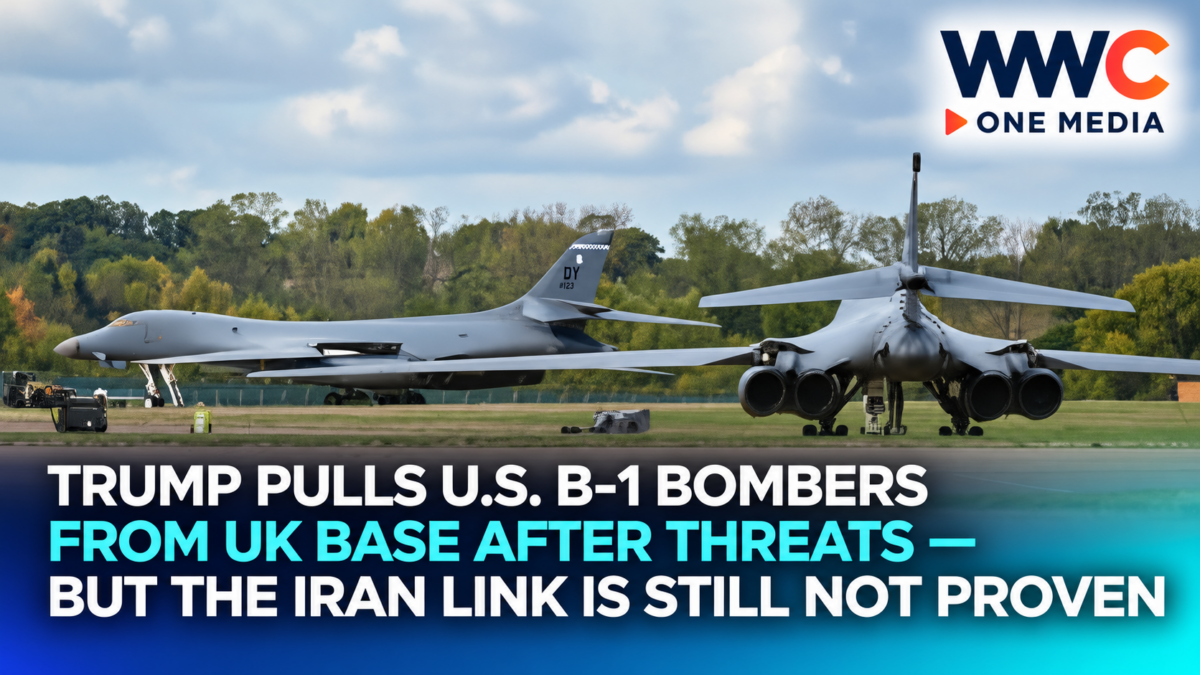
WASHINGTON/LONDON — President Donald Trump says the United States abruptly moved its B-1B Lancer bombers out of Britain because of security threats surrounding RAF Fairford, a strategically important airbase recently used for American strikes against Iran.
The decision followed the arrest of five young British men near RAF Fairford on September 27 on suspicion of terrorism and explosives offences.
A sixth suspect, a 25-year-old dual British-Iranian national, was later arrested in London.
All six have since been released on bail while Britain’s counter-terrorism investigation continues.
Trump said the bombers did not leave Britain accidentally or as part of an irrelevant routine movement.
“There were some threats,” he told reporters, explaining that he saw little reason to keep valuable aircraft exposed if moving them carried relatively little operational cost.
The Pentagon confirmed that the aircraft deployed at Fairford had returned to their home stations in the United States.
The move immediately raised a much larger question:
Did a suspected Iranian-linked plot succeed in forcing America to pull some of its most powerful conventional bombers away from a key European operating base?
The answer is not yet clear.
At least 12 B-1 bombers were moved
ABC News reported that at least a dozen B-1 bombers were flown from RAF Fairford back to bases in the United States.
A U.S. source familiar with the situation said the bombers’ departure was not a previously scheduled rotation, even though Secretary of State Marco Rubio publicly emphasized that military aircraft regularly move between locations.
That distinction matters.
If the aircraft were already scheduled to leave, the security incident may have had little operational significance.
If they were moved early because of a specific threat, the departure becomes evidence that U.S. commanders considered the danger serious enough to alter military posture.
Trump’s own comments strongly support the second interpretation.
But administration officials have not provided a complete public account of the intelligence behind the decision.
RAF Fairford is not an ordinary airfield
RAF Fairford, in Gloucestershire, is one of the most important facilities available to U.S. strategic aviation in Europe.
The base has hosted American long-range bombers for years and has become especially important during periods of heightened military activity.
In 2026, it was used as a staging location for U.S. operations against Iran, making it a highly visible symbol of American strike power close to the Middle East.
Its geographic value is obvious.
Operating from Britain places U.S. bombers substantially closer to Iran than their permanent home bases in the continental United States.
That can shorten missions, reduce the burden on aerial refueling tankers and allow aircraft and crews to respond more quickly.
Removing the bombers does not eliminate American strike capability.
But it reduces one convenient forward option.
The B-1 is built for exactly this kind of mission
The B-1B Lancer is a long-range, conventional heavy bomber capable of carrying the largest conventional weapons payload in the U.S. Air Force inventory.
The Air Force lists its maximum internal and external payload at roughly 75,000 pounds, with an intercontinental range and the ability to carry precision-guided weapons including Joint Direct Attack Munitions and JASSM cruise missiles.
Unlike the B-2 or B-52, the B-1 no longer has a nuclear mission.
Its nuclear capability was removed under arms-control commitments, making it a conventional strike platform.
That still makes each aircraft an extremely valuable military asset.
A group of 12 B-1s represents enormous potential firepower.
Moving them because of a ground-security concern is therefore significant.
Five men were arrested after suspicious vans were reported
The Fairford investigation began after reports of suspicious activity near the base.
British police arrested five men, aged roughly 23 to 25, near three white vans.
The men were initially detained under terrorism and explosives legislation.
Authorities recovered a quantity of petrol from the vehicles.
But British counter-terrorism police later stressed that they had found no improvised explosive device.
That is a critical factual distinction.
The suspects were arrested in relation to a suspected plot.
Authorities have not announced the discovery of a completed bomb.
Nor have any of the men been convicted.
The investigation remains ongoing.
One suspect reportedly called police himself
The case has become even more unusual because one of the men reportedly contacted emergency services.
Reuters reported that investigators were considering multiple explanations for what happened, including possibilities such as surveillance, a dry run or some form of political signaling.
Those possibilities remain investigative theories.
Authorities have not publicly established the full purpose of the group’s presence near RAF Fairford.
That uncertainty is one reason headlines describing a confirmed Iranian bombing plot should be treated cautiously.
There was a serious security incident.
But major facts remain unresolved.
A sixth suspect brought the Iran question closer
Several days after the initial arrests, counter-terrorism officers detained a 25-year-old dual UK-Iranian national in London.
Police searched two properties in connection with the investigation.
He was subsequently released on bail as inquiries continued.
His arrest strengthened public speculation about an Iranian connection.
But nationality alone does not prove state involvement.
British investigators have been examining whether any foreign government or proxy played a role.
They have not announced a final conclusion.
Britain says there are “strong indications” involving Iran
UK Prime Minister Andy Burnham has said there are “strong indications” that Iran may have been connected to the incident.
British and American investigators are examining whether the suspected activity involved a foreign government or people acting on its behalf.
Iran rejects the allegation.
Tehran has denied involvement and summoned the British ambassador in protest over accusations linking it to the Fairford investigation.
So the political positions are clear.
Britain believes there is significant reason to investigate an Iranian link.
Iran says the accusation is false.
The investigation has yet to publicly prove either side’s case.
JD Vance was more direct than British investigators
Vice President JD Vance went further.
He said the United States believed with some confidence that Iran was continuing a longstanding pattern of terrorist activity and said the bombers had been moved “out of an abundance of caution.”
That language strongly suggests the White House viewed Tehran as a credible threat to the aircraft.
But Vance stopped short of releasing evidence proving that the Iranian government directed the suspected Fairford activity.
That difference matters.
A government may take precautionary military action based on intelligence before evidence is strong enough to disclose publicly or support criminal charges.
Rubio then complicated the story
Secretary of State Marco Rubio offered a noticeably more cautious explanation.
He said he would not directly tie the bomber withdrawal to the suspected Fairford plot, noting that the U.S. regularly rotates military aircraft and reallocates forces depending on operational requirements.
Rubio nevertheless acknowledged concerns about foreign involvement in the wider security incident.
His remarks create an apparent tension inside the administration.
Trump says threats drove the move.
Vance emphasizes Iran and precaution.
Rubio says bomber redeployments should not automatically be treated as a direct reaction to the plot.
Those positions are not completely incompatible.
Security concerns could have accelerated a movement that military planners were already considering.
But the administration has not publicly reconciled the explanations.
Trump says America knows who made the threat
Trump went further than most officials, telling reporters that the U.S. knew who was behind the threat.
He declined to provide details when asked whether intelligence specifically identified Iran or an Iranian drone threat.
That leaves the most important evidence classified or undisclosed.
For accurate reporting, that means the Iranian connection should still be described as suspected or assessed, not conclusively established.
Iran had previously called Fairford a legitimate target
One reason U.S. and British officials are taking the threat seriously is that Iran’s Revolutionary Guards had previously identified RAF Fairford as a potential target because of its role in American military operations.
That does not prove Iran organized the September incident.
But it gives investigators a clear reason to examine the possibility.
RAF Fairford is not a random British installation.
It has been directly associated with U.S. strikes on Iranian targets.
From Tehran’s strategic perspective, that makes the base relevant to the conflict.
Security threats to Western bases are becoming more difficult
The incident also highlights a wider vulnerability exposed by modern warfare.
Heavy bombers are designed to survive hostile airspace.
But when parked on the ground, they can be far more vulnerable.
Recent wars have demonstrated how comparatively cheap:
drones;
saboteurs;
commercial vehicles;
explosives;
and long-range weapons
can threaten extraordinarily expensive aircraft while they are sitting at bases.
That changes military planning.
Protecting a $300 million-plus bomber from an enemy air-defense network is one challenge.
Protecting it from a small covert team operating near a perimeter fence is another.
Ukraine has shown what ground attacks can do to bomber fleets
Military planners have been paying especially close attention to attacks on aircraft inside supposedly secure bases.
Ukraine has repeatedly demonstrated that relatively inexpensive drones and covert operations can damage or destroy high-value Russian aircraft far from the front.
Those attacks have reinforced a basic military lesson:
concentrated aircraft on the ground can become extremely lucrative targets.
The Fairford incident occurred in a very different context and there is no evidence of the same tactics being prepared.
But the strategic concern is similar.
If intelligence suggested credible hostile surveillance or preparations near a bomber base, commanders had strong incentives to disperse the aircraft.
Moving the B-1s does not mean the U.S. cannot strike Iran
This point is important.
The B-1 is specifically designed for long-range operations.
The Air Force describes its range as intercontinental, and the aircraft can be refueled in flight.
That means B-1s can operate from the United States and still reach distant targets with tanker support.
America also retains extensive forces in and around the Middle East, including combat aircraft, ships and tens of thousands of personnel.
Fairford made operations easier.
It was not the only way to conduct them.
But the move can still have strategic consequences
Forward bases exist for a reason.
Aircraft stationed closer to a conflict generally:
reach targets faster;
require less tanker support;
can generate sorties more efficiently;
and give commanders more flexibility.
Removing a bomber deployment from Britain therefore imposes some operational cost, even if it does not eliminate capability.
That is why former British officials have warned that Tehran could interpret the withdrawal as evidence that indirect pressure can affect Western military deployments.
Whether Iran actually caused the move remains unproven.
But perception matters in deterrence.
Critics worry it could look like a victory for Tehran
Former British national-security officials told The National that the rapid U.S. departure risked being seen in Tehran as a success.
Their concern is not that the United States suddenly lost the ability to bomb Iran.
It is that a threatened base appears to have lost the aircraft being threatened.
An adversary could draw an uncomfortable lesson:
threatening high-value assets may force Washington to disperse them.
That could encourage further attempts against overseas facilities.
The opposite argument is just as strong
There is also a straightforward military counterargument.
Leaving expensive bombers exposed simply to avoid appearing intimidated would be irrational.
Aircraft can be moved.
Their mission can continue from elsewhere.
The purpose of force protection is to preserve combat power, not demonstrate bravery by parking valuable equipment in a potentially threatened location.
Trump himself made essentially that argument:
if moving the bombers is relatively easy, why leave them somewhere intelligence suggests may be dangerous?
From that perspective, dispersal is not retreat.
It is prudent risk management.
The U.S.-UK relationship remains vital
RAF Fairford has long represented unusually close American-British military cooperation.
The broader U.S. presence in Britain includes intelligence facilities, airbases and logistical hubs supporting NATO and operations across Europe and the Middle East.
Rubio publicly stressed that Washington still has confidence in British bases and denied that the movement represented a breakdown in the alliance.
That reassurance is important.
If the United States genuinely concluded British facilities were broadly unsafe, the implications would extend far beyond Fairford.
There is no evidence Washington has reached that conclusion.
Other U.S. bases in Europe are watching closely
ABC reported that vigilance has increased at other U.S. installations in Europe following the Fairford incident and that additional security measures could be introduced.
That is arguably the bigger military story.
Modern conflicts increasingly extend beyond formal battlefields.
Adversaries can use:
proxies;
cyber operations;
surveillance;
drones;
sabotage;
and covert action
against military infrastructure located inside allied countries.
Europe therefore cannot assume that bases supporting Middle East operations remain insulated simply because they sit thousands of kilometers away from conventional fighting.
Iran has repeatedly been accused of overseas plots
Western governments have previously accused Tehran and Iranian-linked actors of plotting attacks against dissidents, Jewish institutions and other targets outside Iran.
Britain has intensified scrutiny of suspected Iranian state activity in recent years.
At the same time, every case still requires individual evidence.
The Fairford allegations cannot simply be declared proven because other Iranian-linked plots have allegedly occurred.
That is why British counter-terrorism police continue investigating rather than announcing a conclusion.
A separate UK case highlights the wider concern
Two Iranian nationals appeared in a British court last week over an unrelated alleged terrorist plot targeting the Jewish community in Manchester.
Prosecutors allege they conducted surveillance and planned an attack under direction from another Iranian national believed to be in Iran.
British authorities have stressed that this case is not connected to the Fairford investigation.
The existence of two separate cases nevertheless adds to wider British concern over alleged hostile-state activity.
Again, allegation and proof must remain distinct.
Fairford may force Britain to reassess base security
Military installations have traditionally focused heavily on:
perimeter fences;
armed guards;
access controls;
and air defense.
The suspected plot demonstrates why security increasingly has to extend beyond the fence.
Potential adversaries can conduct surveillance from public roads.
They can use commercially available drones.
They can rent vehicles.
They can gather information from social media and aircraft-tracking communities.
Protecting strategic aircraft may therefore require larger security zones and tighter coordination between military and civilian police.
That could change the way Britain protects facilities hosting American strategic assets.
The timing is particularly sensitive
The bomber withdrawal comes amid continuing U.S.-Iran confrontation and growing strain on American military resources.
Reuters recently reported that 2026 operations have put heavy demands on U.S. missile stocks, drones and other assets, with the cost of multiple campaigns approaching tens of billions of dollars.
That makes every long-range bomber especially valuable.
Washington cannot afford unnecessary losses.
Dispersing aircraft when intelligence indicates a credible threat is therefore consistent with preserving scarce combat capacity.
The incident exposes the economics of modern military threats
There is another asymmetry at work.
A B-1 bomber costs hundreds of millions of dollars.
The Air Force’s historical fact sheet lists unit cost at about $317 million, though replacement value and modernized capability make any simple current-dollar comparison imperfect.
A small hostile team could potentially threaten that asset using equipment costing only a tiny fraction of the bomber’s value.
That creates a difficult security equation.
Defenders may have to spend enormous amounts protecting against relatively cheap methods of attack.
This problem now affects:
airfields;
naval bases;
energy infrastructure;
data centers;
and other strategic sites.
No explosion happened—and that matters
Despite the alarming security response, no attack at RAF Fairford has been reported.
Police found no viable explosive device.
No bomber was damaged.
No personnel were killed.
And all suspects remain under investigation rather than convicted.
That makes this ultimately a story about risk assessment, not a successful bombing.
The United States appears to have moved valuable aircraft because leaders believed the possibility of attack was serious enough to justify caution.
The Iran allegation remains the most important unanswered question
Washington and London have publicly pointed toward Tehran.
Iran categorically rejects the accusation.
British investigators are still examining the evidence.
Until that process produces firmer findings, the safest description is that the Fairford incident is suspected of having an Iranian or foreign-state connection.
Anything stronger risks turning an intelligence assessment into an established fact.
Trump’s decision may still reshape U.S. force protection
Even if the Fairford suspects are never proven to have acted for Iran, the incident may have already altered military thinking.
A dozen strategic bombers were moved.
Other European bases are on heightened alert.
British authorities are reassessing potential foreign-state threats.
And Washington has been reminded that an aircraft does not need to be flying over hostile territory to become a target.
That could lead to:
greater dispersion of bombers;
tighter security around foreign bases;
more rapid relocation plans;
counter-drone systems;
and fewer large concentrations of valuable aircraft.
The biggest question is whether caution strengthens deterrence—or weakens it
That is where the strategic debate begins.
One interpretation says Trump made the obvious decision:
protect billion-dollar-scale military capability rather than risk losing aircraft on the ground.
The other says removing bombers after a threat could embolden adversaries by showing that covert pressure changes American deployments.
Both arguments have merit.
The answer may depend on what happens next.
If Washington quickly returns bombers once security improves, the move may look like temporary dispersal.
If Fairford ceases to serve as an important bomber hub for Iran operations, the geopolitical meaning becomes much larger.
Trump says America moved its B-1s because there was no reason to leave them exposed to a threat.
That may have prevented a potentially catastrophic loss.
But if Iran or an Iranian proxy is eventually proven to have been behind the suspected plot, the episode will raise a far more uncomfortable question:
did a relatively small threat just demonstrate that even America’s most powerful bombers can be pushed off a strategically valuable base without a single shot being fired?