AUROVILLE, INDIA — A settlement founded to prove that people from different nations could live together beyond politics is now locked in one of the most bitter political and governance battles in its nearly six-decade history.
Auroville, the experimental international township straddling Tamil Nadu and Puducherry in southern India, is facing a deep struggle over roads, forests, housing, land, visas and ultimately who has the power to decide what the community should become.
Residents critical of the current administration accuse the government-appointed Auroville Foundation leadership of imposing development plans without the consensus culture that shaped the settlement for decades.
The Foundation’s leadership argues almost the opposite:
Auroville has spent too long delaying construction of the city envisioned by founder Mirra Alfassa—known as “The Mother”—and the legally approved Master Plan now needs to be implemented.
Both sides claim they are defending Auroville’s original vision.
That is what makes the conflict so difficult.
Auroville began as an experiment in human unity
Auroville was inaugurated on February 28, 1968, when around 5,000 people gathered on what was then a largely barren plateau near Puducherry.
Young representatives from 124 countries and 23 Indian states placed soil from their homelands inside an urn at the centre of the new settlement.
The township was conceived by The Mother, a close collaborator of Indian philosopher Sri Aurobindo.
Its founding charter declared that Auroville would belong not to any individual but to “humanity as a whole” and would serve as a place for continuous education, material and spiritual research, and the practical pursuit of human unity.
UNESCO had already endorsed the project before its inauguration.
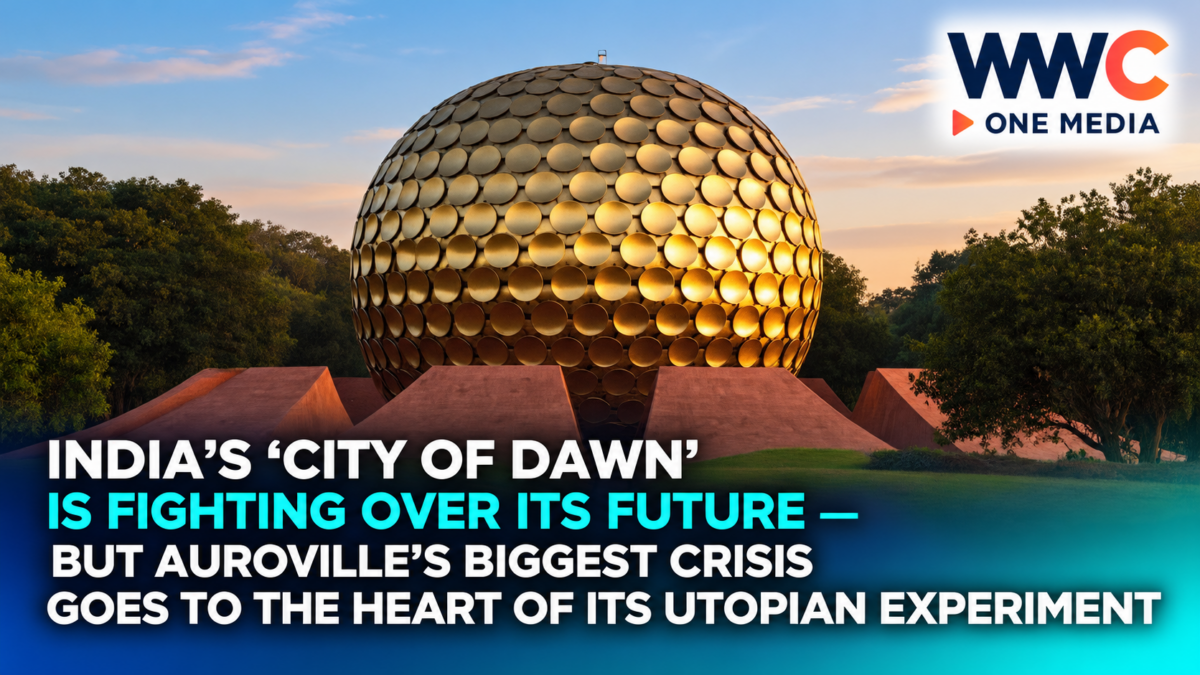
The long-term plan imagined a city with as many as 50,000 residents, arranged around the golden Matrimandir meditation centre and divided into residential, cultural, industrial and international zones surrounded by a green belt.
Almost 60 years later, however, Auroville remains far smaller than that original vision.
Auroville has only about 3,500 residents today
Auroville’s 2026 census lists 3,527 residents from 60 nationalities.
Of those, 1,888 are Indian.
The largest foreign communities include:
France, with 413 residents;
Germany, with 233;
Italy, with 161;
the United States, with 103;
and the Netherlands, with 100.
That makes Auroville extraordinarily international for a community of its size.
But it also creates one of the vulnerabilities now at the center of the dispute.
Many foreign Aurovilians do not own the land on which they live and depend on Indian visas to remain in the country.
That gives administrative decisions enormous personal consequences.
The crisis exploded in late 2021
The current conflict began escalating after Jayanti Ravi, a senior Indian civil servant, became secretary of the Auroville Foundation in 2021.
Ravi and the Governing Board pushed for faster implementation of Auroville’s approved Master Plan, particularly a circular infrastructure corridor known as the Crown.
The Foundation argues that the Crown is not a new proposal.
It forms part of the long-standing city plan approved by the Government of India.
Official planning documents describe the Crown as a 75-metre-wide special-use zone running through Auroville’s four main zones, incorporating a circular road and facilities needed to support the city.
The Foundation eventually settled on a road right-of-way of about 16.7 metres.
Its 2021 explanation said the actual Crown road footprint would occupy only about 0.36% of the overall Master Plan area.
That sounds relatively modest.
On the ground, however, parts of the planned corridor ran through areas residents had spent years turning into forests, community spaces and youth facilities.
That is where the dispute became explosive.
Bulldozers transformed a planning argument into a political crisis
In late 2021, machinery began clearing parts of the proposed Crown corridor.
Residents protested.
Some tried to physically block work.
Trees were removed.
Structures and community facilities were threatened or dismantled.
The confrontation quickly spread beyond road engineering into questions about environmental protection, internal democracy and government control.
Critics said Auroville’s traditional culture of consultation and consensus was being replaced by centralized decision-making.
The Foundation said long-delayed implementation of a legally approved plan was being obstructed by residents who had built or planted inside land reserved for future infrastructure.
Those are fundamentally different interpretations of the same events.
The Foundation says Auroville cannot remain permanently unfinished
Ravi has been explicit about her position.
In an interview published late last year, she argued that Auroville was originally designed for 50,000 people but has never come close to reaching that population because it lacks sufficient housing and infrastructure.
Her argument is that the community cannot fulfil The Mother’s vision if construction is indefinitely postponed.
She said the government intends to implement the Master Plan in a “time-bound manner.”
From that perspective, roads, housing, water and electricity are not threats to Auroville.
They are prerequisites for allowing thousands more people to live there.
Residents say the plan should evolve with reality
Opponents are not necessarily arguing that Auroville should never develop.
Their dispute is often about how development occurs.
The official Master Plan itself describes planning as a dynamic process and provides for development plans and annual plans beneath the broader long-term framework.
Residents have argued that decades of ecological restoration, newly created forests and existing settlements should influence how roads and buildings are actually placed.
Some proposed modifying or allowing parts of the Crown road to meander around ecologically sensitive areas.
The Foundation rejected some of those alternatives, saying they were impractical after consultation with town-planning and infrastructure experts.
So the disagreement is not simply:
road versus no road.
It is:
how literally should a decades-old urban concept be implemented when the landscape underneath it has changed dramatically?
Auroville’s forest is itself part of the experiment
When Auroville began, much of the site was severely degraded land.
Over decades, residents planted trees, restored soils, built water-retention systems and created farms and forests.
Today, the community includes more than 230 settlements and projects, including forest sanctuaries, organic farms, research centres, educational institutions and alternative housing experiments.
That ecological transformation is one of Auroville’s most celebrated achievements.
It also created the present contradiction.
Some land now considered environmentally valuable lies inside areas reserved for city infrastructure.
Developing the city can therefore mean disturbing ecosystems created by the very people who were trying to fulfil Auroville’s environmental ideals.
The legal fight reached India’s Supreme Court
Residents challenged aspects of the development push through the courts and environmental tribunals.
In March 2025, India’s Supreme Court delivered a major victory to the Auroville Foundation.
The court concluded that under the Auroville Foundation Act of 1988, the Governing Board has general superintendence, direction and management of the Foundation.
The court said the Residents’ Assembly had been required to participate in formulating the Master Plan—but once that plan was approved, the Governing Board retained authority to ensure its implementation.
The Master Plan had been approved in consultation with the Residents’ Assembly in 1999, cleared by the relevant central planning authority in 2001 and later published in India’s official Gazette.
That ruling significantly weakened the residents’ argument that internal community bodies could legally block the Governing Board from executing the plan.
The Supreme Court also overturned an environmental roadblock
In a separate ruling concerning the Crown road, the Supreme Court overturned earlier intervention by India’s National Green Tribunal.
The court concluded that the Tribunal had gone beyond the appropriate scope of judicial review by interfering with implementation of the approved Master Plan.
That does not mean every environmental concern was proven baseless.
It means the highest court concluded that the statutory planning authority belonged to the Foundation and that the approved planning framework could not be effectively rewritten through that litigation.
Legally, that gave the administration a much stronger hand.
Politically, it did not end the conflict.
Another 2026 court ruling strengthened the Foundation further
The Madras High Court continued that trend this year.
In litigation involving 18.37 acres occupied for decades by residents, petitioners said they had lived there since 1986, invested personal resources and transformed barren coastal land through afforestation.
They challenged a proposed land exchange and redevelopment process.
The court nevertheless ruled that these residents were essentially permissive occupants rather than landowners and that the Auroville Foundation had legal authority over its property.
The ruling allowed the residents to seek continued residence or alternative accommodation but did not give them the right to prevent the Foundation from using the land.
That distinction goes to the heart of Auroville’s unusual structure.
Residents may spend decades building and caring for a place without holding conventional private-property rights.
That creates an uncomfortable contradiction with Auroville’s charter
Auroville’s founding charter says the township belongs to “humanity as a whole.”
Legally, however, the land and institutional authority sit inside a statutory Indian foundation ultimately operating under the country’s Ministry of Education.
For decades, those two realities coexisted through compromise and informal community governance.
The current dispute has exposed what happens when they collide.
Spiritual ownership is one thing.
Legal ownership is another.
Foreign residents are particularly vulnerable
The FT highlights the situation of long-serving foreign Aurovilians whose ability to remain in India depends on visas.
Some residents critical of the administration say visa recommendations have become part of the power struggle.
The case of veteran Aurovilian Frederick Schulze-Buxloh, whose visa was denied after decades of involvement in the community, became one of the most prominent examples.
Because immigration decisions are ultimately sovereign government decisions, foreign residents have much less security than Indian citizens.
That creates a fundamental imbalance inside a township explicitly founded around international participation.
Critics accuse the administration of centralizing power
Residents opposed to the current administration say the dispute now extends far beyond one road.
They allege that community bodies have been bypassed or replaced, access to financial resources has been tightened, dissident residents have faced administrative pressure and traditional consensus structures have lost influence.
These remain claims from one side of a deeply contested internal conflict and should not be presented as independently proven in every instance.
The administration’s position is that many changes were necessary because informal structures had obstructed lawful governance and slowed implementation of the city plan.
The 1988 law deliberately created three centres of authority
Auroville is unusual because its governing statute does not create one ordinary municipal government.
The Auroville Foundation Act establishes three authorities:
the Governing Board;
the Residents’ Assembly;
and the Auroville International Advisory Council.
The Governing Board is appointed by India’s central government.
The Residents’ Assembly represents adult residents.
The International Advisory Council provides advice around Auroville’s broader ideals and international character.
That structure was supposed to balance state oversight with community participation.
The dispute is largely about where that balance now lies.
The Supreme Court gave the Governing Board the stronger legal position
The Supreme Court was unambiguous on one point.
General management authority rests with the Governing Board.
The Residents’ Assembly does not possess an equal veto over implementation decisions once the Master Plan has already been formally adopted.
For supporters of the current administration, this settled years of uncertainty.
For critics, it produced a new fear:
that a community founded as an experiment in participatory human unity could legally become highly centralized.
The ruling settled a statutory question.
It did not settle the philosophical one.
Parliament then complicated the picture
Just months after the Supreme Court rulings, an Indian parliamentary committee reviewing autonomous higher-education institutions examined Auroville.
Its recommendations were notably more sympathetic to residents’ concerns.
A summary of the committee’s report says it stressed Auroville’s distinctive and autonomous character and described an empowered Residents’ Assembly as critical because it is the statutory body representing residents.
The committee also recommended that implementation of the Master Plan occur in close consultation with the Residents’ Assembly and other stakeholders and that land transactions be conducted transparently.
Those recommendations are advisory rather than a reversal of the Supreme Court.
But politically, they matter.
Parliament also raised concern over Annapurna Farm
One of the biggest current disputes concerns Annapurna Farm, an important agricultural operation associated with Auroville.
The parliamentary committee welcomed plans involving IIT Madras but reportedly recommended that Annapurna Farm not be disturbed and that an alternative location be considered.
The issue resurfaced this year when eviction notices were issued to residents associated with the farm.
In September, the parliamentary committee’s chair reportedly urged the Education Ministry to halt irreversible action—including demolitions, evictions or land transfers—until the matter could be properly reviewed.
That shows the political dispute remains active despite the Foundation’s strong legal position.
The conflict now involves two different definitions of Auroville
One side sees Auroville primarily as a city that was never completed.
From that perspective, only about 3,500 people living in a settlement designed for 50,000 represents failure to implement the founding vision.
Housing must expand.
Roads must be built.
Urban zones must take shape.
The planned city must finally become a city.
The other side sees Auroville primarily as a living experiment that evolved organically.
Over decades, residents created forests, farms, schools, enterprises and communities.
From that perspective, the reality that emerged on the ground should matter at least as much as lines drawn decades earlier on a planning map.
Both arguments can invoke The Mother.
That may be why compromise has been so difficult.
Auroville’s population problem strengthens the administration’s case
There is no avoiding one uncomfortable number:
50,000 planned residents versus 3,527 actual residents.
After nearly six decades, Auroville has reached only about 7% of its intended population.
Supporters of faster development argue that this demonstrates the existing model has failed to scale.
A settlement without enough housing, transportation or infrastructure cannot suddenly welcome tens of thousands of new residents.
From that perspective, environmental protection without urban development risks preserving Auroville as a small enclave rather than creating the international city originally envisioned.
But scaling Auroville could destroy what made it special
The opposite risk is equally obvious.
Rapid development could transform one of India’s most unusual ecological and social experiments into a far more conventional planned township.
The forests residents planted are now mature.
Community farms provide food.
Alternative architecture and educational institutions have developed around low-density settlement patterns.
Expanding from roughly 3,500 people toward tens of thousands would fundamentally alter the landscape.
So the question is not merely whether Auroville should grow.
It is how much of present-day Auroville would survive that growth.
The political atmosphere in India makes the dispute more sensitive
Critics quoted by the FT place Auroville’s conflict inside a broader debate about centralization under India’s national government.
Some residents believe the community’s unusually international, decentralized culture is viewed with suspicion by officials seeking stronger institutional control.
Government supporters reject the implication that implementing a legally approved city plan amounts to an ideological takeover.
They argue that the Foundation is exercising authority explicitly granted by Parliament and reaffirmed by India’s Supreme Court.
Without direct evidence, claims that the development drive is primarily an ideological or nationalist project should therefore be treated as interpretation, not established fact.
Auroville’s international identity is still real
Despite the conflict, Auroville remains extraordinarily diverse.
Its 2026 population includes residents from 60 countries, with nearly half of the population still coming from outside India.
That international character is not incidental.
It is foundational.
At Auroville’s opening ceremony, representatives from 124 nations symbolically contributed soil to the community.
Any governance structure that weakens meaningful international participation therefore raises a deeper question about whether Auroville could remain recognizably Auroville even if its buildings and roads match the original Master Plan.
The paradox is that both sides can claim the law and the vision—but not in the same way
The Foundation has the stronger legal argument after the Supreme Court decisions.
The Governing Board has statutory management authority.
The Master Plan was legally approved.
The Crown road forms part of that plan.
Residents have the stronger argument that Auroville’s founding experiment was always supposed to involve an unusual level of participation and international community life.
Even Parliament’s own committee has emphasized the importance of an empowered Residents’ Assembly and consultation.
Those positions are not necessarily impossible to reconcile.
But the last several years have shown how far trust has broken down.
What happens next may depend less on another court case and more on rebuilding trust
India’s courts have already answered much of the legal question.
The Governing Board has broad power.
What remains unresolved is whether it should use that power without deep community participation simply because it legally can.
Likewise, residents must confront another reality:
Auroville cannot claim to be building a city for 50,000 while permanently blocking the infrastructure necessary to accommodate anything close to that population.
The most sustainable outcome probably lies somewhere between those extremes.
A city cannot be governed entirely by endless consensus.
But a community built around human unity cannot survive indefinitely through coercion either.
Auroville’s deepest crisis is therefore philosophical
This began as a fight over a road.
It became a fight over trees.
Then land.
Then visas.
Then courts.
Now it has become a struggle over the meaning of the entire project.
Is Auroville a government-recognized planned city that must finally be completed?
Or is it an evolving international community whose residents should continually reinterpret that plan?
India’s Supreme Court has largely answered the legal version of that question.
The Governing Board has the final statutory authority.
But Auroville was never conceived merely as a legal structure.
Its founding promise was much more ambitious:
to demonstrate whether people from different cultures could live and make decisions together in pursuit of human unity.
That is why the current conflict is so damaging.
Auroville can build the Crown road.
It can construct new housing.
It can eventually accommodate thousands more people.
But if the process of building the “City of Dawn” permanently fractures the community that was supposed to embody its ideals, the project could win its legal battle—
and still lose the experiment that made Auroville matter in the first place.