WASHINGTON/BEIJING — The United States and China are no longer fighting mainly over tariffs, semiconductors or Taiwan. Their rivalry is expanding into something much larger: a contest over the infrastructure, minerals, shipping routes, currencies, artificial intelligence systems and alliances that could determine how the global economy works for decades.
Financial Times columnist Rana Foroohar compares the struggle with the 19th-century “Great Game,” when the British and Russian empires competed for influence across Central Asia.
The comparison is imperfect.
America and China are deeply economically intertwined in ways Britain and imperial Russia never were.
They trade hundreds of billions of dollars of goods.
Their companies remain linked through enormous supply chains.
Their financial markets affect each other.
And neither side appears to want a direct military conflict.
But the underlying idea is increasingly relevant.
This is no longer simply a fight over which country has the larger economy.
It is becoming a competition over systems.
Who processes the minerals?
Who builds the ships?
Who owns the ports?
Whose AI models become standards?
Whose currency settles transactions?
Whose technology powers governments and businesses?
And which country can persuade the rest of the world that aligning with its system is the safer bet?
That is the real “new Great Game.”
China’s biggest advantage may be hidden inside supply chains
China’s power is often measured by GDP, exports or military spending.
But some of its strongest leverage sits much deeper inside the global economy.
Critical minerals are one example.
Reuters reported in September that despite billions of dollars in Western investment, China still controls roughly 70% to 95% of refining capacity for several strategically important minerals.
Its share of rare-earth refining, although down from above 90%, was still around 85% in 2025.
China also controls approximately 98% of global lithium-iron-phosphate cathode-material production, according to data cited from the International Energy Agency.
These materials are essential for:
electric vehicles;
wind turbines;
electronics;
missile systems;
industrial motors;
data centers;
and advanced weapons.
This gives Beijing leverage that is difficult to replicate quickly.
A country may discover a lithium or rare-earth deposit.
That does not mean it can turn the raw material into something an advanced factory can immediately use.
Mining is only the beginning.
Refining and processing are where much of China’s strategic advantage lies.
Rare earths have already changed U.S. behavior
That leverage is not theoretical.
Ahead of recent Trump-Xi diplomacy, Reuters reported that China’s control of rare-earth supply had helped push Washington toward a less confrontational position because U.S. industry remains dependent on Chinese material.
China controls more than 85% of rare-earth refining and production, according to the reporting.
The United States is investing heavily to reduce that dependence.
But rebuilding an entire mineral ecosystem takes years.
Reuters reported this summer that the U.S. produced only around 300 metric tons of rare-earth magnets in 2025 despite consuming roughly 48,000 tons.
Some strategic minerals are still not produced domestically in meaningful quantities at all.
That makes minerals one of Beijing’s most powerful economic pressure points.
Washington can restrict advanced chips.
Beijing can restrict the materials needed to build advanced machines.
Each superpower has something the other still needs.
America has responded by going back to Central Asia
The comparison with the original Great Game becomes especially literal in Central Asia.
In February, Washington signed a Joint Investment Framework with Uzbekistan focused on critical minerals.
The agreement prioritizes investment in:
exploration;
mining;
processing;
and infrastructure.
It also proposes a joint U.S.-Uzbek investment holding company.
Uzbekistan contains important reserves of uranium, copper, lithium, tungsten and other strategic materials.
The deal illustrates Washington’s new approach.
Instead of treating minerals as ordinary commodities, the United States increasingly views them as part of national security.
China reached that conclusion much earlier.
Beijing got there first
China’s economic relationships across Central Asia have expanded rapidly through infrastructure investment, trade and the Belt and Road Initiative.
Beijing often finances not only mines, but also the infrastructure needed to make those mines commercially useful:
roads;
railways;
power;
processing plants;
and export corridors.
That gives China influence across more of the supply chain.
The Belt and Road Initiative itself has also regained momentum.
Reuters Breakingviews estimated that Belt and Road-related agreements reached a record $213 billion in 2025, helped by smaller projects, more equity financing and a renewed focus on industrial standards and supply chains.
The initiative is no longer simply about building dramatic highways and ports.
Its newer form is increasingly about embedding Chinese companies, standards and financing into the economic infrastructure of partner nations.
Ports may matter as much as mines
China has also spent decades building influence across global maritime trade.
The state-owned shipping giant COSCO operates the world’s largest shipping fleet and has operations or port connections across more than 160 countries.
Its shipbuilding arm is now expanding through a public listing as Beijing strengthens its already dominant maritime-industrial base.
This matters because ports are not just transportation facilities.
They are nodes controlling:
cargo data;
container flows;
energy imports;
industrial inputs;
and potentially naval access.
Commercial infrastructure can therefore have strategic value.
The FT’s larger argument is that China increasingly understands physical trade networks as instruments of national power—not simply business assets.
China also dominates shipbuilding
The maritime imbalance is striking.
UN Trade and Development says 91% of ships completed globally in 2025 were built in China, South Korea or Japan, with China now the largest shipbuilder by a wide margin.
Reuters reported that Chinese yards captured around 74% of global new ship orders during the first seven months of 2026.
The U.S., by comparison, has allowed its commercial shipbuilding sector to shrink dramatically.
That has strategic implications.
A country with a giant commercial shipbuilding ecosystem also possesses:
dry docks;
steel fabrication;
marine engineering;
skilled workers;
ship-repair facilities;
and enormous supplier networks.
Those capabilities can support naval expansion too.
That is why Washington has begun treating shipbuilding as an economic-security priority again.
But China’s maritime ambitions are not unstoppable
Washington has also demonstrated that it can disrupt Chinese expansion when allies cooperate.
One revealing example is LOGINK, China’s state-backed logistics-data platform.
U.S. officials once feared LOGINK could become a global maritime-information system capable of giving Beijing visibility into cargo flows and commercial activity.
But Reuters reported this week that the platform’s international ambitions largely collapsed after legal problems, financial trouble and sustained U.S. diplomatic pressure discouraged allied governments and ports from participating.
That is an important counterexample.
China can build powerful systems.
It does not automatically get to internationalize them.
American alliances and regulatory influence can still block adoption.
The United States still controls the world’s most important financial system
This may remain Washington’s single greatest structural advantage.
Despite years of predictions about “de-dollarization,” the U.S. dollar remains the world’s dominant reserve currency.
IMF data show the dollar accounted for 56.7% of global foreign-exchange reserves in the second quarter of 2026.
That share is lower than it was decades ago.
But no competitor is remotely close.
The euro remains far behind.
The Chinese renminbi represents only a small fraction of global reserves.
That gives Washington extraordinary power.
The dollar sits at the center of:
global banking;
trade finance;
commodity pricing;
foreign reserves;
international debt;
and payment systems.
Countries may trade heavily with China.
Many still save, borrow and settle financial transactions primarily through the dollar system.
The dollar is more than a currency
Dollar dominance gives the United States leverage that China cannot yet match.
American financial sanctions can be devastating because so much international activity touches U.S. banks or dollar clearing.
Treasury markets also provide a vast pool of highly liquid assets for global governments and investors.
Even countries trying to reduce exposure to the United States often struggle to find an alternative with comparable:
liquidity;
market depth;
convertibility;
and legal infrastructure.
That is why America can remain financially central even while China becomes more industrially important.
The two countries dominate different layers of the global system.
AI is another front where the picture is surprisingly balanced
Artificial intelligence once looked like a clear American advantage.
That gap has narrowed dramatically.
Stanford’s 2026 AI Index concludes that the performance gap between top U.S. and Chinese AI models has effectively closed.
As of March, Stanford measured the leading U.S. model at only about 2.7% ahead on its benchmark framework.
Chinese and American systems have traded the lead several times since early 2025.
China also leads in AI publication volume, citations, patent output and industrial-robot installations.
But the United States remains far ahead in private AI investment.
U.S. private AI funding reached $285.9 billion in 2025, more than 23 times China’s $12.4 billion in recorded private investment, although Stanford cautions that private-sector numbers understate China’s government-backed funding.
So neither country clearly dominates every part of AI.
America has capital and chips; China has scale and engineering depth
The AI rivalry increasingly resembles the broader economic contest.
America has:
Nvidia;
leading cloud companies;
frontier AI laboratories;
deep venture-capital markets;
and world-class universities.
China has:
massive engineering talent;
industrial deployment;
strong state coordination;
low-cost models;
robotics leadership;
and enormous domestic manufacturing capability.
Reuters reported in September that AI had become one of the most sensitive issues in Trump-Xi talks, particularly over advanced-chip access and Chinese model development.
Neither side wants the other to gain a decisive lead.
That ensures export controls and technological restrictions are likely to continue.
The battle is increasingly over open AI
Another important shift is occurring in customizable AI models.
Chinese companies such as Alibaba, Z.ai and DeepSeek have built powerful open or open-weight models that organizations can run on their own infrastructure.
The U.S. remains stronger in many proprietary systems, but Chinese open models have become highly competitive.
That is why American startups such as Nvidia-backed Reflection AI are now explicitly trying to counter China’s advantage.
This matters because open models can spread standards.
A company in Indonesia, Brazil or Saudi Arabia might not care which country has the most prestigious chatbot.
It may care which model is:
cheaper;
customizable;
available locally;
and easy to deploy.
Influence can therefore spread through technology adoption rather than diplomacy.
The South China Sea remains the most dangerous physical arena
Economic competition exists alongside military rivalry.
The South China Sea remains one of the most contested regions.
Reuters reported this month that satellite imagery shows China accelerating construction on Antelope Reef in the Paracel Islands, including what analysts believe could become a military-grade runway by mid-2027.
China argues many of its installations serve civilian, research and defensive purposes.
Other governments see them as part of a broader militarization strategy.
The underlying strategic importance is enormous.
The South China Sea connects major Asian economies and carries some of the world’s busiest shipping routes.
China wants greater control over its immediate maritime environment.
The U.S. wants to prevent any single power from dominating those routes.
Taiwan makes the rivalry even more dangerous
No issue carries more risk than Taiwan.
Washington continues selling weapons and supporting Taiwan’s self-defense.
Beijing considers Taiwan part of China and has not renounced the use of force.
Reuters reported Tuesday that a potential new U.S. arms package could be worth around $14 billion, though final details remain under review.
Both sides simultaneously want leverage and restraint.
Trump has delayed some decisions to preserve room for negotiations with Xi.
But Washington continues signaling that its support for Taiwan remains.
This is what makes the new Great Game fundamentally different from an ordinary trade dispute.
It carries military escalation risk.
Yet most Asian countries do not want to choose
This may ultimately be the biggest weakness in both superpowers’ strategies.
ASEAN members, India, South Korea and other middle powers increasingly resist binary alignment.
At Reuters NEXT Asia, policymakers and investors repeatedly emphasized strategic flexibility rather than choosing between Washington and Beijing.
Thailand, for example, described its goal as becoming a “trusted connector” while selecting partnerships based on technology transfer, investment quality and domestic benefits.
This approach is spreading.
Countries want Chinese infrastructure and trade.
They may simultaneously want U.S. security guarantees, technology and capital.
Their objective is not ideological purity.
It is bargaining power.
South Korea illustrates the dilemma
South Korea is one of America’s closest military allies.
It also has enormous commercial exposure to China.
That increasingly makes Washington uncomfortable.
A senior U.S. Republican lawmaker recently called for scrutiny of South Korea’s China relationship, citing semiconductor investments and growing economic ties.
Seoul responded by reaffirming that its U.S. alliance remains central.
But it also made clear that China remains economically important.
That balancing act is not unique to South Korea.
Much of Asia faces the same reality.
India may become one of the biggest swing powers
India is another crucial example.
Washington wants New Delhi as a strategic counterweight to China.
The two cooperate through the Quad and other Indo-Pacific initiatives.
But India refuses to become a conventional American ally.
It continues buying Russian oil.
It maintains an independent foreign policy.
And current U.S.-India trade talks have reached what Indian Finance Minister Nirmala Sitharaman called a “plateau” amid American tariff pressure.
India’s choices could matter enormously.
A closer U.S.-India alignment would strengthen Washington’s position across the Indo-Pacific.
A more independent India would prevent the world from dividing neatly into two blocs.
Europe also wants room to maneuver
Europe faces a similar problem.
It worries about Chinese industrial subsidies, trade imbalances and strategic dependence.
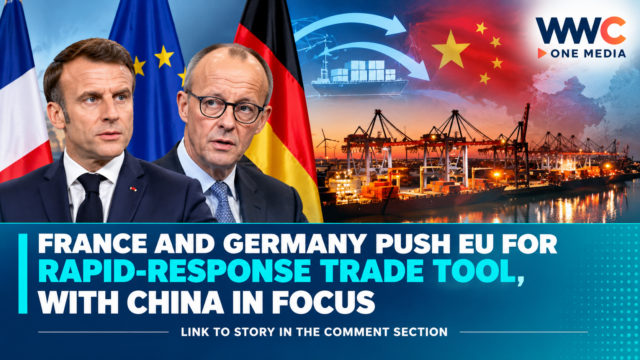
France and Germany have proposed new rapid-response trade tools likely aimed largely at China.
But Europe also depends on China as a major trading partner.
Many European governments do not want a complete economic break.
The EU’s preferred language is increasingly “de-risking” rather than decoupling.
That means reducing dangerous dependencies without eliminating trade.
Again, the world refuses to fit neatly into an American-versus-Chinese binary.
The Arctic is becoming another frontier
Climate change is opening new shipping routes and increasing interest in Arctic resources.
China has described itself as a “near-Arctic state” and has pursued scientific, commercial and infrastructure relationships across the region.
The United States, Canada and Nordic countries are increasingly treating the Arctic as a security theater.
The FT identifies the region as another arena in the new Great Game.
Here too, middle powers matter.
Greenland.
Norway.
Finland.
Iceland.
Canada.
Russia.
Their decisions can shape which outside power gains access to minerals, ports and shipping routes.
Digital payments could become another system battle
China has also worked for years to internationalize alternative payment infrastructure and reduce exposure to the dollar.
The renminbi has not displaced the dollar.
But digital payments create new pathways.
Chinese platforms have already exported payment technology throughout parts of Asia, Africa and Latin America.
Central-bank digital currencies could eventually add another layer.
Washington’s advantage remains enormous.
But payments are precisely the kind of system that can shift gradually before becoming visible in headline reserve statistics.
That is why competition over finance will continue even if the dollar remains dominant.
China’s industrial ecosystem may be its hardest advantage to copy
Perhaps the most important lesson from the FT analysis is that power increasingly lies in networks rather than individual products.
China does not merely manufacture batteries.
It processes the minerals.
Makes the cathode materials.
Builds the factories.
Produces the machines.
Ships the products.
Finances infrastructure.
And increasingly owns or operates parts of the logistics network.
That integrated system creates resilience and leverage.
The U.S. can subsidize a new factory.
Recreating an entire industrial ecosystem is much harder.
But China also has serious weaknesses
The new Great Game is not a story of inevitable Chinese victory.
China faces:
slowing economic growth;
property-sector problems;
high local-government debt;
weak demographics;
capital-control concerns;
and international resistance to some of its overseas investments.
Its attempts to internationalize certain systems have also failed.
LOGINK is one example.
Some Belt and Road countries have renegotiated debts or become cautious about additional borrowing.
Chinese technology can also face security restrictions abroad.
Beijing possesses immense structural power.
It does not possess unlimited trust.
America has its own vulnerabilities
The United States also faces structural problems.
Its commercial shipbuilding base is weak.
Critical-mineral supply chains remain highly dependent on China.
Infrastructure can be slow and expensive to build.
Political polarization can make long-term industrial policy inconsistent.
And Stanford’s AI Index notes that the number of AI researchers and developers relocating to the U.S. has fallen dramatically since 2017.
America’s alliances are powerful.
But allies increasingly question whether U.S. policy will remain stable across presidential administrations.
That uncertainty can weaken Washington’s influence even when countries prefer the American security system.
China offers infrastructure; America offers a system
The rivalry can be simplified too easily.
China is not only offering roads and ports.
America is not only offering military alliances.
But there is a broad contrast.
Beijing often competes through:
infrastructure;
trade;
industrial supply chains;
commodity demand;
and state-backed financing.
Washington competes through:
finance;
military alliances;
advanced technology;
capital markets;
the dollar;
and institutional networks.
The most successful countries in between increasingly use both.
That is precisely why neither superpower can fully control the outcome.
This is not a new Cold War
Calling the competition a new Cold War can be misleading.
The United States and Soviet Union had relatively limited direct economic integration.
America and China remain deeply connected.
Their businesses trade.
Their investors watch each other’s markets.
Their supply chains overlap.
Their citizens travel and study across borders.
A complete split would be economically devastating.
That means the likely future is not clean separation.
It is managed rivalry with selective interdependence.
Countries will cooperate where necessary and restrict one another where strategically useful.
That is a messier system than the Cold War.
It may also be harder to manage.
The biggest danger is miscalculation
When competition spreads across:
technology;
trade;
military security;
minerals;
shipping;
finance;
and ideology,
almost any commercial dispute can acquire geopolitical significance.
A semiconductor export license becomes national security.
A port investment becomes naval strategy.
A mineral refinery becomes defense policy.
A social-media app becomes an intelligence concern.
A commercial satellite becomes military infrastructure.
That creates endless opportunities for escalation.
And because America and China remain economically linked, retaliation can quickly damage both.
The biggest winners may be the countries in the middle
The irony is that intensifying U.S.-China rivalry can create opportunities for everyone else.
Vietnam can attract manufacturing leaving China while continuing to trade heavily with Beijing.
India can court U.S. technology while protecting strategic autonomy.
Singapore can serve American and Chinese businesses.
Saudi Arabia and the UAE can attract investment from both sides.
Central Asian governments can negotiate better terms for their minerals.
Latin American countries can seek competing infrastructure offers.
The more Washington and Beijing compete, the more leverage these countries gain.
That may ultimately make the world more multipolar, not less.
That is why neither Xi nor Trump can decide who wins
China’s strengths are formidable:
industrial depth;
shipping;
critical minerals;
manufacturing scale;
and infrastructure diplomacy.
America retains equally formidable assets:
the dollar;
global capital markets;
frontier technology;
alliances;
military reach;
and enormous innovation capacity.
The FT’s “Great Game” analogy works best when it emphasizes one lesson from history:
great-power rivalry is rarely determined entirely by the great powers themselves.
Smaller and middle-sized countries can change alliances.
Technologies can shift unexpectedly.
Financial crises can rewrite strategy.
Wars can destroy assumptions.
Domestic politics can weaken foreign policy.
And economic breakthroughs can create advantages nobody predicted.
The U.S.-China rivalry is therefore not a race with one scoreboard.
China can dominate shipbuilding while America dominates reserve currencies.
America can lead private AI investment while Chinese models close the capability gap.
China can control rare-earth refining while the U.S. controls critical semiconductor technology.
Both can claim victories simultaneously.
The decisive question is which system the rest of the world increasingly chooses to depend on.
And right now, much of the world is sending both Beijing and Washington the same message:
we would rather depend completely on neither.