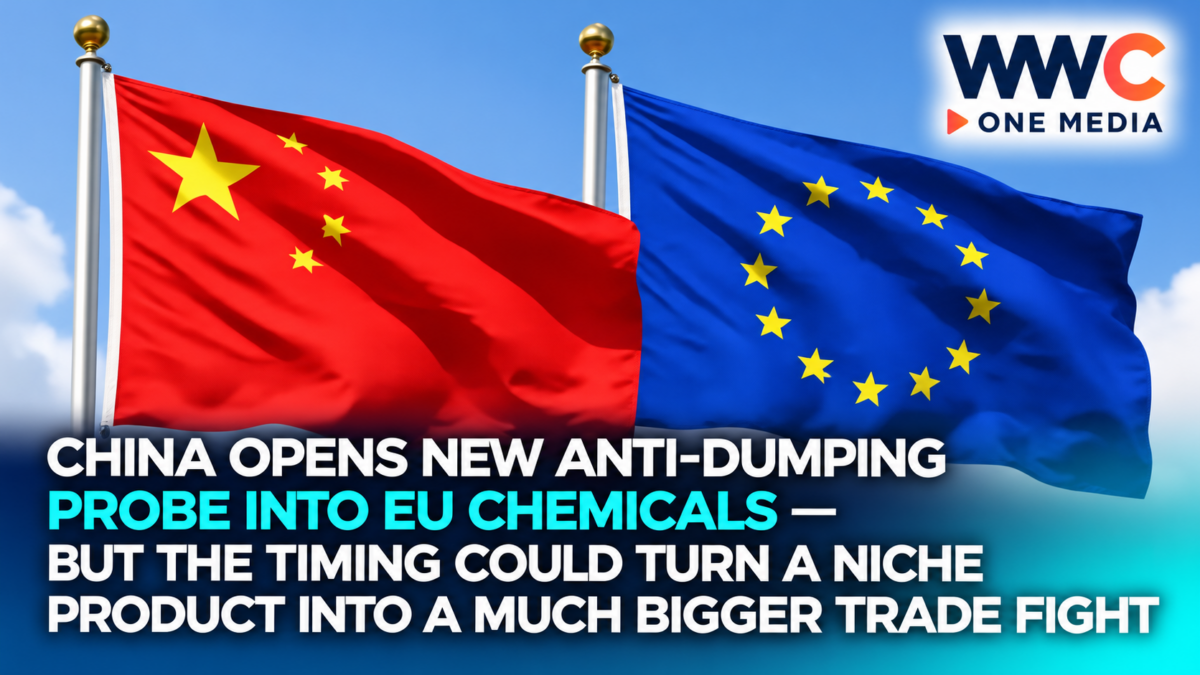
BEIJING/BRUSSELS — China has opened a new anti-dumping investigation into European chemical exports just days before senior EU officials arrive in Beijing for crucial trade talks, adding another flashpoint to an economic relationship already under strain from electric vehicles, rare earths, chemicals and a widening European trade deficit.
China’s Ministry of Commerce announced on October 3 that it is investigating imports of p-nitrotoluene, also known as 4-nitrotoluene or PNT, originating in the European Union. The chemical is used to manufacture products for dyes, pigments, pesticides and pharmaceuticals.
The investigation was requested by two Chinese producers — Jiangsu Huaihe Chemical and Hubei Dongfang Chemical — which Beijing says represent a sufficient share of the domestic industry to bring an anti-dumping complaint.
Chinese authorities say preliminary evidence submitted by the companies shows imports from the EU remained at high levels from 2022 through 2025 while their prices fell by nearly 60% cumulatively, allegedly damaging domestic producers.
That does not mean dumping has already been proven.
It means China has decided there is enough initial evidence to investigate.
No final anti-dumping duty has yet been imposed.
China says the probe follows WTO rules
Beijing says the case will be handled under Chinese anti-dumping law and World Trade Organization rules, with affected companies allowed to submit evidence and participate in the investigation.
The formal dumping investigation covers July 1, 2025 through June 30, 2026, while the injury investigation examines conditions in China’s domestic industry from January 1, 2022 through June 30, 2026.
The investigation is scheduled to conclude before October 3, 2027.
Chinese authorities can extend it by another six months under special circumstances.
So immediate tariffs should not be assumed.
But if Beijing ultimately determines EU producers sold PNT in China below fair value and materially harmed Chinese industry, anti-dumping duties could follow.
What is p-nitrotoluene?
The chemical at the center of the dispute is not a household product.
P-nitrotoluene is an intermediate chemical used further down the industrial supply chain.
It can be processed into compounds used in:
pharmaceuticals;
agrochemicals;
dyes;
pigments;
and other specialty chemical products.
That makes the product small compared with cars, steel or semiconductors.
But the symbolism is much larger.
Chemicals have become one of the most contested sectors in EU-China trade.
Beijing says Europe has already targeted Chinese chemicals repeatedly
China’s Commerce Ministry explicitly linked its new investigation to the growing number of EU trade-defense actions against Chinese exports.
Beijing says the European Union has launched 28 trade-remedy investigations against China since 2025, with roughly half involving chemical products.
China also pointed to several recent European probes involving products such as polyvinyl chloride and other chemical inputs.
From Beijing’s perspective, the new PNT investigation is therefore not happening in isolation.
It is part of a broader cycle of defensive trade measures.
Europe has been aggressively investigating Chinese dumping too
The EU has significantly increased trade-defense activity as European manufacturers complain that excess Chinese industrial capacity is being pushed onto overseas markets at prices local producers cannot match.
European Commission trade officials said Chinese imports into the EU reached roughly €571 billion in 2025, helping create a trade deficit of around €360 billion.
The Commission opened 32 new trade-defense cases in 2025, close to the record 33 launched in 2024.
Twenty-seven more had already been opened in 2026 by early October.
More than one-third of recent cases involve chemicals.
So the chemical sector is increasingly becoming one of the main battlefields in the trade relationship.
Europe recently imposed huge duties on another chemical
The intensity of the fight is visible in recent EU measures.
In June, the European Commission imposed definitive anti-dumping duties on 1,4-butanediol, or BDO, imported from China, Saudi Arabia and the United States.
Duties on Chinese producers ranged from about 105.6% to 113.7% after the Commission concluded dumped imports had injured European producers.
BDO is itself a major industrial chemical used in plastics, electronics, automotive components, textiles, batteries, pharmaceuticals and defense-related products.
That case illustrates how aggressively both sides are now willing to use trade-defense instruments in chemicals.
China’s move comes at an unusually sensitive moment
The timing may matter more than the product.
EU Trade Commissioner Maroš Šefčovič is scheduled to visit Beijing on October 8 and 9 for talks with Chinese Commerce Minister Wang Wentao.
The two sides created a consultation mechanism earlier this year focused on four major areas:
trade and investment imbalances;
export controls;
intellectual-property rights;
and WTO reform.
The Commission said teams were working toward “tangible results” by October.
The new Chinese chemical probe lands only days before that deadline.
Brussels says the trade imbalance cannot continue
Šefčovič has been unusually direct about Europe’s concerns.
He said earlier this year that Chinese exports into the EU continue to rise while European companies are losing market share inside China.
The trend, he said, is “not sustainable.”
The EU wants Beijing to address what it sees as structural imbalances caused by:
industrial subsidies;
excess manufacturing capacity;
market-access restrictions;
public procurement barriers;
and unequal conditions for European companies operating in China.
European policymakers increasingly argue that dialogue must produce measurable results—or additional trade action will follow.
France and Germany want Europe to move even faster
The pressure inside Europe is rising.
France and Germany have proposed a new rapid-response trade tool allowing Brussels to react much faster to what they describe as systematic market distortions and politically motivated economic pressure.
Their proposal would strengthen the EU’s ability to restrict market access and reduce strategic dependence on single suppliers.
China was not formally named as the only target.
But European officials have made clear that concerns over Chinese subsidies, overcapacity and critical supply-chain dependence are central to the debate.
Beijing has warned it would respond if Europe introduces new discriminatory measures aimed at Chinese products.
Electric vehicles remain the biggest symbol of the dispute
The most prominent trade clash remains Chinese electric vehicles.
The European Union has argued that heavy Chinese government support allows manufacturers to sell electric vehicles at unfairly competitive prices inside Europe.
Beijing rejects that characterization and says Chinese EV companies are competitive because of technology, scale and efficient supply chains.
That argument has already spilled into multiple other sectors.
China has previously targeted European products including:
brandy;
pork;
and dairy products
in trade investigations widely seen in Europe as responses to EU pressure on Chinese EVs.
This has made every new trade-defense case politically sensitive, even when officials insist it is based on normal legal procedures.
Rare earths add an even bigger strategic risk
Trade tensions are not limited to tariffs.
Europe is also heavily dependent on China for rare earths and permanent magnets used in:
electric vehicles;
wind turbines;
industrial motors;
defense systems;
electronics;
and advanced manufacturing.
Earlier EU-China discussions included Chinese assurances that export controls on rare earths and magnets would not disrupt European supply chains.
But European companies have complained about licensing delays.
That makes the upcoming Beijing talks especially important.
The EU wants a more predictable system.
China wants Europe to stop introducing measures it views as discriminatory.
Each side believes the other is politicizing trade.
China argues Europe has its own competitiveness problem
Beijing increasingly argues that European industrial weakness cannot simply be blamed on Chinese imports.
That argument has some support from inside Europe itself.
Major European chemical manufacturers have warned that high energy and labor costs are making production less competitive.
Swiss chemical group Clariant, for example, has warned that more manufacturing could leave Europe because energy and operating costs are substantially higher than in Asia.
That complicates the dumping debate.
European producers may face unfairly cheap imports.
But they also face genuine structural disadvantages at home.
Tariffs cannot solve all of those problems.
Chemicals are especially vulnerable because energy matters so much
Chemical manufacturing is extremely energy intensive.
Natural gas can function both as a fuel and as a feedstock.
Europe’s energy costs rose sharply after Russia’s invasion of Ukraine and the reduction in Russian gas supplies.
Chinese producers often operate with lower input costs and in larger industrial clusters.
That can create legitimate cost advantages.
The policy challenge is determining when low prices result from efficient production—
and when they result from dumping or subsidies.
That is precisely what anti-dumping investigations are supposed to determine.
China’s own chemical industry is also under pressure
The dispute is not one-sided.
China has invested heavily in new petrochemical and specialty-chemical capacity over the past decade.
That expansion has created intense domestic competition.
Falling prices inside China can squeeze local producers even before imports are considered.
This makes anti-dumping complaints politically attractive to struggling manufacturers.
But a formal investigation still needs evidence showing foreign suppliers sold below fair value and caused material injury.
That is why China’s current 60% price-drop claim should be treated as an allegation under investigation, not a final finding.
The investigation could become bargaining leverage
Trade probes often take months or years.
But their political impact starts immediately.
By opening the case before Šefčovič arrives in Beijing, China has created another item on the negotiating table.
The EU can point to Chinese trade restrictions.
China can point to European investigations of Chinese chemicals and industrial goods.
Both can argue they are merely enforcing WTO-compatible trade law.
And both can use those legal processes as leverage in wider negotiations.
That is why even a relatively obscure chemical can become geopolitically important.
The EU wants structural changes, not just one-off concessions
Brussels has said the core problem is broader than individual products.
The Commission wants more balanced access for European exporters and less reliance on industries where China dominates supply.
EU officials are also worried about a surge of Chinese exports being redirected toward Europe as trade barriers rise elsewhere.
Imports from China have increased particularly strongly in:
machinery;
textiles;
basic metals;
and chemicals.
That helps explain why Europe’s trade-defense machinery has become much more active.
Beijing sees Europe drifting toward protectionism
China views the same trend differently.
Beijing says Europe increasingly blames Chinese competition for domestic economic problems.
China has accused European governments of moving toward protectionism and following Washington’s harder trade stance.
The Commerce Ministry warned in late September that new EU restrictions could undermine mutual trust and force China to take countermeasures.
This is the deeper disagreement.
Europe says it is defending fair competition.
China says Europe is trying to contain Chinese industry.
The trade relationship is too large for either side to easily walk away
Despite the rhetoric, economic ties remain enormous.
China is one of the EU’s largest trading partners.
Europe is an essential export market for Chinese manufacturers.
European companies also depend heavily on Chinese manufacturing, raw materials and consumers.
That makes a full trade war extremely costly for both sides.
It also explains why Šefčovič and Wang continue negotiating even as both governments open new investigations.
The goal is not necessarily to eliminate trade conflict.
It is to prevent individual disputes from becoming an uncontrolled escalation.
October 8–9 could become a key test
The upcoming Beijing meeting may therefore be one of the most important EU-China trade engagements this year.
Officials are expected to discuss:
the trade imbalance;
rare-earth licensing;
market access;
trade-defense investigations;
and broader industrial competition.
Europe wants concrete progress.
China wants the EU to reduce what it sees as discriminatory trade pressure.
Neither side appears ready to make major unilateral concessions.
That makes the negotiations difficult.
The PNT case itself could remain unresolved for a year
Even if trade talks improve, the chemical investigation is likely to continue through normal legal channels.
China has given itself until October 2027 to reach a conclusion.
European exporters will have opportunities to provide evidence.
Chinese domestic producers will attempt to prove injury.
Officials will examine:
export prices;
Chinese domestic prices;
production costs;
market share;
profitability;
and whether imports actually caused the alleged harm.
Only after that process can Beijing justify definitive anti-dumping duties under its rules.
So this is not yet a tariff story
That distinction is essential for accurate coverage.
China has not imposed a new tariff on EU p-nitrotoluene.
It has opened an investigation.
The 60% price decline cited by Beijing comes from preliminary evidence provided by the Chinese companies requesting the investigation.
Those claims have not yet been tested through the complete process.
Calling the investigation proof that European chemical companies dumped products would therefore go too far.
But politically, the message is unmistakable
China could have announced a highly technical chemical investigation with little international attention.
Instead, its Commerce Ministry explicitly mentioned Europe’s growing number of investigations against Chinese products.
That sends a clear political message:
if Brussels continues using trade-defense measures against Chinese industry, Beijing has tools of its own.
That does not prove retaliation motivated the case.
It does show that Beijing itself sees the investigation within the context of the wider EU-China trade dispute.
The bigger risk is a chain reaction
A chemical investigation leads to a tariff.
Europe answers with another investigation.
China targets another European export.
European governments demand tougher tools.
Companies begin shifting supply chains.
Investment falls.
Each individual decision may look defensible.
Collectively, they can push two major economies toward deeper separation.
That is the danger both sides are now trying to manage.
One obscure chemical is becoming a test of a much larger relationship
Few consumers have ever heard of p-nitrotoluene.
But the product now sits at the center of a trade dispute involving two of the world’s largest economic blocs.
China says European exporters may have undercut its chemical producers by allowing prices to fall nearly 60%.
Europe says Chinese industrial overcapacity is flooding its own market with cheap products.
Both sides accuse the other of distorting trade.
And both say their own investigations comply with international rules.
That is what makes this dispute more important than the chemical itself.
China’s investigation may ultimately end without punitive duties.
Or it could become another layer of tariffs in a trade relationship already filled with them.
But with Europe’s top trade official arriving in Beijing only days after the probe was announced, the timing guarantees one thing:
p-nitrotoluene is no longer just a chemical-market issue—it has become another bargaining chip in the increasingly difficult struggle over who gets to define fair trade between Europe and China.