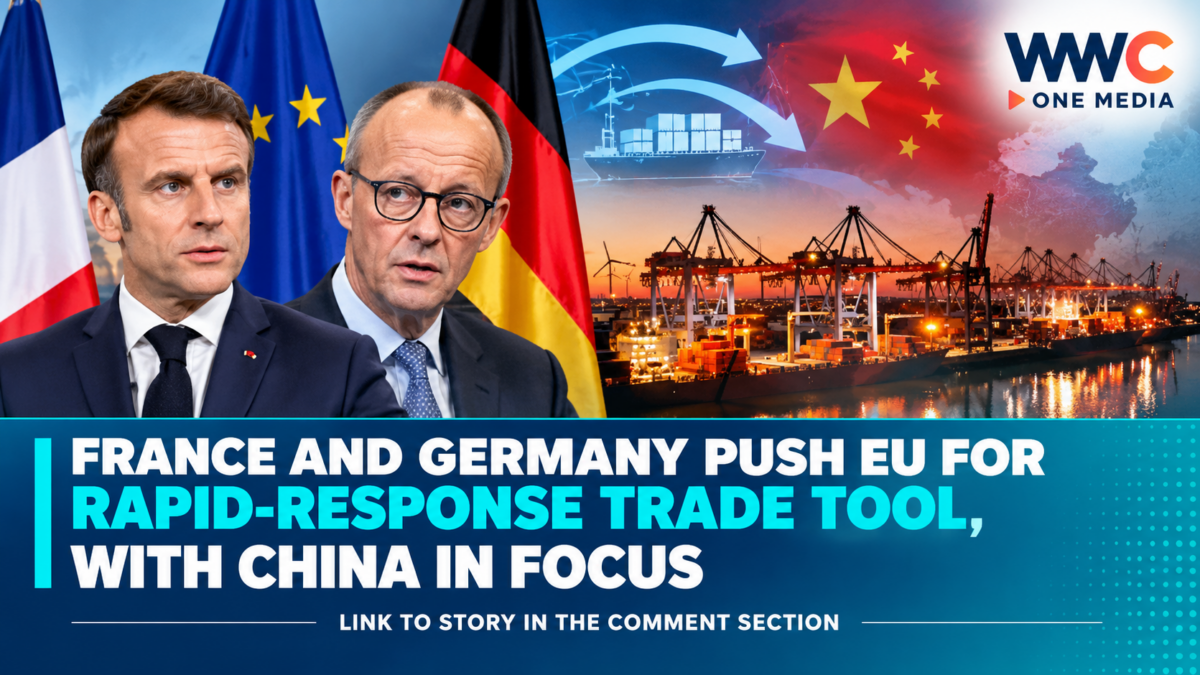
France and Germany are calling for the European Union to create a new rapid-response trade instrument that would allow the bloc to act more quickly against countries whose economic policies are deemed to cause serious and systemic distortions in the European market.
The proposal, put forward by French President Emmanuel Macron and German Chancellor Friedrich Merz, comes as the EU faces growing trade tensions with China and prepares for a summit where leaders are expected to discuss the bloc’s widening economic imbalances with Beijing.
Although the proposal does not name China specifically, the measures described in the Franco-German document closely reflect European concerns over China’s industrial overcapacity, subsidies, dumping and other trade practices.
New Tool Could Give Brussels Faster Powers
Macron and Merz outlined their proposal in a letter sent on Oct 5 to European Commission President Ursula von der Leyen, accompanied by a policy paper on global economic imbalances.
They argued that “systemic market-distorting practices” are threatening the EU’s economy and industrial base and require a faster response than existing trade-defence procedures can provide.
Under the proposed mechanism, the European Commission would have greater authority to introduce countermeasures against severe market distortions.
One of the most significant elements would allow the Commission to act unless a qualified majority of EU member states opposes the measure. That could make it substantially easier to respond quickly than under procedures requiring broader political agreement before action can be taken.
The proposed instrument could potentially cover problems ranging from individual products to entire sectors.
China Is the Likely Target
Neither France nor Germany has formally described the mechanism as a China-specific measure.
However, China is widely seen as the main focus because of the circumstances surrounding the proposal and the sectors identified by Paris and Berlin.
The Franco-German paper points to concerns including structural overcapacity, large trade imbalances, widespread subsidies, dumping and currency undervaluation — issues that European governments have repeatedly raised in relation to Chinese exports.
The proposal comes just days before EU Trade Commissioner Maroš Šefčovič is due to travel to Beijing for talks with Chinese officials.
EU leaders are also scheduled to discuss trade relations with China at a summit in Brussels next week, placing the proposal at the centre of an increasingly tense debate over the bloc’s economic relationship with Beijing.
Potential Restrictions on Access to EU Market
The proposed mechanism could give Brussels a powerful new option: restricting access to the EU’s single market when severe economic distortions are identified.
The Franco-German proposal says the tool should be capable of responding to distortions caused by subsidies, dumping, currency manipulation and other political or economic measures.
The goal would be to give the EU greater leverage in negotiations and discourage trading partners from using economic policies that European governments consider harmful to the bloc.
The proposal is broader than conventional anti-dumping measures, which generally focus on specific products and require lengthy investigations.
Paris and Berlin want the EU to be able to respond to problems affecting entire industrial value chains where existing trade-defence measures may be too narrow.
Supply Chains Also a Major Concern
The French and German governments are also calling for a separate instrument aimed at reducing Europe’s dependence on single sources of critical goods.
The proposed diversification mechanism would encourage companies to spread their supply chains and reduce concentration risks linked to a particular country, company or supplier.
The initiative reflects wider EU efforts to strengthen “economic security” by ensuring that European industries are less vulnerable to disruptions involving strategically important products.
France and Germany want the mechanism to address both existing dependencies and emerging risks before they become major vulnerabilities.
Chemicals, Plastics and Vehicles in Focus
Paris and Berlin have called for faster and broader trade investigations in several sectors.
The countries specifically highlighted chemicals, certain plastics and plug-in hybrid vehicles as areas where targeted measures could be needed.
The broader concern is that European manufacturers may struggle to compete with overseas producers benefiting from large-scale state support, excess production capacity or other advantages.
The joint paper argues that protecting individual categories of goods may no longer be sufficient when distortions affect entire sectors and supply chains.
Germany’s Position Marks a Shift
The proposal is particularly notable because Germany has traditionally maintained strong commercial ties with China and has often been cautious about aggressive trade restrictions.
That position has increasingly come under pressure as Chinese exports into Europe have grown and German manufacturers have faced stronger competition in sectors including automobiles and industrial machinery.
The latest initiative suggests Berlin is now more willing to support stronger EU-wide trade-defence measures, alongside France, which has long pushed for greater European economic protection and strategic autonomy.
The two governments have nevertheless stressed that their objective is to restore fair competition rather than start a trade war.
China Has Already Warned of Retaliation
The proposal also comes against a backdrop of warnings from Beijing.
China’s Commerce Ministry said in September that it would take a “resolute response” if the EU introduced restrictions targeting Chinese companies or products.
Beijing described the proposed approach as protectionist and unilateral, warning that increased European pressure could damage mutual trust and disrupt China-EU trade consultations.
Chinese officials have indicated that possible responses could include anti-discrimination investigations, reviews of industrial and supply-chain security and scrutiny of foreign subsidies.
That raises the possibility that aggressive use of the proposed EU instrument could trigger countermeasures from Beijing.
EU Seeks More Leverage in Trade Disputes
The initiative is part of a broader effort by the EU to strengthen its ability to respond when trade and economic relationships become increasingly politicised.
France and Germany have also urged the European Commission to make greater use of existing anti-dumping, anti-subsidy and safeguard tools and to launch more investigations on its own initiative.
They want the EU to have sufficient resources to investigate entire sectors rather than focusing only on individual products.
The proposal also calls for the bloc to prepare for possible retaliation by assessing how different countermeasures could affect individual EU member states.
What Happens Next
The proposal is not yet an EU-wide policy.
France and Germany must persuade the other member states and the European Commission to support the new mechanism, while the details of how it would operate would still need to be negotiated.
The coming EU-China discussions could provide an early test of how much support exists for stronger trade-defence powers.
With Brussels facing growing concerns over industrial competitiveness, supply-chain dependence and China’s expanding exports, the Franco-German initiative could become an important part of the EU’s evolving economic-security strategy.
For now, however, the proposed rapid-response instrument remains a negotiating proposal rather than a new EU trade measure already in force.