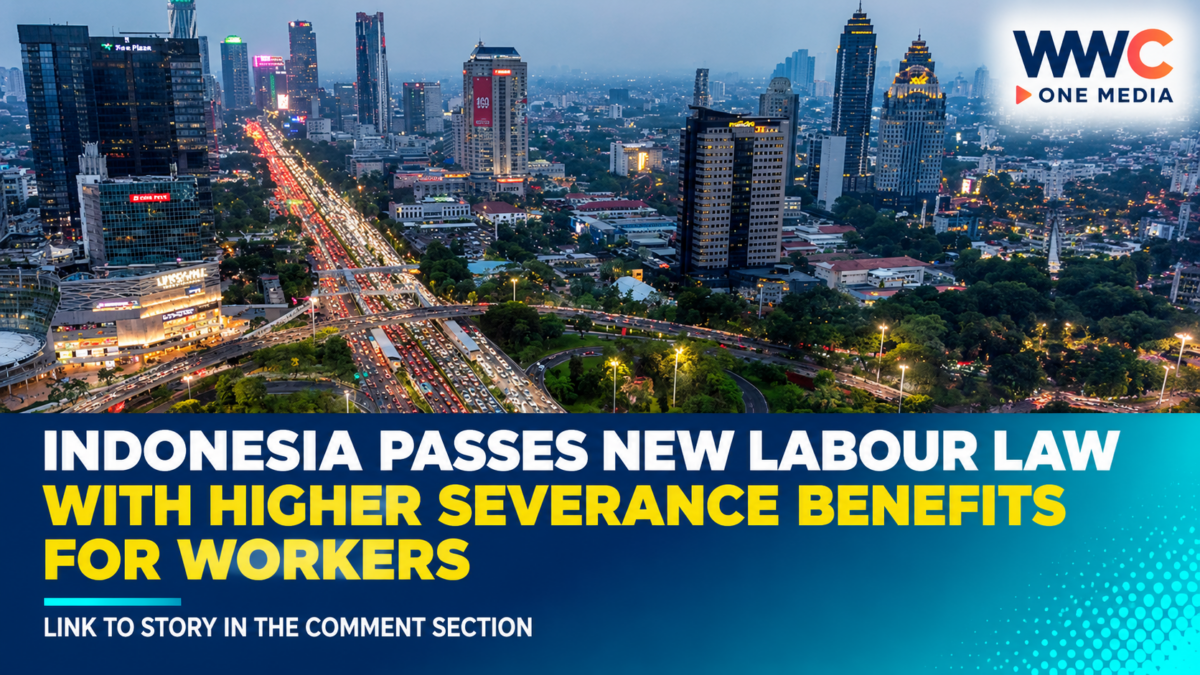
Indonesia’s parliament has passed a new labour protection law that increases severance benefits for workers who are laid off and makes it harder for employers to dismiss employees on cost-efficiency grounds.
The House of Representatives approved the legislation on Tuesday (Oct 6), marking a major revision of Indonesia’s employment framework and rolling back some of the pro-business measures introduced under former president Joko Widodo.
Manpower Minister Yassierli said the new law was designed to strike a balance between stronger worker protections and the sustainability of businesses.
“This bill reflects a balance between the protection of workers’ fundamental rights and the sustainability of the business sector,” Yassierli told parliament following the vote.
Higher Severance Benefits
One of the most significant changes concerns severance pay for workers whose employment is terminated.
Under the new framework, the previous 0.5 multiplier used in certain circumstances has been removed. Yassierli said workers would no longer receive severance calculated using that reduced multiplier, with the minimum multiplier now set at one in the relevant cases. Other factors, including length of service and the circumstances surrounding termination, can affect the final amount.
The law also introduces a severance security programme intended to ensure that companies have funds available to meet their obligations when workers are laid off. Local reports said the programme could involve employers making severance-related contributions to Indonesia’s state social security provider, BPJS.
The full text and implementing regulations will be important in determining how the new calculations and funding mechanism work in practice.
Tougher Rules on Layoffs
The legislation also restricts employers’ ability to dismiss workers simply by citing cost efficiency.
Yassierli said companies would no longer be able to “easily” use efficiency as a justification for layoffs. The change is intended to strengthen job security at a time when Indonesian businesses continue to face pressure from rising costs and economic uncertainty.
The new law covers a much broader range of employment issues, including fixed-term contracts, outsourcing, wages, working hours, termination of employment, severance, social security and labour inspections.
Indonesia’s House said the legislation consists of 23 chapters and 313 articles. It also aims to strengthen protections for vulnerable workers, including women, children and people with disabilities, while adapting employment rules to changes brought by digitalisation and new forms of work.
Digital Workers Also Set to Gain Protections
The reforms extend beyond traditional employees.
According to an assessment by Indonesian law firm Assegaf Hamzah & Partners, the legislation would provide protections for informal and digital-platform workers, including social security coverage, fair pay, greater transparency over algorithms used to manage their work and safeguards against unjustified deactivation of accounts.
That could give Indonesia’s growing platform workforce stronger legal protections as employment increasingly expands beyond conventional office and factory jobs.
Employers Warn of Higher Costs
The changes have raised concerns among employers, who argue that stronger severance obligations could increase labour costs.
The Indonesian Employers Association, known as Apindo, warned last month that the legislation could discourage formal hiring and weaken Indonesia’s competitiveness by increasing the cost of employing workers.
Businesses have also raised concerns over other provisions, including minimum-wage calculations, outsourcing arrangements and fixed-term employment contracts.
Assegaf Hamzah & Partners said the new framework could introduce stricter limits on dismissals, higher severance payments for certain types of terminations and minimum wages in some sectors. The firm advised employers to reassess planned layoffs, employment costs and wage structures.
The debate reflects a wider challenge for Indonesia: strengthening workers’ rights without making businesses reluctant to hire or invest.
Reversing Parts of the 2020 Labour Reform
The new law represents a significant shift from the direction taken under former president Joko Widodo.
In 2020, Widodo’s administration introduced the sweeping Job Creation Law, which reduced severance benefits and eased a range of employment and business regulations in an effort to attract investment and improve Indonesia’s business climate.
The reforms triggered large demonstrations involving workers, students and activists, who argued that the changes weakened labour protections.
The latest legislation moves some of those provisions back towards stronger employee protections.
Constitutional Court Ruling Paved the Way
The new law was also driven by a 2024 Constitutional Court ruling.
The court ordered lawmakers to revise the employment provisions contained in the Job Creation Law following a petition filed by several trade unions. Legislators were given two years to make the required changes.
Indonesia’s parliament completed the legislation ahead of that deadline, approving the bill during its ninth plenary meeting of the 2026–2027 parliamentary year on Tuesday.
The bill had received government approval to proceed to the final parliamentary stage on Monday, with the government and lawmakers completing the first-level discussions before the final vote.
Balancing Workers’ Rights and Business Competitiveness
The new law marks one of Indonesia’s most important labour-policy changes in years.
For workers, the removal of the 0.5 severance multiplier and tighter restrictions on efficiency-based layoffs could provide greater financial protection when employment ends. For employers, however, higher potential severance costs and stricter termination rules could make workforce restructuring more expensive.
Parliament has framed the legislation as an attempt to balance the interests of workers, employers and the government while improving legal certainty and maintaining investment and job creation.
How significantly the reforms affect Indonesian companies and workers will depend in large part on the final implementation rules, particularly those governing severance calculations, employer contributions and the new restrictions on layoffs.