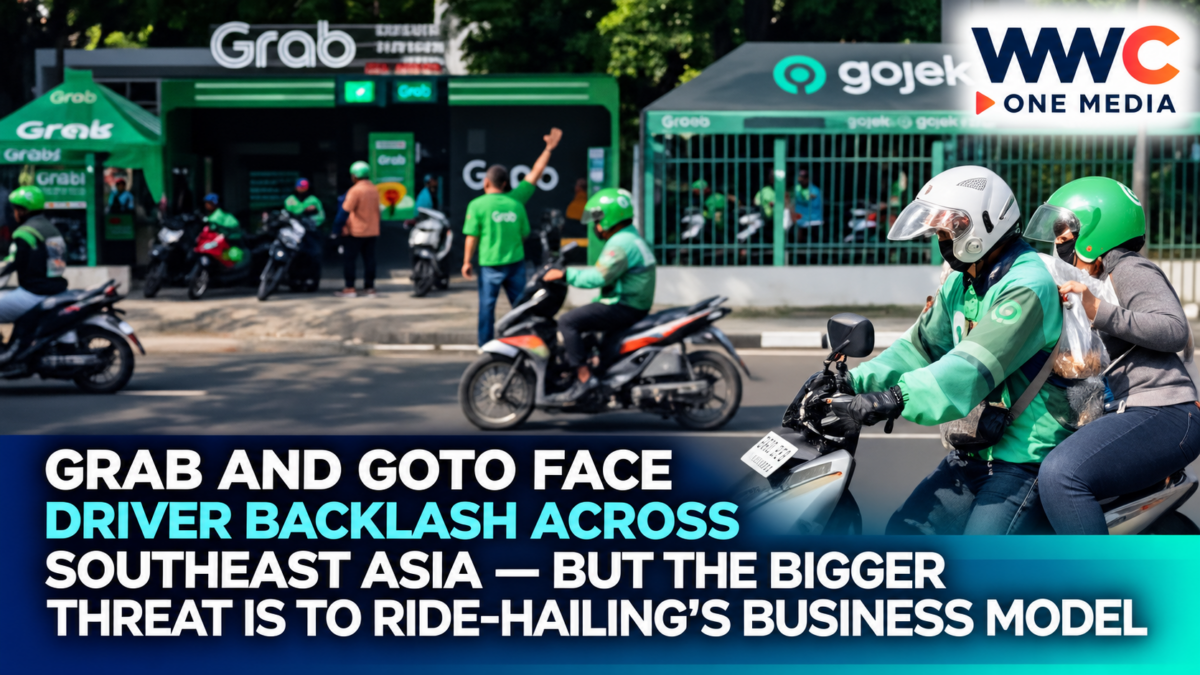
SINGAPORE/JAKARTA — Southeast Asia’s ride-hailing boom is running into a new problem: the people behind the wheel are increasingly saying the economics no longer work.
Across Indonesia, Vietnam, Thailand and the Philippines, drivers have complained about falling take-home pay, high commissions, rising fuel costs and algorithm-driven pricing they say is becoming harder to understand.
That pressure is now colliding with a second problem for the companies themselves.
Ride-hailing platforms such as Grab and GoTo spent years subsidizing growth, cutting fares and recruiting drivers.
Now investors want profits.
But governments and drivers are pushing in the opposite direction—demanding lower commissions, better benefits and more predictable earnings.
That puts the entire business model under pressure.
Indonesia has already forced a major reset
The clearest example is Indonesia.
President Prabowo Subianto moved this year to cut the maximum commission charged to motorcycle ride-hailing drivers from 20% to 8%.
Grab Indonesia and GoTo agreed to implement the new rate from July 1.
That means drivers now keep at least 92% of the fare before other costs.
For drivers, it is a major victory.
For the platforms, it threatens margins in what Reuters has described as their most important ride-hailing market in Southeast Asia.
The policy shows how dramatically the balance of power has shifted.
A commission once treated as a commercial decision has become a political issue.
Why Indonesia matters so much
Indonesia is one of the world’s largest motorcycle ride-hailing markets.
Millions of people rely on two-wheel transport because it can move through congested cities faster than cars.
That gives Grab and GoTo extraordinary reach.
But it also means driver dissatisfaction quickly becomes politically sensitive.
Drivers are not just app users.
They are a highly visible workforce operating in nearly every major city.
When their earnings fall, governments notice.
Prabowo made that explicit when announcing the lower commission cap, arguing that drivers should receive a larger share of what they earn.
GoTo’s stock has been punished
The pressure is arriving at a difficult time for investors.
GoTo shares have fallen more than 90% from their 2022 peak, according to the Financial Times.
The stock recently traded near 29 rupiah after Indonesia’s stock exchange changed its minimum share-price rules.
Market data show GoTo closing around 30 rupiah on October 5, after a string of sharp declines at the end of September.
The collapse reflects more than driver protests.
Investors have worried about:
profitability;
competition;
regulation;
and whether the company can generate enough cash from its core transport and delivery businesses.
The lower driver commission cap adds another challenge.
Grab has also been hit hard
Grab’s Nasdaq-listed shares have also suffered.
Reuters Breakingviews reported in September that Grab stock had fallen more than 40% in 2026.
That is striking because Grab has made major progress compared with its earlier loss-making years.
The company has expanded into:
ride-hailing;
food delivery;
payments;
lending;
buy-now-pay-later;
and other financial services.
But the market is increasingly asking whether the core mobility business can keep expanding without either hurting drivers or sacrificing margins.
That is the uncomfortable equation facing the company.
Vietnam’s drivers launched a boycott
In Vietnam, driver anger became even more visible.
Grab drivers called for a two-day app boycott in September, accusing the company of changing its payment structure in ways that sharply reduced earnings.
Reuters reported that drivers said deductions could reach as much as 50% of the customer fare in some cases.
Drivers cited take-home rates of roughly 2,600 dong per kilometer for motorcycle rides and about 6,000 dong per kilometer for car trips, before fuel and maintenance costs.
Grab said it was engaging with drivers and trying to clarify misinformation.
But the protest demonstrated that pricing disputes are no longer isolated complaints.
They are becoming organized labor actions.
Vietnam’s government stepped in
Vietnam’s National Competition Commission then opened a review of Grab’s pricing and commission policies.
The agency said it had received complaints from drivers concerning:
customer fares;
driver deductions;
commissions;
and how pricing policies are changed and communicated.
It requested documents from Grab and other ride-hailing companies as part of the review.
That matters because transparency may become the next major regulatory battleground.
Drivers increasingly want to know not only how much a platform takes—
but how the algorithm decided the price in the first place.
Algorithms are becoming the new boss
Modern ride-hailing platforms increasingly use dynamic pricing systems to determine:
what customers pay;
what drivers receive;
which driver gets a booking;
and when incentives appear.
The system can respond instantly to:
traffic;
weather;
location;
supply;
demand;
and historical behavior.
Platforms argue that this makes the market more efficient.
Drivers increasingly argue that it makes their income unpredictable.
That tension is not limited to Southeast Asia.
In Europe, a major collective legal action has accused Uber of using personal driver data and automated systems to determine how little individual drivers may be willing to accept for specific rides.
Uber disputes those allegations.
The case illustrates how algorithmic pay is becoming a global labor issue.
The Philippines is facing the same argument
The Philippines has already seen its own fight over commissions.
In April, lawmakers questioned ride-hailing and motorcycle-taxi companies after drivers submitted screenshots showing commission rates that appeared higher than the reductions companies had promised.
Rep. Brian Poe cited examples ranging from about 20.8% to 23.4% despite previous commitments to cut rates.
The issue emerged as fuel prices surged and drivers said operating costs were eating deeper into daily earnings.
The LTFRB later announced temporary commission reductions among several operators.
Grab lowered commissions to 15% from 20%, while other platforms announced various cuts.
Philippine platforms were forced to respond to fuel costs
The fuel-price shock was severe enough that Grab Philippines created a ₱350 million support program for drivers and delivery partners.
The package included:
fuel subsidies;
commission rebates;
incentives;
and spot bonuses.
Grab and Move It had already introduced emergency support in March as gasoline and diesel prices surged because of Middle East conflict and supply disruptions.
That highlights one of the biggest weaknesses of the gig-economy model.
Platforms do not normally pay for the vehicle.
The driver does.
Platforms do not normally buy the fuel.
The driver does.
Platforms do not normally pay routine maintenance.
The driver does.
When those costs rise, driver income can collapse quickly even if gross fares remain stable.
Ride-hailing’s biggest advantage is also its biggest weakness
The model became successful partly because platforms avoided many costs associated with traditional transport fleets.
Drivers supplied:
the cars;
the motorcycles;
the fuel;
the insurance;
and much of the maintenance.
The platform provided:
technology;
customer demand;
payments;
dispatch;
and branding.
That made expansion incredibly fast.
A company did not need to buy 100,000 vehicles before serving 100,000 drivers.
But it also means drivers absorb much of the inflation risk.
When gasoline rises sharply, drivers feel it first.
That is exactly what has happened across Southeast Asia.
Customers do not want higher fares either
Platforms cannot simply solve the problem by raising prices.
Consumers are highly price sensitive.
Ride-hailing became popular partly because it was affordable and convenient.
If fares rise too far, passengers can switch to:
public transport;
traditional taxis;
motorcycle alternatives;
or rival apps.
That creates a three-way squeeze.
Drivers want more money.
Customers want cheaper trips.
Investors want higher profits.
The platform sits in the middle.
There is no easy way to satisfy all three.
Competition makes the problem worse
Grab is not alone.
Across Southeast Asia, passengers can choose from companies including:
GoTo’s Gojek;
inDrive;
Xanh SM;
Angkas;
Move It;
JoyRide;
Maxim;
and other local platforms.
That competition keeps fares under pressure.
If one operator charges dramatically more, customers can switch.
If one pays drivers dramatically less, drivers can switch.
The result is a constant battle to keep both sides of the marketplace satisfied.
That is why ride-hailing economics can become fragile even when booking volumes continue growing.
Thailand is trying another solution: EVs
Grab Thailand has responded partly by reducing drivers’ operating costs.
The company said in April that more than 30,000 electric vehicles were already operating on its platform.
It has formed partnerships with EV manufacturers and leasing providers offering rental and “drive-to-own” programs for drivers.
The logic is simple.
If drivers spend less on fuel, they can keep more of each fare without forcing the platform to dramatically increase payouts.
Electrification therefore has an economic argument as well as an environmental one.
But EVs require upfront capital, charging infrastructure and financing.
They are not an immediate solution for every driver.
Grab is also recruiting more part-time drivers
Interestingly, Grab Thailand is simultaneously trying to expand its labor pool.
In September, it launched a program encouraging:
students;
civil servants;
military personnel;
police officers;
and other workers
to drive or deliver part-time for additional income.
That can help Grab increase service availability.
But a larger driver pool also raises a difficult question.
If more drivers compete for the same number of bookings, average earnings per driver can decline.
That is one of the fundamental tensions inside platform work.
More drivers improve service for passengers.
They do not necessarily improve income for drivers.
Regulators are increasingly treating drivers as a political constituency
Governments once treated ride-hailing mostly as a technology and transport-policy issue.
That is changing.
Drivers now represent a large informal or semi-formal workforce.
Their concerns involve:
wages;
social protection;
health insurance;
accident coverage;
fuel costs;
and job security.
Indonesia’s new rules go beyond commission limits.
Prabowo’s regulation also calls for platforms to provide accident and health insurance.
That looks increasingly similar to labor regulation rather than simple app regulation.
The distinction between “partner” and “employee” is becoming harder to ignore.
The word “partner” is becoming controversial
Ride-hailing companies generally describe drivers as independent partners rather than employees.
That provides flexibility.
Drivers can theoretically choose when and how much they work.
But critics argue that algorithms can exercise substantial control over:
pay;
ride allocation;
ratings;
bonuses;
and access to work.
Human Rights Watch has documented drivers in several countries saying platform algorithms make earnings unpredictable and can pressure them to accept jobs they would otherwise reject.
That has turned employment classification into a major global policy question.
If drivers eventually receive employee-like rights, costs for platforms could rise substantially.
Grab and GoTo are looking beyond rides
This helps explain why both companies are putting more emphasis on financial services.
Grab has expanded into:
lending;
payments;
banking;
and buy-now-pay-later products.
In September, it agreed to buy a 60% stake in Atome Financial for about $1.5 billion, with an option structure covering the remaining stake later.
Atome had around 25 million users and roughly $1 billion in loans, according to Reuters Breakingviews.
Financial services currently account for a minority of Grab’s revenue, but they offer potentially higher-margin growth outside core transport.
That diversification is becoming increasingly important.
Why financial services are attractive
Ride-hailing requires drivers, vehicles and physical movement.
Finance does not.
Once a platform already has millions of users, it can potentially sell them:
loans;
credit;
insurance;
payments;
and investment products
at much lower incremental cost.
Grab already knows enormous amounts about customer and merchant activity.
That gives it data useful for underwriting and payments.
The financial-services strategy is therefore not separate from ride-hailing.
It is built on the ecosystem ride-hailing created.
GoTo is seeing the same trend
The FT notes that GoTo’s financial-services business has been outperforming its core operations.
That is strategically significant.
If mobility margins remain squeezed by driver demands and regulation, payments and lending may become increasingly important to the company’s valuation.
The same transformation happened in other technology industries.
A low-margin service attracts users.
Then the company sells them higher-margin financial products.
Southeast Asian super-apps may be moving deeper into that phase.
But finance brings new risks
Financial services are not a free profit engine.
Lending creates credit risk.
Buy-now-pay-later creates default risk.
Banking creates regulatory requirements.
Consumer finance can attract political scrutiny if borrowers become overextended.
Grab’s push into Atome therefore diversifies the business—
but also changes the risks investors need to watch.
The company could become less dependent on drivers while becoming more dependent on credit quality.
Grab still has significant financial firepower
Grab entered its latest acquisition wave with roughly $5.4 billion in net cash, according to Reuters Breakingviews.
That gives chief executive Anthony Tan room to invest.
But Grab has also announced a large share-buyback program, while operating cash flow has recently come under pressure.
Investors therefore want acquisitions that clearly improve profitability rather than simply make the company bigger.
This is another reason the driver crisis matters.
Every dollar spent subsidizing fares or increasing driver payouts is a dollar unavailable for expansion elsewhere.
A Grab-GoTo merger is still complicated
For years, investors have speculated about a combination between Grab and GoTo.
A merger could theoretically reduce competition and eliminate duplicated costs in markets such as Indonesia.
But political and regulatory obstacles remain significant.
The FT reports that merger discussions have stalled amid uncertainty over Indonesian policy.
That is unsurprising.
Indonesia has just intervened aggressively in driver commissions.
Allowing the two largest platforms to combine could create even greater concerns over market power.
The government may prefer competition even if investors prefer consolidation.
Drivers have more political power than investors expected
This may be the biggest lesson from 2026.
Drivers were once treated as almost infinitely replaceable participants in the gig economy.
That assumption looks increasingly outdated.
They can organize through:
Facebook groups;
WhatsApp;
Telegram;
unions;
and informal networks.
They can coordinate app shutdowns.
They can lobby lawmakers.
They can bring evidence directly to regulators.
Vietnam’s attempted boycott, Indonesia’s commission cap and the Philippine congressional hearings all demonstrate the same trend.
Drivers have discovered collective leverage.
The platforms cannot operate without them
Ride-hailing companies often emphasize technology.
But the fundamental service remains human.
An algorithm cannot transport a passenger without a driver or rider unless autonomous vehicles become widespread.
That gives drivers bargaining power.
At the same time, drivers depend heavily on platforms for customers.
This mutual dependence creates a difficult relationship.
As Human Rights Watch quoted one Kenyan driver:
the platforms need drivers, and drivers need the platforms.
That is the core tension now playing out across Southeast Asia.
Robotaxis could eventually change the equation
Autonomous vehicles are the long-term wild card.
If ride-hailing companies eventually operate large robotaxi fleets, they could reduce dependence on human drivers.
But Southeast Asia presents difficult conditions:
dense traffic;
motorcycles;
informal road behavior;
varying regulation;
and lower labor costs than many Western cities.
That makes widespread robotaxi deployment more difficult economically and technically.
Human drivers are therefore likely to remain central to Southeast Asian ride-hailing for years.
Platforms cannot simply wait for automation to solve the labor problem.
Fuel prices have accelerated an old problem
Driver complaints existed before the latest energy shock.
Higher fuel prices made them much harder to ignore.
In the Philippines, companies cut commissions and created support funds after fuel costs surged.
Thailand accelerated EV programs.
Vietnamese drivers complained that their remaining income after deductions was no longer enough once operating expenses were included.
The current conflict over pay is therefore partly structural and partly cyclical.
Fuel made the structural weakness more visible.
Consumers could eventually feel the consequences
So far, much of the debate has focused on platforms and drivers.
Passengers may ultimately be affected too.
If governments force commissions lower, platforms may:
increase fares;
reduce discounts;
cut driver incentives elsewhere;
introduce new fees;
or become more selective about markets.
If drivers leave because earnings are too low, wait times can rise.
A recent U.S. study found Uber ride wait times increasing alongside rising prices, although Uber disputed the analysis.
The exact dynamics differ by market.
But the principle is universal:
a ride-hailing service only works when enough drivers believe it is worth logging in.
The era of cheap growth is over
This may be the most important change.
For years, ride-hailing companies could use venture capital to subsidize:
passenger fares;
driver bonuses;
promotions;
and expansion.
Profitability was a future problem.
Public-market investors changed that.
Grab and GoTo now have shareholders demanding returns.
That forces platforms to find a sustainable balance between:
what passengers pay;
what drivers earn;
and what the company keeps.
Driver protests suggest that balance has not yet been found.
Southeast Asia may be rewriting the gig-economy contract
Indonesia’s 8% commission cap could prove especially influential.
If drivers there successfully earn a much larger share without destroying the platforms’ economics, other governments may study the model.
If profitability deteriorates badly, platforms will use that result to argue against similar intervention elsewhere.
Either way, Indonesia has created a regional experiment.
The outcome could influence policies from Manila to Hanoi.
Grab’s biggest problem may no longer be competition
For years, Grab’s biggest strategic threat appeared to be rival platforms.
Today, the bigger challenge may be the economic structure of the business itself.
If drivers cannot earn enough, they protest or leave.
If customers pay too much, they switch.
If the platform keeps too little, investors complain.
If it keeps too much, regulators intervene.
That is a much harder problem than simply beating a competitor.
The super-app may be evolving because ride-hailing has reached its limits
Grab and GoTo’s expansion into financial services should therefore be viewed in this context.
They are not abandoning transport.
Transport remains essential because it brings users into the ecosystem.
But increasingly, ride-hailing may function as the entry point rather than the highest-margin end product.
A customer opens the app for a ride.
Later they may:
pay a bill;
borrow money;
use BNPL;
order food;
buy insurance;
or make a digital payment.
That is where the next stage of growth may come from.
Driver anger could reshape the entire sector
The FT’s “driver fury” framing captures a real shift.
This is no longer a dispute about a few percentage points of commission.
It is becoming a contest over who captures the value created by digital transport platforms.
Drivers say they provide the labor and carry the operating costs.
Platforms say they provide customers, technology, safety systems and infrastructure.
Governments increasingly say both sides need rules.
And investors still expect profits.
That leaves Grab, GoTo and their rivals with perhaps the hardest challenge they have faced since the ride-hailing boom began:
not how to grow faster—
but how to make the economics work for everyone at the same time.
Because Southeast Asia’s drivers are making one thing increasingly clear:
if the people behind the wheel stop believing the ride is worth taking, even the region’s biggest super-apps can hit the brakes.