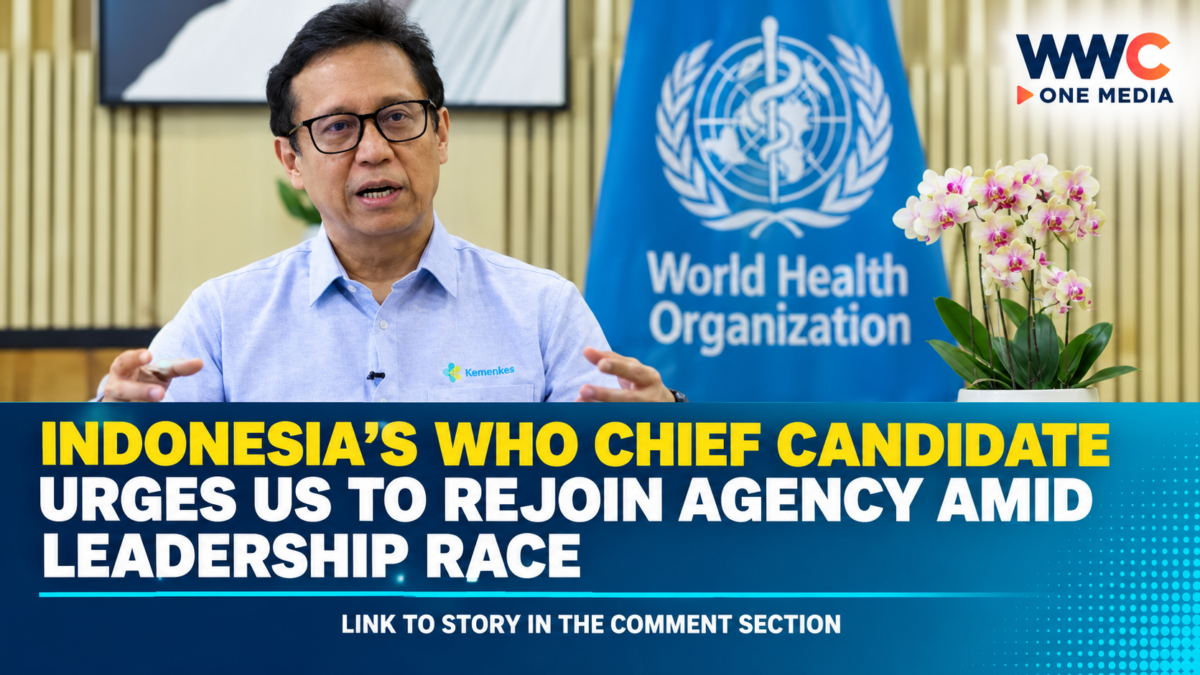
Indonesia’s candidate to lead the World Health Organization has called on the United States to rejoin the global health agency, arguing that countries cannot effectively respond to the next pandemic by acting alone.
Health Minister Budi Gunadi Sadikin, one of six candidates seeking to become the WHO’s next director-general, told Reuters that the United States should return to the organisation after formally withdrawing earlier this year under President Donald Trump.
“Many member states feel that the US should be back,” Budi said in an interview in Jakarta, stressing that international cooperation would remain essential during future health emergencies.
The comments come as the WHO prepares for a leadership transition, with its current director-general, Tedros Adhanom Ghebreyesus, due to complete his second term in August 2027. The next director-general is expected to be appointed at the World Health Assembly in May 2027.
Budi says US involvement remains essential
Budi argued that a major pandemic would make it difficult, if not impossible, for individual countries to operate independently.
He described it as “scientifically impossible” for a country to go it alone in dealing with a global pandemic, pointing to the need for international coordination on disease surveillance, research, standards, financing and medical responses.
His appeal is particularly significant because the United States had been the WHO’s largest financial contributor before its withdrawal.
Trump accused the organisation of mishandling the Covid-19 pandemic and criticised its relationship with China. The WHO has rejected those criticisms.
The US formally left the agency in January 2026, removing a major source of funding at a time when the WHO was already facing pressure to reduce spending.
Budi said he personally knows US Health Secretary Robert F. Kennedy Jr. and suggested that the relationship could help facilitate dialogue between Washington and the WHO.
“We can talk easily and the connection is there,” he said.
Indonesia’s candidate is an unusual choice
Budi brings a different background to the WHO leadership race.
Unlike the other candidates, he is not a physician, public-health specialist or former WHO official. He began his career in banking and has worked at IBM and Indonesia’s Bank Mandiri.
He was appointed Indonesia’s health minister in 2020 and became closely involved in the country’s response to the Covid-19 pandemic, including its nationwide vaccination campaign.
Indonesia has about 280 million people, making the country’s vaccination effort one of the largest public-health operations in the region.
Budi has also overseen an ongoing free health-screening programme in Indonesia.
His supporters could therefore point to his experience in managing large-scale programmes and raising funds, while his lack of traditional medical or WHO experience could make his candidacy more unconventional.
Six candidates are competing for the top job
Budi is currently one of six candidates seeking to succeed Tedros.
The other nominees come from Qatar, Saudi Arabia, Spain, Botswana and Belgium, according to Reuters.
The leadership contest is still at an early stage. WHO member states submitted nominations in 2026, with the Executive Board due to narrow the field before the final appointment is considered by the World Health Assembly.
The WHO says the Executive Board will nominate up to three candidates for consideration by the World Health Assembly in 2027.
That means Budi still faces several stages before becoming a finalist, let alone winning the position.
Budi wants the WHO to return to its core role
Beyond calling for the United States to return, Budi has used his campaign to argue that the WHO itself needs reform.
He said many member states believe the organisation has expanded too far beyond what should be its central responsibilities.
In his view, the WHO should focus more heavily on establishing science-based international health standards and norms.
“Almost all member states” are calling for reform, Budi said, arguing that restoring trust among countries is more important than simply increasing the agency’s budget.
His criticism reflects a broader debate about the role of the WHO following the Covid-19 pandemic.
The organisation has faced questions over its handling of the pandemic, its funding model and the balance between global standards and the priorities of individual governments.
For Budi, the answer is to make the WHO more focused and useful to its member states.
Development banks could play a larger role
Budi has also proposed making greater use of international financial institutions to support national health programmes.
He said the WHO could help mobilise development banks such as the Asian Development Bank and World Bank to help countries finance and implement their own health plans.
His proposal reflects his background outside conventional public health.
Rather than viewing the WHO primarily as a large funding organisation, Budi said it could act as a coordinator that helps countries connect their health priorities with international financing.
He also suggested that some member states feel that donor funding can come with priorities established by international organisations rather than by national health authorities themselves.
A leadership contest shaped by US withdrawal
The US withdrawal has become one of the defining issues surrounding the WHO’s upcoming leadership transition.
The loss of its biggest donor has forced the organisation to reassess its finances and priorities.
For Budi, bringing Washington back would therefore be important not only financially but also politically.
A renewed US role could strengthen the WHO’s ability to coordinate global responses, while potentially restoring some of the influence the organisation lost after the American departure.
But persuading Washington to return could prove difficult.
Trump’s administration has sharply criticised the WHO, and any future decision to rejoin would depend on US political priorities as well as the organisation’s willingness to address Washington’s concerns.
Indonesia puts forward a candidate with a reform message
President Prabowo Subianto personally nominated Budi for the WHO leadership race earlier this year, according to the minister.
The candidacy gives Indonesia an opportunity to play a larger role in global health diplomacy while promoting a reform agenda that emphasises national ownership, science-based standards and financial sustainability.
Budi’s campaign is likely to be closely watched in Southeast Asia, where Indonesia has increasingly sought a larger voice in international institutions.
His appeal for the United States to return to the WHO also places him in the middle of one of the agency’s most consequential debates: how to maintain effective global cooperation when major powers disagree over the organisation’s role.
Final decision expected in 2027
The WHO is expected to announce the complete list of nominations later in October.
The Executive Board will subsequently assess the candidates and nominate up to three for the final stage of the process.
The new director-general is scheduled to be selected by member states at the World Health Assembly in May 2027, with Tedros remaining in office until August 2027.
For Budi, the campaign will now be about convincing governments that an outsider can lead one of the world’s most important health institutions — while rebuilding relationships with countries such as the United States.
His message is straightforward: global health problems require global cooperation, and the WHO will ultimately be stronger if Washington returns to the table.