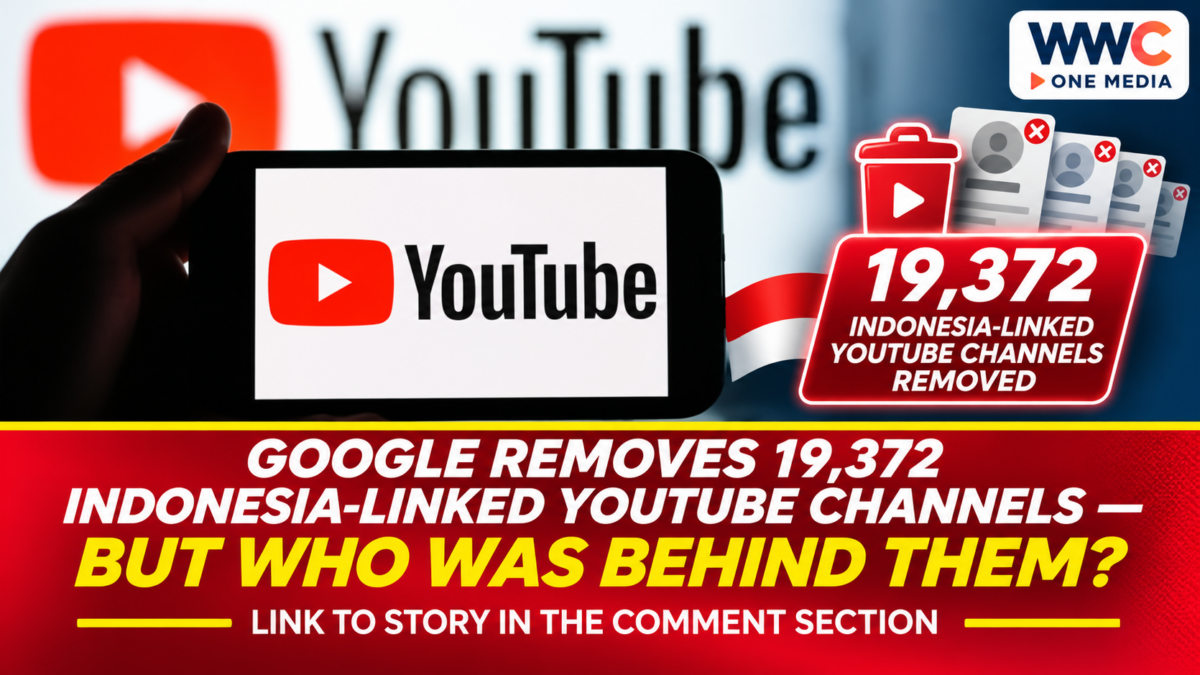
JAKARTA — Nov. 18, 2026. Google disclosed the termination of 19,372 YouTube channels across three Indonesia-linked coordinated influence-operation investigations during July, August and September 2026. The company described the channels as carrying messaging favourable to Indonesia’s government, but its public findings did not identify who ultimately paid for or directed the activity.
The removals expose a critical distinction in online politics: a message supporting an administration is not, by itself, evidence that the administration organised it. Google’s published enforcement data establishes the volume, timing and reported character of the campaigns, while leaving important questions about sponsorship and audience impact unanswered.
Indonesia YouTube Channels: How the Removals Add Up
Google’s third-quarter Influence Operations Bulletin lists 6,888 terminated channels in July, 10,134 in August and 2,350 in September as part of investigations expressly linked to Indonesia. Together, those three monthly counts total 19,372.
The July campaign was described as sharing Bahasa-language content supportive of Indonesia’s government and its administration. The August group supported the government while criticising its critics. September’s channels again shared government-supportive Bahasa content.
A separate July entry records 17 more channels sharing supportive content about the Indonesian government in five languages: English, Indonesian, Portuguese, Russian and Telugu. But that entry does not use the same explicit description of a campaign linked to Indonesia. Combining it with the three named Indonesia-linked batches gives 19,389 channels sharing government-supportive messaging, rather than 19,389 channels all specifically attributed to Indonesia-linked campaigns.
These are quarterly enforcement figures disclosed in a report published before Nov. 18. They should not be portrayed as channels all removed on Nov. 18, or as a fresh single-day shutdown.
What Google Found — and What It Did Not Establish
Google classifies these cases as coordinated influence operations, a category concerned with attempts to shape online discussion through organised activity. Its bulletin identifies channel removals and broad themes in the content. It does not publicly name the individuals, companies or government bodies that operated the Indonesia-linked campaigns.
The distinction matters because government-supportive speech is not automatically improper. A real person may express support for a public official, criticise an opponent or publish political commentary without taking part in a coordinated manipulation scheme.
The enforcement finding concerns the networks Google investigated, not an assertion that ordinary pro-government creators collectively violated rules. Nor does the public bulletin establish that every video was factually false, that an election result changed, or that any particular government official ordered the campaign.
What this could mean: Transparency about the scale of removals is valuable, but without further disclosure of operators, financing or distribution methods, readers cannot responsibly turn an enforcement report into a claim of proven state sponsorship.
Why YouTube Can Terminate Coordinated Networks
YouTube’s published spam policy prohibits behaviour intended to manipulate the platform or mislead its users. It applies not just to individual videos but also to coordinated networks of channels. The policy covers artificial engagement, mass-produced repetitive material and techniques designed to evade detection.
That framework also helps explain why the removal of a channel does not necessarily prove that its political opinions were prohibited. Platforms may act against patterns of deceptive coordination, even where a position expressed in a video could otherwise be lawful political speech.
The written policy allows measures ranging from content removal and warnings to loss of monetisation or channel termination. Google’s influence-operations bulletin, however, does not provide a case-by-case explanation for every Indonesia-related channel.
Southeast Asia’s related digital-safety challenges have featured in WWC’s report on Google and ASEAN’s anti-scam education programme. Fraud and political influence are different problems, but both raise questions about the authenticity and reliability of material encountered on digital platforms.
The Wider Pattern Extends Beyond Indonesia
Google’s same quarterly bulletin identifies other campaigns associated with multiple countries and political causes. Its July disclosures include 115 terminated YouTube channels sharing Filipino-language content supportive of the Philippine government, without identifying an operator in that entry.
Such disclosures demonstrate that the company examines different viewpoints and geographic contexts. They should not be interpreted as proof of coordination between the Indonesia and Philippines cases, because the bulletin supplies no such connection.
In the Philippines, WWC’s coverage of Cebu students and misinformation has addressed the need to assess claims before sharing them. The Indonesian case adds another reason to examine not only what a channel says but also whether apparently independent voices may be acting as part of a network.
Likewise, the reported disruption of an AI-related political influence scheme in Malaysia illustrates a separate concern about online authenticity. Google’s Indonesia bulletin does not establish that artificial intelligence was used in the removed networks, so the two cases should not be conflated.
Why Counts Alone Cannot Measure Political Impact
Nineteen thousand channels is a substantial enforcement count, but channel totals are not the same as unique human operators, individual viewers or successful persuasion. One organisation might manage many channels, and an account may attract little audience activity. The bulletin does not supply reach or engagement figures sufficient to calculate an influence effect.
It also does not indicate how many channel operators appealed, whether any appeals succeeded, or whether the networks reappeared elsewhere. Those missing details limit conclusions about long-term effectiveness.
For Indonesia’s public debate, the important question is therefore larger than the number of terminated accounts. People need clear standards for identifying deceptive behaviour, proportionate enforcement, and care not to treat legitimate political disagreement as evidence of organised misconduct.
What Happens Next
Any further attribution should come from additional verifiable findings, not speculation about political beneficiaries. Useful disclosures would identify network-control methods, show how Google distinguished coordination from independent commentary, and clarify whether further enforcement occurred after September.
For YouTube users, the immediate lesson is practical: a high volume of similar political videos does not prove that multiple independent sources support the same claim. Assess individual evidence, trace claims to original records and avoid treating repetition as verification.
Google’s public accounting establishes that thousands of channels were removed. Who organised them, and whether they materially influenced audiences, remain questions the disclosed record does not answer.
Frequently Asked Questions
How many Indonesia-linked YouTube channels did Google remove?
Google listed 6,888 in July, 10,134 in August and 2,350 in September 2026 across three explicitly Indonesia-linked campaigns, totalling 19,372. A separate entry listed 17 additional pro-government channels without the same explicit Indonesia-linked designation.
Did Google accuse Indonesia’s government of operating the channels?
No. The public bulletin described the messaging and linked three campaigns to Indonesia, but did not establish that the government owned, financed or directed the channels.
Why were the YouTube channels terminated?
Google listed the channels as part of investigations into coordinated influence operations. YouTube’s separate policies prohibit deceptive coordination and platform manipulation, but Google did not publish individual violation details for all the terminated accounts.
Were all 19,372 channels removed in November 2026?
No. The reported removals were recorded in July, August and September 2026 and disclosed in Google’s third-quarter bulletin.