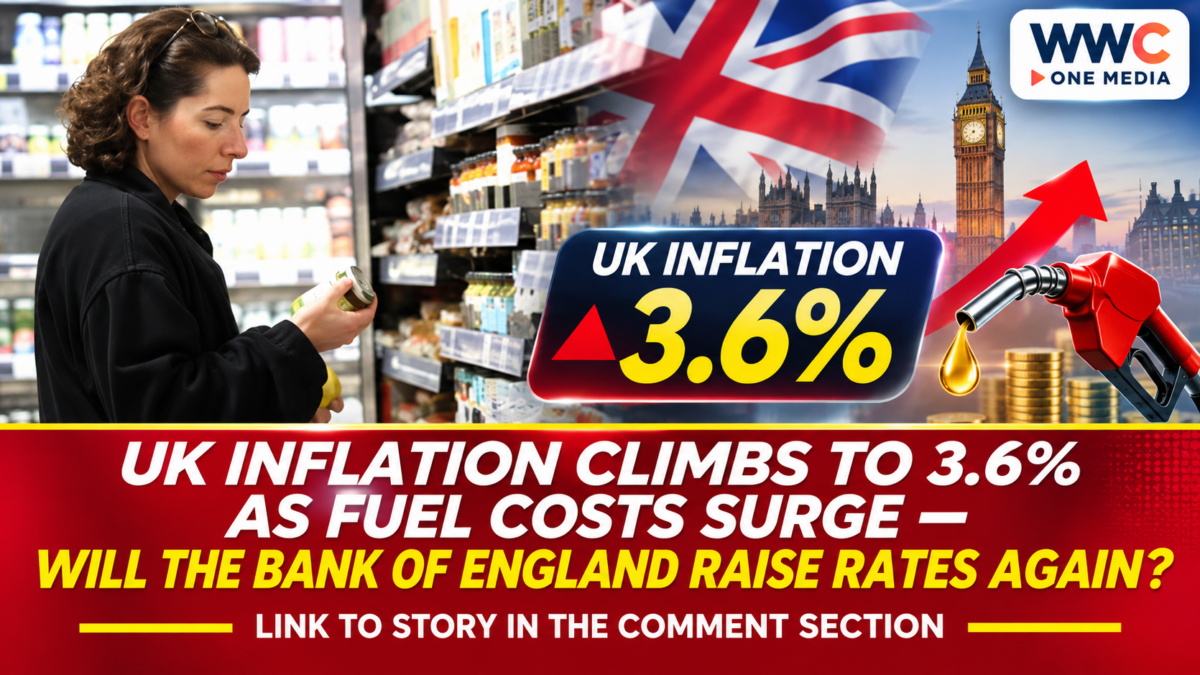
Britain’s annual consumer inflation rate increased to 3.6% in October 2026 from 3.5% in September, the Office for National Statistics reported on Nov. 18. Rising petrol and diesel costs made the largest contribution to the acceleration, creating another test for the Bank of England after it raised interest rates earlier this month.
The latest figures show why an inflation slowdown cannot be assumed merely because borrowing costs have increased. Fuel prices are climbing quickly, but the central bank must decide whether that external cost shock will spread into pay demands, services and business pricing before setting policy again.
UK inflation rate reaches 3.6% in October
The Consumer Prices Index, or CPI, rose 0.5% during October, compared with an increase of 0.4% in October 2025. Its annual rate climbed to 3.6%, the highest since September 2025. This is the measure used for the Bank of England’s 2% inflation target.
The broader CPIH measure, which incorporates owner-occupiers’ housing costs, rose 3.7% over the year, compared with 3.6% in September. CPI and CPIH describe different household-cost baskets, so their numbers should not be combined or treated as interchangeable.
WWC’s earlier report on September’s UK inflation and the November rate increase provided the starting point for this release. The October statistics replace that earlier inflation reading; they are not a second November rate decision.
Fuel prices explain the new pressure
Transport prices increased 7.5% year on year, up from 6.6% in September. Motor fuel prices alone were 33.2% higher than a year earlier, against 29.8% in September, the largest annual increase since July 2022.
Average petrol prices increased by 5.2 pence per litre between September and October to 174.7 pence. Average diesel prices rose 7.0 pence per litre to 199.5 pence. The petrol average was the highest since August 2022, while the diesel average was the highest in the statistical series beginning in January 1996.
Restaurants and hotels provided the largest offsetting downward contribution to the change in the annual inflation rate. The figures therefore describe a broad index whose components can work against one another, rather than a uniform acceleration across the economy.
Analysis: Dearer fuel can increase the cost of commuting and moving goods, but the eventual effect on supermarket prices or business margins is not mechanically determined. Companies may absorb some costs, pass them on or change operations.
Energy and housing make the burden uneven
Housing and household services remained the largest contributor to the overall CPIH inflation rate. Owner-occupiers’ housing costs increased 4.0% over the year, while the CPIH services inflation rate was 3.9%, little changed from September.
Core CPIH, which excludes energy, food, alcohol and tobacco, increased 3.1% annually, also little changed. These measures help distinguish an energy-led shock from a broad-based increase in underlying costs, but none of them tells an individual family exactly how much its budget has changed.
The annual contribution from food and non-alcoholic beverages to CPIH was just 0.08 percentage points in October, the smallest since September 2021. That does not mean food was free of inflation; it means food’s measured contribution to the overall annual index was relatively limited.
Why it matters: Families that rely heavily on driving or heating may feel a larger financial squeeze than those with different spending patterns. An inflation rate is an average measure, not an identical experience for all households.
Bank of England already raised its rate to 4%
At its meeting ending Nov. 4, the Monetary Policy Committee voted eight to one to lift Bank Rate by a quarter percentage point, from 3.75% to 4.00%. The decision was published Nov. 5. Catherine L Mann preferred a half-point increase to 4.25%; the other eight members backed the smaller rise.
The bank explained that higher global energy prices were feeding into household bills and firms’ expenses. It projected consumer inflation could reach around 5% by the middle of 2027 before easing, while noting that clear evidence of broader effects on wages and other prices was still limited.
This is a projection, not a reading of current inflation or a commitment to a specific future rate. The committee stated that monetary policy is not on a preset path.
WWC’s broader review of global central-bank rate increases provides international context, but each central bank makes its own decisions using domestic evidence.
Why households and businesses should watch the next data
Higher Bank Rate can affect mortgage renewals, floating-rate borrowing and business financing, although actual loan pricing depends on lenders and contracts. Raising rates may reduce demand over time, but it does not directly produce oil or lower wholesale energy costs.
The UK central bank will also assess whether employers and businesses respond to rising input costs by seeking higher wages or charging more for goods and services. Sustained inflation can become harder to contain if those indirect effects spread, but the October release alone does not prove that they have.
For Philippine readers, the UK’s fuel-price shock is relevant to understanding common global energy pressures, not evidence of an identical price effect at home. WWC’s report on Philippine inflation and monetary tightening covers a separate domestic policy setting.
Analysis: Policymakers face a trade-off: tighter financing may dampen demand, while the energy shock raises costs independently of spending. A credible policy response depends on how persistent the inflation becomes and how the broader economy responds.
What happens next
The ONS has scheduled the November consumer-price release for Dec. 16, one day before the Bank of England’s next policy announcement on Dec. 17. Those dates create an important sequence, but do not predetermine the committee’s vote.
The verified position on Nov. 18 is that CPI inflation has risen to 3.6%, fuel prices are a major driver, and Bank Rate stands at 4%. Whether another rise is needed depends on evidence still to come, not a guaranteed outcome from today’s statistics.
FAQ
What is the UK’s latest inflation rate?
UK CPI inflation reached 3.6% in the 12 months to October 2026, while the broader CPIH measure rose 3.7%.
Why did UK inflation increase in October?
Transport prices, particularly motor fuels, made the largest upward contribution to the change in the annual inflation rate. Restaurant and hotel prices partly offset the increase.
How expensive were petrol and diesel in October 2026?
Average petrol was 174.7 pence per litre and diesel was 199.5 pence per litre, based on the national monthly averages published by the ONS.
Will the Bank of England raise rates again in December?
No further increase has been decided. Bank Rate is 4.00%, and the next scheduled monetary-policy announcement is Dec. 17, 2026.