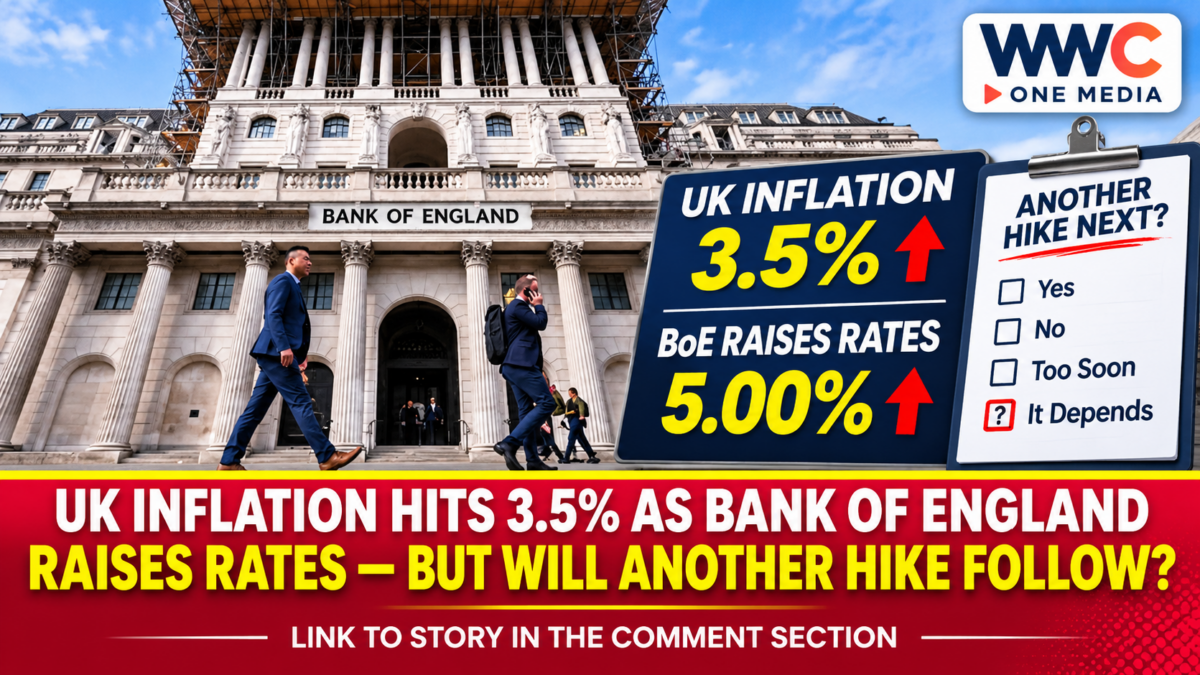
LONDON, Nov. 15, 2026 — UK inflation reached 3.5% in September, and the Bank of England responded on Nov. 5 by lifting its benchmark interest rate to 4%. Britain’s next official consumer-price report, due Nov. 18, will help determine whether policymakers face an even stronger case for tightening borrowing conditions again.
The approaching release matters because the central bank is trying to contain an energy-driven rise in prices without unnecessarily weakening the wider economy. Its next scheduled interest-rate announcement is Dec. 17, but neither the timing nor the size of any further increase has been decided.
UK Inflation Is Moving Away From the Target
The Consumer Prices Index rose 3.5% over the 12 months to September, compared with 3.1% in August. Prices increased 0.4% during September alone, after little change in the same month a year earlier.
That headline rate is well above the central bank’s 2% inflation target. It also represents an acceleration, not merely a continuation of the previous month’s reading.
The broader CPIH measure, which includes owner-occupiers’ housing costs, rose 3.6% year on year in September, up from 3.3% in August. CPI and CPIH answer slightly different questions, so readers should not treat them as interchangeable.
Transport costs, especially motor fuel, made the largest upward contribution to the change in the annual inflation rate. Restaurants and hotels partly offset that pressure. The contrast shows why one overall percentage can conceal very different experiences across household budgets.
The Bank of England Has Already Taken Action
At its meeting ending Nov. 4, the nine-member Monetary Policy Committee voted 8–1 to raise Bank Rate by 0.25 percentage points, from 3.75% to 4%. The decision was published the following day.
The split was over the size of the increase, not whether rates should rise. Eight members supported the quarter-point move, while Catherine L Mann preferred a larger increase of 0.5 percentage points, which would have brought the rate to 4.25%.
The official decision did not promise another hike in December. Instead, the committee said it would judge incoming evidence, including underlying pay, businesses’ pricing decisions and how much unused capacity remains in the economy.
This is a useful distinction in a climate of changing rate expectations: the current rate is an official decision; the next rate is still an open question. An earlier WWC examination of global central-bank tightening and Britain’s move to 4% provides a wider comparison, while this report concentrates on the next UK data test.
Energy Prices Complicate the Inflation Outlook
The November policy minutes describe higher global energy costs as a central source of uncertainty. The committee estimated that direct energy effects contributed about one percentage point to September’s 3.5% CPI reading, with fuel accounting for most of that contribution.
For households, an oil or gas shock can first appear in petrol and utility bills. For firms, it can raise transport, manufacturing and operating expenses. What happens next depends partly on whether businesses absorb those expenses or pass them through to customers.
The minutes said the evidence of broad knock-on effects on other prices and wages was still limited. That offers some reassurance, but it is not proof that further effects will never emerge.
In its November assessment, the Bank projected inflation of around 5% by the middle of 2027 before easing later. That is a forecast, not a measurement of prices today, and it depends on assumptions about how energy markets and the economy develop.
Why a Higher Rate Is Not a Simple Cure
Increasing Bank Rate makes borrowing more expensive over time and can restrain spending and investment. That may reduce the ability of businesses to increase prices, helping inflation return towards target.
But a domestic interest-rate increase cannot directly produce more oil or natural gas. The central bank’s challenge is therefore to prevent a temporary external cost shock from developing into persistent inflation across wages and prices.
The trade-off matters to mortgage borrowers and businesses refinancing debt. Some loans respond relatively quickly to market interest rates, while fixed-rate contracts can delay the impact until renewal. A higher policy rate does not mean every household’s monthly payment immediately rises by the same amount.
Comparable tensions appear elsewhere. WWC’s report on Singapore’s interbank borrowing costs discusses how funding benchmarks can affect financing conditions, while its coverage of Colombia’s inflation and rate dilemma illustrates why price stability and economic activity are often difficult to balance. Those examples are context, not predictions of UK policy.
What the Next Inflation Report Must Clarify
The October CPI report is scheduled for release on Nov. 18. As of Nov. 15, that report has not been published, so there is no verified October headline figure to compare with September’s 3.5%.
Three questions are particularly important. Has the headline rate continued rising? Are price increases spreading beyond energy-related categories? And are measures that exclude volatile items pointing to more persistent domestic inflation?
September’s core CPI rate, excluding energy, food, alcohol and tobacco, was 2.8%, up from 2.6% in August. Services CPI inflation was 3.7%, compared with 3.4% the preceding month. Those figures make the composition of the next release as important as the headline number.
Analysis: Another increase in headline CPI would intensify scrutiny of the Bank’s response, particularly if core and services measures also accelerated. A softer report could give members more reason to assess the shock’s effects before tightening again. Neither outcome mechanically determines the vote.
What Happens Next
Official UK labour-market statistics are scheduled for Nov. 17, followed by consumer-price data on Nov. 18. The Bank of England’s next announced policy decision is due Dec. 17.
Those dates create a clear sequence: evidence on employment and wages, evidence on prices, then a committee decision. The Bank has explicitly rejected a preset path for rates, making the incoming data and their implications more important than any single forecast.
For households, the underlying issue is not simply whether the rate reaches another round number. It is whether inflation starts moving sustainably back towards 2% without requiring a prolonged period of expensive credit.
Frequently Asked Questions
What is the current UK inflation rate?
The latest published annual CPI inflation rate is 3.5% for September 2026. October’s figure is scheduled for publication on Nov. 18 and is not yet available as of Nov. 15.
What is the Bank of England interest rate now?
Bank Rate is 4%, following the decision announced on Nov. 5, 2026.
Will the Bank of England raise rates again in December?
It may, but no December increase has been decided. The Monetary Policy Committee will weigh inflation, pay, pricing behaviour and economic conditions before its Dec. 17 announcement.
Why can inflation rise when interest rates are increasing?
Higher interest rates work with a lag and mainly affect domestic demand. They cannot immediately reverse a global energy supply disruption, although they can help limit the spread of rising costs into other prices and wages.