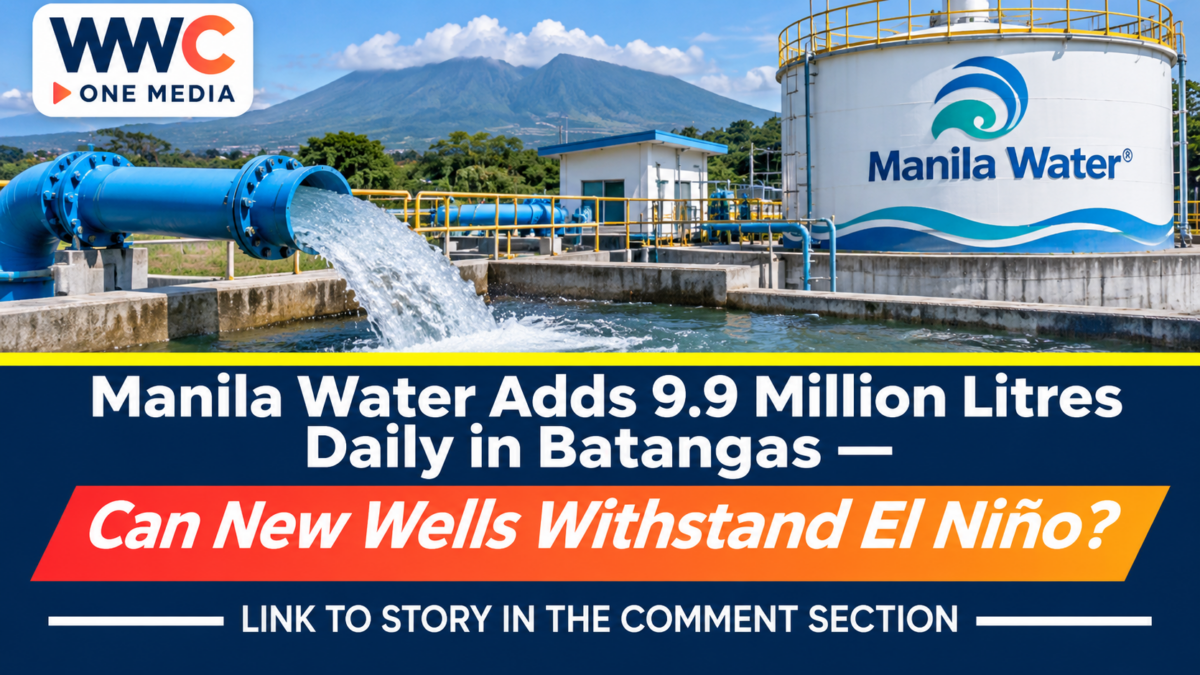
MANILA, Nov. 15, 2026 — Manila Water’s South Luzon operating units are strengthening their water systems as the Philippines experiences a very strong El Niño, with six deepwell sites in Tanauan City, Batangas, adding 9.9 million litres of supply a day. The company’s Nov. 11 update also identifies Laguna Aquatech as part of its regional preparedness effort, while the national weather bureau warns that dry conditions could persist into 2027.
The expansion addresses a practical problem: water utilities must keep supplying homes when rainfall becomes less reliable. But newly developed wells are not an absolute guarantee against shortages. Their usefulness depends on groundwater, pumps and distribution infrastructure.
Manila Water El Niño Preparations Reach Tanauan
South Luzon Water, a Manila Water operating unit serving Tanauan City, developed deepwell facilities during 2025 and 2026 at Poblacion, Tinurik, Cale, Sulpoc Nayon, Sulpok Sulok and Sulpoc Timbain. Its Nov. 11 company announcement states that the facilities add 9.9 million litres per day to the city’s water supply.
That is additional daily supply capacity reported by the company, not a count of customers guaranteed uninterrupted service. Actual output can depend on groundwater conditions and the operation of pumps, treatment and distribution infrastructure.
The dispersed locations may offer alternatives when a source faces difficulties. Still, the number of wells alone does not establish the volume that will be available during the most severe dry conditions.
The company has also described wider operational preparations in its South Luzon service areas. The most useful public indicators from here will be actual production, water pressure and the number and duration of customer interruptions—not merely the announcement of new facilities.
Why PAGASA’s Latest Warning Changes the Stakes
In its Nov. 4 advisory, PAGASA confirmed that a very strong El Niño was present in the tropical Pacific. It expected the event to continue into the first half of 2027 and said it could peak before the end of 2026.
The agency documented meteorological drought in five provinces, dry spells in 11 provinces and dry conditions in 10 provinces during October. For November, it expected below-normal to way-below-normal rainfall across much of the Philippines.
PAGASA also warned that storms and other weather systems could still produce heavy rainfall. El Niño raises the probability of rainfall deficits; it does not mean that every community will receive no rain or that every water utility will impose rationing.
The same climate pressure has prompted preparations outside South Luzon. WWC’s earlier report on six water-treatment plants being readied for El Niño examined capacity measures in the capital region. Those projects serve a different geography and should not be counted as additional Tanauan supply.
Laguna’s Challenge Is More Than Drilling Wells
Laguna Aquatech is also identified in Manila Water’s Nov. 11 update as part of its South Luzon preparedness efforts. A separate company announcement dated July 17 described Laguna Water’s work to monitor water sources, optimise system operations and conduct preventive maintenance.
The distinction between finding more water and reliably delivering it is important. A system can have adequate total volume while individual neighbourhoods experience pressure problems, especially where pumping stations, elevation or distribution lines limit delivery.
Leaks and other forms of non-revenue water further complicate the calculation. Water produced but not properly delivered or billed cannot be treated as an equivalent increase in dependable customer supply. Repairs and network management can sometimes protect supply without the construction of a completely new source.
Analysis: Diversifying sources can reduce reliance on any one well or surface-water intake, but additional groundwater extraction also makes monitoring essential. A new well should be judged against sustainable yield, water quality and the utility’s ability to distribute the output over time.
Manila Water’s Wider Strategy Relies on Multiple Sources
The company’s October update identifies the Cardona Water Treatment Plant in Rizal as a separate part of its drought preparations. That facility can treat 100 million litres per day from Laguna Lake, with output potentially rising to 110 million litres under favourable raw-water quality conditions.
Cardona serves an East Zone network; it is not part of the 9.9-million-litre addition in Tanauan. Combining the two numbers as one Batangas-Laguna project would misrepresent their locations and purposes.
Manila Water also said in November that it had inspected and prepared 33 reservoirs across its East Zone, with combined treated-water storage capacity of 557 million litres. Reservoir storage can help balance demand and distribution, but stored water and a continuing daily source are different measures.
WWC’s coverage of Davao City’s water-supply contingency planning illustrates a similar operational distinction: adequate aggregate supply does not necessarily rule out temporary pressure problems in particular areas.
Why Households Still Need Reliable Local Advisories
For households in Tanauan and Laguna, a useful measure of preparedness is whether water continues to reach taps at workable pressure during peak demand. The headline capacity of a deepwell cannot, on its own, establish that outcome.
Customers should distinguish an actual supply shortage from a scheduled maintenance interruption. WWC’s guide to local water-service advisories explains why scheduled repairs require separate notices; the areas in that story are not the same as those served by South Luzon Water.
Analysis: The strongest public accountability would come from publishing dated production figures, service-interruption records and progress on new sources. These would let residents compare promised preparedness with service delivered during the dry months.
Water conservation remains useful even when a provider reports available supplies. PAGASA’s official warning specifically urges efficient water-resource management, reflecting the possibility that a lengthy rainfall deficit could affect more than one source.
What Happens Next
The immediate test is whether South Luzon Water can maintain production from its six named deepwell sites as the dry season develops. For Laguna Aquatech, future official updates should clarify the status and output of additional sources and how service performance changes.
PAGASA’s next advisories will help utilities and residents assess how rainfall deficits evolve. New construction targets, if formally confirmed, should be reported separately from facilities already supplying water.
The evidence presently supports a measured conclusion: Manila Water has added significant deepwell capacity in Tanauan and is preparing operating units in Laguna, but no public announcement can guarantee that every household will avoid service interruptions throughout El Niño.
Frequently Asked Questions
How much additional water do the Tanauan deepwells provide?
Manila Water’s Nov. 11 announcement says six deepwell facilities developed during 2025–2026 add 9.9 million litres of water supply per day in Tanauan City.
Which areas have the new Tanauan deepwell sites?
The company identifies Poblacion, Tinurik, Cale, Sulpoc Nayon, Sulpok Sulok and Sulpoc Timbain.
How long could the current El Niño last?
PAGASA’s Nov. 4 advisory says the very strong El Niño could persist into the first half of 2027, potentially peaking near the end of 2026.
Do more wells guarantee uninterrupted tap water?
No. Actual service also depends on available groundwater, operational equipment, water quality and distribution performance. Customers should monitor their own provider’s official notices.