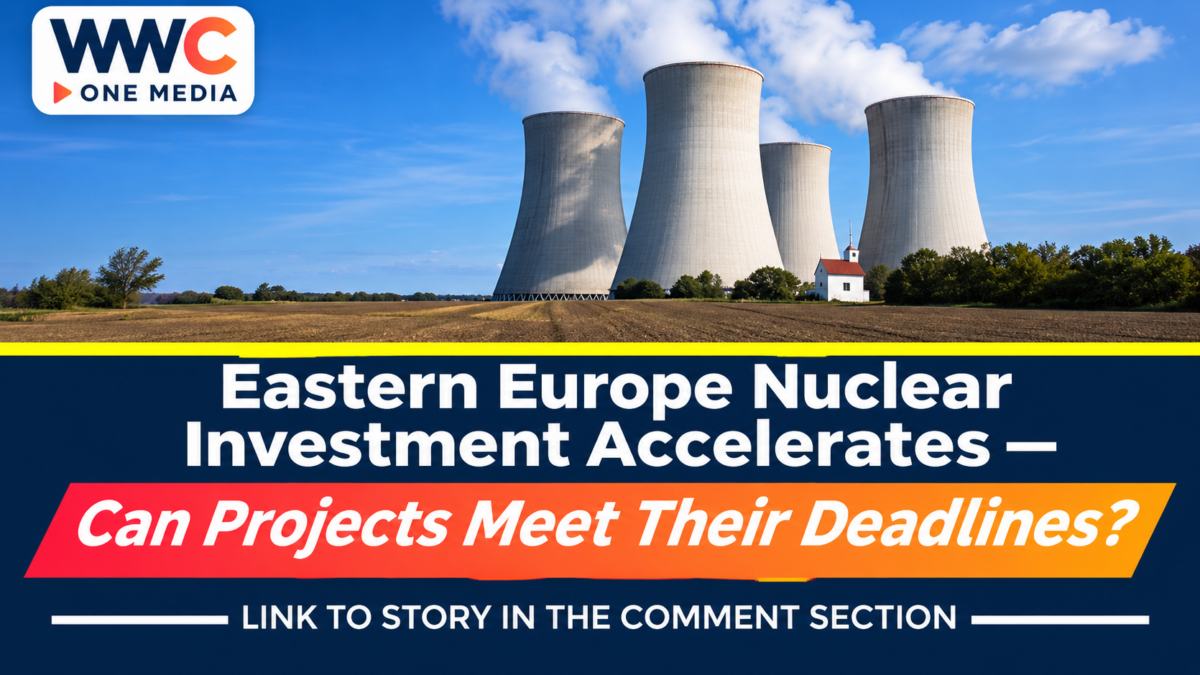
Eastern Europe nuclear investment is moving from policy announcements into engineering contracts, financing arrangements and regulatory reviews as governments seek more dependable electricity. Poland approved proposed changes to accelerate nuclear projects on Nov. 10, while Czechia, Romania and Bulgaria are pursuing separate reactor programmes at different stages of development.
The distinction matters for energy security and public finances. An engineering agreement does not mean a reactor is under construction, and a proposed financing facility is not the same as a completed investment. Official records reveal substantial ambition alongside schedules, permitting decisions and funding questions that remain unresolved.
Eastern Europe Nuclear Investment Faces a Delivery Test
Poland offers one of the clearest examples of how a nuclear strategy becomes a long-term infrastructure programme. Its updated national plan, adopted in September, envisages two nuclear power stations providing up to 9 gigawatts of generating capacity in total.
The first project, at Lubiatowo-Kopalino on the Baltic coast, would have three Westinghouse AP1000 reactors with combined capacity of approximately 3.75 gigawatts. The government targets commercial operation of its first unit in 2036 and full plant capacity by 2038.
Those are planned milestones, not dates guaranteed by completed construction. The government says it has provided for 60.2 billion złoty in capital support across 2025–2030, alongside an approach involving debt financing. Both costs and construction timetables will require continued scrutiny.
The Nov. 10 proposal seeks to simplify administrative procedures, protect subcontractors and adjust annual state funding limits. Because it is a proposed legislative amendment, approval by the cabinet should not be confused with every provision becoming law.
Poland Starts Procurement While Permits Remain Essential
On Oct. 8, the Polish investor authorised Westinghouse to begin the procurement process for components with long manufacturing lead times for the first reactor. This can help a project avoid delays caused by equipment that takes years to manufacture.
But beginning procurement does not establish that the entire plant is licensed or built. Poland’s nuclear regulator had already received the project company’s application for a nuclear construction licence in March. Preparatory works and regulatory examination therefore remain crucial steps before full construction.
Poland is also developing a second plant. Preferred sites are Bełchatów and Konin, with a technology partner targeted for selection in 2027 and the first unit provisionally envisaged around 2040.
For consumers, the essential question is not only whether Poland can build reactors. It is whether financing, construction risks and operating costs will ultimately produce electricity at an acceptable long-term price.
Czechia Has a Contract, but Construction Comes Later
Czech electricity group ČEZ confirmed in June that the state-owned project company had signed a contract with Korea Hydro & Nuclear Power for two new units at Dukovany. A year into the arrangement, the company reported geological investigations, design work and preparations for licensing and local suppliers.
Actual construction was scheduled to begin in 2029. That separates an executed supplier contract from the start of reactor building work.
The Czech government also arranged to acquire an 80% stake in the Dukovany project company from ČEZ, leaving the utility with 20%. The ownership structure illustrates why nuclear development often requires direct government participation alongside industrial contractors.
How financing is finalised matters as much as who supplies the reactor. State participation can support a large project, but it also raises questions about fiscal exposure, public guarantees and the eventual electricity price.
Romania and Bulgaria Pursue Different Routes
Romania’s Nuclearelectrica disclosed documents for a proposed financing arrangement of up to €75 million involving Export Development Canada for the Cernavodă units 3 and 4 project. The disclosure concerned shareholder consideration of financing documentation, not proof that the entire multibillion-euro expansion had been funded.
The distinction between an initial financing instrument and a complete project budget is especially important for readers comparing announcements across borders. Large nuclear plants often require several layers of funding, construction agreements and regulatory approvals.
Bulgaria, meanwhile, is developing plans for two new units at Kozloduy using Westinghouse AP1000 technology. An official government announcement describes engineering work with Westinghouse and Hyundai Engineering & Construction to support permitting and assessments of costs.
Those steps demonstrate technical progress without proving that final construction costs or commercial operation dates are fixed. Project viability will depend on the financing package, regulatory decisions and delivery performance.
Europe Needs Capital, Not Just Reactor Announcements
The European Commission estimates that the European Union will need around €241 billion of investment through 2050 for new large reactors and extensions of existing reactors’ operating lives. That EU-wide projection is not a sum already allocated to Eastern Europe, nor does it cover every potential advanced-reactor development.
The Commission also adopted a strategy for small modular reactors in March 2026. These reactors remain a separate investment category, with commercial deployment depending on design maturity, licensing and industrial supply chains.
The push reflects concerns about security of electricity supply, industrial demand and decarbonisation. Yet nuclear power must coexist with grid expansion, renewable generation and other investment needs.
In earlier coverage of Europe’s changing energy-security risks, WWC examined how imported fuel disruptions can expose industries and consumers to volatile costs. Nuclear developers seek to address part of that vulnerability, though reactors still depend on fuel, specialist equipment and international supply chains.
The same challenge of matching ambitions with funding appears in the Philippines’ exploration of small nuclear reactors. The technology choices differ, but both regions must resolve regulatory readiness, affordability and delivery risks.
Similarly, Singapore’s nuclear-technology cooperation with China illustrates the importance of separating technical cooperation from a binding decision to construct a power plant.
What Happens Next
Poland’s proposed legislative changes must move through the appropriate lawmaking process, while procurement and licensing progress continue. Czechia must advance the Dukovany programme through design and authorisations before the scheduled 2029 construction phase. Romania and Bulgaria still need further decisions on financing and project execution.
What this could mean: The decisive measure of Eastern Europe’s nuclear expansion will be how many projects turn preliminary commitments into licensed, financed and completed generating units. Announcements alone cannot reduce bills or displace imported energy.
FAQ
Is Eastern Europe already building all the nuclear plants it has announced?
No. Projects differ considerably. Some have contracts and preliminary works, while others remain in engineering, regulatory review or financing stages.
When is Poland’s first nuclear reactor expected to operate?
Poland’s published programme targets commercial operation of the first reactor in 2036. The date is a plan rather than a guaranteed completion outcome.
Who is constructing the two planned Dukovany units in Czechia?
The project company signed a contract with Korea Hydro & Nuclear Power in 2025. Preparatory activities are continuing, with construction planned to begin in 2029.
How much nuclear investment does the EU estimate it needs?
The European Commission projects about €241 billion through 2050 for large reactors and life extensions. It is an EU-wide investment estimate, not a confirmed spending total.
Could new nuclear stations lower electricity prices?
Possibly, but no reduction is guaranteed. Construction costs, financing, operating performance and grid expenses all influence the price customers ultimately pay.