BRUSSELS / BERLIN / LONDON / MANILA — November 11, 2026 | WWC ONE MEDIA | Global Business, European Energy, Natural Gas and Financial Markets
Europe is heading into another dangerous winter for energy prices, as natural gas supply disruptions, unusually low storage levels and weak renewable electricity generation combine to push wholesale power prices to their highest levels since the continent’s previous energy crisis.
The warning signs are already visible.
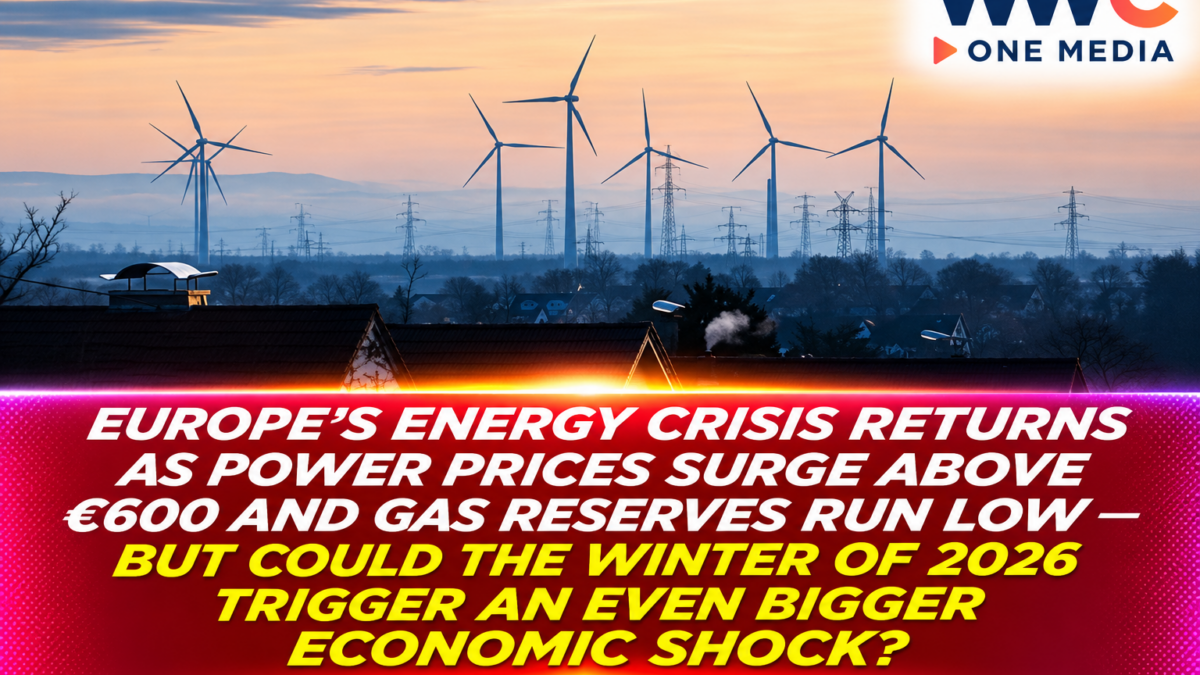
On November 9, electricity prices for selected evening trading intervals in Germany surged above €600 per megawatt-hour, while benchmark day-ahead prices in Germany and France rose above €300 per megawatt-hour.
At the same time, European gas inventories remain well below normal seasonal levels, leaving households, manufacturers and utilities exposed to another period of expensive energy.
The crisis has intensified because of disruptions to liquefied natural gas shipments from the Middle East, particularly Qatar, following the conflict involving Iran and restrictions affecting the Strait of Hormuz.
According to the European Union Agency for the Cooperation of Energy Regulators (ACER), the Middle East conflict added an estimated €18 billion to €33 billion to Europe’s gas import costs during the period examined in its 2026 market monitoring.
Meanwhile, the International Energy Agency has warned that Europe’s natural gas storage facilities could finish the winter of 2026–2027 at exceptionally low levels.
The danger extends beyond household electricity and heating bills.
High energy costs threaten chemical manufacturers, steel producers, factories and businesses already struggling to compete internationally.
Europe has invested heavily in renewable energy and reduced its dependence on Russian gas since 2022. But with another global supply shock exposing weaknesses in its electricity system, can the continent avoid another prolonged energy crisis—or will households and businesses pay the price for years to come?
Europe Faces Another Energy Crisis Four Years After the 2022 Shock
Europe’s energy system has changed substantially since Russia’s invasion of Ukraine in 2022 triggered a historic surge in gas and electricity prices.
Governments expanded liquefied natural gas import infrastructure, increased renewable electricity capacity and sought to reduce reliance on Russian pipelines.
Those changes improved supply diversification.
However, they did not eliminate Europe’s exposure to internationally traded fossil fuels.
The 2026 conflict involving Iran disrupted LNG production and shipments from the Persian Gulf, producing another international energy shock.
Europe is now competing with Asian importers for available LNG cargoes.
Unlike pipeline supplies delivered under relatively predictable arrangements, LNG is transported by specialized ships and can be redirected toward markets willing to pay higher prices, subject to contractual obligations.
That flexibility can support energy security by allowing buyers to obtain gas from multiple regions.
But during international shortages, it can also intensify price competition.
The result is a system that is less dependent on Russia but remains vulnerable to disruptions elsewhere.
European Power Prices Surge Above €600 as Wind Generation Collapses
One of the clearest examples occurred on November 9.
Bloomberg reporting published by BusinessMirror showed that German wholesale electricity prices exceeded €600 per megawatt-hour during selected evening intervals.
Germany’s average day-ahead price for the session settled at approximately €345.64 per megawatt-hour.
France’s corresponding price reached approximately €334.12 per megawatt-hour, its highest level since December 2022.
The immediate pressure came from unusually weak wind and solar generation.
A slow-moving weather system brought calm and cloudy conditions across parts of northwestern and central Europe.
When wind farms and solar installations generate less electricity, power systems must rely more heavily on other sources.
Natural gas-fired plants frequently help fill the gap.
But when gas is expensive, electricity produced by these facilities also becomes more costly.
The resulting market conditions can produce extreme price spikes.
The €600 figure is not the average price paid by households.
It refers to selected wholesale trading intervals.
Actual customer bills depend on retail contracts, regulation, taxes, network charges and other factors.
Nevertheless, sharp wholesale price increases can create significant pressure for suppliers and businesses exposed to market prices.
Why Europe Is Vulnerable to a ‘Dunkelflaute’
The German term Dunkelflaute describes periods when both wind and solar generation are unusually weak.
Such conditions can occur during cloudy, relatively windless weather.
Europe has rapidly increased renewable electricity generation, but weather conditions still influence how much electricity these sources produce.
When renewable output declines, the grid needs alternative sources of power.
Natural gas, hydropower, nuclear generation, energy storage and electricity imports can all play a role, depending on the country and available capacity.
The problem becomes more difficult when several sources are constrained simultaneously.
Reuters reported on November 10 that Germany’s flexible electricity supply cushion has been weakened by low Nordic hydropower reserves and below-normal water availability in parts of central Europe.
That leaves gas-fired generation playing a greater role in balancing the system.
With gas prices already elevated, even relatively short periods of weak renewable output can produce substantial electricity-price movements.
The challenge is not simply building additional solar panels and wind turbines.
Europe also needs sufficient flexibility to maintain reliable supply when weather conditions are unfavorable.
Europe’s Gas Storage Levels Are Much Lower Than Normal
Natural gas storage is another major concern.
European countries typically inject gas into underground facilities during warmer months and withdraw it during winter.
The stored fuel provides a buffer when heating demand rises.
But Europe entered the 2026 heating season with inventories substantially below historical averages.
According to ACER, EU gas storage stood at approximately 75% of capacity on October 21.
Reuters subsequently reported that storage was 74.62% full on November 1.
Germany’s storage level was approximately 61% at the beginning of November, below the country’s 70% target.
The lower inventories reduce the margin available to absorb prolonged cold weather or further supply disruptions.
They do not mean Europe has already run out of gas.
But they increase the importance of maintaining imports throughout winter.
A sustained period of strong heating demand could accelerate withdrawals.
That could force buyers to compete more aggressively for additional LNG cargoes.
The IEA Warns Storage Could Fall Below 10% Under a Worst-Case Scenario
The International Energy Agency has warned that Europe’s gas difficulties could continue into 2027.
In its November 3 assessment, the IEA said the region could end the current heating season with record-low inventories.
Under a particularly severe scenario involving continued LNG disruptions through the Strait of Hormuz and colder weather, EU storage could fall below 10% of working capacity by the end of March 2027.
That is a modeled worst-case outcome, not the IEA’s confirmed prediction of what will happen.
The concern is that Europe could enter spring with so little stored gas that it would need substantial imports during the following summer.
Those purchases could keep international markets tight even after winter heating demand declines.
For European consumers, the consequences might include sustained high gas prices.
For industrial companies, persistent volatility could complicate budgeting and investment decisions.
But the actual outcome will depend on weather conditions, LNG supply recovery, consumption and new production capacity.
Qatar’s LNG Disruption Has Become a Major European Supply Problem
The conflict in the Middle East has changed Europe’s access to gas.
Qatar is one of the world’s largest LNG exporters.
Its shipments are particularly important to international buyers that rely on gas transported through the Persian Gulf.
Damage to production infrastructure and disrupted tanker movements have reduced the reliability of Qatari deliveries.
In a significant development on November 10, Poland’s energy company Orlen announced that it had initiated termination of one long-term LNG agreement with QatarEnergy.
The agreement covered approximately one million metric tons of LNG annually and had an estimated 2026 contract value of €570 million.
Orlen cited prolonged force majeure affecting the supplier’s ability to make deliveries.
In related reporting, WWC ONE MEDIA examined Poland’s €570-million Qatar LNG contract termination and the broader questions it raises about European energy security.
Orlen retained another LNG agreement with QatarEnergy and said its supply security was not threatened.
The development demonstrates that a major European buyer can have alternative sources while still facing serious disruption to an individual contract.
For the wider market, the danger is that prolonged shortages increase competition and costs.
Europe Is Becoming More Dependent on American LNG
Europe’s shift away from Russian pipeline gas has increased the importance of supplies from the United States.
According to ACER, US LNG represented approximately 30% of total European Union gas supply in the period reviewed in its 2026 monitoring report.
Russian gas, including remaining pipeline and LNG supplies, accounted for approximately 11%.
The change represents a major realignment in Europe’s energy trade.
American LNG has helped diversify Europe’s energy suppliers.
But dependence on any major supplier creates commercial and geopolitical considerations.
US exports are influenced by American production, terminal operations, shipping costs and domestic policy.
Global LNG prices also respond to demand from Asia.
Therefore, even if sufficient gas is available from American producers, European consumers may still face elevated prices.
A more diversified supply portfolio reduces exposure to an individual disruption.
It does not guarantee permanently cheap energy.
The Energy Crisis Is Hurting European Manufacturers
High energy prices are especially challenging for industries that consume substantial quantities of natural gas or electricity.
Chemical manufacturers use gas both as fuel and as a feedstock for certain products.
Steel, fertilizers, glass and other industrial activities also require large amounts of energy.
When input costs rise, manufacturers may face difficult choices.
They can attempt to increase selling prices.
They can absorb lower profit margins.
Or they can reduce production when operating becomes uneconomical.
Reuters reported on November 5 that French energy company Engie expects higher energy prices to reduce European gas consumption during winter.
Engie executives said large industrial customers were already showing signs of weaker demand.
The chemical sector has faced particular pressure from elevated costs, weaker demand and regulatory challenges.
Reduced industrial gas use can ease pressure on energy supplies.
However, it may also indicate that high prices are discouraging economically productive activity.
That is a critical distinction.
Lower gas consumption is not necessarily evidence that Europe’s energy crisis has been solved.
In some cases, it may mean factories are operating less.
Energy Costs Could Become a Bigger Competitiveness Problem
Europe’s energy difficulties extend beyond the current winter.
Manufacturers compete internationally with companies operating in regions where electricity and gas may be cheaper.
Persistent differences in energy costs can influence where businesses build factories and invest in new production.
Industries may postpone expansion when future electricity expenses are uncertain.
Some companies could consider shifting energy-intensive operations elsewhere.
The effects would depend on labor costs, market access, productivity, regulation and other factors—not energy prices alone.
Still, higher utility costs can weaken Europe’s industrial competitiveness.
The issue has become a major concern for European policymakers trying to support manufacturing while pursuing climate objectives.
The challenge is designing an electricity system that is simultaneously affordable, secure and capable of reducing emissions.
Why More Renewable Energy Has Not Eliminated High Electricity Prices
Europe has made substantial progress expanding renewable electricity.
Solar and wind farms can generate power without purchasing fossil fuels during normal operation.
That provides an important advantage when gas prices surge.
However, renewable energy is not available at the same output at every hour of the day.
Generation also varies by geography and season.
Some regions may have abundant renewable electricity while others experience shortages.
Limited transmission connections can make it difficult to move surplus power between countries.
Energy storage can help shift electricity from periods of abundant generation to periods of greater demand.
But batteries have limited storage durations, while pumped hydropower depends on suitable infrastructure and water availability.
Other dispatchable electricity sources also remain important.
Reuters’ November 10 analysis highlighted this problem: Europe needs a stronger reserve of flexible electricity resources to complement its renewable capacity.
Without that flexibility, electricity prices may continue spiking when renewable output is weak.
Europe Is Reconsidering Its Energy and Climate Policies
The supply crisis has intensified debate over European energy regulation.
Several governments have argued that new requirements affecting fossil-fuel imports need to be implemented carefully during a period of supply uncertainty.
One contentious issue concerns the EU’s methane-emissions rules.
In related coverage, WWC ONE MEDIA examined the European Union’s debate over delaying methane-compliance deadlines, as some governments warned that implementation difficulties could complicate energy imports.
The European Commission proposed postponing selected requirements.
The European Parliament supported a longer delay for certain obligations.
However, the proposals had not all become final law.
The dispute illustrates the difficulty of balancing immediate energy security with longer-term climate commitments.
Relaxing requirements might reduce some near-term procurement concerns.
But weakening emissions oversight could create environmental costs.
Governments must therefore evaluate both objectives rather than assume they are mutually exclusive.
A Warmer Asian Winter Could Offer Some Relief
Not every indicator points toward a worsening crisis.
Reuters reported on November 5 that a potentially warmer winter in East Asia could reduce international competition for LNG.
Japan, South Korea, Taiwan and China are important gas importers.
If temperatures remain above seasonal norms, demand for heating fuel could be lower than otherwise expected.
That may leave more LNG cargoes available to European buyers.
However, long-range weather forecasts are uncertain.
Unexpected cold spells, technical outages or renewed geopolitical disruption could quickly change the supply outlook.
Additional LNG production scheduled to enter service in 2027 could also support future availability.
But new production requires successful commissioning and reliable transportation.
The possibility of additional supply should not be confused with a guarantee that European prices will decline by a specific amount.
Why Europe’s Energy Problems Matter to the Philippines
The Philippines is exposed to international energy markets even though it is geographically distant from Europe.
Natural gas and petroleum products are traded globally.
When European buyers compete aggressively for LNG, they may affect the prices available to importers in Asia.
The Philippines increasingly relies on imported LNG to supplement domestic gas resources used in electricity generation.
Therefore, sustained international gas-price volatility can create additional cost pressures.
However, European wholesale electricity prices do not directly determine Philippine household electricity bills.
Local prices depend on domestic generation contracts, exchange rates, fuel costs, transmission expenses, distribution charges and regulatory arrangements.
The more relevant connection is global competition for fuel.
For example, WWC ONE MEDIA reported on Bangladesh’s efforts to obtain additional American LNG as Qatari deliveries became less reliable.
Bangladesh’s circumstances differ from those of the Philippines.
But its search for alternative supplies illustrates how Asian importers are responding to the same international LNG disruption affecting Europe.
For Philippine policymakers, the crisis reinforces the importance of a diversified and reliable energy supply.
Five Factors That Could Determine Europe’s Winter Energy Outlook
1. Winter temperatures
An extended cold spell could accelerate gas withdrawals and increase electricity demand.
2. LNG shipments through the Strait of Hormuz
A sustained recovery in Middle Eastern gas exports could ease international supply pressure.
3. Wind and solar generation
Weather conditions will influence how frequently Europe must rely on expensive gas-fired power plants.
4. Gas storage withdrawals
Rapid depletion of inventories could increase the need for costly LNG imports.
5. Industrial demand and electricity-system flexibility
Lower demand, better storage, stronger grids and flexible generation could help stabilize prices.
These indicators will determine whether Europe’s problems remain manageable or develop into a more severe economic shock.
The Bottom Line: Europe’s Energy Transition Faces a New Stress Test
Europe’s 2026 energy crisis is exposing weaknesses that remain despite years of investment and reform.
The continent has reduced its dependence on Russian gas and expanded renewable electricity generation.
But it remains vulnerable to global LNG disruptions, low storage reserves and sudden changes in renewable output.
The latest warning came on November 9, when German electricity prices exceeded €600 per megawatt-hour during selected trading intervals.
Meanwhile, EU storage levels remained around 75% entering November, with Germany’s reserves even lower.
ACER estimates that the Middle East conflict added €18 billion to €33 billion to Europe’s gas import costs during the period it examined.
And the IEA has warned that the consequences of low storage could extend into 2027.
There are possible sources of relief.
More LNG production, warmer weather and improved renewable generation could reduce pressure.
But these outcomes remain uncertain.
For European households, high energy costs threaten purchasing power.
For manufacturers, they undermine competitiveness.
For governments, they complicate the balance between energy security, affordability and climate policy.
Europe has spent four years rebuilding its energy system after the 2022 crisis, yet another international supply shock has sent gas costs surging and electricity prices briefly above €600 per megawatt-hour. But as winter begins with unusually low reserves and manufacturers face growing pressure, can Europe’s new energy strategy withstand the test—or is the continent preparing for another prolonged economic shock?