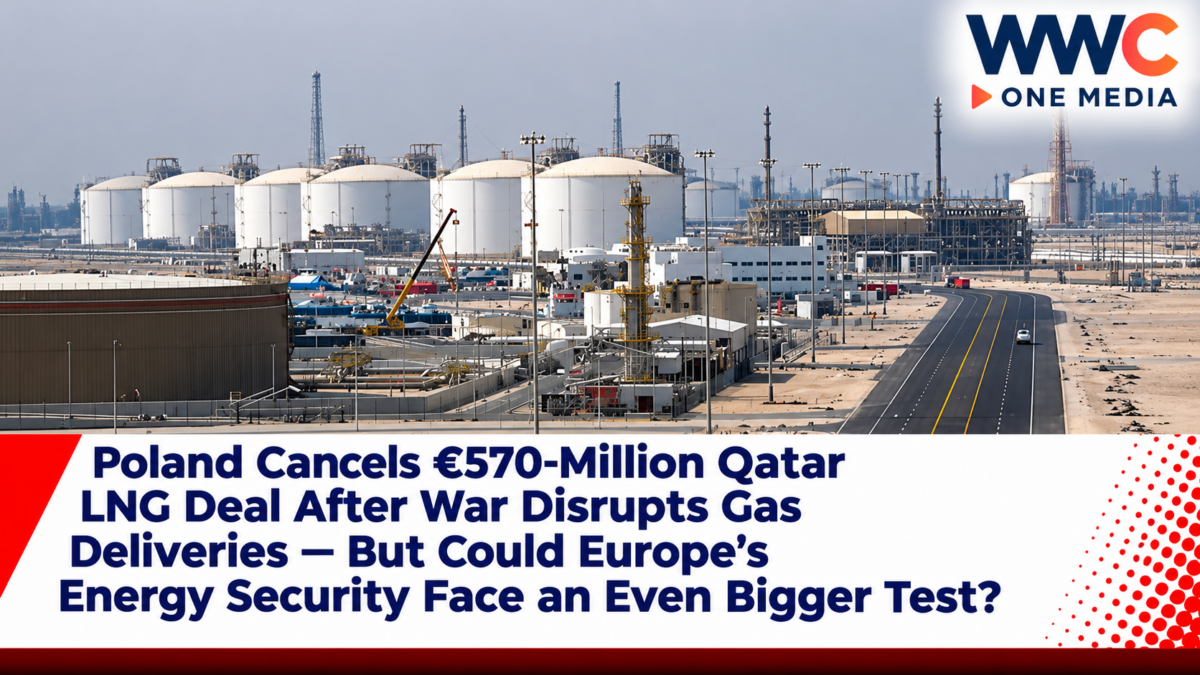
WARSAW, POLAND / DOHA, QATAR — November 11, 2026 — Europe’s energy crisis has delivered another major blow to Qatar’s natural gas business after Polish energy giant Orlen formally moved to terminate a long-term liquefied natural gas supply agreement worth approximately €570 million annually.
The decision follows months of disrupted gas shipments caused by the Middle East conflict, which has damaged Qatari energy infrastructure and severely restricted tanker movements through the strategically important Strait of Hormuz.
On November 10, Orlen announced that it had exercised its contractual right to terminate one of its two long-term LNG agreements with QatarEnergy.
The affected contract covers one million metric tons of LNG annually, equivalent to approximately 15.3 terawatt-hours of energy.
Originally signed in 2009, the agreement began supplying gas in 2016 and was scheduled to remain in force until 2034.
But persistent delivery failures under a force majeure declaration have now pushed the Polish company toward ending the arrangement.
The termination is particularly significant because Qatar had long been considered one of the world’s most reliable LNG exporters.
According to Reuters, the decision marks the first known termination of a long-term QatarEnergy LNG contract resulting from the disruptions associated with the Iran war.
Yet Poland is not abandoning Qatar entirely.
Orlen will retain a second long-term agreement with QatarEnergy, while continuing to obtain supplies from its own production and other international sources.
The larger question is whether Qatar can restore confidence among its customers—or whether the war is accelerating a permanent shift in Europe’s gas-buying strategy toward the United States and other suppliers.
Orlen Terminates One of Two Major Qatar LNG Agreements
Orlen confirmed the decision in regulatory announcement No. 39/2026, released on November 10.
The company said it was terminating one of its agreements with QatarEnergy LNG because prolonged force majeure had prevented the supplier from fulfilling its delivery obligations.
Force majeure is a contractual mechanism that may apply when extraordinary circumstances beyond a party’s control prevent agreed obligations from being performed.
Depending on the contractual terms, such events may provide relief from certain obligations or create termination rights after a prolonged disruption.
In this case, Orlen explicitly stated that it had exercised its right to terminate the agreement.
But the contract does not end immediately.
According to the company’s official disclosure, it remains effective for another 60 days after the termination notice.
That distinction is important.
Orlen has initiated termination, but the contractual notice period must still run.
The company has not announced that every commercial relationship with QatarEnergy has ended.
The Terminated Contract Was Worth €570 Million Annually
The scale of the agreement demonstrates why the decision matters.
Orlen placed the estimated 2026 annual contract value at approximately:
- €570 million.
- 2.5 billion Polish zlotys.
- One million metric tons of LNG annually.
- Approximately 15.3 terawatt-hours of energy per year.
These figures represent the annual volume and estimated value of the specific agreement being terminated.
The €570-million figure is not a confirmed cancellation penalty or an immediate financial loss.
Nor does it mean Orlen has already paid that amount for undelivered gas.
The terminated contract used a pricing formula linked to crude oil quotations.
Such oil-indexed agreements were common when major LNG importers were securing long-term supplies during the 2000s.
However, the global gas market has changed significantly since then.
Buyers increasingly have access to contracts linked to gas-market benchmarks, including arrangements involving American exporters.
The commercial difference between those pricing structures has become particularly important during periods of extreme oil and gas volatility.
Qatar’s LNG Supply Crisis Began With the Iran War
The immediate trigger for Orlen’s decision was the prolonged interruption of Qatari LNG deliveries.
QatarEnergy declared force majeure in March 2026 after Iranian drone attacks damaged facilities at Ras Laffan, the country’s major liquefied natural gas production and export complex.
The conflict also disrupted tanker movements through the Strait of Hormuz.
The narrow waterway connects the Persian Gulf with international shipping routes.
It is essential to LNG exports from Qatar and a major corridor for global oil transportation.
Damage to infrastructure and uncertainty over safe shipping severely reduced Qatar’s ability to deliver contracted cargoes.
For customers dependent on Middle Eastern gas, the disruption created serious supply-planning problems.
Long-term contracts can provide greater certainty about future purchases.
But they cannot eliminate the physical risks associated with damaged production facilities or inaccessible shipping routes.
Orlen’s decision demonstrates how a geopolitical crisis can eventually become a contractual and commercial crisis.
Poland Had Expected Qatari Deliveries to Resume in November
The termination follows an earlier indication that deliveries might restart.
According to Reuters, Orlen said in October that it expected QatarEnergy cargoes to resume around the middle of November.
That expectation suggested the company was still preparing for the possibility of restored supply.
However, the prolonged force majeure continued.
By November 10, Orlen had decided to exercise its termination rights.
The change highlights how quickly energy procurement decisions can evolve when supply disruptions persist.
An importer may initially tolerate delays if it expects normal operations to resume within a manageable period.
But prolonged uncertainty can make that approach increasingly difficult.
Utilities and major energy companies need predictable delivery schedules to manage customer demand, storage, financing and contractual obligations.
At some point, securing alternative supply arrangements may become more commercially attractive than continuing to wait.
For Orlen, the November decision marks that turning point for one particular agreement.
Poland Keeps Its Second QatarEnergy Contract
Despite the termination, Orlen is retaining another LNG agreement with QatarEnergy.
The second contract covers deliveries of up to one million metric tons of LNG annually through 2034.
Unlike the terminated agreement, it uses a pricing formula linked to gas-market quotations rather than crude oil.
The difference is commercially important.
Oil-linked and gas-indexed LNG contracts can produce substantially different prices depending on market conditions.
An agreement priced against crude oil may become less attractive when oil prices remain high relative to international gas benchmarks.
An agreement linked to gas prices may respond more directly to conditions in LNG and natural gas markets.
However, neither structure guarantees the lowest price under every circumstance.
The relative advantage depends on the precise contractual formula, delivery terms, applicable benchmarks and prevailing commodity prices.
Orlen’s decision to preserve the second QatarEnergy contract shows that the company is not severing ties with the Qatari supplier.
Instead, it is responding to the extended disruption affecting one agreement while retaining another commercial relationship.
Could US LNG Be Cheaper Than Qatar’s Oil-Linked Gas?
The termination also raises a major pricing question.
Reuters reported that market participants estimated the terminated Qatar agreement’s oil-linked formula at approximately 16% of Brent crude prices.
Analysts also estimated that some long-term US LNG contracts currently correspond to around $6–$7 per million British thermal units.
That was reported as substantially lower than the indicative cost of gas under the oil-linked Qatari arrangement.
But those figures should be interpreted carefully.
Actual delivered LNG prices can depend on liquefaction charges, transportation, financing, regasification and contractual terms.
A lower underlying gas benchmark does not automatically mean every American cargo will be cheaper than every Qatari shipment.
Nevertheless, the availability of alternative pricing arrangements gives LNG importers more options than they had when many older contracts were signed.
For Poland, the decision creates an opportunity to reconsider how much of its gas procurement should depend on long-term oil-indexed contracts.
For QatarEnergy, it demonstrates the competitive pressure created by changing market structures.
American LNG Is Becoming More Important to Poland
Orlen is increasingly connected to American LNG supply.
Reuters reported that Venture Global began commercial deliveries from the first phase of its Plaquemines LNG export facility in Louisiana earlier in November.
Orlen is a long-term customer of the project.
The development gives the Polish company another source of supply outside the Persian Gulf.
American LNG offers several potential advantages for European importers.
It avoids the Strait of Hormuz.
It can provide additional geographic diversification.
And some US contracts use gas-market-linked pricing formulas that differ from traditional oil-indexed agreements.
However, American LNG is not free from risk.
Export facilities may experience technical problems or construction delays.
Shipping costs can fluctuate.
Weather events can affect operations.
Prices can also change significantly with market conditions.
Diversification therefore reduces reliance on individual suppliers or transport corridors, but it does not eliminate supply and price uncertainty.
Qatar Is Expanding Its Own US LNG Interests
The global LNG market is becoming more interconnected in another unexpected way.
QatarEnergy is pursuing access to substantial American LNG capacity, even as its domestic exports remain under pressure.
The Financial Times reported in early November that QatarEnergy was positioned to control approximately 23.7 million metric tons of US LNG annually by 2033.
The planned supply portfolio includes additional agreements signed in October and QatarEnergy’s involvement in the Golden Pass LNG project in Texas.
The strategy could eventually make QatarEnergy one of the world’s largest buyers and international marketers of American LNG.
That reflects an important shift.
QatarEnergy is not simply defending its domestic production system.
It is seeking to build a more geographically diversified trading business.
American export capacity could allow the company to deliver LNG to international customers even when some Gulf infrastructure is unavailable.
But the reported new volumes are scheduled for later years.
They will not immediately replace the Qatari shipments disrupted in 2026.
For affected customers, near-term supply availability remains the more urgent issue.
The Strait of Hormuz Has Become a Global Energy Risk
The crisis illustrates the vulnerability of international energy markets to disruption in the Strait of Hormuz.
Before the conflict, the waterway carried a substantial share of global LNG trade.
Major importers in Europe and Asia relied on cargoes transported from Qatar and other Gulf energy producers.
Disruptions have forced buyers to reconsider their supply arrangements and shipping routes.
In related reporting, WWC ONE MEDIA examined how Bangladesh is seeking additional US LNG as Qatar’s supply crisis threatens electricity generation and industrial activity.
Bangladesh faces a different set of economic and contractual circumstances from Poland.
However, both countries demonstrate how the same disruption can force importers to seek alternative suppliers.
The consequences may include more expensive emergency cargoes, longer shipping arrangements or greater uncertainty over future deliveries.
The crisis is therefore not limited to Qatar and Poland.
It is affecting the broader global market for internationally traded natural gas.
Europe Faces a Difficult Winter Energy Calculation
For European governments, maintaining reliable gas supplies remains a major priority.
Natural gas is used for electricity generation, industrial production and household heating.
When LNG supplies become uncertain, governments and companies may increase purchases from alternative sources.
That can intensify international competition for available cargoes.
Europe’s energy security has undergone substantial changes since Russia’s invasion of Ukraine.
Countries have sought to diversify imports and reduce dependence on politically risky supply arrangements.
The Middle East crisis has added another layer of uncertainty.
As WWC ONE MEDIA reported on the European Union’s debate over delaying methane-emissions requirements for energy imports, policymakers are balancing energy affordability, security of supply and environmental obligations.
The EU methane debate is separate from Orlen’s QatarEnergy termination.
Nevertheless, it highlights the difficult choices governments face when energy markets are under stress.
Additional regulatory requirements can affect procurement decisions, while delays to environmental protections create their own policy concerns.
Orlen Says Poland’s Gas Supply Security Is Not Threatened
One of the most important details in the company’s announcement concerns domestic energy security.
Orlen explicitly stated that terminating the QatarEnergy agreement would not compromise the security of its gas supplies.
The company pointed to two major sources of protection.
First, it produces natural gas from its own fields.
Second, it maintains other long-term supply agreements.
According to Orlen, those resources are sufficient to cover the group’s gas requirements.
The company also has access to gas from Norway and the United States.
That gives the Polish group alternatives to the terminated Qatari agreement.
However, supply security and price stability are different considerations.
Having enough gas available does not automatically guarantee that every replacement shipment will be purchased at a lower price.
The overall financial effect will depend on the cost of alternative supplies, contractual obligations and conditions in international markets.
At this stage, Orlen has not disclosed a final net financial gain or loss resulting from the termination.
Why Norway Is Important to Poland’s Energy Strategy
Norwegian gas is an important component of Poland’s diversified energy system.
The Baltic Pipe infrastructure provides a route for transporting gas from Norway through Denmark to Poland.
This gives Poland access to a major European production source without relying on LNG shipments crossing the Strait of Hormuz.
Pipeline gas and LNG have different commercial characteristics.
Pipeline supplies depend on upstream production and transportation infrastructure.
LNG requires liquefaction, specialized tankers and receiving terminals.
Both can be affected by technical and geopolitical risks.
But using multiple routes and suppliers can reduce the consequences of a disruption involving any one source.
For Orlen, access to Norwegian gas and its existing production base helps explain why the company believes it can terminate the affected Qatar contract without creating a supply shortfall.
Does the Termination Signal a Wider Collapse of Qatar’s LNG Contracts?
The decision could encourage other LNG buyers to reconsider their contractual positions.
But it would be premature to conclude that QatarEnergy’s entire long-term customer portfolio is unraveling.
Reuters described Orlen’s termination as the first known termination of a long-term QatarEnergy LNG contract linked to the current conflict.
That makes it an important precedent.
However, other contracts may contain different force majeure provisions, termination rights and pricing arrangements.
Some buyers may prefer to maintain their agreements and wait for deliveries to recover.
Others may negotiate revised arrangements.
A customer’s decision will depend on its access to alternative supplies, current market prices and the specific terms of its contract.
QatarEnergy also has significant long-term relationships with major buyers around the world.
The termination of one contract is a meaningful commercial setback, but it does not establish that all Qatari LNG agreements are invalid or that the company can no longer export gas.
The larger risk is that prolonged disruption could weaken buyer confidence in the reliability of deliveries from the Gulf.
South Korea Is Also Reconsidering Long-Term LNG Security
The experience of Poland and Qatar is relevant to Asian economies that depend heavily on imported natural gas.
South Korea, Japan and other industrialized economies must balance energy affordability with secure access to fuel.
Some governments are considering investments in North American LNG infrastructure to diversify their supply sources.
As WWC ONE MEDIA examined in its coverage of South Korea’s hesitation over a multibillion-dollar Alaska LNG investment, even strategically attractive projects face questions about costs and commercial viability.
The Alaska development is not a direct replacement for Orlen’s Qatari agreement.
It represents a separate effort to establish energy supply routes that avoid the Persian Gulf.
The broader lesson is that governments are increasingly evaluating not just the price of LNG, but also the reliability of the infrastructure and shipping routes that deliver it.
Could the Crisis Affect Philippine Energy Prices?
The Philippines is geographically distant from Poland, but it is not insulated from international gas-market developments.
The country’s energy system includes natural gas-fired electricity generation, and imported LNG is becoming more important as domestic gas resources face long-term constraints.
A prolonged disruption affecting a major LNG exporter can influence prices available to international buyers.
If Asian and European importers compete more aggressively for alternative cargoes, procurement costs may increase.
That could affect power-generation costs where electricity producers rely on imported gas.
However, the relationship is not automatic.
Electricity prices depend on generation contracts, fuel costs, plant operations, transmission conditions and regulatory arrangements.
It would be inaccurate to claim that Orlen’s decision itself will immediately increase Philippine electricity bills.
The more relevant risk is sustained global LNG tightness.
In related reporting, WWC ONE MEDIA examined how the Iran conflict has increased interest in rooftop solar among Filipinos seeking protection from volatile energy costs.
The growing interest in alternative energy reflects a wider concern about dependence on internationally traded fuels.
For the Philippines, the long-term response involves a combination of reliable gas procurement, energy efficiency, grid improvements and diversified generation sources.
What Happens During the 60-Day Notice Period?
Orlen’s termination notice does not immediately erase the affected agreement.
The contract remains effective for 60 days after November 10.
During that period, the parties’ legal and commercial rights will remain governed by the agreement’s terms.
Orlen has not publicly detailed every possible financial consequence of the termination.
It has also not announced a specific damages claim or settlement with QatarEnergy.
Any such development would require further disclosure or reporting.
The central facts remain that the company has formally exercised its termination right, the notice period is running and its separate second agreement with QatarEnergy remains in place.
For investors, additional information about replacement volumes, gas costs and contractual outcomes will be important.
For energy buyers elsewhere, the case may provide insight into how prolonged force majeure conditions affect long-term supply agreements.
The Biggest Winners and Losers Could Be Determined by Contract Pricing
The commercial consequences of the decision extend beyond the physical availability of gas.
Different LNG contracts can produce substantially different prices.
An oil-linked contract may become expensive when crude oil prices remain elevated.
A gas-indexed agreement may respond to a different set of market conditions.
Spot LNG purchases can be flexible, but they may also become very costly during supply disruptions.
Buyers must consider the complete price of delivered energy, including transport and terminal costs.
For Orlen, the termination could offer greater flexibility to purchase LNG through alternative arrangements.
But that does not guarantee an immediate financial benefit.
For QatarEnergy, the loss of a long-term oil-linked agreement could reduce future contracted sales under that specific arrangement.
However, the wider effect depends on whether QatarEnergy can restore production, redirect supply or replace the lost commercial relationship.
The ultimate financial impact has not yet been established.
The Bigger Picture: Qatar’s LNG Crisis Is Reshaping Energy Security
The termination of Orlen’s QatarEnergy agreement is a significant development in the global energy market.
A contract originally signed in 2009 and scheduled to continue until 2034 is now being ended because the supplier has been unable to fulfill its delivery obligations during an extended period of conflict.
The agreement’s estimated annual value of €570 million underscores the commercial scale of the decision.
But the implications extend beyond one contract.
The war has exposed the vulnerability of LNG infrastructure and shipping routes in the Persian Gulf.
Energy importers are seeking greater geographic diversification.
American gas producers are gaining commercial opportunities.
And QatarEnergy itself is investing in US LNG capacity to strengthen its global portfolio.
For Poland, Orlen says its other supply arrangements are sufficient to maintain energy security.
For Qatar, the challenge is restoring confidence in its ability to deliver cargoes under long-term agreements.
For international consumers, the concern is whether supply disruptions will keep energy markets volatile.
Poland’s Orlen has moved to terminate a major Qatar LNG agreement that was supposed to last until 2034, citing months of failed deliveries following the Middle East conflict. But as European and Asian buyers look increasingly toward American gas, will Qatar restore its reputation as a dependable global energy supplier—or is the world’s LNG trade entering a lasting realignment that could reshape energy prices for years?