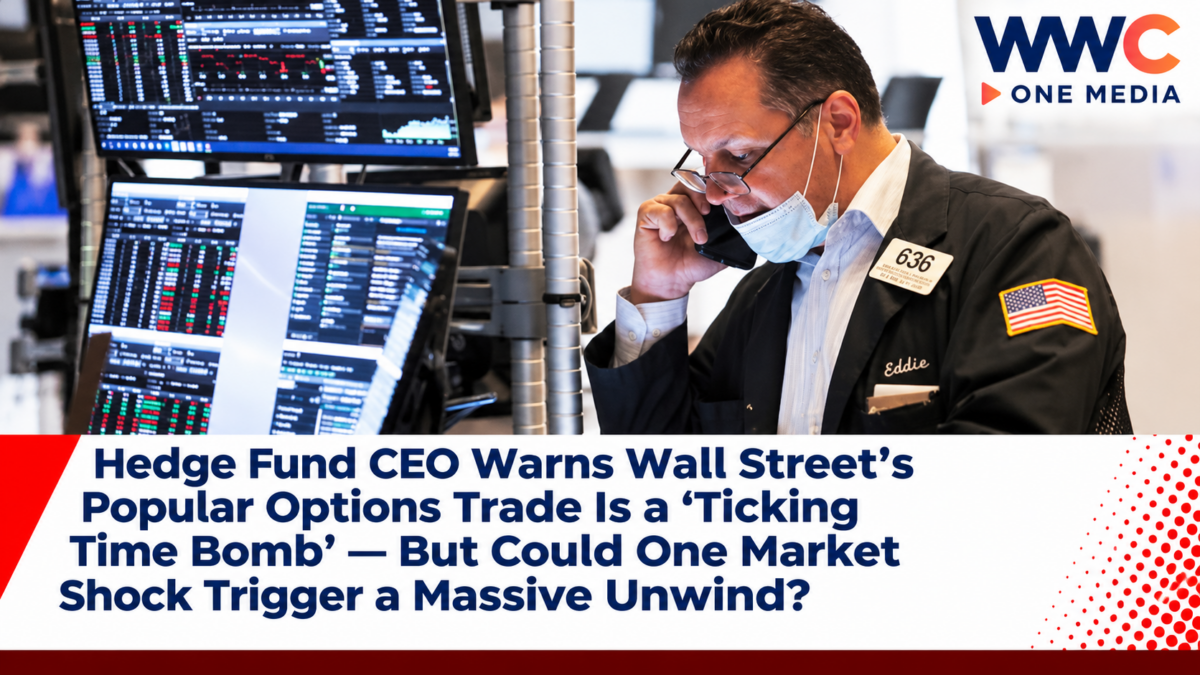
NEW YORK, UNITED STATES — November 11, 2026 — A popular Wall Street trading strategy that has delivered attractive opportunities for sophisticated investors is facing a potentially dangerous test, with a veteran hedge fund executive warning that a sudden change in stock-market behavior could trigger severe losses.
Will Bartlett, chief executive officer of Parallax Volatility Advisers, sounded the alarm during the Bloomberg Volatility Forum in New York on November 10.
His concern centers on the equity-dispersion trade, an options strategy that seeks to profit from the difference between volatility in individual stocks and volatility in a broad market index such as the S&P 500.
The trade has flourished in a market where technology shares, artificial intelligence companies and other major stocks often move sharply in different directions while the broader index appears relatively calm.
But Bartlett believes the strategy carries significant danger if those relationships suddenly change.
“The dispersion trade is a ticking time bomb,” Bartlett said, according to Bloomberg.
The warning arrives after a turbulent period for hedge funds, with the early-November technology selloff erasing substantial investment gains and forcing several firms to reduce risk.
Yet the most troubling possibility is not simply that stock prices could fall.
It is that a sudden rise in correlation—when previously independent stocks begin moving together—could cause large, crowded options positions to lose money simultaneously.
For investors, the question is becoming increasingly urgent: Could a strategy designed to exploit differences between stocks become a source of market instability when those differences suddenly disappear?
What Is the Equity-Dispersion Trade?
Equity dispersion is the degree to which individual stocks perform differently from one another.
In a highly dispersed market, some stocks may rise sharply while others fall.
Those opposing moves can partly offset each other in a stock-market index.
As a result, the overall index can appear relatively stable even while individual shares experience substantial price swings.
For example, imagine that some of the largest technology companies surge on strong earnings while other heavyweight stocks decline because of disappointing results.
The S&P 500 might finish the day with only a small change despite dramatic movements among its constituents.
This is the environment in which equity-dispersion trading can become attractive.
A common version of the strategy involves buying options exposure to volatility in individual stocks while selling options exposure to volatility in the broader index.
The strategy is designed to benefit when individual share-price movements remain substantial relative to the movement of the index.
Cboe Global Markets describes dispersion trading as a sophisticated institutional strategy involving relationships between individual-stock volatility and index volatility.
Actual positions can be complicated.
Trading desks must manage options prices, maturities, hedging costs, market liquidity and changes in relationships between securities.
The approach is not simply a bet that stocks will rise or fall.
It is a bet on how differently they will behave.
Why Hedge Funds Have Been Making Money From the Strategy
The dispersion trade has benefited from an unusual market environment.
Throughout much of 2026, investors have watched individual technology companies experience large price swings while broader stock indexes remained comparatively stable.
Artificial intelligence investment has been an important contributor.
Some technology companies have benefited from surging demand for computing infrastructure.
Others have faced concerns about expensive capital spending, weak returns or intensifying competition.
These opposing trends have created large differences in individual stock performance.
For options traders, that divergence can produce opportunities.
In October, Citadel Securities reported a widening gap between the implied volatility of individual S&P 500 constituents and that of the overall index.
Since September 29, average one-month at-the-money implied volatility for S&P 500 stocks had climbed from approximately 34.1% to 36.4%.
Over the same period, the corresponding measure for the S&P 500 index had declined from 13.2% to 11.7%.
That produced a spread of approximately 24.7 volatility percentage points.
The divergence highlighted how the market could experience substantial activity beneath the surface without an equally large increase in headline index volatility.
But the same conditions that make dispersion strategies attractive can expose traders to sudden changes in correlation.
Will Bartlett Warns the Trade Could Blow Up
Bartlett’s warning is particularly significant because he has extensive experience trading volatility.
In July, Cboe published an interview with the Parallax chief executive discussing the behavior of volatility markets and the popularity of dispersion strategies.
He explained that the trades had continued working despite significant macroeconomic risks because realized stock correlations remained low.
At the same time, he identified sudden correlation shocks as an important danger.
His latest warning at the Bloomberg Volatility Forum suggests the concern has become more pressing.
The central risk is a sharp change in the relationship between individual stocks and the overall market.
When investors become fearful, they may sell a wide range of assets simultaneously.
Stocks that previously moved independently can begin declining together.
Index volatility may then increase sharply.
For traders who have sold index volatility, that can generate substantial losses.
Those losses may be partially offset by the long positions in individual-stock volatility, but the effectiveness of that protection depends on the structure of the trade.
The net result can be damaging if the correlation shift is larger or faster than traders anticipated.
Importantly, Bartlett did not establish a date on which such an event would occur.
His warning describes a potential vulnerability, not a confirmed imminent market collapse.
The Hidden Danger Is Correlation, Not Just Falling Stock Prices
Correlation measures the extent to which different securities move together.
When correlation is relatively low, individual stocks can rise and fall independently.
When correlation increases, they tend to move in the same direction.
Dispersion strategies are particularly sensitive to these relationships.
A market can remain volatile at the individual-stock level while displaying relatively low volatility at the index level.
But during a major economic shock, the relationship can change abruptly.
Investors may stop distinguishing between companies with strong earnings and companies with weaker prospects.
Instead, they may sell stocks broadly to raise cash or reduce risk.
If that happens, the diversification effect that had kept index volatility comparatively low can weaken.
This may lead to an increase in the price of index options and losses for strategies positioned against such an increase.
Cboe’s research emphasizes that implied correlation and dispersion are closely connected.
The exchange also publishes a dispersion index designed to measure the market’s expectations for differences in future stock returns.
For professional investors, the danger is that historical relationships may provide insufficient protection when markets experience an extreme event.
Wall Street’s Volatility Gap Reaches Unusual Levels
Citadel Securities’ October research offered evidence of the increasingly unusual market structure.
The firm’s analysis placed the ratio of single-stock implied volatility to index implied volatility at approximately 3.1 times.
It also reported that one-month implied correlation had declined to around 7.6%, near the lowest levels recorded in its historical dataset since 2006.
These figures suggest that options markets were pricing substantial differences between individual-stock movements and the broader index.
However, implied correlation is derived from options prices.
It is not a direct measurement of how every stock actually moved during the period.
Likewise, low implied correlation does not automatically indicate that a market crash is approaching.
It indicates that market participants are pricing a particular relationship between individual-stock and index volatility.
The problem arises when the positioning becomes heavily concentrated and investors may be unprepared for that relationship to change.
November’s AI Selloff Exposes Hedge Fund Vulnerabilities
The warning comes after a difficult period for professional investors.
Reuters reported on November 6 that a technology-led global stock selloff wiped out much of the year’s gains for several hedge fund strategies.
According to Goldman Sachs data cited by Reuters, technology-focused equity long-short funds lost more than 4% during the November 5 market decline.
Their average year-to-date returns were left roughly flat, compared with peak gains of approximately 24% in June.
Global fundamental long-short strategies lost an average of 1.3% during the session.
Multistrategy funds fell approximately 1.4%.
The figures illustrate how quickly investment performance can deteriorate during a broad market reversal.
But those are returns for various hedge fund categories.
They are not direct measurements of the performance of all equity-dispersion trades.
In fact, some dispersion strategies performed relatively well during the same turbulence.
The distinction is critical to understanding Bartlett’s warning.
A market shock does not affect every hedge fund strategy in the same way.
Some Dispersion Trades Actually Profited From the AI Rout
Specialist derivatives publication Risk.net reported on November 6 that several equity-dispersion strategies had successfully weathered the previous day’s technology selloff.
Some gamma-weighted versions of the trade gained nearly 7% during the session as individual-stock volatility surged.
That finding challenges the assumption that every stock-market decline must hurt dispersion traders.
The performance of a dispersion strategy depends on how its positions are constructed and hedged.
A sharp increase in individual-stock volatility can benefit the long single-stock options component.
If that benefit exceeds losses on the short index-volatility position, the strategy may remain profitable.
But not all strategies use the same options, maturities or hedging rules.
Some may be more sensitive to sudden changes in correlation than others.
The November results therefore do not contradict Bartlett’s warning.
They show that dispersion trading can survive some volatile sessions while remaining vulnerable to a different type of shock.
The greatest risk may arise when individual-stock volatility no longer provides enough protection against a sudden surge in broader index volatility.
Hedge Funds Are Already Cutting Risk After Major Losses
The wider hedge fund industry is under pressure to reassess crowded positions.
One example is Walleye Capital, a major multistrategy investment firm.
After suffering a significant October decline, Walleye announced plans to reduce its internal equity long-short business and return part of its capital to investors.
Reuters reported that the firm was also reducing investment staff and changing its allocation of resources.
As WWC ONE MEDIA reported on Walleye Capital’s plans to return approximately $2 billion following a 5.9% October loss, the selloff has already forced some managers to reconsider their risk-taking.
Walleye’s reported losses should not be attributed specifically to a dispersion-trading failure without evidence.
Its restructuring concerns a broader investment operation.
Nevertheless, the episode demonstrates how losses can prompt sophisticated investors to reduce exposure and sell positions.
If multiple funds unwind similar trades simultaneously, market liquidity can come under pressure.
That is one possible mechanism through which crowded investment strategies can amplify volatility.
Viking Global Shows Why Avoiding Crowded Trades Matters
Not every hedge fund has been equally exposed to the technology downturn.
Viking Global Investors experienced a comparatively smaller October loss after avoiding some of the most crowded artificial intelligence investments.
According to reporting cited by WWC ONE MEDIA, Viking’s flagship long-short equity fund declined approximately 1.2% for the month.
That was less severe than the performance of some competitors heavily exposed to technology shares.
As WWC ONE MEDIA examined in its report on Viking Global’s cautious AI positioning, portfolio construction can strongly influence the outcome of market turbulence.
The fund’s performance does not directly establish anything about equity-dispersion trading.
But it illustrates a related concern: crowded strategies can become vulnerable when many investors rely on similar assumptions.
For dispersion traders, the shared assumption may involve the persistence of low correlation.
For other funds, it could involve continued gains in specific technology shares.
In either case, concentrated exposure can increase the consequences of an unexpected market shift.
Nvidia’s Wild Market Divergence Shows Why Dispersion Is Important
The recent performance of Nvidia provides an example of how different individual-stock and index movements can become.
On November 9, Nvidia shares fell approximately 4.3%, erasing around $190 billion in market value.
Yet the S&P 500 rose approximately 2.3% during the same session.
The Dow Jones Industrial Average also advanced sharply.
As WWC ONE MEDIA reported on the rare divergence between Nvidia and the wider US stock market, the session highlighted how a major company can experience substantial losses while other parts of the market rally.
That type of divergence is relevant to dispersion traders.
If individual stocks experience large movements in opposing directions, the broader index may remain comparatively stable.
But the relationship can change if a macroeconomic shock causes many major stocks to decline together.
The financial risk lies in how quickly traders can adjust when that happens.
China’s Regulators Are Also Warning About Crowded AI Investments
Concerns about concentrated investment strategies extend beyond the United States.
Chinese financial regulators have warned that enormous amounts of capital flowing toward artificial intelligence companies may create systemic risks.
Xiao Yuanqi, deputy head of China’s National Financial Regulatory Administration, raised concerns about the concentration of investment and the potential consequences for financial stability.
As WWC ONE MEDIA reported on China’s warning about excessive AI investment concentration, investors face questions about whether valuations and financing structures have moved ahead of companies’ actual earnings.
The Chinese regulator’s remarks concerned a broader range of investment and financial risks.
They were not a direct warning about US equity-dispersion trades.
However, both developments reflect a common concern.
Financial markets can become fragile when large numbers of investors pursue similar opportunities without fully preparing for adverse conditions.
Diversification and effective risk management become particularly important when market behavior changes unexpectedly.
Could Rising Interest Rates Trigger a Correlation Shock?
Another possible trigger involves global monetary policy.
Central bankers have recently signaled that further interest rate increases may be needed to control inflation.
Higher interest rates can affect the valuation of stocks, especially companies whose expected profits lie far in the future.
They can also increase borrowing costs for leveraged investment strategies.
If investors simultaneously reassess economic growth, financing expenses and corporate earnings, selling pressure may spread across multiple sectors.
This could produce a broader market decline rather than isolated losses in a few companies.
However, higher interest rates do not automatically cause correlations to increase.
The relationship depends on the economic circumstances and how investors respond.
For dispersion traders, the relevant question is whether a major event could cause individual stocks to move more closely together than the options market had anticipated.
That risk can arise from monetary policy, recession fears, geopolitical developments or other unexpected shocks.
What Happens if Dispersion Trades Begin Unwinding?
A disorderly unwind could create several financial consequences.
Investors holding losing options positions may need to rebalance their exposures.
Some may close trades to limit further losses.
Others could face margin requirements or internal risk limits that force them to reduce positions.
If large numbers of funds respond simultaneously, liquidity in certain options markets could deteriorate.
Trading costs may increase.
Dealers may also adjust hedging positions in the underlying securities or index futures.
These adjustments can influence prices, particularly during stressed market conditions.
However, the exact market impact depends on the size and structure of outstanding positions.
The available public reporting does not establish the total dollar amount currently committed to equity-dispersion trades.
It also does not show that a systemic unwind has already begun.
Bartlett’s warning should therefore be understood as a caution about potential vulnerabilities, not proof of an approaching financial disaster.
What Ordinary Investors Should Understand
The equity-dispersion trade is primarily a sophisticated institutional strategy.
It involves options, correlation assumptions and complex risk management.
Most retail investors do not directly operate the same structures.
Nevertheless, the underlying market behavior matters to ordinary shareholders.
A broad market index can appear calm even when important companies experience large price swings.
That means headline index performance may not fully describe the risks inside an investment portfolio.
Investors should also understand that diversification can become less effective during severe market stress.
Assets that normally behave differently can sometimes decline together.
This does not mean investors should assume a crash is inevitable.
It means portfolio risk should be evaluated under multiple scenarios rather than relying only on recent market conditions.
The main lesson is that low market volatility is not necessarily the same as low financial risk.
Can Wall Street Avoid a Bigger Blowup?
The outcome will depend on how market conditions evolve.
Several indicators will be important.
The first is implied correlation among major stocks.
A sustained increase could signal that investors expect securities to move together more closely.
The second is the relationship between index volatility and individual-stock volatility.
A sudden narrowing of that gap could alter the economics of dispersion strategies.
The third is options-market liquidity.
Thin liquidity during stress can increase transaction costs and make positions difficult to adjust.
The fourth is hedge fund leverage.
Highly leveraged strategies may face greater pressure to unwind after unexpected losses.
Finally, developments involving AI valuations, interest rates and geopolitical risks could influence the overall market environment.
A gradual adjustment may allow funds to rebalance.
An abrupt shift could produce more severe losses.
But the outcome remains uncertain.
The Bigger Picture: Wall Street’s Quietest Risks May Be Hiding Beneath the Index
The popularity of equity-dispersion trading reflects an extraordinary period in financial markets.
Individual technology companies and other major stocks have experienced large price swings.
But the broader market has often remained comparatively stable because those movements offset one another.
Professional investors have developed sophisticated strategies to profit from this divergence.
For some funds, the approach has delivered attractive results.
Yet the same strategy can become dangerous if correlations change unexpectedly.
Will Bartlett’s warning is significant because it comes from an experienced volatility trader familiar with the mechanics of these markets.
Recent market turbulence has already demonstrated how quickly crowded positions can generate losses and force hedge funds to reduce risk.
However, not every dispersion strategy has suffered.
Some performed well during the November technology selloff, demonstrating that the risks depend on position structure and market conditions.
The underlying concern is therefore not that dispersion trading is inherently doomed.
It is whether investors have become too comfortable with market relationships that may not persist during a severe shock.
Wall Street’s equity-dispersion trade has thrived while individual stocks swing wildly and major indexes appear comparatively calm. But as hedge funds crowd into increasingly complex options strategies, could a sudden surge in market correlation turn one of the industry’s favorite trades into its next major financial blowup?