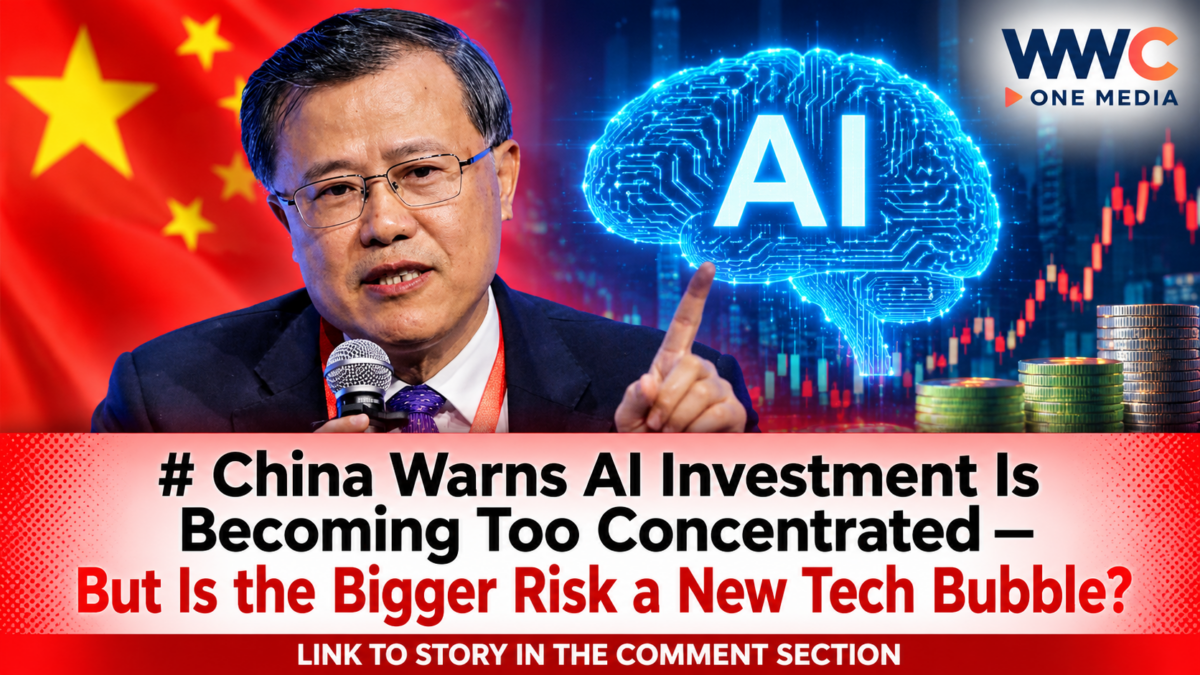
HONG KONG / BEIJING — November 3, 2026
China is warning that the global artificial-intelligence investment boom may be becoming too concentrated, raising concerns that enormous flows of capital into a relatively small group of technology companies could create broader financial risks.
Xiao Yuanqi, deputy head of China’s National Financial Regulatory Administration, said on Tuesday that a massive influx of capital into technology companies and leading AI firms had pushed up leverage and could encourage excessively rapid expansion.
His warning came at the Hong Kong Monetary Authority’s Global Financial Leaders’ Summit, as investors are already confronting a sharp correction in Chinese AI-related stocks.
The concern is no longer simply whether artificial intelligence will transform the economy.
The harder question is whether too much money is being committed to the technology at the same time — and whether that concentration could eventually affect industries, borrowers and financial markets far beyond AI.
Reuters reported that Xiao said concentrated capital was creating a “crowding-out effect” on traditional industries by increasing borrowing costs and financial burdens. He urged policymakers to develop frameworks specifically designed to address the economic and financial risks created by the AI transformation.
China’s warning comes as its AI stock boom is already under pressure
The timing of Xiao’s comments is significant.
China has spent much of 2026 encouraging technological development in artificial intelligence, semiconductors, robotics and advanced manufacturing.
Investors responded enthusiastically.
But the rally has recently reversed sharply.
Reuters reported in late October that China’s STAR 50 Index, heavily exposed to AI and semiconductor companies, had fallen about 40% from its mid-year high, wiping out roughly US$480 billion in market value.
That correction has transformed the investment debate.
Earlier in the year, the dominant question was how quickly Chinese companies could benefit from the AI revolution.
Now investors are asking whether valuations, corporate spending and expectations had moved too far ahead of actual earnings.
WWC One Media previously examined this shift in China’s AI Hardware Selloff Deepens as Valuation Fears Hit Tech Darlings — But the Earnings Boom Isn’t Over Yet, highlighting how semiconductor, optical-networking and robotics companies became some of the biggest beneficiaries — and later victims — of the AI investment surge.
The problem is bigger than falling stock prices
A stock-market correction by itself does not necessarily mean the underlying technology is failing.
Companies can continue developing useful AI systems even when their shares fall.
The financial concern is different.
When investors pour money into the same group of companies, their valuations can rise rapidly. Those higher valuations can then encourage additional borrowing, new investment and further expansion.
That creates a feedback loop.
More capital can produce more AI infrastructure.
More infrastructure can create expectations of greater future AI demand.
Those expectations can push valuations higher.
Higher valuations can then encourage companies and investors to commit even more capital.
The system works extremely well when demand and profits meet expectations.
The danger appears when they do not.
Xiao’s warning specifically focused on this relationship between capital concentration, leverage and expansion.
He said the large influx of money into technology and leading firms had increased leverage in those areas and could contribute to excessively rapid growth.
Traditional industries could become the unintended losers
One of the most important parts of Xiao’s warning is that the consequences may not remain inside the technology sector.
Capital is limited.
If investors and lenders become overwhelmingly attracted to AI companies, other businesses may have to compete harder for financing.
That can increase borrowing costs for companies operating in manufacturing, transportation, construction, consumer services and other traditional industries.
Higher financing costs can discourage companies from investing in factories, equipment, workers and expansion.
That is what economists mean by a crowding-out effect.
In other words, an AI boom can create enormous technological investment while simultaneously making capital more expensive for businesses outside the technology sector.
Xiao warned that this could weaken traditional companies’ ability to reinvest and expand production while increasing credit risks.
China has already started warning against blind investment
Xiao’s comments also fit into a broader shift in Beijing’s approach to AI and advanced technology.
In October, Chinese authorities issued policy guidance warning against blind investment and excessive expansion into emerging industries.
The government said it wanted to support advanced technology while preventing bubbles, industrial hollowing-out and “swarm-like” investment into high-tech sectors.
The policy also emphasized the need for AI development to remain safe, reliable and controllable.
At the same time, Beijing continues to promote its “AI Plus” strategy, which seeks to apply artificial intelligence across traditional industries and accelerate the development of AI-enabled products.
That creates an important distinction.
China is not abandoning AI investment.
It is trying to make sure the investment becomes more productive and less speculative.
The central bank is also taking a more cautious view
China’s financial authorities have been increasingly focused on how AI affects the broader economy.
People’s Bank of China Governor Pan Gongsheng said last month that AI was already influencing stock prices and financial-market volatility.
He also outlined a three-part approach involving financing AI innovation, cautiously adopting AI within financial operations and monitoring its effects on monetary policy and the wider economy.
Pan warned that AI demand and supply could develop at different speeds.
He also noted that AI could increase investment and inflation in the short term while potentially improving productivity and lowering inflation over a longer period.
That illustrates the policy challenge.
AI could eventually make economies more productive.
But getting there may involve a period of heavy spending, volatile asset prices and uneven returns.
China’s AI market has become unusually concentrated
The scale of the concentration is striking.
Reuters reported that Goldman Sachs estimates AI-related stocks represented about 42% of China’s market capitalization and 57% of trading activity across mainland-listed A-shares and Hong Kong-listed H-shares during the recent boom.
That means a large portion of investor activity became linked to the same broad technology theme.
When confidence was rising, that concentration amplified gains.
When sentiment turned, it amplified losses.
The same pattern can appear in other markets when investors crowd into a handful of popular themes.
The problem is not simply that investors own technology stocks.
It is that many seemingly different investments may ultimately depend on the same assumption:
AI spending will continue growing rapidly and companies will eventually earn enough money to justify the capital being committed today.
China’s AI hardware correction shows what happens when expectations become extreme
The recent performance of Chinese AI hardware companies provides an early example.
Optical-networking suppliers and semiconductor companies became major beneficiaries of rising data-center demand.
But some of those stocks subsequently suffered enormous declines as investors questioned whether valuations had become excessive.
Reuters reported that shares of optical component makers Zhongji Innolight and Eoptolink Technology had fallen roughly 60% from their highs in June and July during the recent correction.
That does not necessarily mean demand for optical technology has disappeared.
It means investors are reassessing how much future growth they are willing to pay for today.
This distinction is crucial.
A company can have a good business and still have an overpriced stock.
A technology can be genuinely transformative while some of the companies associated with it generate poor investment returns.
AI may be real — but the economics still have to work
That is increasingly becoming the dividing line in the global AI debate.
There is little question that artificial intelligence is being adopted across industries.
Companies are investing in chips, data centers, software, electricity infrastructure and networking equipment.
But investment itself is not the same as profitability.
Someone ultimately has to pay for all of that infrastructure.
If AI applications generate enough revenue and productivity gains, the spending can be justified.
If companies build capacity faster than customers are willing to pay for it, returns can disappoint.
That is why investors are beginning to examine utilization rates, cash flow, margins and customer demand rather than simply counting the amount of money being spent on AI.
China’s AI ambitions remain intact
The financial warning should not be interpreted as a reversal of Beijing’s technology strategy.
China still considers AI and advanced technology central to its economic and geopolitical ambitions.
Beijing wants greater technological self-reliance in areas including:
- artificial intelligence;
- semiconductors;
- robotics;
- advanced manufacturing;
- computing infrastructure; and
- industrial automation.
The government continues to provide policy support for these sectors.
The challenge is ensuring that support encourages genuine technological development rather than simply encouraging companies to build similar products at the same time.
WWC One Media previously examined this dynamic in China’s AI Boom Shifts Toward Global Markets as Domestic Competition Squeezes Local Firms, where the growing competition among Chinese AI companies was highlighted as a source of pressure on prices and profit margins.
Domestic competition could make the problem worse
China has an enormous number of companies pursuing AI-related opportunities.
That competition can accelerate innovation.
But it can also create excess capacity.
If multiple companies receive financing and government encouragement to build similar chips, robots, AI applications or data-center equipment, they may eventually compete primarily on price.
That can produce a familiar industrial pattern:
More factories.
More supply.
Lower prices.
Lower margins.
And eventually weaker returns for investors.
China has experienced versions of this cycle in other manufacturing industries.
AI could face similar pressures if investment grows much faster than sustainable demand.
The global AI market is also facing questions about returns
China is not alone.
Technology companies around the world are spending extraordinary amounts on AI infrastructure.
Asian chipmakers recently said demand for AI products remained strong, even as investors continued questioning whether the enormous capital expenditures would generate adequate returns.
Reuters reported that companies including Alphabet, Intel and Amazon came under market pressure amid concerns over the relationship between AI spending and future returns.
That means Xiao’s warning is not necessarily a criticism aimed only at China’s technology sector.
It reflects a much broader global concern.
The AI economy is becoming one of the largest destinations for corporate and investment capital.
If its growth remains strong, that spending could produce substantial productivity gains.
If returns disappoint, however, the financial consequences could extend across markets.
Why concentration matters to global markets
The greater the concentration of investment, the more sensitive financial markets become to one theme.
If AI companies continue exceeding expectations, concentrated investment can generate impressive returns.
But if expectations suddenly change, investors may all try to reduce their exposure at the same time.
That can create a much faster market correction.
The risk is especially significant when companies are highly valued and investors have borrowed money to participate in the rally.
Leverage magnifies both gains and losses.
That is why Xiao specifically connected AI investment concentration with higher leverage and credit risks.
AI could still be one of the biggest productivity breakthroughs in history
There is an important reason policymakers do not simply want to stop the investment boom.
Artificial intelligence could significantly improve productivity.
It could help businesses automate repetitive work, improve logistics, accelerate scientific research, support medical discovery and make software development more efficient.
China also sees AI as a way to modernize traditional industries.
That is why Beijing’s policy approach is becoming more sophisticated.
The goal is not to prevent AI investment.
It is to direct investment toward productive uses while reducing the chance that speculation overwhelms the underlying economics.
The bigger concern is a mismatch between investment and earnings
This may be the most important issue for investors.
AI companies can continue reporting growth while their shares decline.
That happens when investors believe future earnings will not justify current valuations.
It is already happening in parts of China’s technology sector.
Reuters reported that even after the dramatic decline, the STAR 50 remained valued at roughly 100 times trailing earnings at the end of October — far below its peak valuation but still extremely high by traditional standards.
That suggests the market correction may be less about rejecting AI itself and more about resetting expectations.
The AI bubble question is becoming harder to ignore
The phrase “AI bubble” has become increasingly common because the pattern resembles previous investment booms.
The technology is real.
The demand is real.
The economic potential is real.
But investor enthusiasm can still become excessive.
The internet transformed the global economy, yet the dot-com crash destroyed enormous amounts of investment capital.
The electric-vehicle industry has grown dramatically, but many companies have struggled to deliver sustainable profits.
China’s solar industry became globally competitive while also experiencing intense price competition and overcapacity.
AI could follow a similar path.
The technology can succeed even if many investments fail.
What happens to traditional industries if AI keeps absorbing capital?
That is the question behind Xiao’s warning.
If AI companies can attract financing at increasingly favorable terms while traditional businesses face higher borrowing costs, economic resources may become distorted.
A manufacturer might postpone a factory expansion.
A smaller company might delay hiring.
A business might decide not to upgrade equipment because financing is too expensive.
Meanwhile, another company may raise billions for an AI infrastructure project based on projections of demand several years into the future.
That does not automatically make the AI project wrong.
But policymakers need to ensure that capital markets continue functioning efficiently across the entire economy.
China wants AI growth without another investment frenzy
This balancing act could become one of Beijing’s biggest economic challenges.
The government wants China to lead in strategic technologies.
It also wants to avoid the kind of speculative investment cycles that can create debt, overcapacity and financial instability.
Those objectives can conflict.
Strong government support can accelerate technological development.
But investors may interpret that support as a signal that almost any AI-related company deserves funding.
That can encourage excessive risk-taking.
Beijing is now trying to make the distinction clearer.
Support the technology.
Discourage blind investment.
Promote innovation.
Prevent bubbles.
Expand AI into the real economy.
Avoid hollowing out traditional industries.
What the warning means for the rest of Asia
The consequences extend well beyond mainland China.
Asian economies are deeply connected to the global technology supply chain.
Taiwan manufactures advanced semiconductors.
South Korea dominates major areas of memory-chip production.
Japan supplies sophisticated manufacturing equipment and components.
Singapore is a major data-center and financial hub.
Malaysia is expanding its role in data centers and digital infrastructure.
The Philippines is seeking greater participation in digital services and AI-enabled industries.
A major slowdown in global AI spending could therefore affect manufacturers, infrastructure companies, exporters and technology workers throughout the region.
At the same time, continued AI expansion could generate significant new investment opportunities.
The outcome depends heavily on whether spending translates into sustainable demand.
The market may now demand proof instead of promises
That could be the most important change underway.
During the early stages of an investment boom, investors often focus on possibility.
How large could the market become?
How quickly could technology improve?
How many customers could eventually adopt it?
After valuations rise sharply, the questions become more demanding.
How much revenue is already being generated?
What are the margins?
How much debt is being accumulated?
When will the investment generate cash?
How much additional capital will be required?
And what happens if demand grows more slowly than expected?
China’s AI market is entering this second stage.
A correction does not necessarily mean the AI revolution is over
This distinction matters.
A 40% decline in an AI-heavy stock index does not mean AI technology has lost 40% of its economic value.
Stock prices reflect expectations about future earnings, not simply current technology adoption.
A company can continue growing while its share price falls because investors had previously priced in even faster growth.
That is why the current correction should be viewed as a financial repricing rather than proof that artificial intelligence has failed.
But financial concentration creates real risks
Xiao’s warning deserves attention precisely because it goes beyond stock-market valuations.
He is highlighting the possibility that concentrated AI investment could influence borrowing costs, corporate leverage and the allocation of capital throughout the economy.
That makes the issue relevant to policymakers, banks, businesses and investors — not just technology companies.
The financial system must be able to absorb a period in which AI investment grows rapidly without assuming that every project will succeed.
What happens next?
China is unlikely to slow its AI ambitions dramatically.
Instead, regulators appear more likely to focus on where the money is going and whether the resulting projects have credible economic foundations.
Investors, meanwhile, may become increasingly selective.
Companies with genuine technology, strong customers, sustainable revenue and manageable debt could continue attracting capital.
Companies relying primarily on hype may find financing much more difficult.
That could produce a healthier AI industry in the long run.
The winners may not necessarily be the companies receiving the most money.
They may be the companies capable of turning that money into lasting productivity and profits.
The Bigger Question: Can China Fund the AI Revolution Without Creating a New Financial Imbalance?
China wants artificial intelligence to become a foundation of its next phase of economic growth.
But Xiao Yuanqi’s warning highlights a difficult contradiction.
The more capital flows into AI, the faster the technology can develop.
Yet the more concentrated that capital becomes, the greater the risk that valuations rise too quickly, leverage expands and traditional industries struggle to compete for financing.
China’s recent AI stock correction has already demonstrated how quickly investor enthusiasm can reverse.
The challenge now is not simply preventing an AI bubble from bursting.
It is ensuring that the money flowing into artificial intelligence produces enough real economic value to justify the enormous financial expectations surrounding it.
If AI is truly the next great productivity revolution, can China and the rest of the world keep investing at extraordinary speed without allowing the concentration of capital to become the next major financial risk?