SEOUL — November 3, 2026
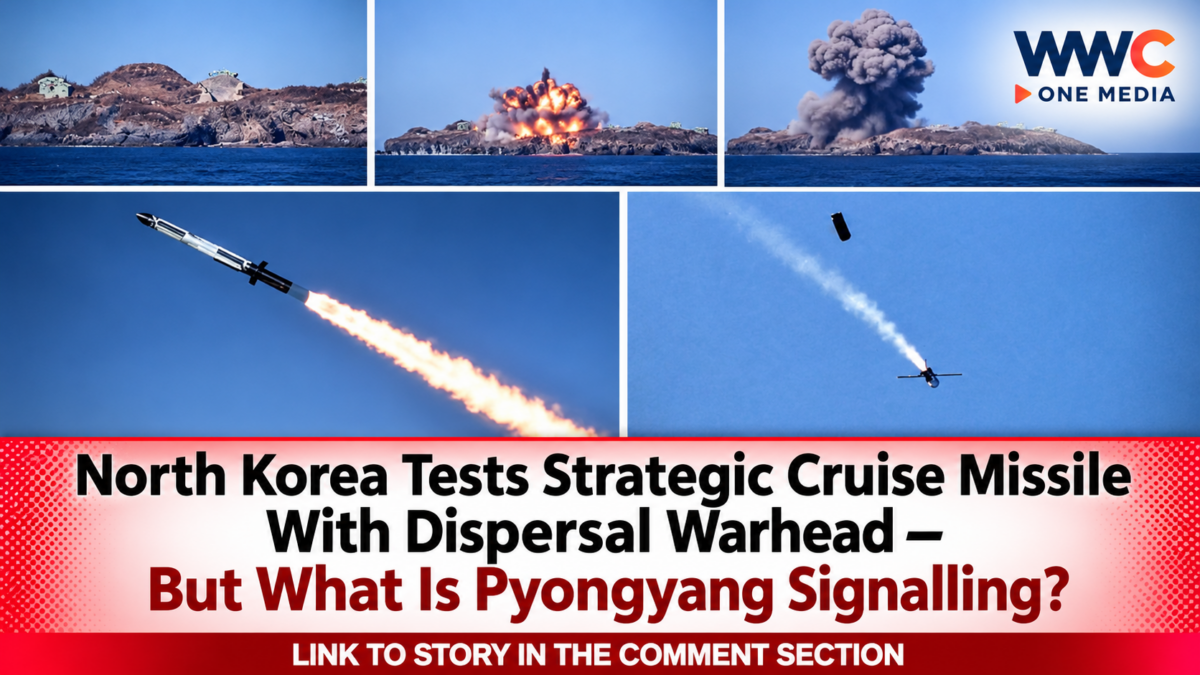
North Korea says it has tested a strategic cruise missile equipped with a dispersal warhead, marking another step in its expanding conventional weapons programme as military tensions on the Korean Peninsula remain elevated.
The test was conducted on Monday, Nov. 2, according to North Korea’s state-run Korean Central News Agency, or KCNA.
Pyongyang said the exercise assessed both the power of the warhead and the missile’s ability to conduct what it described as a vertical strike.
Reuters confirmed the basic claim but noted that North Korea did not provide independent evidence or detailed information about the missile’s performance.
The announcement comes only days after North Korea reported another test involving a dispersal or cluster-type warhead for a tactical ballistic missile.
Taken together, the tests point to a broader effort by Pyongyang to diversify its conventional strike capabilities.
But the immediate question is not simply how powerful the latest weapon may be.
It is why North Korea is displaying these capabilities now — and what the tests mean for the already tense security environment around the Korean Peninsula.
A new warhead test follows another weapons demonstration
North Korea’s Missile Administration conducted Monday’s tests, according to KCNA.
The country’s Warhead Institute said the medium-sized dispersal warhead could affect a target area of approximately 5 to 6 hectares under what it described as its highest-density effect.
The Cruise Missile System Institute, meanwhile, claimed it had improved the missile’s ability to approach a target from above by refining its terminal manoeuvrability.
Those claims come entirely from North Korean state media and have not been independently verified.
Yonhap reported that the tests were overseen by Gen. Kim Jong-sik, a member of the Workers’ Party of Korea’s Central Military Commission and a senior official involved in the country’s weapons programmes.
North Korean officials described the exercise as part of efforts to strengthen the country’s military capabilities and deter perceived threats.
What makes this test significant?
The latest development is significant because it involves a cruise missile, rather than simply another ballistic missile test.
Cruise missiles generally fly within the atmosphere and can be designed to approach targets differently from ballistic systems.
The important point for regional security is therefore not just the warhead itself, but the apparent effort to expand the number of ways North Korea could threaten military targets.
South Korean analysts have described the recent weapons testing as part of a broader effort to strengthen conventional strike options alongside North Korea’s existing nuclear and ballistic-missile programmes.
The development comes as Pyongyang continues to showcase new military systems across multiple areas.
WWC One Media previously reported on North Korea Tests New Combat Weapon as Kim Jong Un Warns Enemies of a ‘Cruel’ Blow, documenting how Pyongyang has continued testing and displaying new missile and military technologies despite ongoing diplomatic tensions.
The latest cruise-missile test appears to fit that same broader pattern.
The timing is particularly important
North Korea’s latest announcement comes during another period of heightened tensions.
The Nov. 2 test followed a separate cluster-warhead test reported on Oct. 31.
North Korea said that earlier test involved a warhead intended for a tactical ballistic missile and indicated that different types of such warheads could be deployed according to operational requirements.
The two tests therefore appear to form part of a concentrated series of weapons demonstrations rather than isolated events.
That matters because Pyongyang has increasingly used military tests to demonstrate technological progress while simultaneously sending political messages to Seoul, Washington and Tokyo.
South Korea is watching closely
South Korea did not publicly announce the latest cruise-missile launch when it occurred.
The country’s Joint Chiefs of Staff said it was coordinating closely with the United States and conducting detailed analysis of North Korea’s recent weapons activities.
JCS spokesperson Capt. Jang Do-young said South Korea’s military had already developed precision-strike capabilities and maintained operational readiness.
He also explained that Seoul does not necessarily publicly announce every projectile launched by North Korea because decisions about disclosure can involve intelligence and operational-security considerations.
That means the absence of an immediate public announcement should not necessarily be interpreted as a lack of awareness.
Cruise-missile tests are different from ballistic-missile launches under UN sanctions
Another important distinction is legal.
North Korea’s ballistic-missile launches are subject to United Nations Security Council sanctions.
Cruise-missile testing, however, is not prohibited in the same way under the existing UN sanctions framework.
The distinction does not make the test irrelevant to regional security.
Instead, it means Pyongyang has some room to demonstrate certain conventional weapons systems without triggering the same direct sanctions issue associated with prohibited ballistic-missile activity.
The Straits Times reported that South Korean authorities were analysing the latest activity while noting that cruise-missile tests are not banned under the UN sanctions regime.
The “vertical strike” claim is drawing attention
KCNA said the latest test improved the cruise missile’s ability to conduct a vertical strike against a target.
The agency said the missile’s terminal manoeuvrability had been improved while taking into account the geographical characteristics of the target area.
North Korea did not provide sufficient technical information to independently assess how much its capability has improved.
South Korean and international analysts therefore have to distinguish between what Pyongyang claims and what has been independently demonstrated.
That distinction is especially important with North Korean weapons announcements, where state media frequently presents tests as evidence of major technological achievements.
Why conventional weapons matter even for a nuclear-armed state
North Korea is already a nuclear-armed country with an extensive ballistic-missile programme.
So why invest so heavily in conventional systems?
One explanation is that Pyongyang wants a wider range of military options.
Nuclear weapons serve a strategic deterrence role, but conventional weapons can provide capabilities for situations that do not necessarily involve nuclear escalation.
Recent North Korean military displays have included missiles, drones, naval systems and other conventional weapons.
A November analysis by the Korea JoongAng Daily said North Korea’s recent activity appeared aimed at expanding its conventional military options while complementing its nuclear capabilities.
That could make military planning more complicated for South Korea and the United States.
North Korea is developing more than missiles
The latest cruise-missile test should not be viewed in isolation.
North Korea recently displayed drones and other unmanned systems at an exhibition attended by leader Kim Jong Un.
It has also continued developing naval capabilities and other conventional weapons.
The combination suggests a broader military-modernisation strategy.
Instead of relying on one category of weapon, Pyongyang appears to be developing multiple systems that could potentially be used for different military purposes.
That does not mean all of these systems are equally mature or operational.
But the breadth of the programme is attracting increasing attention from South Korean analysts.
A wider weapons buildup is underway
The recent sequence is striking.
On Oct. 31, North Korea tested a cluster-type warhead associated with a tactical ballistic missile.
On Nov. 2, it tested a dispersal warhead associated with a strategic cruise missile.
North Korean officials have also talked about developing multiple categories of warheads for deployment.
Yonhap reported that Pyongyang had said it intended to field different types of cluster warheads by the end of the year.
This suggests that North Korea is not merely experimenting with one weapon design.
It is trying to develop a broader family of conventional strike capabilities.
The Korean Peninsula was already under pressure
The weapons testing comes against a backdrop of renewed tension along the inter-Korean border.
A landmine blast recently injured three South Korean soldiers in the heavily fortified border area.
The incident added another layer of tension between Seoul and Pyongyang.
North Korea has also continued to criticise US-South Korean military cooperation and regional defence activities.
That makes the timing of the latest weapons announcement especially sensitive.
North Korea often uses weapons tests as political signalling
Weapons tests serve a military purpose, but they can also serve a political one.
By announcing a successful test, Pyongyang can attempt to demonstrate that sanctions and diplomatic isolation have not stopped its weapons development.
It can also signal to South Korea and the United States that North Korea believes it is strengthening its ability to respond to military pressure.
At the same time, such announcements can be intended for a domestic audience.
Demonstrating new military achievements allows the government to reinforce its message that the country is capable of defending itself against external threats.
The precise motivation behind any individual test, however, cannot be established solely from North Korean state media.
The US and South Korea face a more complicated defence problem
Every new weapons category potentially adds another layer to regional military planning.
South Korea and the United States already maintain systems designed to detect and respond to ballistic missiles.
The addition of increasingly varied conventional systems could force military planners to monitor more types of threats simultaneously.
WWC One Media reported last month that South Korea Called an Emergency Security Meeting After a North Korean Missile Launch as Seoul reviewed its security posture following another North Korean launch.
That earlier episode illustrates the recurring challenge for South Korea: even when a missile test does not directly trigger a military response, each launch can affect surveillance, readiness and diplomatic calculations.
The bigger concern is escalation
The latest test does not mean war is imminent.
There is no evidence from the available reporting that North Korea launched the weapon against a South Korean or US target.
The missile activity is better understood as part of an ongoing military-development and signalling campaign.
But repeated weapons demonstrations can gradually increase the risk of miscalculation.
If one side interprets a test as preparation for an attack while the other views it as routine development, the space for diplomatic misunderstanding can become narrower.
That is why South Korean and US officials closely monitor both the technical characteristics and the political context of North Korean launches.
North Korea says it is acting for deterrence
North Korean officials described the latest testing as necessary because the country’s armed forces must protect national security and deter threats.
KCNA said the Missile Administration considered the tests part of research intended to increase the power of combat systems.
That is consistent with Pyongyang’s long-standing argument that its weapons programmes are defensive responses to pressure from the United States and South Korea.
Washington and Seoul, however, view North Korea’s expanding arsenal as a major security challenge.
The competing interpretations are central to the security dilemma on the peninsula.
South Korea says its own capabilities remain strong
Seoul has sought to reassure the public that it is not technologically standing still.
JCS spokesperson Jang Do-young said South Korea had already developed precision-strike capabilities and relevant weapons systems and maintained continuous readiness.
South Korea also works closely with the United States on intelligence and military planning.
That alliance remains one of the central factors shaping the balance of power on the peninsula.
The tests also complicate diplomacy
Military development and diplomacy have continued in parallel.
North Korea has repeatedly rejected demands that it abandon its nuclear and missile programmes as a precondition for negotiations.
At the same time, regional governments continue to seek ways to prevent military tensions from escalating.
That creates a difficult situation.
The more weapons North Korea demonstrates, the harder it can become for South Korea and the United States to convince Pyongyang that dialogue can produce meaningful security guarantees.
But the greater the military pressure, the more strongly North Korea may argue that its weapons are necessary.
This is not the first time Pyongyang has expanded its conventional options
North Korea’s recent activities show a pattern of diversification.
In September, Pyongyang tested another new combat system and described it as part of its effort to modernise the country’s armed forces.
WWC One Media’s earlier report, North Korea Tests New Combat Weapon as Kim Jong Un Warns Enemies of a ‘Cruel’ Blow, noted that North Korea had been showcasing multiple types of missile and military technology.
The latest tests suggest that this development programme has continued into November.
What can be independently confirmed?
This is an important question when assessing North Korean weapons announcements.
The existence of the state-media announcement is independently reportable.
South Korean authorities are aware of the broader testing activity and are analysing it.
But many of North Korea’s specific claims about destructive power and technical performance cannot be independently verified from the information publicly available.
Reuters specifically reported that KCNA provided no further details about the missile or its performance.
Consequently, claims about the exact effectiveness of the new warhead should be treated as North Korean government claims, rather than established technical facts.
Why the cluster-warhead development matters
The recent tests have also raised humanitarian concerns because dispersal or cluster-type warheads can spread multiple smaller explosive components over a wider area.
Such weapons have historically generated international concern because of their potential effects on civilians and the danger from unexploded remnants.
The latest reporting does not establish that North Korea has deployed the newly tested system operationally.
But Pyongyang’s stated intention to develop and field different warhead types makes the issue more significant.
A broader conventional strategy may be emerging
The emerging picture is therefore larger than one cruise missile.
North Korea appears to be seeking greater diversity in its conventional strike capabilities while continuing to maintain and expand its nuclear deterrent.
That could give Pyongyang more options during a crisis.
It could also make the security environment more complicated because South Korea and the United States would have to account for a broader range of possible military actions.
But the actual battlefield effectiveness of many of these systems remains difficult to determine from publicly available information.
What happens next?
South Korean and US authorities are expected to continue analysing the latest test and monitoring North Korea for additional launches or weapons demonstrations.
Pyongyang, meanwhile, has signalled that the development of different types of warheads and weapons systems remains a priority.
The latest test therefore appears unlikely to be an isolated event.
Instead, it forms part of a broader pattern of military development that has accelerated across several areas.
For South Korea, the immediate priority is maintaining surveillance and readiness while preventing individual weapons tests from triggering a larger escalation.
For Washington, the challenge is balancing deterrence with efforts to keep diplomatic channels open.
And for Pyongyang, the objective appears to remain the same: demonstrate that its military capabilities are becoming harder to ignore.
The Bigger Question: Is North Korea Building a More Flexible Conventional Strike Force?
North Korea’s latest cruise-missile test does not by itself prove that Pyongyang has achieved every capability claimed by its state media.
But the direction is increasingly clear.
The country is testing more diverse weapons, developing different types of warheads and attempting to expand the range of conventional options available to its military.
That development matters because the Korean Peninsula already contains one of the world’s most heavily armed and politically sensitive security environments.
The danger is not necessarily that every new test will lead to conflict.
It is that a growing collection of weapons, military exercises and competing threat perceptions can make a future crisis harder to control.
As North Korea expands its conventional capabilities alongside its nuclear arsenal, can South Korea, the United States and their allies strengthen deterrence without creating a cycle of military escalation that leaves diplomacy with even less room to work?