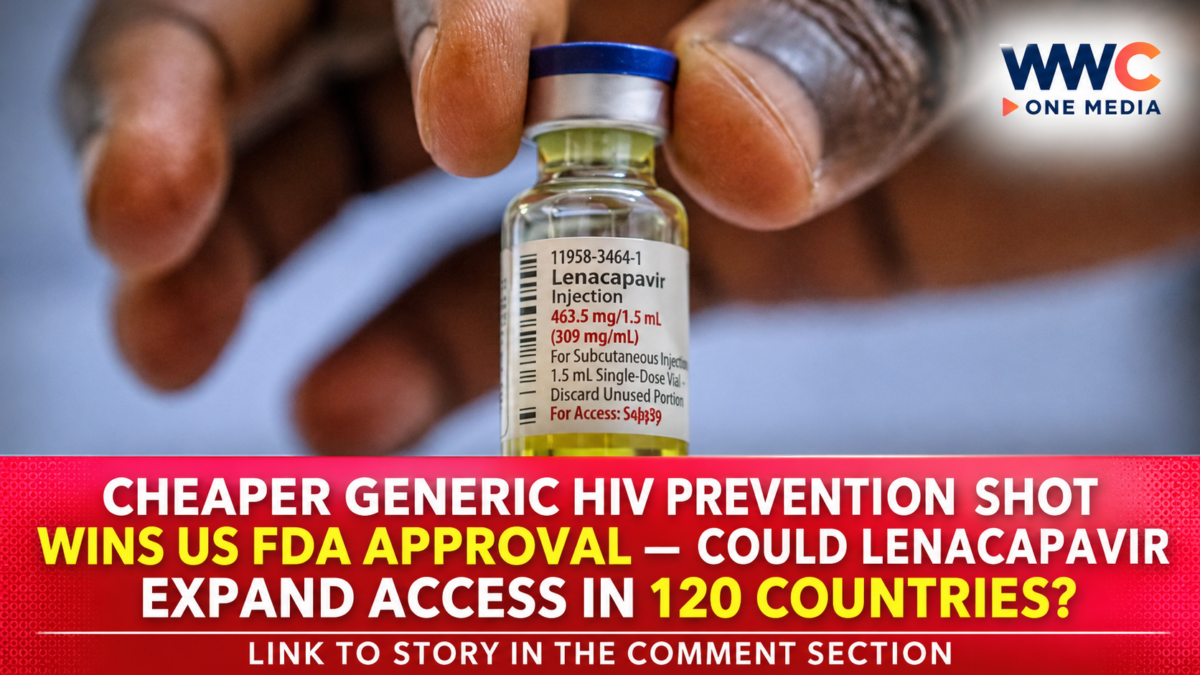
GENEVA, November 3, 2026 — A major development in HIV prevention is bringing a twice-yearly injectable medication closer to millions of people who may benefit from longer-acting protection. The United States Food and Drug Administration (FDA) has granted tentative approval to the first generic version of lenacapavir, a long-acting medicine designed to prevent HIV infection.
Developed by India’s Dr. Reddy’s Laboratories, the generic version is expected to cost approximately US$40 per person annually in 120 eligible low- and middle-income countries under an existing voluntary licensing arrangement.
The development could help address one of the biggest barriers to newer HIV prevention technologies: affordability.
Lenacapavir is administered through injections twice a year, offering an alternative to daily oral pre-exposure prophylaxis, commonly known as PrEP. Its longer dosing interval may make prevention easier to maintain for people who find daily medication difficult to follow.
However, regulatory approval is only one part of the process. Governments still need to complete relevant national requirements, secure funding, prepare healthcare systems and establish distribution arrangements before the generic can reach communities at scale.
The announcement was made on November 2 by Dr. Reddy’s and the organisations that helped accelerate the generic’s development. <Cite refs={[“turn947024news10″,”turn947024search0″,”turn947024news11”]} />
FDA Tentative Approval Marks a Major Milestone
The FDA’s decision concerns the first generic version of lenacapavir developed by Dr. Reddy’s Laboratories.
The approval was granted through a regulatory pathway used for certain medicines intended for international public-health programmes. It is classified as tentative approval because the original branded product remains protected by patent or other exclusivity restrictions in the United States.
That distinction is important.
The decision confirms that the generic has met the relevant FDA requirements for the pathway, but it does not mean the generic can immediately be sold in the US market.
Instead, the approval can help accelerate regulatory reviews and procurement decisions in eligible low- and middle-income countries.
The generic was developed through cooperation involving Dr. Reddy’s, global health organisation Unitaid, the Clinton Health Access Initiative (CHAI) and the Wits Reproductive Health and HIV Institute (Wits RHI).
Their partnership was designed to shorten the time between the introduction of an important medical innovation and the availability of a more affordable version for countries with fewer healthcare resources.
The organisations said initial supplies are expected to reach some countries before the end of 2026, with broader availability anticipated in 2027. <Cite refs={[“turn947024search0″,”turn947024news11”]} />
Why Lenacapavir Is Different From Daily HIV Prevention Pills
Lenacapavir is a long-acting medicine used for HIV prevention. It belongs to a newer generation of prevention options that do not require taking a pill every day.
Traditional oral PrEP requires consistent use to provide protection. For some people, maintaining a daily medication routine can be difficult because of busy schedules, access barriers, privacy concerns or other personal circumstances.
Lenacapavir offers a different schedule: two injections per year.
This longer interval could make prevention more manageable for people who prefer not to take daily medication.
It is important, however, to understand that lenacapavir is not a vaccine. It does not train the immune system to recognise and fight HIV. It is a medicine that works by interfering with a protein structure the virus needs during its replication process.
It is also a prevention option, not a treatment that cures an existing HIV infection.
The distinction matters because HIV prevention and HIV treatment involve different medical approaches, even though both are essential to controlling the epidemic.
Clinical Studies Showed Very High Protection
Lenacapavir’s development attracted international attention after major clinical trials demonstrated very high effectiveness among participants at risk of HIV infection.
In the PURPOSE 1 study, conducted among adolescent girls and young women in sub-Saharan Africa, researchers observed no new HIV infections among participants who received lenacapavir during the primary analysis period.
The PURPOSE 2 study also demonstrated very high protection among a broader population of people at risk.
These results helped establish lenacapavir as an important development in long-acting HIV prevention.
The findings should nevertheless be interpreted within the context of the clinical trials. Results from controlled studies do not remove the need for appropriate medical assessment, testing and follow-up in real-world healthcare settings.
The World Health Organization has recommended long-acting injectable lenacapavir as an additional HIV prevention option, recognising its potential contribution to prevention programmes. <Cite refs={[“turn947024search7″,”turn947024search8”]} />
The US$40 Annual Price Could Change Access
One of the most significant aspects of the generic announcement is its expected price.
The generic version is expected to cost approximately US$40 per person per year in the countries covered by the relevant licensing arrangements.
That is comparable to the reported annual cost of some existing generic daily oral PrEP options.
The price is substantially different from the US list price of Gilead Sciences’ branded lenacapavir product, marketed for HIV prevention as Yeztugo, which was reported at approximately US$28,218 annually before insurance.
The comparison illustrates the gap that can exist between the price of an innovative branded medicine in a high-income market and the cost that public-health programmes may be able to negotiate for generic supplies in lower-income countries.
However, the US list price and the expected generic price apply to different markets and purchasing arrangements. They should not be treated as direct comparisons of what every patient would personally pay.
For eligible countries, the US$40 arrangement could make large-scale procurement more financially realistic.
But a low purchase price does not automatically guarantee free or universal access. Governments and healthcare programmes still need resources for procurement, medical services, testing, distribution and follow-up. <Cite refs={[“turn947024news10″,”turn947024search0″,”turn947024news11”]} />
120 Low- and Middle-Income Countries Could Benefit
The generic licensing arrangement is intended to cover 120 low- and middle-income countries across selected regions of Africa, Asia and Latin America.
The arrangement builds on voluntary licences established by Gilead Sciences, the original developer of lenacapavir.
Gilead previously entered royalty-free licensing agreements with six generic manufacturers, allowing them to produce versions for designated countries.
Dr. Reddy’s is the first of those licensed manufacturers to receive tentative FDA approval for its generic version.
The development is significant because it introduces an additional potential source of supply in a market where demand has exceeded the availability of the original product.
More manufacturers could eventually help increase production capacity and reduce dependence on a single supplier.
Nevertheless, the licensing arrangements have geographical limits. The 120-country figure does not mean that every country automatically receives supplies or that the generic can be sold without meeting local regulatory requirements.
The actual rollout will depend on national approvals, procurement arrangements and the readiness of healthcare systems.
India Plays a Central Role in the Generic’s Development
Dr. Reddy’s Laboratories, the Indian pharmaceutical company behind the first generically manufactured version to receive tentative FDA approval, developed the product with support from international public-health partners.
The collaboration brought together pharmaceutical manufacturing expertise and organisations focused on expanding access to essential medicines.
Unitaid helped facilitate the partnership, while CHAI and Wits RHI provided financial, technical and regulatory support.
This model demonstrates how cooperation between pharmaceutical companies, research institutions and international health organisations can help accelerate the development of lower-cost medicines.
The objective was not simply to create another version of an existing product. It was to make a long-acting prevention technology available to countries that might otherwise face financial and supply constraints.
The FDA milestone also creates a potential pathway for other generic manufacturers to advance their own versions, although those products must undergo their respective regulatory assessments. <Cite refs={[“turn947024search0″,”turn947024news11”]} />
HIV Prevention Still Requires Medical Testing and Follow-Up
Although lenacapavir offers a longer dosing interval, it is not a substitute for proper medical assessment.
People must be tested for HIV before starting the medication and before subsequent injections, because the drug is intended for prevention rather than treatment of an existing infection.
This is particularly important because using it in someone with an undiagnosed HIV infection can create conditions in which drug resistance develops.
Reported side effects include injection-site reactions, headaches and nausea.
Healthcare providers also need to follow appropriate clinical protocols and monitor patients according to established guidance.
These considerations show why introducing a new prevention medicine requires more than making it available at a lower price. Countries must also ensure that the necessary testing, trained personnel and follow-up services are in place.
Global HIV Statistics Show Why Prevention Matters
The announcement comes as HIV continues to affect millions of people worldwide.
According to figures cited in the Associated Press report, approximately 41 million people were living with HIV globally in 2025, while around 570,000 died from HIV-related causes.
The World Health Organization has also highlighted the continuing need to expand access to prevention, diagnosis and treatment.
Although modern HIV medicines have transformed the outlook for people living with the virus, new infections remain a significant public-health challenge.
Prevention programmes therefore continue to play a central role alongside testing, treatment and efforts to reduce stigma.
The importance of prevention is also visible in Southeast Asia.
In the Philippines, the latest national surveillance figures covered by WWC One Media showed that thousands of newly reported HIV cases continued to be recorded in 2026, despite a decline in reported diagnoses during the second quarter.
The figures were examined in HIV Cases in Philippines Drop 39% in Q2 2026 — But Experts Say the Bigger Story Is Still Unfolding.
The article highlighted the continuing importance of prevention, testing, treatment and public awareness.
Fiji has also declared a national HIV emergency as infections increased, prompting plans to expand prevention and treatment programmes. WWC One Media covered the country’s response in Fiji Declares National HIV Emergency as Cases Surge.
These developments illustrate why new prevention technologies could matter across the wider Asia-Pacific region, provided countries can establish affordable and reliable access.
Approval Does Not Guarantee Immediate Availability
Despite the excitement surrounding the FDA decision, several challenges remain before the generic can reach millions of potential beneficiaries.
The first is national regulatory approval.
Although an FDA decision may help speed up assessments elsewhere, individual countries may still require their own regulatory processes before the product can be introduced.
The second challenge is financing.
Even at an expected price of US$40 per person annually, public-health programmes need funding to purchase sufficient supplies and support the services needed to deliver them.
The third is distribution.
Countries need appropriate supply chains, trained healthcare professionals and testing services to support the medicine’s introduction.
Finally, communities need accurate information about what the medication does, who it is intended for and what medical monitoring is required.
CHAI has emphasised that the FDA milestone is only one step in a much larger effort. Its representatives have said that funding, procurement and the practical work of reaching people remain essential to the rollout. <Cite refs={[“turn947024search0″,”turn947024news10”]} />
Will the Philippines Be Among the Countries to Benefit?
For the Philippines, the development raises an important question about whether the country could eventually benefit from the lower-cost generic.
The licensing arrangement covers selected countries across Asia, Africa and Latin America, but the public announcement alone does not establish the Philippines’ eligibility or confirm a local introduction date.
The country would also need to consider regulatory requirements, procurement arrangements and the readiness of its healthcare services.
The Philippines already has HIV prevention programmes that include oral PrEP. The introduction of a longer-acting option could potentially expand the choices available to eligible populations if it is approved and incorporated into national programmes.
However, no confirmed Philippine rollout date, local price or procurement commitment was established in the reports reviewed for this article.
It would therefore be premature to suggest that the generic is already available locally or that Filipino patients can obtain it at the announced US$40 annual price.
The broader significance for the country lies in the possibility of expanding prevention choices as international supply and affordability improve.
The Next Challenge Is Turning Scientific Progress Into Public Access
The FDA’s tentative approval of generic lenacapavir represents an important step in making a major HIV prevention innovation more affordable.
The expected US$40 annual price could help eligible low- and middle-income countries consider wider procurement, while the involvement of additional manufacturers may eventually strengthen supply.
But the difference between a scientific breakthrough and a public-health success is measured by how many people can actually benefit from it.
That requires more than regulatory approval. It requires funding, national planning, reliable distribution, appropriate medical services and clear public information.
The coming months will therefore be important as the first supplies move towards eligible countries and governments consider how to incorporate the medicine into their prevention programmes.
If the rollout succeeds, lenacapavir could become a more accessible option alongside existing prevention methods, giving public-health systems another tool to reduce new HIV infections.
Will a US$40 generic version of a twice-yearly HIV prevention injection help close the global access gap—or will funding, regulation and healthcare delivery remain the biggest barriers between medical innovation and the people who need it?