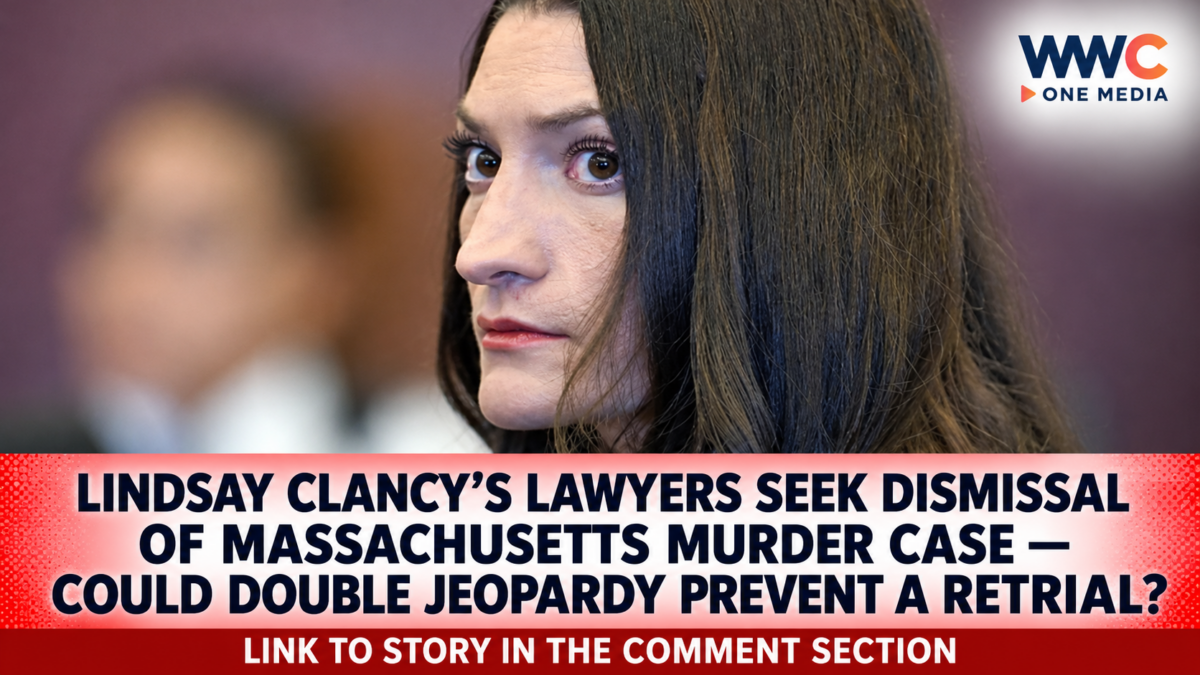
PLYMOUTH, MASSACHUSETTS — Lawyers representing Lindsay Clancy have urged a Massachusetts judge to dismiss the murder charges against her, arguing that putting her through another trial after a jury deadlock would violate her constitutional protection against double jeopardy.
The defence made its arguments during a court hearing on Monday, November 2, before Judge William Sullivan in Plymouth Superior Court.
Clancy, 36, is charged with first-degree murder in connection with the 2023 deaths of her three young children at the family’s home in Duxbury, Massachusetts.
Her first trial ended in a mistrial in September after the jury failed to reach a unanimous verdict.
Her lawyers now argue that the judge should not have declared a mistrial without conducting a more detailed inquiry into a disagreement involving one juror. They maintain that the court should have taken additional steps that might have allowed deliberations to continue.
Prosecutors oppose the dismissal request, arguing that the judge acted appropriately and that further questioning could have improperly interfered with the jury’s private deliberations.
The case has attracted national attention because of the legal dispute over Clancy’s mental state, the disagreement among jurors and the possibility of a second trial.
Judge Sullivan has scheduled another hearing for November 16 and indicated that he aims to address the dismissal request by then.
Why Clancy’s Lawyers Want the Murder Charges Dismissed
The defence’s central argument is that a second trial would violate Clancy’s constitutional rights.
Attorney Martin G. Weinberg argued that the judge acted prematurely when he declared a mistrial after the jury reported that it could not reach a unanimous decision.
The defence maintains that the court should have investigated further after receiving two notes from the jury foreperson.
Those notes reportedly indicated that one juror was not following the judge’s instructions concerning the legal standard of reasonable doubt.
According to the defence, the judge could have questioned the juror more thoroughly and considered whether the person should have been replaced by an alternate juror.
Instead, the court declared a mistrial after the jury remained divided.
The lawyers argue that the circumstances did not justify ending the first trial and allowing prosecutors to pursue the case again.
Their position is that the court’s handling of the jury disagreement created a constitutional problem that should prevent another prosecution for the same alleged offences.
However, this remains an argument presented by the defence. The judge has not yet ruled on whether the mistrial was legally justified or whether a retrial would violate Clancy’s rights.
What Is Double Jeopardy?
Double jeopardy is a constitutional protection under the Fifth Amendment to the United States Constitution.
It generally prevents a person from being prosecuted or punished more than once for the same offence after a final acquittal or conviction.
The principle is intended to protect individuals from repeated criminal proceedings over the same alleged conduct.
However, the legal rules surrounding mistrials are more complicated.
When a jury cannot reach a unanimous verdict, a judge may declare a mistrial. Under certain circumstances, prosecutors can then seek a new trial because the first proceeding did not produce a final verdict.
The court must consider whether there was a legally sufficient reason to end the original trial.
In Clancy’s case, the defence argues that the judge should have done more before declaring a mistrial.
Prosecutors disagree and maintain that the jury had reached an impasse that justified ending the proceedings.
The judge’s decision will determine whether the case can move forward to another trial or whether the charges must be dismissed.
The Jury’s 11-1 Deadlock Became the Centre of the Dispute
The disagreement among jurors is one of the most significant issues in the case.
Reports following the September mistrial indicated that 11 of the 12 jurors were prepared to find Clancy not criminally responsible because of her mental condition at the time of the incident.
One juror favoured a conviction.
The jury could not reach the unanimous verdict required for the case, leading Judge Sullivan to declare a mistrial on September 4.
The foreperson had sent two notes to the judge during deliberations raising concerns about the disagreement and whether one juror was applying the court’s instructions correctly.
After receiving the notes, Sullivan spoke with the jurors individually.
He reminded them of their responsibilities, explained the reasonable-doubt standard and asked whether they could apply the law to the case.
All jurors indicated that they could.
The defence argues that the judge’s inquiry was insufficient and that he should have examined the situation more closely.
The prosecution, however, maintains that the judge struck the appropriate balance between addressing concerns and protecting the independence of jury deliberations.
Prosecutors Say the Mistrial Was Properly Declared
Plymouth County prosecutors have opposed the defence’s request to dismiss the charges.
In a court filing, Assistant District Attorney Jennifer Sprague argued that the judge handled the jury’s concerns appropriately.
She said further questioning of the juror could have crossed the line into judicial coercion and interfered with the jury’s decision-making process.
The prosecution’s position is that the juror had not refused to participate in deliberations but had simply disagreed with the other members of the panel.
That distinction is important.
Jurors are expected to evaluate evidence independently, even when their conclusions differ from those of other members of the jury.
A disagreement does not automatically mean that a juror has violated their responsibilities.
Prosecutors therefore want the court to reject the dismissal motion and allow the Commonwealth of Massachusetts to continue pursuing the case.
They have also indicated that they intend to retry Clancy if the proceedings move forward.
However, prosecutors have not yet announced whether they will pursue the same first-degree murder charges or consider lesser charges.
What Happened During Clancy’s First Trial?
Clancy’s first trial examined the deaths of her three children in January 2023.
The children were identified as Cora, 5, Dawson, 3, and Callan, who was eight months old.
The central issue was not simply what happened at the family home.
The prosecution and defence presented competing arguments about Clancy’s mental condition and whether she could be held criminally responsible under Massachusetts law.
The defence argued that she was experiencing postpartum psychosis and was unable to understand or control her actions in the way required for criminal responsibility.
Prosecutors acknowledged that Clancy had experienced mental health problems but argued that she acted deliberately and understood that her actions were wrong.
The case therefore required jurors to consider both the circumstances surrounding the children’s deaths and the legal question of Clancy’s responsibility at the time.
The jury’s inability to reach a unanimous decision meant that the first trial ended without a verdict.
A mistrial is not an acquittal, and it does not establish that the defendant is guilty or not guilty.
Postpartum Psychosis and the Legal Question of Criminal Responsibility
Clancy’s mental health has been a major part of the legal proceedings.
Her defence has argued that she was experiencing postpartum psychosis around the time of the incident.
Postpartum psychosis is a rare but serious mental health condition that can occur after childbirth. It can involve major changes in a person’s perception, thinking and behaviour and requires urgent medical attention.
However, a diagnosis alone does not automatically determine whether someone is legally responsible for an alleged offence.
The court must consider the evidence presented and the applicable legal standard.
In Clancy’s case, the defence has argued that her mental condition affected her ability to understand or control her actions.
The prosecution has challenged that position, maintaining that she understood what she was doing and knew it was wrong.
The jury’s disagreement shows how central this issue became during the first trial.
It also highlights the distinction between a medical diagnosis and the separate legal question of criminal responsibility.
Judge Sets November 16 Hearing as Retrial Questions Remain
Judge Sullivan did not immediately decide whether the murder charges should be dismissed.
Instead, he scheduled another hearing for November 16, when the court is expected to address outstanding issues and discuss the potential timetable for further proceedings.
The judge has indicated that he aims to rule on the dismissal request by that hearing.
Clancy’s lawyers have also expressed concern about delays.
Attorney Kevin Reddington told the court that he wanted the matter resolved without leaving his client in custody for another year or several years.
He said that if another trial is necessary, he would prefer it to take place in the spring before Sullivan retires.
The judge’s planned retirement next year adds another scheduling consideration.
Reuters reported that Sullivan indicated a March 2027 retrial could be realistic if the case proceeds.
However, no new trial date has been formally established.
Prosecutors Have Not Decided Which Charges They Will Pursue
Even if the judge rejects the dismissal request, the prosecution’s next decision will be important.
Clancy currently faces first-degree murder charges.
However, prosecutors could consider pursuing the same charges or a lesser offence, depending on their assessment of the case and the available legal options.
The decision could influence the structure of a second trial and the potential consequences if a conviction is obtained.
For now, prosecutors have said they intend to retry Clancy but have not publicly confirmed the exact charges they would pursue.
The defence, meanwhile, wants the court to dismiss the case or establish a clear timetable for another trial.
Until the judge rules, the prosecution’s final approach remains uncertain.
Separate Dispute Over Public Comments and the Holdout Juror
The November 2 hearing also involved other disputes surrounding the case.
Prosecutors have requested restrictions on public comments by lawyers involved in the proceedings.
They argued that public statements could affect the potential jury pool and create an atmosphere that might interfere with a future trial.
The defence opposed the request, arguing that restrictions on lawyers’ public comments could violate constitutional protections for freedom of speech.
The judge has not resolved every issue connected to the proposed restrictions.
There was also disagreement over whether the court should investigate the conduct and background of the juror who opposed an acquittal.
Clancy’s lawyers sought further examination of the juror’s questionnaire and raised concerns about whether the information provided during jury selection was accurate.
The judge has previously rejected a request for an investigation into the juror.
During the November 2 hearing, Sullivan also instructed the defence to stop identifying the juror by name in open court, referring to existing protections concerning juror identities.
The dispute highlights the challenges of protecting jurors while allowing both sides to raise legitimate concerns about the conduct of a trial.
A Separate Wrongful Death Lawsuit Adds Another Legal Dimension
The criminal prosecution is not the only legal proceeding involving the Clancy family.
Patrick Clancy, Lindsay’s former husband, has filed a separate wrongful death lawsuit against healthcare providers who treated her before the children’s deaths.
The lawsuit alleges that the providers failed to provide adequate care and that their actions or omissions contributed to the tragedy.
Those allegations are disputed.
Lindsay Clancy’s defence lawyer has specifically rejected suggestions that she told healthcare providers she intended to harm her children.
Her lawyer has also disputed claims that she planned to testify in Patrick Clancy’s civil lawsuit.
The civil case is separate from the criminal prosecution and will be decided under a different legal process.
Its allegations should not be treated as established findings about the criminal case.
What Happens Next in the Lindsay Clancy Case?
The next major development is expected on November 16.
The judge’s ruling on the double-jeopardy motion will determine whether prosecutors can continue toward a second trial or whether the charges must be dismissed.
If the motion is rejected, prosecutors will still need to decide which charges to pursue and how to proceed with the case.
A potential March 2027 trial has been discussed, but the date remains dependent on the court’s decisions and the resolution of outstanding motions.
The case also raises broader questions about jury deliberations, mistrials, constitutional protections and how courts assess mental health evidence when determining criminal responsibility.
For now, neither side has secured the outcome it wants.
The defence argues that another trial would violate Clancy’s constitutional rights.
The prosecution maintains that the first trial ended properly and that the case should continue.
The judge’s next decision could determine whether the highly watched Massachusetts case moves toward another trial or comes to an end without a second jury hearing the evidence.
Until that ruling is issued, Clancy remains charged, and the allegations have not resulted in a final criminal verdict.