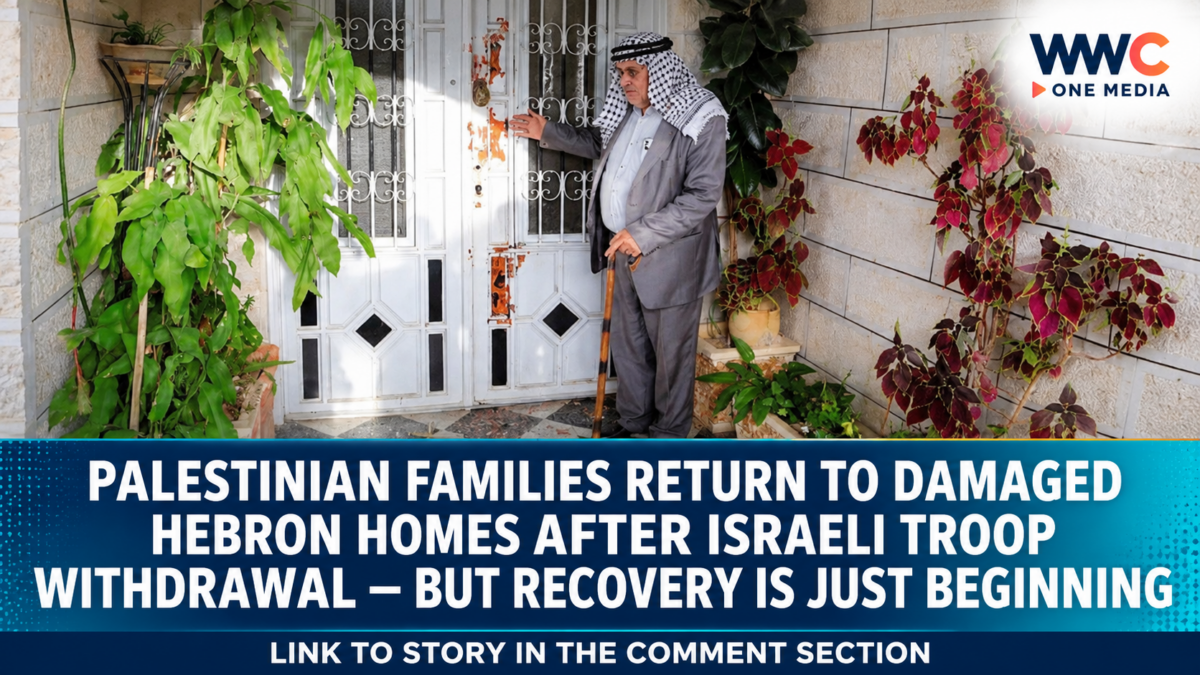
HEBRON, OCCUPIED WEST BANK — Palestinian families have begun returning to their homes in Hebron after Israeli forces withdrew from parts of the city on Monday, November 2, ending a 10-day military operation that displaced more than 3,000 people and disrupted businesses, schools and essential services.
Residents returning to neighbourhoods including Al-Jaladah and Ein Deir Baha found damaged homes, destroyed structures and belongings scattered across rooms after Israeli troops searched buildings and used some properties as military positions.
The withdrawal followed an operation ordered by Israeli Prime Minister Benjamin Netanyahu after two Palestinian gunmen killed two Israeli soldiers at a checkpoint near Hebron on October 23. Both attackers were also killed.
The Israeli military said its forces had completed searches, detained and questioned suspects, and confiscated four weapons, several vests and additional military equipment.
While residents have started returning, the effects of the operation remain visible across the affected neighbourhoods. Local authorities reported demolished properties, closed shops, infrastructure damage and significant disruption to education.
More Than 3,000 Palestinians Displaced
The operation forced thousands of Palestinians to leave their homes as Israeli forces imposed closures and restrictions across parts of Hebron.
According to Hebron Municipality figures reported by Arab News, 491 Palestinian families, comprising approximately 3,189 people, were displaced during the operation.
Other reports put the number of people displaced or otherwise affected at more than 3,300, depending on the areas and categories included in the count.
The United Nations also reported that more than 3,000 people had been displaced.
The military operation focused particularly on Al-Jaladah and Ein Deir Baha, neighbourhoods near the checkpoint where the October 23 shooting occurred.
Residents were ordered to leave, while some homes were reportedly taken over and converted into military positions and interrogation facilities.
Following the withdrawal, Palestinian families began returning to assess their properties and determine whether their homes were safe to occupy.
Residents Return to Damaged Homes
For many families, returning home brought a difficult discovery: their properties had been left damaged and their belongings displaced.
Tamara Obeid, one of the residents interviewed by Reuters, described the experience of Israeli forces entering her home during the operation.
She said soldiers forced their way inside, frightened her children and detained her husband.
When she returned, she found broken furniture and personal belongings scattered across the property.
Other residents also reported damage to their homes after soldiers searched or occupied them.
The Israeli military said its troops had conducted searches and questioned suspects as part of the operation.
It also confirmed that the homes of the two Palestinian attackers had been demolished. Separately, local officials reported additional destruction affecting homes, shops, roads and factories, although the full scale of the damage remained unclear.
The military said it was looking into separate allegations made by residents concerning soldiers’ conduct during the operation.
At Least 15 Homes and Structures Reportedly Demolished
The damage extended beyond individual households.
According to Hebron Municipality figures reported by Arab News and the Palestinian news agency WAFA, Israeli forces demolished 15 homes and other structures during the operation.
The municipality also reported that 327 shops were forced to close.
Local officials said the destruction and closures affected commercial activity, transportation and access to essential services.
On November 2, bulldozers were seen clearing rubble and earth barricades as Palestinian civil defence personnel and local security forces returned to the affected areas.
However, the return of residents does not automatically mean every damaged property is safe to enter.
Palestinian Civil Defence warned residents against entering damaged buildings before safety inspections had been completed. People were also advised not to touch suspicious objects and to allow emergency personnel to carry out their work.
These precautions are intended to prevent further harm as residents begin assessing the condition of their homes.
Businesses and Local Livelihoods Suffer Major Disruption
The operation also affected Hebron’s local economy.
Municipal authorities estimated direct economic losses at more than US$3.8 million per day during the operation.
They also reported infrastructure damage exceeding US$1.9 million, while losses in the health and environmental sectors were estimated at approximately US$160,000.
These figures are estimates provided by the municipality, rather than independently audited final losses.
The closure of hundreds of shops meant that business owners and employees faced interruptions to their income.
Factories and other commercial facilities also experienced disruption as movement restrictions limited access to workplaces and surrounding areas.
Although some businesses began resuming operations after the withdrawal, the recovery process may take longer for owners whose premises were damaged or whose operations were interrupted.
For families dependent on daily wages and small businesses, even a temporary shutdown can create financial difficulties.
Around 80,000 Students Affected by School Disruptions
Education was another major casualty of the operation.
According to Hebron Municipality figures reported by WAFA, approximately 80,000 students in the city were unable to attend school during the military operation.
The disruption affected students across Hebron as closures and restrictions prevented normal educational activities.
Following the withdrawal, schools and universities began reopening, allowing students to return to classrooms.
Hebron Mayor Yousef Al-Jaabari said residents were returning and that educational institutions and factories were resuming operations.
However, reopening does not immediately reverse the effects of missed lessons, interrupted examinations and the uncertainty experienced by families during the operation.
Why Israel Launched the Operation
The Israeli military operation followed a shooting attack on October 23 near a checkpoint in Hebron.
Two Palestinian gunmen killed two Israeli soldiers and wounded three others. Israeli forces subsequently killed both attackers.
Netanyahu ordered the military response following the incident.
The Israeli military said the operation involved searches of multiple locations, the detention and questioning of suspects, and the seizure of weapons and other military equipment.
The military also confirmed demolishing the homes of the two attackers.
The operation was presented by Israeli authorities as a security measure following the deadly checkpoint attack.
However, its broader impact on Palestinian residents, including displacement, movement restrictions and property demolitions, prompted criticism from Palestinian officials and international observers.
United Nations Raises Concerns Over Displacement and Demolitions
The operation drew criticism from the United Nations, particularly over the displacement of residents and restrictions imposed on affected neighbourhoods.
UN human rights chief Volker Türk warned on October 26 that the mass displacement, demolitions and sweeping movement restrictions raised serious concerns about Israel’s use of force.
He said collective punishment is a grave violation of international law and called for displaced residents to be allowed to return to their homes.
The UN’s concerns centred on the effects of the operation on civilians who were not necessarily involved in the October 23 attack.
The distinction is important: the killing of Israeli soldiers was a serious security incident, but measures taken in response must still comply with international humanitarian law and applicable protections for civilians.
Palestinian residents and local authorities also challenged the operation through legal channels.
A petition filed with Israel’s Supreme Court by the legal rights organisation Adalah sought to end forced evacuations, demolitions and movement restrictions.
The petition argued that the measures amounted to collective punishment and violated international humanitarian law. These are allegations presented in the legal challenge, not a final court ruling.
Hebron Remains a Sensitive Flashpoint in the West Bank
Hebron is one of the largest and most politically sensitive cities in the occupied West Bank.
It is home to tens of thousands of Palestinians, alongside hundreds of Israeli settlers living in and around parts of the city.
The presence of Israeli settlements, military checkpoints and movement restrictions has long contributed to tensions.
The latest operation added another episode to a period of increased violence across the West Bank since Hamas’s October 7, 2023 attack on Israel and the subsequent Israeli military offensive in Gaza.
Violence in the territory has included Israeli military raids, attacks by Palestinian armed groups and an increase in attacks by militant Israeli settlers against Palestinians.
These developments have contributed to displacement, property damage and growing humanitarian concerns across several Palestinian communities.
For additional background, see WWC ONE MEDIA’s report, Israel Launches Massive West Bank Military Operation After 2 Soldiers Killed Just Days Before Election, which examines the October 23 attack and the military response that preceded the Hebron withdrawal.
The broader housing consequences of demolitions are explored in Palestinian Families Turn Ancient Caves Into Homes After Demolitions.
What Happens After the Withdrawal?
The withdrawal allows displaced families to begin returning, but the immediate challenge is restoring normal life.
Residents must assess damaged homes, arrange repairs and determine whether buildings are safe to occupy.
Businesses need to reopen, workers must return to their jobs and students need to resume their education.
Local authorities and civil defence teams also face the task of clearing debris, inspecting damaged structures and restoring essential services.
The withdrawal does not necessarily mean that all restrictions affecting Hebron have ended. Arab News reported that movement restrictions remained at some city entrances even after Israeli forces left the affected neighbourhoods.
For residents, the return home is therefore only the beginning of a longer recovery process.
The wider situation in the West Bank remains a concern for international observers. In September, WWC ONE MEDIA reported on a US Ambassador’s Visit to a West Bank Town Hit by Settler Violence, highlighting continuing concerns about civilian protection.
The operation may have ended, but the consequences remain visible in damaged properties, disrupted livelihoods and families trying to rebuild their daily routines.
The central question now is whether the withdrawal will lead to sustained improvements in residents’ freedom of movement and security, or whether further restrictions and military operations will again disrupt life in Hebron.