HEBRON, West Bank — Israel has launched a multi-day military operation in the occupied West Bank following a deadly shooting near Hebron that killed two Israeli soldiers and wounded three others, raising fears of a wider confrontation just four days before Israel’s October 27 parliamentary election.
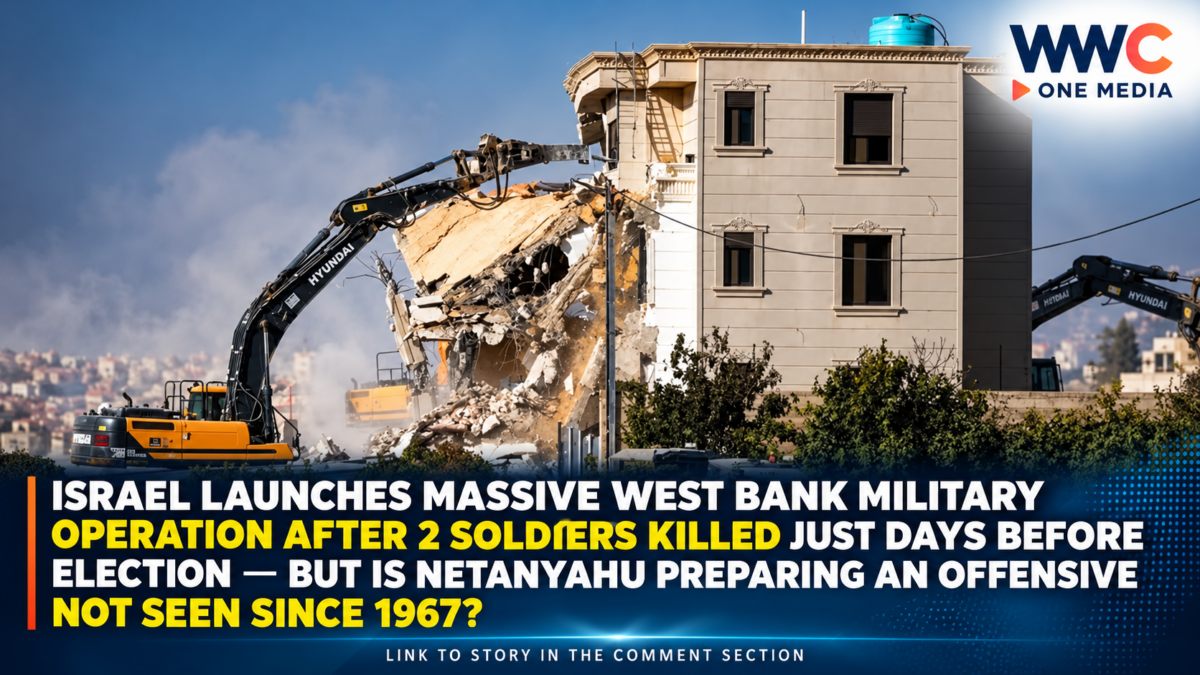
Israeli troops, working alongside the Shin Bet domestic security agency and other security units, began extensive searches, interrogations and building demolitions on Friday, October 23, as Prime Minister Benjamin Netanyahu warned that an even broader operation could follow.
The military says its objective is to eliminate militant infrastructure, locate weapons and prevent further attacks. But the operation has sparked concerns over Palestinian civilian displacement, movement restrictions and the possibility of a major escalation in one of the Middle East’s most volatile territories.
Deadly shooting near Hebron triggers military response
The latest escalation began when two armed Palestinian men opened fire near a checkpoint outside Hebron on October 23.
The exchange of gunfire killed two Israeli soldiers, identified by the Associated Press as Staff Sergeant Ron Yonatan Roytman, 23, and Sergeant Yuval Shai Svilem, 20. Three others were lightly wounded.
Israeli forces subsequently shot and killed both suspected attackers following a prolonged exchange of fire.
Netanyahu praised the soldiers for confronting the gunmen, arguing that security forces had prevented an attack that could have caused even more casualties.
Israel launches searches, demolitions and movement restrictions
The Israeli military and Shin Bet confirmed that security forces were conducting coordinated operations targeting locations allegedly connected to militant activity.
Troops were instructed to search buildings, confiscate weapons, question suspects and dismantle infrastructure suspected of supporting armed groups.
The Israel Defense Forces described the immediate operation as geographically focused and expected it to last several days.
Military officials also announced that Palestinians in affected areas could exit through designated points, subject to identification checks and questioning.
Israeli authorities said some structures were being demolished because they presented security risks. Palestinian residents and human rights advocates have challenged the measures and warned that demolitions and restrictions could punish people who had no involvement in the shooting.
Netanyahu signals a much bigger offensive
Visiting the area after the shooting, Netanyahu suggested that Israel could undertake a far more extensive military campaign across the West Bank.
He referred to the possibility of an operation on a scale unseen since Israel captured the territory during the 1967 war.
The prime minister described measures that could involve evacuating residents from certain neighborhoods, systematically searching homes and destroying suspected militant facilities.
Netanyahu also cited previous Israeli military operations in northern West Bank refugee camps as a possible model.
However, his remarks were about a broader operation under consideration, not confirmation that such a territory-wide campaign had already begun.
Hamas praises attack without claiming responsibility
Hamas, the Palestinian militant group, publicly praised the shooting and encouraged further attacks against Israel.
However, the organization did not formally claim responsibility for the incident.
The distinction is important because support for an attack does not establish that a group planned, directed or carried it out.
Israeli security forces continued questioning suspects and investigating possible militant connections.
Israeli hardliners demand tougher action
The shooting also prompted increasingly forceful statements from senior members of Netanyahu’s right-wing government.
Finance Minister Bezalel Smotrich called for a sweeping military response comparable to Israel’s operations in Gaza.
National Security Minister Itamar Ben Gvir went further, calling for the dismantling of the Palestinian Authority, which administers parts of the occupied West Bank.
There is no established evidence that the Palestinian Authority was involved in the October 23 shooting.
These demands highlight the competing pressures on Netanyahu as he tries to demonstrate a firm security response while avoiding an uncontrolled expansion of the conflict.
United Nations and rights groups warn of humanitarian consequences
The United Nations expressed concern about Israeli closures and the effects they could have on Palestinian daily life and livelihoods.
Secretary-General António Guterres, through a spokesperson, called for an end to violence.
Israeli human rights organization B’Tselem warned that the proposed actions could amount to collective punishment and potentially involve violations of international humanitarian law.
Any assessment of possible war crimes requires examination of the actions taken, their military justification and their effects on civilians; the allegations should not be presented as a final legal finding.
The latest developments also come amid continuing tensions over Israeli settlements, movement restrictions and attacks involving Palestinians and Israeli settlers across the West Bank.
Why Israel’s October 27 election matters
The timing of the military operation has made the crisis especially politically sensitive.
Israel is scheduled to hold its parliamentary election on Tuesday, October 27, with Netanyahu facing a closely contested battle to remain prime minister.
National security has been a central theme of the campaign, and the deadly attack has renewed scrutiny of the government’s ability to protect Israeli citizens and military personnel.
Netanyahu’s opponents face their own challenge: condemning the attack while questioning whether the government’s policies have made Israel more secure.
Former military chief Gadi Eisenkot, one of Netanyahu’s leading political rivals, expressed concern for those wounded in the shooting.
The outcome of the election could influence the direction of Israel’s security policies and its approach to the occupied Palestinian territories.
What happens next?
Three major uncertainties now surround the operation: whether Israeli forces will expand beyond the Hebron area, how Palestinian communities will be affected by prolonged restrictions and demolitions, and whether the security crisis will influence voters ahead of Tuesday’s election.
For Israel, the immediate priority is preventing further attacks. For Palestinian residents, the growing concern is whether military operations will result in additional displacement, destroyed homes and lasting restrictions on movement.
The central question is no longer only how Israel will respond to the killing of two soldiers, but whether that response will develop into a much larger West Bank offensive at a critical political moment.