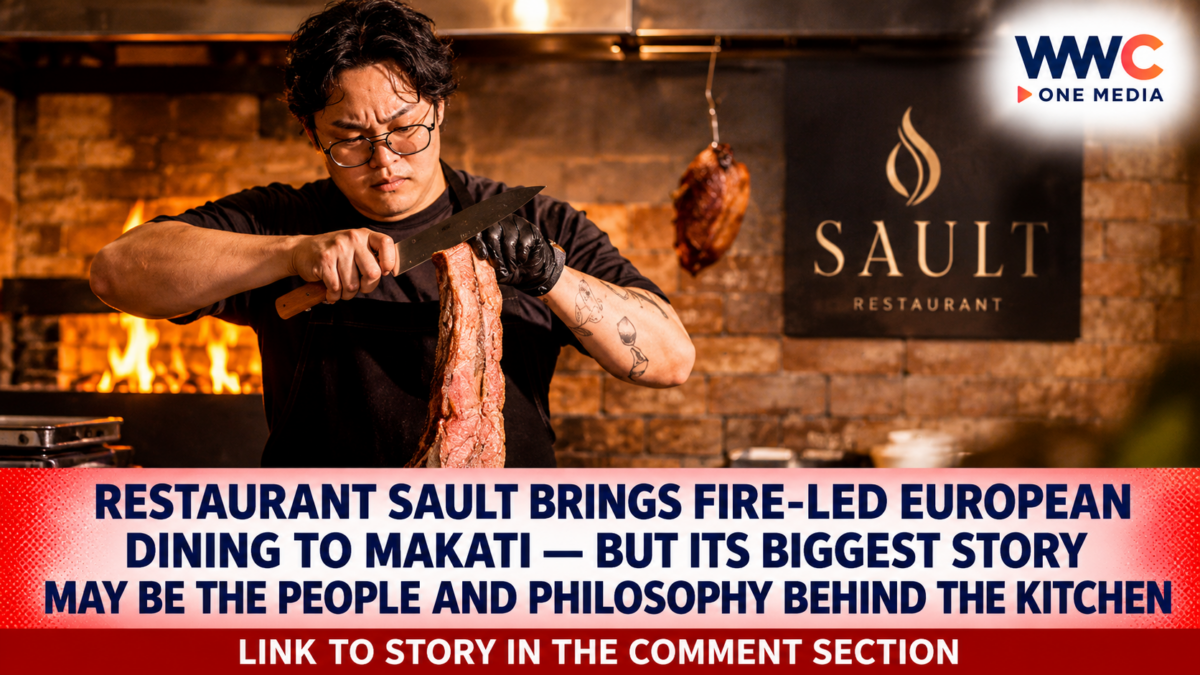
MAKATI CITY, Philippines — A restaurant does not always reveal its character from the street. In Legazpi Village, Makati, Restaurant Sault asks diners to look beyond an ageing office building, take an old lift to the fourth floor and pass through a quiet corridor before discovering a spacious dining room built around open-fire cooking, seasonal ingredients and contemporary European cuisine.
The restaurant is the latest project of Pam and Geronimo Begre, who are also partners in Celera, Tatler Best Asia Pacific 2026’s Best New Restaurant. Working with chef Raphael Dimarucut, the couple has created a dining space that combines a personal design approach with a menu shaped by the seasons and the elements.
Sault is not simply another European-inspired restaurant in Metro Manila. Its identity comes from the relationship between its kitchen, its physical surroundings and the people who built it. Across the corridor, the Begres have also introduced Freaquency, or Freaq, a more relaxed space that extends the experience beyond the main dining room.
Together, the two concepts offer a glimpse into a restaurant project that treats food, design and hospitality as parts of the same idea.
A Restaurant Inspired by the ‘Soul of the Earth’
The name Sault draws from the expression “salt of the earth”, which the team has reinterpreted as “soul of the earth”.
That idea is reflected in the restaurant’s understated interiors and its approach to cooking. Rather than relying on elaborate decoration, the dining room uses plaster, concrete and dark timber to create a warm, restrained atmosphere.
Large windows open the space towards a view of treetops, offering an unusual sense of greenery in the middle of Makati’s business district. An open kitchen sits at the back, where diners can observe the cooking process and the role of fire in the restaurant’s menu.
A long bar provides seating for individual diners and couples, while a private dining room behind a taupe-coloured curtain accommodates groups of up to 10.
The design is deliberately personal. Pam and Geronimo Begre took an active role in shaping the restaurant, with Pam developing the visual concept and Geronimo translating many of her ideas into physical details.
The result is a dining room that feels carefully assembled rather than designed around a standard luxury-restaurant template.
Pam and Geronimo Begre Turn a Vision Into a Dining Space
The Begres’ involvement extends beyond ownership. The couple personally worked on the restaurant’s design and construction, from the initial layout to the details that give the room its identity.
Pam began with a search for a location in the centre of the city. The opportunity eventually came through two adjoining units on the fourth floor of the YL Holdings Building. One had previously been a law office, while the other had been occupied by a water-treatment specialist.
Pam developed the layout and design details, while Geronimo used his practical skills to turn those ideas into fixtures and finishes. These included the door handles, wall treatments and a smoked-mirror panel behind the bar.
The kitchen’s layout was developed with Dimarucut, who planned the flow of the working space and the equipment needed to support the restaurant’s cooking style. Geronimo also fabricated the oven as part of the project.
Even the tableware reflects the couple’s attention to detail. Dinner and dessert plates were made by local ceramics studio Aarde, while other pieces were collected during their travels. Kamagong butter knives, meanwhile, were sourced from a stall at Legazpi Market.
These choices give Sault a combination of international influences and local craftsmanship.
Chef Raphael Dimarucut Makes Fire the Centre of the Menu
At the heart of Sault is chef Raphael Dimarucut, its executive chef and partner.
His cooking is contemporary European, with seasonal ingredients and fire serving as central elements. The menu draws attention to the flavour and texture that can emerge from open-fire preparation rather than treating the technique as a decorative feature.
Dimarucut previously spent three years at Metiz before continuing his training at Restaurant Jordnær in Copenhagen and The Harbor House Inn in California.
His experience informs a menu that balances more adventurous combinations with dishes that allow the ingredients and cooking method to take the lead.
Tatler’s feature highlights smoked Chilean mussels with chicharo and a rich crema made from the mussels themselves. The dish reflects the kitchen’s interest in using the ingredient in more than one way, building flavour through the relationship between the main product and its accompanying elements.
Other examples include lazy ravioli with chicken liver pâté and mushroom ragù, alongside aged duck cooked over embers.
The menu’s range suggests that Sault is interested in both bold combinations and quieter expressions of European cooking.
An Approach to Sustainability That Starts in the Kitchen
One of the more notable aspects of Sault’s operation is its attention to food waste.
Dimarucut estimates that the restaurant operates at around 80 per cent zero waste. This is the chef’s own estimate, rather than an independently certified figure, but it offers an indication of how the kitchen approaches ingredients and by-products.
The idea is also visible in the relationship between Sault and Freaq. Some ingredients and preparations that originate in Sault’s kitchen are given another purpose across the corridor.
This approach reflects a broader effort to make more use of what the kitchen already has, rather than treating every by-product as something to discard.
It also gives the two spaces a practical connection: Freaq is not simply a separate lounge with its own identity, but an extension of the culinary operation.
Freaquency Offers a Different Side of the Concept
Across the corridor from Sault is Freaquency, shortened to Freaq.
Where Sault uses earthy neutrals and a restrained design, Freaq takes a more colourful and relaxed direction. Its sofas, lounge seating and decorative details create an atmosphere intended for casual visits and longer conversations.
Pam Begre describes it as a neighbourhood lounge. It is designed for people who want to spend time with friends before an evening out or continue socialising after a meal.
Freaq also functions as a gallery. At the time of Tatler’s feature, it was showing work by Filipino artist Bjorn Calleja, with the team considering future events and DJ nights.
Its food offering uses some of Sault’s kitchen by-products in a more casual format. Among the dishes highlighted are double-fried fries with egg, XO sauce, fried shallots and capers, as well as a burger made with a dry-aged patty, cheddar, melon ketchup and fried shallots.
Another dish mentioned in the feature is Eggs on the Eggmaker, combining chicken nuggets, labneh, scallions and kaluga hybrid caviar.
The dessert selection includes chocolate tenerina with smoked vanilla ice cream and seasonal fruit jam.
The contrast between the two spaces is intentional. Sault offers a more structured dining experience, while Freaq gives guests another reason to spend time in the same building.
A Beverage Programme With a Personal Point of View
The Begres’ travels have also influenced the beverage identity of the two spaces.
Pam, who is involved in Sault’s beverage direction, has drawn inspiration from experiences abroad and from producers whose work reflects a strong sense of place.
The programme includes selections that move beyond familiar choices, while Freaq is intended to provide a more informal setting for drinks and small plates.
The important distinction is that the beverage offering is part of the overall hospitality concept rather than the sole reason for visiting either space.
For Sault, the focus remains on the relationship between the food, the atmosphere and the experience of dining together.
The Connection Between Sault and Celera
Sault is also part of a wider restaurant portfolio built by the Begres.
The couple are partners in Celera, which received Tatler Best Asia Pacific 2026’s Best New Restaurant recognition. The two restaurants, however, have distinct culinary identities.
Celera is known for contemporary Asian cooking, while Sault focuses on seasonal European food and open-fire techniques.
Their connection is also a reminder that restaurant groups do not necessarily need to repeat one successful formula. Instead, the same ownership team can develop different concepts around separate culinary ideas and dining experiences.
That spirit of collaboration is also visible in Manila’s wider restaurant community. Off Menu PH 2026: Meet the Restaurant Teams Bringing Manila’s Best Kitchens Together explored how chefs, restaurants and beverage teams are creating collaborations that introduce diners to different approaches and combinations. Sault’s opening adds another example of the city’s evolving food scene, where individual restaurant identities can exist alongside a more connected hospitality community.
Why Sault’s Location Matters
Restaurant Sault is located on the fourth floor of the YL Holdings Building at 115 V.A. Rufino Street, Legazpi Village, Makati City.
Its location is part of the experience. Rather than occupying a prominent street-facing space, the restaurant sits within an older building, reached through an unassuming lift and corridor.
That contrast between the exterior and the dining room is one of the details that makes the restaurant memorable.
Once inside, the view of the treetops, open kitchen and warm lighting creates a different atmosphere from the surrounding business district.
For diners, the setting offers an alternative to the more conventional restaurant experience of a highly visible entrance and a familiar dining-room layout.
What Restaurant Sault Adds to Makati’s Dining Scene
Sault arrives at a time when Manila’s restaurant scene continues to expand beyond familiar international formats.
Its combination of seasonal European cooking, open-fire preparation, locally made tableware and a closely connected lounge concept gives it a clear identity.
The restaurant’s sustainability approach also adds another dimension to its operation, particularly through the use of kitchen by-products across the Sault and Freaq concepts.
Still, the most distinctive part of the project may be the way its owners have approached the experience as a whole. The design, the kitchen layout, the tableware and the relationship between the two spaces all reflect a consistent point of view.
For Dimarucut, the aim is not simply to present a particular cuisine but to make guests feel welcome. That philosophy gives the restaurant a more personal foundation than a menu alone can communicate.
Restaurant Sault and Freaq are located at 4/F, YL Holdings Building, 115 V.A. Rufino Street, Legazpi Village, Makati City. Pop Bottleshop was also announced as a planned addition within Freaq; its opening status should be confirmed directly before visiting.
Can Restaurant Sault’s combination of seasonal European cooking, open-fire techniques and a neighbourhood-minded lounge establish a distinctive new identity in Makati—or will its strongest legacy be the personal vision behind the space?