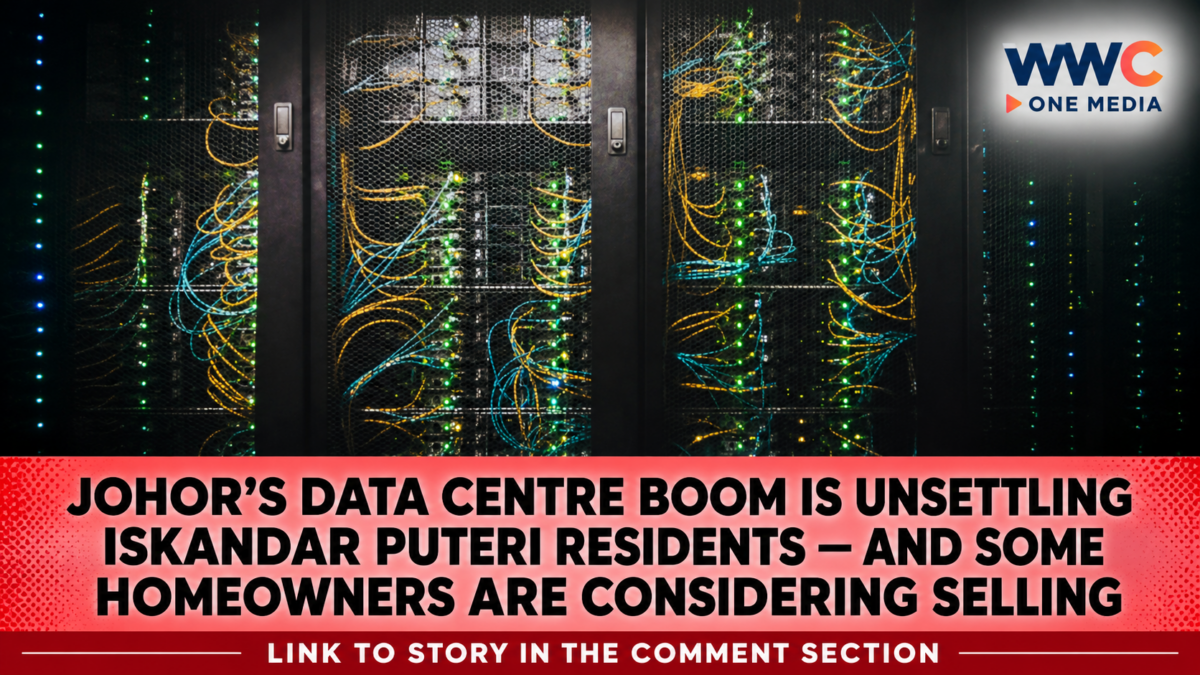
ISKANDAR PUTERI, Johor, November 3, 2026 — Johor’s rapid transformation into one of Asia-Pacific’s major data centre hubs is bringing billions in investment and expanding Malaysia’s digital infrastructure. But in residential neighbourhoods around Iskandar Puteri, the same development is creating a different conversation: homeowners are questioning whether the arrival of large data centres and high-voltage transmission towers will change their surroundings and affect the value of their properties.
Some residents are already considering selling their homes.
The concerns include construction dust, persistent humming noises, changes to the surrounding landscape and the appearance of electricity transmission infrastructure near residential properties. Others worry that potential buyers may become reluctant to purchase homes close to industrial facilities, even when there is no established evidence of a health danger at the distances involved.
The issue illustrates a growing tension in Johor’s development strategy. The state wants to attract major technology investments and strengthen its position in the regional artificial intelligence economy. Yet residents living near the projects are asking whether local infrastructure, environmental conditions and community interests are receiving sufficient attention.
A November 3 report by The Straits Times, republished by Malay Mail and covered by AsiaOne, documents the concerns of homeowners in Eco Botanic, Nusantara Prima and other parts of Iskandar Puteri. <Cite refs={[“turn253983search0″,”turn253983search1”]} />
Eco Botanic Homeowner Lists RM1 Million Property for Sale
One of the residents featured in the report is Lee Shi Qing, a 38-year-old finance manager who purchased a 2,293-square-foot terraced home in Eco Botanic for approximately RM1 million.
The property was intended to be her first matrimonial home in Johor. However, after construction began on a nearby data centre and new transmission towers appeared in the area, she decided to put the house up for sale.
The development nearby is a 64-megawatt hyperscale data centre operated by TM Nxera, a joint venture involving Telekom Malaysia and Singtel’s digital infrastructure business Nxera.
Lee said the land clearing began in 2025, while the transmission towers were erected in 2026. Her concerns about living near high-voltage lines were among the reasons behind her decision to sell.
The response from prospective buyers has so far been limited. According to the report, only two potential buyers had made inquiries since she listed the property approximately six months earlier.
Lee also acknowledged that the surrounding property market was already saturated, with additional landed homes being developed nearby.
Her experience highlights an important distinction: the presence of new infrastructure may influence a homeowner’s willingness to remain in a neighbourhood, but it is not necessarily the only factor affecting a property’s resale prospects.
In Eco Botanic, the availability of competing homes and broader market conditions may also influence buyer interest. <Cite refs={[“turn253983search0″,”turn253983search1”]} />
Johor’s Data Centre Expansion Is Moving at an Extraordinary Pace
The concerns are emerging as Johor experiences one of the region’s fastest-growing data centre markets.
According to figures cited by Invest Johor chief executive Natazha Harris, the state has 65 data centre projects at various stages of approval.
Meanwhile, data centre tracker Baxtel lists 31 operational facilities in Johor.
Knight Frank’s Data Centre Atlas 2026, released in August, puts Johor’s operational data centre IT load at approximately 1,110 megawatts. The figure represents a dramatic increase from around 10MW in 2021.
That growth places Johor among Asia-Pacific’s largest data centre markets, behind Tokyo and Singapore in the ranking cited by the report.
The expansion has been supported by demand from cloud computing, artificial intelligence and other digital services.
Johor also benefits from its location immediately north of Singapore, where limited land and electricity capacity have encouraged data centre operators to consider alternative locations across the border.
The result is a growing concentration of digital infrastructure around Johor Bahru, Iskandar Puteri, Gelang Patah and other industrial areas.
But the pace of development is also increasing demand for electricity connections, water infrastructure and supporting utilities.
Harris said utility providers such as Tenaga Nasional and Johor water supplier Ranhill SAJ had been required to accelerate infrastructure upgrades that were originally planned for later years.
The scale of the expansion is therefore affecting more than the technology industry. It is also changing the infrastructure requirements of the communities surrounding new facilities. <Cite refs={[“turn253983search0″,”turn200022search2”]} />
Transmission Towers Are Becoming a Property-Market Concern
One of the most visible changes around some residential areas is the appearance of large electricity transmission structures.
Near the Eco Botanic data centre development, grey monopole transmission towers now line sections of the road. Some residents have described the structures as unattractive additions to an otherwise residential environment.
The Straits Times examined infrastructure maps and historical satellite imagery and identified more than 200 transmission towers around Iskandar Puteri. About one in five appeared to have been erected since late 2025.
However, the report did not establish how many of those towers were specifically built to support data centre developments.
That distinction is important because Johor’s expanding electricity network serves multiple industrial, commercial and residential requirements.
For homeowners, however, the visual impact can still influence how they feel about their surroundings.
Samuel Tan, chief executive of Johor-based property consultancy Olive Tree Property Consultants, said property buyers often take perceptions of infrastructure, visual appearance and noise into account when deciding where to purchase.
Even when a particular infrastructure feature does not establish a health risk, its presence may affect buyer preferences.
That could create an additional challenge for homes located near transmission towers, particularly in neighbourhoods where buyers have several competing properties to consider. <Cite refs={[“turn253983search0″,”turn253983search1”]} />
Residents Report Dust, Noise and Changes to Their Surroundings
The concerns are not limited to property values.
Residents of Nusantara Prima and Nusa Bayu have previously raised objections to construction activity near their homes, including complaints about dust spreading into residential properties.
Some residents have also described persistent humming noises and warmer surrounding conditions, which they believe may be connected to nearby data centre cooling systems.
Iskandar Puteri municipal councillor Lim Soon Hai told The Straits Times that residents had raised these concerns.
Data centres require cooling systems because servers generate substantial heat during operation. The type of cooling technology used, the size of the facility and the surrounding environment can all influence how a development affects its immediate surroundings.
However, individual complaints do not independently establish the source or extent of noise and temperature changes. Environmental measurements and site-specific assessments are necessary to determine whether particular facilities are exceeding applicable standards.
For residents, the practical concern is whether the changes they experience will become a permanent feature of their neighbourhood.
That question is especially important for families who chose their homes because of greenery, quieter surroundings and a residential environment away from industrial activity.
Kindergarten Operator Says Enrolment Has Fallen
The reported changes have also raised concerns among local businesses and institutions.
Mohanambal Rethinam, who operates a kindergarten in Nusantara Prima, told the newspaper that enrolment had fallen from 50 children in 2025 to 20 in 2026.
She said parents had expressed concerns about the surrounding environment and the school’s proximity to the data centre development.
The reported decline is significant for the kindergarten, although the available report does not establish that the data centre alone caused the reduction in enrolment.
Changes in population, competition, household decisions and other local factors can also influence the number of children attending a school.
Nevertheless, the account illustrates how infrastructure development can become a community issue beyond the immediate question of property prices.
Parents evaluating a school may consider its location, surroundings and perceived suitability for children. Businesses operating in the area may also worry about whether customers will continue visiting if the neighbourhood changes.
For a local kindergarten, those concerns can have direct consequences for its future operations.
A Former Green Hillside Has Become Part of the Development Debate
Another resident featured in the report is Nooraini Jaafar, 68, who moved from Singapore to Nusantara Prima with her Singaporean husband approximately 10 years ago.
She said the data centre development had changed the character of an area that previously included a forested hillside.
Nooraini purchased her terraced home for around RM400,000 in 2014 and was later told that it could be worth approximately RM600,000.
Despite the increase in its estimated value, she worries that future buyers may be less interested because of the nearby development.
Her experience reflects a broader issue in Iskandar Puteri: the relationship between the original character of a residential neighbourhood and the industrial development taking place around it.
For some homeowners, greenery and open spaces are part of the reason they chose a particular location. When those surroundings change, the perceived value of the property may change with them.
That does not necessarily mean the market value will fall. But it can affect how residents assess their long-term plans and whether they want to remain in the area.
Johor Already Has a Significant Unsold Housing Inventory
The property concerns are emerging against another challenge: Johor’s substantial supply of unsold homes.
According to figures from Malaysia’s National Property Information Centre, the state had 4,222 completed residential properties and 9,946 serviced apartments left unsold during the first half of 2026.
Those were the highest figures among Malaysian states for the period cited in the report.
The existing supply matters because homeowners selling properties near new infrastructure may have to compete with other available homes.
Buyers can compare location, price, property condition, accessibility and surrounding amenities. If several similar properties are available, infrastructure concerns may become another consideration in their decisions.
Tan warned that transmission towers and other visible infrastructure could discourage some potential buyers.
However, the available neighbourhood price data should be interpreted carefully.
PropertyGenie figures cited by The Straits Times showed median residential prices of RM452 per square foot in Nusantara Prima and RM409 in Laman Setia, both within 500 metres of the data centre site.
Nusa Bayu, which is farther away, recorded a median of RM505 per square foot.
These figures provide a snapshot of differences between the neighbourhoods. They do not prove that the data centre caused the price differences, since property characteristics, transaction volumes and other market conditions may also influence the figures.
The wider housing situation nevertheless makes the question of resale demand especially relevant for homeowners considering a move. <Cite refs={[“turn253983search0″,”turn253983search1”]} />
Do High-Voltage Transmission Lines Pose a Health Risk?
Health concerns are another important part of the debate.
Electricity transmission lines produce low-frequency electromagnetic fields, commonly referred to as EMFs. These are classified as non-ionising radiation, meaning they do not have the same energy characteristics as ionising radiation such as X-rays.
Residents who live near transmission infrastructure may nevertheless worry about prolonged exposure.
Mohd Fadhil Md Din, director of Universiti Teknologi Malaysia’s Campus Sustainability Centre, told The Straits Times that the electromagnetic fields generated by transmission lines decrease with distance and generally fall towards normal background levels within approximately 50 to 100 metres.
He said the scientific evidence would not support a blanket conclusion that residents living 200 to 300 metres away were experiencing dangerous EMF exposure or needed to relocate solely on health grounds.
His comments are an important qualification to the concerns being raised.
The presence of a transmission tower near a residential area does not automatically establish that people living nearby face a health hazard. Actual exposure depends on factors including distance, line configuration and measured field strength.
Residents with specific concerns should rely on properly conducted environmental measurements and guidance from relevant health and regulatory authorities rather than assuming that every nearby structure creates the same level of exposure.
It is also important to separate EMF questions from other environmental issues. Construction dust, operational noise, traffic and changes to green spaces require their own assessments and should not be dismissed simply because a particular health concern has not been established. <Cite refs={[“turn253983search0”]} />
Johor’s Earlier Data Centre Protests Raised Questions About Consultation
The latest concerns are not the first time residents have challenged the location and impact of data centre projects in Johor.
In February 2026, residents in the Nusa Bayu area staged a protest and submitted a memorandum seeking greater transparency about planned developments and their possible effects on local electricity and water supplies.
Some residents said they had not been adequately consulted before construction activity began near their homes.
The debate continued in March, when Kota Iskandar assemblyman Pandak Ahmad acknowledged that the controversy should serve as a lesson for the state government.
He said residents should have been consulted more thoroughly before projects were developed close to residential estates.
At the time, data centre operator ZData’s Malaysian subsidiary, Computility Technology, said it had invested in dust-control measures, road cleaning and water-recycling facilities.
The company also disputed suggestions that its construction site was responsible for all the dust complaints in the surrounding area.
Tropicana Firstwide, the master developer of Tropicana Industrial Park, separately said it did not own or control the plots adjacent to ZData’s facility.
The exchanges highlighted a planning challenge: when several developments and infrastructure projects are located close together, residents may find it difficult to identify which party is responsible for particular environmental problems.
WWC One Media previously examined the wider expansion of Malaysia’s digital infrastructure in Singapore’s PDG Seeks $1.2 Billion for Malaysia AI Data Center — But Asia’s Growing Debt Boom Faces a Bigger Test.
That report explored the financing behind Johor’s data centre expansion. The current dispute adds another dimension: the communities and infrastructure surrounding those investments also need to be considered.
<Cite refs={[“turn200022search3″,”turn253983search2″,”turn797289search0”]} />
Why Singapore’s Data Centre Demand Is Driving Growth in Johor
Johor’s expansion is closely connected to Singapore’s position as a major regional financial, technology and connectivity hub.
Singapore has limited land and faces constraints involving electricity and water. Its earlier moratorium on new data centre development, which ran from 2019 to 2022, encouraged operators to explore alternative locations in neighbouring markets.
Johor offered several advantages.
It is geographically close to Singapore, has industrial land available for large developments and can support facilities serving customers across the wider region.
The Johor-Singapore Special Economic Zone has added to investor interest by strengthening the economic relationship between the two markets.
The arrangement offers opportunities across manufacturing, logistics, digital services and other industries, while data centres have become an important part of the region’s digital infrastructure strategy.
The expansion is also part of a wider Malaysian effort to attract investment in artificial intelligence, cloud computing and advanced technology.
WWC One Media explored the country’s broader industrial ambitions in Malaysia Is Building a 2,300-Acre “Silicon Island” for the AI Boom — But the Real Prize Is Much Bigger Than Data Centers.
Although Penang’s Silicon Island project has a different focus on semiconductor and advanced manufacturing industries, it illustrates how Malaysia is positioning multiple regions to benefit from the expanding technology economy.
The challenge is ensuring that investment growth is supported by adequate infrastructure and planning rather than placing unexpected pressure on existing communities. <Cite refs={[“turn253983search0″,”turn200022search2″,”turn797289search2”]} />
The Infrastructure Question: Who Pays for the Growth?
The data centre boom is also forcing Johor to accelerate investments in electricity and water infrastructure.
Large facilities require reliable power supplies to keep servers running continuously. Their cooling systems also require careful management of heat and, depending on the technology used, water consumption.
The scale of demand can require utilities to bring forward upgrades that might otherwise have been scheduled years later.
Reuters reported in July 2026 that Malaysia’s rapid data centre expansion was generating public scrutiny over electricity use, water demand, environmental impacts and the benefits received by local communities.
The report also described changes to Malaysia’s approval approach, including greater attention to electricity sourcing, renewable energy and water-intensive cooling systems.
These measures reflect a broader effort to ensure that digital infrastructure growth does not undermine other national priorities.
But the questions extend beyond whether utilities can supply enough resources.
Residents also want to know how projects are selected, how nearby neighbourhoods are protected, how complaints are handled and whether developers are held accountable for construction and operational impacts.
WWC One Media previously examined the wider regional electricity challenge in Electricity Bills Are Soaring as Utilities Race to Upgrade Power Grids — But Who Will Pay for the AI Energy Boom?.
The central issue is increasingly clear: digital infrastructure may create economic opportunities, but its supporting costs and environmental requirements must also be considered.
<Cite refs={[“turn200022news31″,”turn253983search5″,”turn797289search3”]} />
Can Johor Balance Technology Investment With Residential Livability?
Johor’s position as a major data centre destination is unlikely to become less important as demand for artificial intelligence and cloud services continues to grow.
The state has attracted international operators, infrastructure investors and technology companies seeking locations capable of supporting large-scale computing facilities.
Those investments can create construction activity, employment opportunities, demand for engineering services and additional economic activity.
However, the benefits of a data centre project are not automatically shared equally by everyone living nearby.
For residents, the immediate concerns may involve construction dust, noise, the loss of greenery, the appearance of transmission infrastructure and uncertainty about future property values.
For local authorities, the challenge is to ensure that land-use planning, environmental requirements and public consultation keep pace with investment approvals.
Several issues will matter in determining whether the expansion can coexist with residential neighbourhoods:
- Clearer land-use planning: Industrial and residential developments need appropriate separation and consideration of their surrounding communities.
- Transparent public consultation: Residents should receive timely information about major projects that may affect their neighbourhoods.
- Environmental monitoring: Construction dust, operational noise, drainage and other measurable impacts should be assessed and addressed.
- Utility planning: Electricity and water upgrades should account for the needs of existing households as well as new industrial users.
- Accountability: Residents need accessible channels for complaints and clear information about which authorities and developers are responsible for addressing them.
These considerations do not require Johor to abandon its data centre ambitions. They point instead to the importance of making the expansion compatible with the long-term needs of the communities hosting it.
The Real Test of Johor’s Data Centre Boom
The developments in Iskandar Puteri reveal a side of the artificial intelligence investment boom that is often missing from announcements about billions of ringgit in new projects.
A data centre may be a major economic asset, but the infrastructure needed to operate it can change the character of nearby neighbourhoods.
For homeowners such as Lee Shi Qing and Nooraini Jaafar, the question is no longer simply whether Johor is becoming an important technology hub. It is whether their own homes will remain attractive places to live and whether prospective buyers will view the surrounding developments as acceptable.
For the state, the challenge is to demonstrate that large-scale investment can proceed without overlooking residential concerns.
The available evidence does not establish that all homes near data centres or transmission lines face health risks, nor does it prove that the facilities are responsible for every change in property prices or local conditions.
But the concerns about consultation, construction impacts, infrastructure planning and neighbourhood character deserve transparent assessment.
Johor’s ability to attract technology investment may strengthen its economic position. Its ability to manage that growth responsibly will help determine whether residents see the transformation as an opportunity or a burden.
Can Johor remain one of Asia’s leading data centre destinations while protecting the neighbourhoods around its new facilities—or will the pressure of rapid development make local residents pay a price for the region’s AI ambitions?