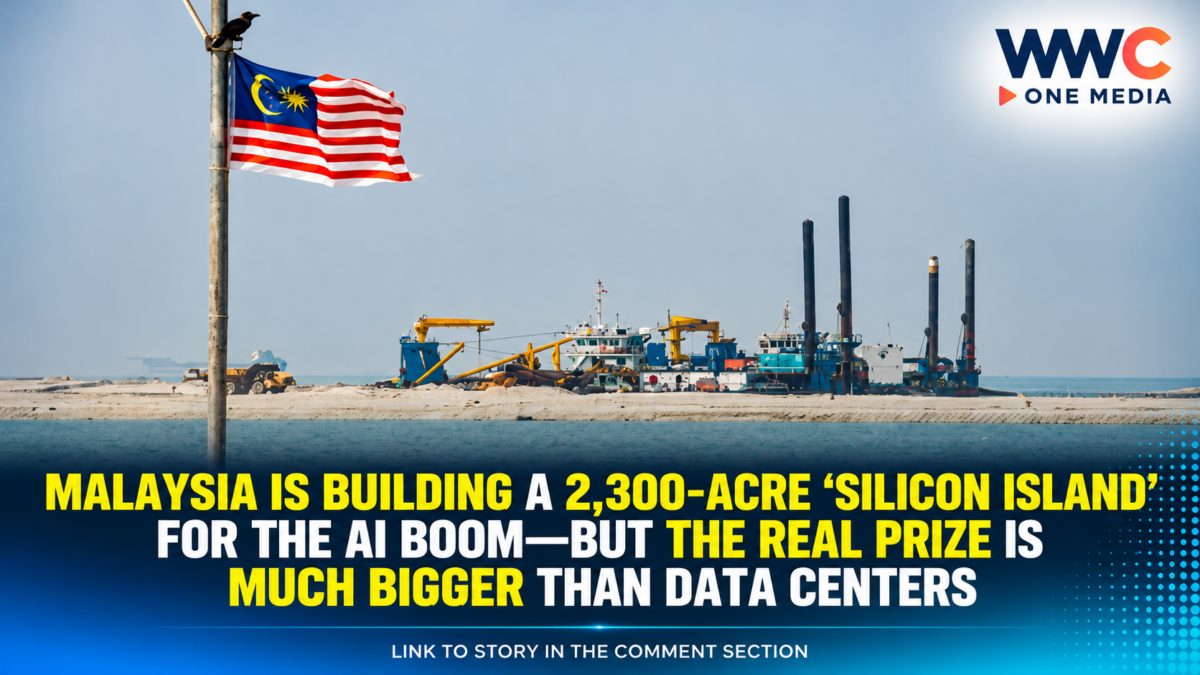
PENANG, Malaysia — Malaysia is literally building new land to capture the next wave of the artificial-intelligence economy.
Off the southern tip of Penang, heavy machinery is reclaiming thousands of acres from the sea for a massive development called Silicon Island—a 2,300-acre artificial island designed to give one of Southeast Asia’s most important semiconductor hubs room to expand.
The project is far more than a real-estate development.
It is part of Malaysia’s broader attempt to move up the global technology ladder—from traditional semiconductor assembly and testing toward advanced packaging, chip design, automated testing and other higher-value activities increasingly critical to AI computing.
The stakes are enormous.
Developers estimate Silicon Island could attract roughly RM75 billion in investment, contribute about RM1.1 trillion to Malaysia’s economic output through 2050 and support around 220,000 jobs over that period.
But there is a catch.
The island will take years to fully reclaim and potentially as long as 15 years to build out.
And Malaysia is entering a brutally competitive race against Singapore, Vietnam, India and other parts of Southeast Asia for the factories, engineers, capital and technology that will determine who benefits most from the AI boom.
Malaysia is building an island because Penang is running out of room
Penang has spent more than five decades building one of Asia’s most important electronics clusters.
The Bayan Lepas industrial zone became the heart of the state’s semiconductor industry, attracting global companies and creating an ecosystem of manufacturers, engineers, suppliers and logistics providers.
Companies including Intel, AMD and ASE Technology have expanded their presence in and around Penang in recent years.
But that success created a problem.
There simply isn’t enough industrial land left to accommodate unlimited expansion.
Silicon Island is the response.
Instead of forcing established companies to move away from Penang, the state is creating an entirely new industrial zone beside its existing technology ecosystem.
That gives companies access to the same talent, suppliers, airport and infrastructure—while providing the physical space required for new factories.
This is not Malaysia’s answer to the data-center race
This distinction is crucial.
Malaysia has become one of Asia’s fastest-growing data-center markets, with enormous investments flowing into Johor, Kuala Lumpur and other regions.
But Penang is taking a different path.
The state’s investment agency has explicitly said it is not positioning Penang as a hyperscale data-center hub.
Instead, Penang is concentrating on areas where it believes its existing ecosystem gives it a stronger advantage:
semiconductors, advanced packaging, integrated-circuit design and precision engineering.
Silicon Island fits directly into that strategy.
Its planned 700-acre Green Tech Park is targeting industries including semiconductor design, advanced packaging and automated test equipment.
So while AI is one of the forces driving the project, Silicon Island is fundamentally a semiconductor and advanced-manufacturing bet.
Why AI makes Silicon Island more important
The artificial-intelligence boom is changing the semiconductor industry.
AI systems require increasingly powerful processors, enormous quantities of memory and sophisticated packaging technologies capable of combining multiple components into high-performance computing systems.
That is creating demand across the entire semiconductor supply chain.
Malaysia already has a major position in the back end of semiconductor manufacturing, particularly assembly, testing and packaging.
Now the country wants to capture more of the higher-value stages.
Malaysia’s Investment Development Authority has specifically identified advanced packaging as a critical opportunity as AI pushes the industry toward chiplets and heterogeneous integration.
That could be one of Silicon Island’s biggest opportunities.
Instead of trying to compete head-on with Taiwan in leading-edge wafer fabrication, Malaysia can specialize in the sophisticated manufacturing processes that connect increasingly complex AI chips into functioning systems.
Penang already has the ecosystem
This is the project’s biggest advantage.
Silicon Island does not have to create a technology industry from zero.
It is being built next to an established semiconductor cluster.
Penang already has decades of experience producing electronics, a deep supplier network and a large pool of engineers and technicians.
That makes the island fundamentally different from a greenfield technology city with no existing industrial base.
The strategy is essentially:
Build the land → attract new factories → expand the existing ecosystem → move into higher-value technology.
That is why the project is being marketed as the next chapter of Penang’s semiconductor story rather than an entirely new economic experiment.
Investors are already showing interest
The project is still under construction, but Silicon Island says it has already attracted interest from both local and international companies.
Penang Chief Minister Chow Kon Yeow told Bloomberg that interest from Taiwan and Japan has been particularly encouraging.
That is significant because both countries are deeply embedded in the global semiconductor supply chain.
Japanese equipment and materials companies, in particular, are crucial to advanced semiconductor manufacturing.
Taiwan, meanwhile, remains the world’s dominant center for advanced chip production and an enormous source of semiconductor expertise and suppliers.
If companies from both ecosystems establish operations on Silicon Island, Penang could deepen its connections to the world’s most important chip markets.
The AI boom is already filling Malaysia’s chip factories
The demand story is not hypothetical.
Malaysia’s semiconductor industry has been benefiting from the global AI investment cycle.
The country’s integrated-circuit exports rose more than 24% in 2025 to about RM389 billion, according to The Straits Times, as AI-related demand boosted the semiconductor sector.
Malaysia’s electrical and electronics exports are also benefiting from the broader technology cycle.
The country’s semiconductor industry has become one of the country’s most important export engines, with Penang playing an outsized role.
That creates a powerful economic incentive to keep expanding capacity.
The next battle is advanced packaging
The most important change may be happening inside the semiconductor itself.
As AI processors become more powerful, chipmakers are increasingly using advanced packaging techniques to combine processors, memory and other components.
High-bandwidth memory, chiplets and heterogeneous integration are becoming increasingly important.
Malaysia wants a larger role in that transition.
The country’s investment authorities are explicitly targeting advanced packaging as part of the National Semiconductor Strategy.
Penang is already building the supporting ecosystem.
InvestPenang recently announced new initiatives designed to expand IC design capacity and help Malaysian semiconductor startups move from development to commercialization.
It has also secured federal funding for a Malaysia Automation, Testing and Equipment campus in Penang.
The goal is increasingly clear:
Malaysia does not want to remain the place where other countries’ chips are simply assembled.
It wants more of the intellectual property, engineering and technology development to happen locally.
New investments are arriving across Penang
Silicon Island is not the only evidence of the shift.
On October 7, PEN S J Electronics announced plans for a new advanced-packaging materials and thermal-management facility in Penang with an investment exceeding US$70 million.
The company plans to manufacture thermal-interface materials and eventually other advanced packaging products used in high-performance processors.
Earlier this year, Chipbond Technology opened an advanced semiconductor manufacturing facility in Penang backed by an investment of almost US$200 million.
The plant is designed to provide advanced wafer bumping, wafer-level chip-scale packaging and testing services.
AIXTRON has also announced a new greenfield manufacturing facility in Penang for semiconductor equipment.
These projects matter because they demonstrate that Malaysia’s semiconductor strategy is increasingly about building an ecosystem, not simply attracting one giant factory.
Silicon Island could become the next Bayan Lepas
Developers have a very ambitious comparison in mind.
For the past half-century, Bayan Lepas has been the engine of Penang’s electronics industry.
Silicon Island is being positioned as the next-generation equivalent.
Its developers expect the island to provide space for high-value manufacturers while also creating offices, commercial districts, housing and transportation infrastructure.
The goal is to make it an industrial ecosystem rather than simply a factory park.
That includes a proposed 29.5-kilometer Mutiara Line light-rail system, which is intended to connect Silicon Island with Bayan Lepas, Penang International Airport and George Town.
Operations are currently targeted for the end of 2031.
The idea is straightforward:
Don’t just build factories. Build the city and transport network needed to support the workers and companies around them.
The first industrial operations are still years away
Despite the excitement, Silicon Island is not about to become a semiconductor metropolis overnight.
Reclamation began in September 2023.
Gamuda’s latest reporting showed 416 acres had been reclaimed by July 31, 2026, with the bridge connecting Penang’s main island to Silicon Island already under construction.
Other reporting put the reclaimed area above 480 acres by September, illustrating the project’s rapid progress.
But developers estimate that fully reclaiming the island could still take another three to four years.
The first industrial operations are expected around early 2029.
That means the real economic payoff is years away.
Gamuda is taking on the financial risk
Silicon Island is being developed through a joint venture involving the Penang state government and Gamuda Berhad.
Gamuda’s subsidiary holds 70% of Silicon Island Development, while the Penang government’s investment vehicle holds the remaining 30%.
The project is being financed through private-sector capital rather than direct recourse to the state government, according to Gamuda’s disclosures.
The project developer estimates roughly RM14 billion in reclamation and infrastructure costs, financed through syndicated borrowing.
That makes the project’s ability to attract high-value industrial tenants critical.
If semiconductor and advanced-technology companies arrive as expected, the economics could work.
If they do not, the project would face a very different financial reality.
There is already a cautionary Malaysian example
The developers know the comparison is unavoidable.
Silicon Island has been compared with Forest City, the enormous reclaimed-land development in southern Malaysia that struggled after demand from overseas property buyers failed to meet expectations.
But the Silicon Island developers argue that the projects have fundamentally different economic models.
Forest City was heavily dependent on residential and commercial demand.
Silicon Island is being built around an existing industrial cluster.
Its developers’ bet is that companies will establish factories first and the residential and commercial city will follow.
That distinction could determine whether Silicon Island becomes a thriving technology district or another ambitious megaproject searching for tenants.
Malaysia’s data-center boom creates another opportunity—and another problem
Even though Penang is not chasing hyperscale data centers, the country’s broader AI infrastructure boom still matters.
Malaysia’s data-center industry is expanding at extraordinary speed.
PwC estimates that Malaysia could attract approximately US$287 billion in cumulative data-center capital expenditure between 2026 and 2050 under its central scenario.
It projects national data-center capacity could expand from 522MW in the first quarter of 2025 to roughly 2,055MW by the end of 2026.
That growth creates demand for the very semiconductor components and advanced electronics that Penang is targeting.
But it also creates a major infrastructure challenge.
Malaysia’s AI boom is already consuming huge amounts of electricity
Reuters reported in September that Malaysian data centers accounted for a record 9.3% of total electricity consumption during the second week of August, compared with a 7% average for the year.
Officials warned that data centers could account for as much as 31% of Peninsular Malaysia’s electricity demand by 2035.
That creates an important distinction between Malaysia’s two technology strategies.
The country can attract data centers.
But it must also make sure it has enough power to operate them.
For Silicon Island, the issue is slightly different: semiconductor factories also require reliable electricity, water and infrastructure.
The technology boom therefore creates an enormous infrastructure bill across Malaysia.
Sustainability is being built into the island’s pitch
Silicon Island is also being marketed as a green development.
Its planned Green Tech Park is designed to operate using renewable energy in its first phase.
The overall development plan includes approximately 402 acres of green space, equivalent to 17.5% of the island’s total area, according to the project developer.
The development also includes plans for extensive walking and cycling networks, renewable-energy infrastructure and measures designed to reduce freshwater consumption.
That positioning is becoming increasingly important to technology companies.
Semiconductor manufacturers and AI infrastructure operators face growing pressure from customers and investors to reduce emissions and improve resource efficiency.
A green industrial park could therefore become a competitive advantage rather than simply an environmental feature.
But reclamation carries environmental and social questions
There is another side to the story.
Silicon Island is being created by reclaiming land from the sea.
That inevitably raises questions about marine ecosystems, fisheries, sediment, coastal changes and the long-term environmental impact of the development.
The project received an Environmental Impact Assessment approval from Malaysia’s Department of Environment in April 2023, followed by approval of an Environmental Management Plan in July 2023.
The developer has incorporated mangrove wetlands, beaches and green areas into its master plan.
But environmental approval does not eliminate the need for continued scrutiny as reclamation progresses.
The project’s long-term sustainability claims will ultimately be judged by what happens on the ground, not simply by the master plan.
Malaysia has a much bigger semiconductor ambition
Silicon Island is one piece of a national strategy.
Malaysia wants to move beyond its historic role in outsourced semiconductor assembly and testing toward more sophisticated activities.
The government is encouraging investment in:
- advanced packaging;
- IC design;
- semiconductor equipment;
- automated testing;
- AI infrastructure;
- digital services;
- and high-value electronics manufacturing.
The country’s investment pipeline demonstrates the scale of the push.
Malaysia approved RM218.5 billion of investments in the first half of 2026, up 11.7% from the same period a year earlier, according to MIDA.
Penang accounted for RM20.2 billion of those approved investments.
The challenge now is converting those approvals into factories, jobs, technology transfer and local supply chains.
The geopolitical timing could not be better
Malaysia is benefiting from a broader restructuring of global supply chains.
Companies are looking for alternatives and additional production bases as U.S.-China tensions, tariffs and geopolitical risks make excessive dependence on one country more difficult.
Penang has an advantage because it already has the factories, suppliers and skilled workforce required to support advanced electronics production.
That makes it easier for companies to expand there than to build entirely new ecosystems elsewhere.
The AI boom is accelerating that process.
Companies no longer need only traditional electronics manufacturing.
They need advanced packaging, thermal management, high-performance components and sophisticated testing.
Those are exactly the areas Malaysia is targeting.
But Malaysia is not alone
The competition is fierce.
Singapore is pushing into advanced manufacturing.
Vietnam is aggressively courting electronics and semiconductor investment.
India is spending heavily to build its domestic chip industry.
Within Malaysia itself, Kedah and Selangor are competing for semiconductor projects.
Penang’s advantage is its existing ecosystem.
Silicon Island’s challenge is proving that the ecosystem can be expanded without losing the characteristics that made it successful in the first place.
The real prize is not the island
The most important thing about Silicon Island may ultimately have little to do with the reclaimed land itself.
The real prize is where Malaysia sits in the global AI supply chain.
If Penang can use the island to attract advanced packaging companies, IC designers, semiconductor equipment manufacturers and high-value electronics producers, Malaysia could capture a much larger share of the economic value created by AI.
That would be a major shift.
Malaysia would no longer be primarily the place where chips are assembled after being designed elsewhere.
It could become a place where increasingly sophisticated parts of the AI hardware stack are designed, packaged, tested and manufactured.
The Bottom Line
Malaysia is spending years and billions of ringgit to create a new industrial frontier off Penang’s coast.
Silicon Island will cover about 2,300 acres, with a 700-acre Green Tech Park at its center and a strategy focused on semiconductors, advanced packaging, IC design and automated testing.
The development could attract around RM75 billion in investment, contribute approximately RM1.1 trillion to Malaysia’s economy through 2050 and support roughly 220,000 jobs, according to projections cited by the project’s developers.
But those numbers are projections—not guaranteed outcomes.
The island still has years of reclamation and construction ahead. Its developers must attract enough high-value companies to justify the enormous infrastructure costs, while Malaysia must solve the energy, talent and environmental challenges created by its broader technology boom.
The opportunity, however, is extraordinary.
AI is creating demand for more chips. More chips require more advanced packaging. More advanced packaging requires more factories, engineers and suppliers.
Malaysia already has much of that ecosystem.
Now it is building the space to scale it.