GENEVA — Global trade has survived tariffs, wars, geopolitical shocks and a wave of economic nationalism better than many expected.
But that resilience is starting to hide a more dangerous transformation.
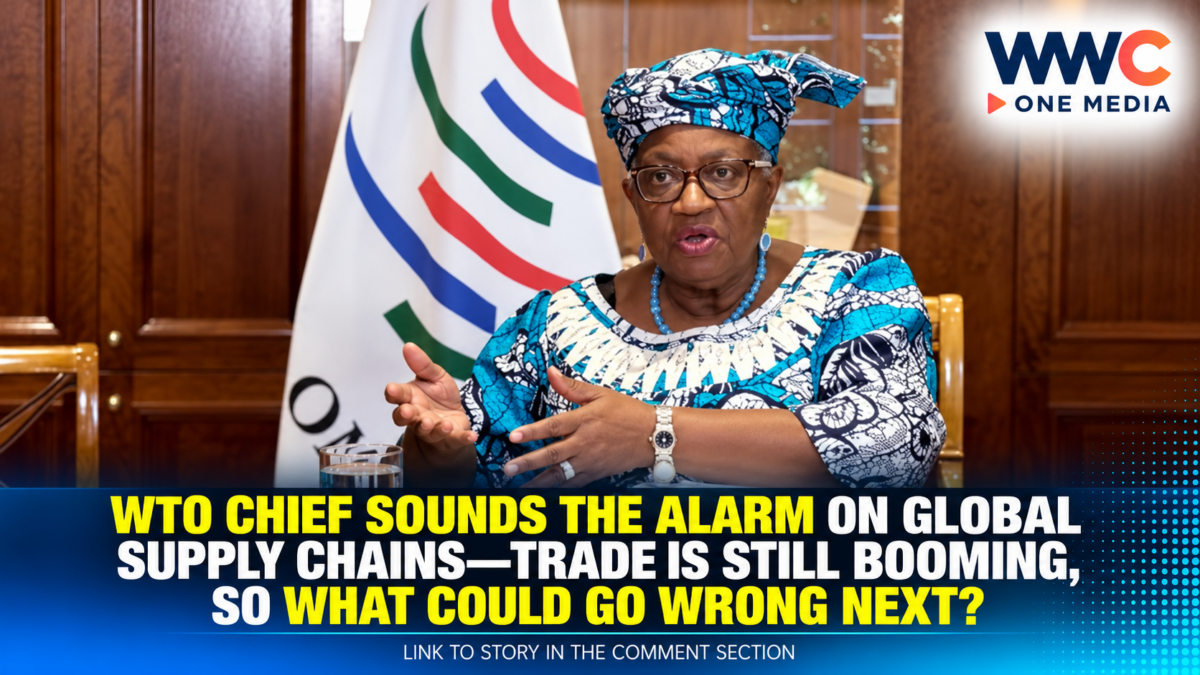
World Trade Organization Director-General Ngozi Okonjo-Iweala is warning that governments and businesses urgently need to make global supply chains more resilient as geopolitical tensions increasingly reshape where goods are produced, sourced and shipped.
Her warning comes at a paradoxical moment: global merchandise trade remains remarkably strong even as the rules governing that trade are under unprecedented pressure.
The question is no longer whether globalization is ending.
It is whether the global economy can rebuild its supply chains quickly enough to survive the next major shock without destroying the efficiencies that made international trade so powerful in the first place.
The world is trading—but the map is changing
The latest evidence from the WTO shows that international commerce has not collapsed despite the increasingly hostile trade environment.
About 72% of global merchandise trade still takes place under most-favoured-nation, or MFN, tariff terms, according to WTO data.
That means the rules-based trading system remains much more intact than some headlines suggest.
The WTO’s deputy director-general, D.J. Nordquist, said global trade grew 4.6% in 2025, significantly faster than economists had initially expected and faster than global GDP growth.
But beneath that headline is a major structural change.
Companies are rerouting trade.
Governments are reassessing strategic dependencies.
And businesses are increasingly thinking about geopolitical exposure alongside cost and efficiency.
In other words:
Globalization isn’t disappearing. It’s being rewired.
Okonjo-Iweala’s warning: resilience now matters as much as efficiency
The WTO chief’s message comes as governments increasingly prioritize supply security for critical products, technologies and raw materials.
For decades, companies largely optimized supply chains around one question:
Where can we make this cheapest?
Now another question is becoming just as important:
What happens if that supplier suddenly becomes unavailable?
A war.
A blockade.
A tariff.
An export ban.
A sanctions regime.
A diplomatic rupture.
Or even a natural disaster.
Any of these can turn a highly efficient supply chain into a vulnerability.
The WTO is therefore increasingly pushing the idea that countries should build resilience without simply retreating behind protectionist barriers.
That distinction is crucial.
The danger: “resilience” can become protectionism
Governments have increasingly justified tariffs, subsidies and domestic manufacturing programs on national-security grounds.
The argument is straightforward:
If a country depends too heavily on another nation for critical goods, it becomes vulnerable.
But the WTO warns that attempts to eliminate foreign dependence altogether can create another problem.
Self-sufficiency can be extraordinarily expensive.
The OECD estimates that efforts to relocalize supply chains globally could reduce international trade by more than 18% and lower global real GDP by more than 5% in its modelling.
More importantly, the modelling suggests that reshoring does not automatically make economies more resilient. In more than half of the economies examined, GDP volatility actually increased.
The implication is uncomfortable:
Building a safer supply chain does not necessarily mean bringing everything home.
It may mean having more suppliers, more routes and more flexibility.
Friend-shoring is becoming the new normal
One of the biggest changes in global trade is the rise of friend-shoring—moving production and sourcing toward countries viewed as politically or economically reliable.
The concept accelerated after the pandemic exposed vulnerabilities in global manufacturing and intensified after Russia’s invasion of Ukraine.
Now the US-China strategic rivalry is pushing the process further.
The WTO says trade between geopolitical blocs has been diverging from trade within those blocs, with the trend showing renewed fragmentation in 2025 amid intensifying US-China trade tensions.
That means companies aren’t necessarily abandoning globalization.
They are increasingly asking:
Which countries can I trust to remain open to trade five or 10 years from now?
AI is unexpectedly keeping global trade alive
Here’s the twist.
One of the biggest forces supporting global trade right now is artificial intelligence.
Demand for AI infrastructure—from advanced chips and servers to networking equipment and data-center components—is generating enormous cross-border trade.
A new DHL-Stern Globalization Tracker report, cited by Bloomberg, estimates global merchandise trade will grow 4.6% in 2026, an upgrade from its previous 3.6% forecast.
AI-related goods accounted for 42% of merchandise trade growth in 2025, according to the report’s WTO and OECD-based analysis.
During the first quarter of 2026, that share jumped to almost 76%.
That creates an extraordinary contradiction.
The same geopolitical tensions threatening globalization are occurring alongside an AI investment boom that requires an even more interconnected global supply chain.
AI needs chips.
Chips need specialized equipment.
Equipment needs critical minerals and precision components.
Data centers need servers, power equipment, cooling systems and networking hardware.
Very few countries can produce all of that independently.
China’s role makes the equation even harder
China remains deeply embedded in global manufacturing and supply chains, while the US and other Western economies are attempting to reduce strategic dependence in sensitive industries.
That creates a difficult balancing act.
Companies want diversification.
But replacing China’s enormous manufacturing ecosystem is not as simple as opening factories somewhere else.
Production can move to Vietnam, India, Malaysia, Mexico or other emerging manufacturing centers—but the underlying supplier networks, skilled labor, infrastructure and logistics systems take years to develop.
This is why supply-chain diversification can be expensive even when the strategic rationale is obvious.
Tariffs are making the problem more complicated
The trade environment has also become much less predictable.
US tariff policy has repeatedly changed the economics of importing, exporting and manufacturing across borders.
The result is that companies have had incentives to build inventories, shift sourcing and redesign logistics networks in anticipation of future policy changes.
That behavior can temporarily boost trade volumes.
But it can also increase costs.
The recent US trade data illustrates the contradiction.
The US trade deficit widened sharply in August 2026, with imports reaching a record $420.8 billion as businesses and consumers continued purchasing foreign goods.
Imports of capital goods also reached a record, helped by spending on AI-related infrastructure.
So tariffs have not suddenly made America independent of global supply chains.
Instead, businesses are continuing to import while trying to adapt to a more unpredictable policy environment.
The next crisis could expose the weak links
The biggest risk may not be today’s trade volumes.
It is what happens when the next major disruption arrives.
The New York Federal Reserve’s Global Supply Chain Pressure Index rose to 1.28 in September from a revised 1.20 in August, although it remains well below the extreme levels seen during the COVID-19 supply shock.
The December 2021 peak was 4.43.
That means today’s system is nowhere near the chaos experienced during the pandemic.
But pressures are moving upward again.
And unlike the pandemic, today’s supply-chain risks increasingly overlap with geopolitical confrontation.
That combination could make future disruptions harder to contain.
The WTO itself is under pressure
There is another problem behind Okonjo-Iweala’s warning.
The institution responsible for maintaining global trade rules is itself struggling to adapt.
The WTO’s 2026 World Trade Report says the multilateral trading system is experiencing its most serious and sustained disruption since its creation roughly 80 years ago.
The organization is facing pressure over:
- US-China trade tensions
- Tariffs and unilateral trade measures
- Industrial subsidies
- National-security restrictions
- Export controls
- Critical-mineral policies
- Digital trade
- AI
- Climate-related trade measures
- Dispute-settlement reform
And the WTO’s members do not necessarily agree on what the solution should be.
The WTO General Council met in early October to discuss reform, dispute settlement and other negotiations, highlighting the continuing effort to modernize the institution.
The numbers reveal just how expensive fragmentation could become
The WTO’s latest modelling provides a sobering warning.
Under a scenario where geopolitical fragmentation deepens, the WTO estimates global GDP could eventually be 5.1% below the baseline by 2050, with global exports 18.6% lower.
Under a scenario where multilateral cooperation deteriorates further and the world moves toward a system dominated by preferential trade agreements, the estimated losses are even larger: global GDP could be 6.9% lower and exports 26.9% lower by 2050.
These are scenarios, not forecasts.
But they illustrate the economic cost of allowing trade fragmentation to become permanent.
The WTO says the difference between stronger multilateral cooperation and erosion of the system could ultimately amount to roughly 5% to 10% of global real GDP.
Smaller and poorer economies could suffer disproportionately because they have less bargaining power in a fragmented trading system.
Developing economies face the biggest dilemma
For countries such as the Philippines, Vietnam, Indonesia, Malaysia and India, supply-chain fragmentation creates both danger and opportunity.
Companies looking to diversify away from concentrated production bases are searching for alternative manufacturing locations.
That can attract:
Factories.
Semiconductor investment.
Logistics hubs.
Data centers.
Ports.
Renewable-energy projects.
High-skilled jobs.
But becoming the “next China” is not simply a matter of offering cheaper labor.
Investors increasingly want reliable electricity, ports, roads, skilled workers, digital infrastructure and predictable regulations.
They also want geopolitical stability.
That means countries hoping to benefit from supply-chain diversification have to compete on the entire ecosystem—not just wages.
Southeast Asia could become one of the biggest winners
Southeast Asia is already benefiting from the diversification of manufacturing.
Vietnam has become an important electronics and manufacturing hub.
Malaysia is expanding its semiconductor and advanced-packaging capabilities.
Thailand is attracting automotive, electronics and data-center investment.
Indonesia is positioning itself around nickel, batteries and downstream processing.
The Philippines is attempting to move further up electronics and semiconductor value chains.
The broader trend is clear:
Global companies are building more options.
But diversification doesn’t mean every country gets an equal share.
The winners will be the economies that can combine infrastructure, skilled labor, reliable energy, trade access and political stability.
What the WTO is really asking for
The WTO’s argument is not that countries should blindly return to the globalization model of the past.
It is essentially asking for something more difficult:
Build resilience without destroying interdependence.
That could mean:
- Multiple suppliers instead of one
- Multiple shipping routes instead of one
- Strategic reserves for critical materials
- Better customs and trade-data systems
- More transparent trade rules
- Cooperation on critical supply chains
- Stronger regional trade agreements
- Diversified manufacturing networks
- Greater coordination between governments and companies
The objective is not to eliminate risk.
It is to make sure one disruption doesn’t become a global economic crisis.
The world has a choice—but neither option is painless
The global economy now faces two competing forces.
One is economic security.
Governments want control over critical technologies, energy, food, minerals and manufacturing capacity.
The other is economic efficiency.
Businesses still want access to the cheapest, fastest and most productive suppliers around the world.
The danger comes when one completely overwhelms the other.
Too much dependence can create vulnerability.
But too much protectionism can make everything more expensive.
And that is the difficult balancing act facing policymakers.
The bottom line
The global trading system is not collapsing. It is changing shape.
Trade remains resilient, and AI investment is generating enormous new cross-border demand.
But the infrastructure beneath that trade is becoming more fragmented as governments prioritize national security, tariffs, industrial policy and strategic independence.
The WTO’s latest research suggests that allowing geopolitical blocs to replace broad-based trade cooperation could carry a massive economic price.
That is why the warning from Okonjo-Iweala matters.
The next era of globalization may not be about finding the cheapest supply chain.
It may be about finding the hardest-to-break one.
And with wars, tariffs, AI demand and US-China rivalry all reshaping global commerce at the same time, the question is no longer whether supply chains will change.
It is whether the world can rewire them without breaking global trade itself.