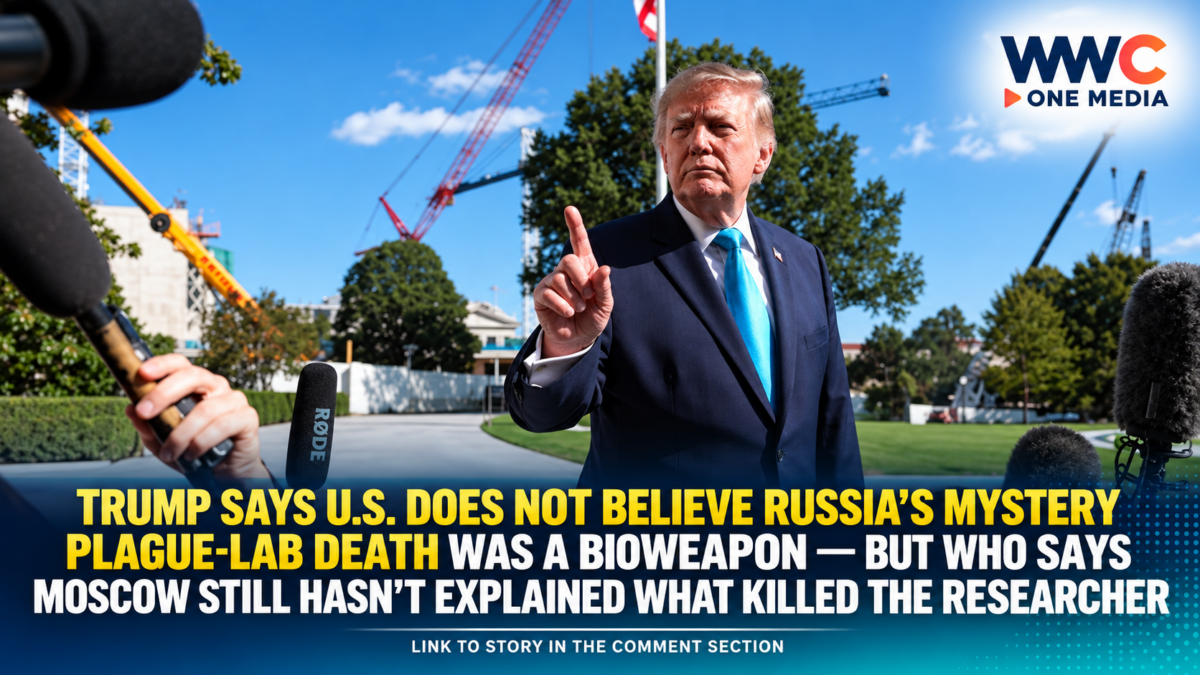
WASHINGTON/MOSCOW — President Donald Trump says the United States does not currently believe the mysterious death of a Russian researcher at a Siberian anti-plague laboratory was caused by a biological weapon—but Washington and the World Health Organization are demanding more transparency from Moscow over what actually happened.
The case centers on Darya Shipilova, 28, an employee of the Irkutsk Anti-Plague Research Institute of Siberia and the Far East, who died on October 2 after developing severe pneumonia. Russian authorities say the cause remains “pneumonia of unknown origin” and insist testing has found no evidence of plague or another dangerous pathogen linked to her laboratory work.
Asked at the White House on October 7 whether the incident involved a biological weapon, Trump said the U.S. did not believe so.
“We don’t think so.”
Trump said Washington expects Russia to provide substantially more information and added that he had arranged a call with Russian President Vladimir Putin to discuss the situation. The Kremlin, however, separately said no such call had been scheduled at that point.
The United States has also delivered a formal diplomatic démarche to Moscow seeking additional details and reminding Russia of its obligations under international health rules, according to ABC News.
The World Health Organization is taking a similarly cautious position.
WHO Director-General Tedros Adhanom Ghebreyesus said the organization still does not have the full picture and has requested further information on laboratory tests, the health of the worker’s contacts, the reasons behind quarantine measures and reports of another employee suffering from pneumonia of undetermined cause.
For now, there is no confirmed evidence that Shipilova died from plague, no verified outbreak, and no publicly established link to a biological weapon.
But the lack of a definitive explanation—combined with the fact that she worked at an institute handling dangerous pathogens—has turned one unexplained death into an international transparency test.
Russia Says There Is No Epidemic
Russia’s public-health regulator, Rospotrebnadzor, says extensive testing has found no evidence of a wider outbreak.
About 200 people were initially placed under quarantine or monitoring, according to Russian authorities and WHO.
Rospotrebnadzor said nearly 5,000 laboratory tests were performed and failed to identify dangerous infectious pathogens among people who had been in contact with Shipilova.
By October 7, Russia said approximately 90% of those originally quarantined had been released and that there was no epidemic risk.
The regulator also said Shipilova had been vaccinated against dangerous pathogens relevant to her work.
But one critical question remains unresolved:
What actually killed her?
Russian authorities have not publicly identified the cause of the pneumonia.
That uncertainty is why the WHO is continuing to press for more information.
WHO Says It Cannot Yet Conduct a Full Risk Assessment
Tedros said the organization first learned of reports of a suspected pneumonic-plague case on October 2.
WHO contacted Russian authorities under the International Health Regulations and asked for clarification.
Russia subsequently told the organization that no recent plague cases had been recorded in the Irkutsk region and that around 200 contacts had been quarantined.
But WHO says the information supplied so far is not enough to fully assess the situation.
The agency wants to know:
which laboratory tests were performed;
which pathogens were tested for;
what caused Shipilova’s fatal pneumonia if it was not plague;
why such extensive precautionary measures were implemented;
and whether reports of another sick laboratory employee are accurate.
WHO officials have stressed that complete and timely information is especially important after the experience of the COVID-19 pandemic.
The Immediate Public-Health Risk Appears Low
Despite the international attention, current evidence does not point to a major public-health emergency.
WHO’s initial assessment placed the broader risk to Russia at low levels and described the risk outside Russia as very low, although the agency says that assessment could change as more information becomes available.
The U.S. Centers for Disease Control and Prevention has also said the risk to the United States is extremely low while remaining prepared to monitor travelers if necessary.
That distinction is essential.
International concern about transparency does not automatically mean there is evidence of widespread transmission.
So far, no secondary plague cases have been confirmed.
What Is Pneumonic Plague?
Plague is caused by the bacterium Yersinia pestis.
It still exists naturally in animal populations in several parts of the world despite being most famous for causing the medieval Black Death.
There are several forms.
Bubonic plague is generally transmitted through infected fleas or contact with infected animals.
Pneumonic plague affects the lungs and can spread between people through respiratory particles.
Untreated pneumonic plague can be extremely dangerous.
But modern antibiotics can successfully treat the disease when it is recognized early.
That means even if a plague infection were eventually confirmed, it would not automatically imply a catastrophe comparable to medieval outbreaks.
Why the Laboratory Connection Has Raised Alarm
Shipilova’s workplace is what transformed the death into a global story.
The Irkutsk Anti-Plague Research Institute is part of Russia’s network of facilities involved in studying dangerous infectious diseases and monitoring natural plague reservoirs.
Because laboratory workers may legitimately handle dangerous pathogens for public-health and scientific reasons, an unexplained severe illness among staff naturally raises biosafety questions.
Initial media reports suggested a possible accidental laboratory exposure.
WHO has acknowledged those reports but has not verified them.
Russian officials deny that an accident occurred.
Rospotrebnadzor said no laboratory incident involving pathogenic microorganisms had been identified.
At this stage, neither account has been independently proven.
There Is No Verified Evidence of a Bioweapon
This point needs to be explicit.
No credible public evidence currently shows that Shipilova’s death involved the deliberate release or testing of a biological weapon.
Trump himself said Washington does not believe the incident was caused by one.
Russia has also denied that dangerous pathogens escaped from the facility.
The WHO is treating the event as a public-health and laboratory-safety question—not as a confirmed weapons incident.
That distinction matters because the words “plague laboratory” and “bioweapon” can easily create a much more dramatic impression than the available evidence supports.
But Russia Has a Complicated Biological-Weapons History
The concern does not arise in a historical vacuum.
The Soviet Union operated a large offensive biological-weapons program during the Cold War.
After the Soviet collapse, Russia acknowledged inheriting that legacy and committed to ending prohibited activities.
For years, however, U.S. government compliance reports have said significant questions remained about whether all elements of the Soviet program were fully dismantled or diverted to peaceful purposes.
That history explains why unexplained incidents involving Russian pathogen laboratories can attract intense Western scrutiny.
But historical compliance concerns are not evidence that the current Irkutsk death resulted from a weapons program.
Conflating those two issues would be misleading.
Washington Has Formally Asked Russia for More Information
The Trump administration is not relying only on public statements.
ABC News reports that Washington sent Russia a formal diplomatic démarche demanding greater transparency over the death.
A State Department spokesperson said the U.S. had officially requested additional information and was coordinating with other governments.
The diplomatic message reportedly reminded Moscow of its obligations under the International Health Regulations.
Those regulations establish rules for countries to share information about events that could present international public-health risks.
They do not automatically presume wrongdoing.
The purpose is early detection and cooperation.
Russia Says It Has Fulfilled Its Obligations
The Kremlin insists Moscow has acted properly.
Spokesman Dmitry Peskov said Russia had provided information through established channels and accused some media coverage of spreading false information.
Russian officials have urged people to rely on Rospotrebnadzor rather than social-media speculation.
They have also rejected claims—circulating online—that plague has been confirmed or that multiple deaths have occurred.
Reuters said it could find no reliable evidence of a second death, despite social-media claims and some foreign reports.
WHO is nevertheless asking Moscow to formally verify reports of another institute employee suffering from unexplained pneumonia.
Conflicting Early Statements Added to the Confusion
Part of the international alarm arose because early Russian messaging was inconsistent.
Alexey Tsydenov, head of the neighboring Buryatia region, initially posted that Shipilova had died from plague.
He later edited the statement to say she had possibly died from the disease.
Russia’s federal health authorities subsequently denied plague had been detected.
Meanwhile, hospitals imposed quarantine measures and health officials carried out extensive contact tracing and testing.
That combination—strong precautions but no confirmed diagnosis—contributed to public suspicion.
It does not establish a cover-up.
But it explains why international agencies want clearer information.
Quarantines Do Not Prove Plague Was Found
The existence of quarantine measures has become one of the most misunderstood aspects of the case.
Authorities can impose precautionary measures before identifying a pathogen.
When a laboratory worker who handles dangerous organisms develops rapidly progressing pneumonia, public-health officials may isolate contacts while testing is underway.
That is standard risk management.
It does not itself prove the person had plague.
Russian authorities say the measures were precautionary and that the absence of secondary infections justified gradually lifting them.
Why COVID-19 Is Shaping the Global Response
The case has immediately revived memories of the early weeks of COVID-19.
That does not mean the two events are medically comparable.
What is similar is the uncertainty.
In both situations, global authorities faced reports of severe pneumonia without immediately knowing the pathogen involved.
That experience has made governments and the WHO much less willing to accept incomplete information around unusual respiratory illnesses.
WHO officials have explicitly invoked the lessons of COVID-19 when calling for timely transparency.
The practical lesson is straightforward:
it is easier to reduce international panic by releasing credible data early than by allowing an information vacuum to develop.
Trump’s Putin Call Is Itself Disputed
Trump said on October 7 that he had a call set up with Putin.
But the Kremlin said no such conversation had been scheduled at that point.
That disagreement is secondary to the public-health issue but adds another layer of uncertainty around diplomatic communication.
Trump had already said a day earlier that he expected to speak with Putin.
Whether that call takes place—and whether Russia provides additional laboratory information afterward—will be closely watched.
The Situation Comes Amid Deep U.S.-Russia Tensions
The health scare is unfolding against an already hostile geopolitical backdrop.
Russia’s war in Ukraine continues.
On October 7, Russian missile and drone attacks across Ukraine killed at least 28 people, according to Reuters.
Relations between Washington and Moscow remain strained by military, sanctions and arms-control issues.
That makes scientific cooperation more difficult.
Public-health emergencies normally benefit from rapid technical communication.
Political distrust can slow that process and encourage both sides to interpret incomplete information through a national-security lens.
Biological Research Is Inherently Dual-Use
A further complication is that legitimate pathogen research and biological-weapons research can involve some of the same organisms and laboratory techniques.
Public-health laboratories study dangerous pathogens to develop diagnostics, understand transmission and prepare treatments.
Those are legitimate activities.
The Biological Weapons Convention prohibits developing or possessing biological agents for hostile purposes.
The dividing line is therefore largely about purpose, scale and intent, not simply whether a laboratory handles dangerous bacteria.
That is why the mere existence of plague research at an anti-plague institute is not evidence of a weapons program.
Russia’s Soviet Legacy Still Creates Distrust
Nevertheless, decades of unresolved questions surrounding Soviet biological-weapons research have made Western governments wary.
Older U.S. State Department assessments repeatedly said Russia had not provided enough information to demonstrate that every prohibited component inherited from the Soviet program had been dismantled.
Those concerns are longstanding.
But they must be separated from the Irkutsk event.
There is currently no publicly verified evidence connecting Shipilova’s death to any offensive biological-weapons activity.
The Bigger Risk May Be Misinformation
In the absence of a confirmed cause, rumors have spread rapidly.
Claims of multiple deaths, mass outbreaks and deliberate biological attacks have circulated online.
Reuters found no supporting evidence for some of the most dramatic claims.
This can create a second crisis alongside the medical investigation.
Rumors can cause unnecessary fear, damage trust and pressure governments into defensive messaging.
The most effective response is credible evidence.
That means laboratory results, timelines and clear explanations of why quarantine measures were taken.
Scientists Still Need the Basic Answer
Despite all the geopolitics, the central question remains remarkably simple:
What caused Darya Shipilova’s pneumonia?
WHO says it wants the laboratory evidence needed to answer that question.
If a routine respiratory infection is ultimately identified, much of the international concern could fade quickly.
If plague is confirmed, authorities will need to establish how she was infected.
If the cause remains unidentified, questions about laboratory safety and transparency will persist.
The Current Evidence Points Away From a Wider Outbreak
So far, the strongest reassuring evidence is epidemiological.
Hundreds of contacts were monitored.
Thousands of laboratory tests were conducted.
No dangerous pathogen has been reported among them.
Russia says the quarantine measures are being eased.
WHO’s current assessment places the international risk at very low levels.
That does not solve the mystery of the original death.
But it makes a rapidly spreading outbreak less likely based on the evidence currently available.
Trump’s Message Is Reassuring—but Conditional
Trump’s statement is therefore carefully phrased.
He did not say Washington had conclusively ruled out every possible connection to dangerous biological research.
He said U.S. officials do not currently think the incident was caused by a bioweapon and expect to know more as information becomes available.
That distinction is important.
The story is still developing.
The correct framing is uncertainty—not confirmation of either a bioweapon or an ordinary illness.
The Bigger Question Is Whether Moscow Will Provide the Missing Data
For now, three major facts can be established.
A 28-year-old worker at a Russian anti-plague institute died from severe pneumonia whose cause remains unidentified.
Russia says testing has found no plague and no wider outbreak.
The United States and WHO want more information, while Trump says Washington does not believe the death was caused by a biological weapon.
The unresolved issue is transparency.
Russia says it has complied with international requirements.
WHO says it still lacks enough information for a complete assessment.
That gap will determine whether the controversy fades or grows.
The most dangerous mistake would be to label the incident a biological attack without evidence.
But the opposite mistake would be to dismiss international questions before Moscow has provided enough data to explain why a young pathogen researcher died so suddenly.
The bigger story is therefore not a confirmed bioweapon—it is whether Russia can provide enough credible evidence to convince the world that this mysterious laboratory death poses no wider threat.