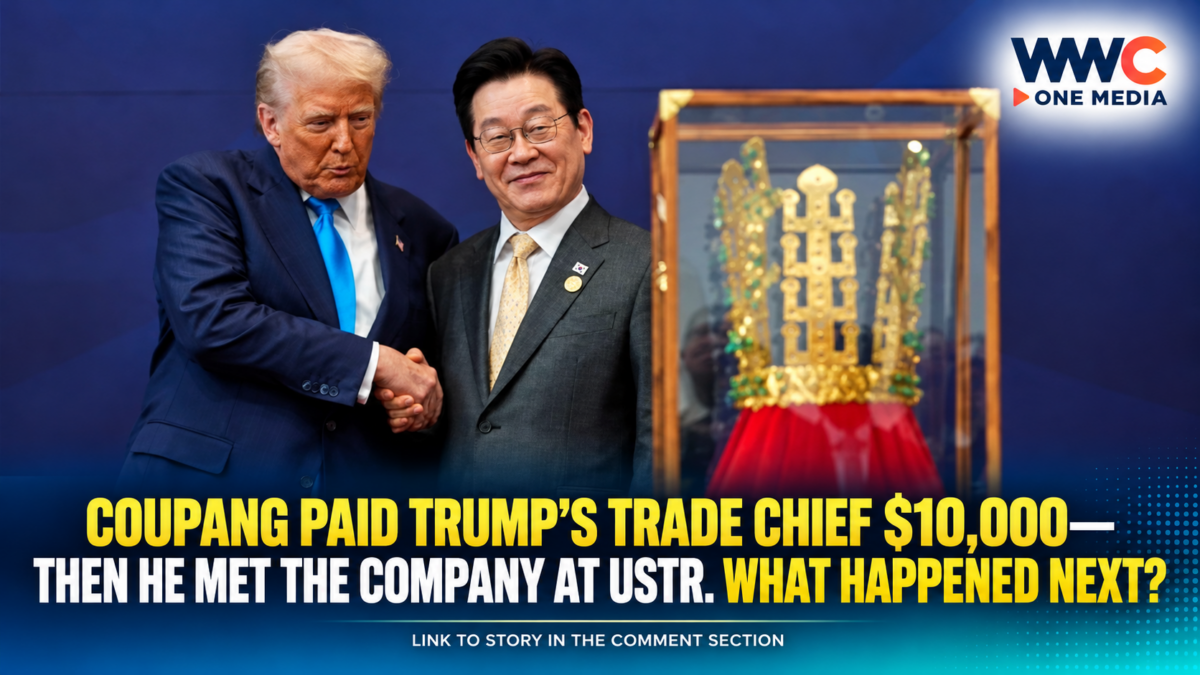
WASHINGTON — A newly disclosed financial record is putting U.S. Trade Representative Jamieson Greer’s past ties to South Korean e-commerce giant Coupang under renewed scrutiny, after records showed the company paid him a $10,000 honorarium in May 2024, months before he joined the Trump administration.
The disclosure is drawing attention because, nearly a year after that payment, Greer met with Coupang at the Office of the U.S. Trade Representative (USTR) on April 24, 2025, while he was already serving as the administration’s top trade official.
The meeting itself is documented in USTR’s official calendar records. They show Greer meeting South Korean Trade Minister Ahn Duk-geun earlier that afternoon before a scheduled 3 p.m. meeting with Coupang as part of a day of Korea-related trade discussions.
But the records do not establish that Greer broke federal ethics rules.
That distinction is critical.
From Coupang Payment to U.S. Trade Policy
Greer’s financial disclosure identifies a $10,000 honorarium from Coupang dated May 17, 2024, when he was a partner at King & Spalding, the Washington law firm where he specialized in international trade and national-security matters. The payment is independently reflected in his official ethics disclosure filed with the U.S. Office of Government Ethics.
Greer later left the law firm and joined the Trump administration. The U.S. Senate confirmed him as U.S. Trade Representative in February 2025, and he assumed responsibility for one of the administration’s most consequential policy areas: tariffs, trade negotiations and disputes involving U.S. trading partners.
CNBC’s review of his latest financial disclosure found that Greer received $652,610 in salary and bonus from King & Spalding in 2025 after leaving the firm for government service. His broader reported holdings in cash, retirement accounts and other investments fell within a range of approximately $1.17 million to $3.75 million, although federal disclosure forms use broad asset ranges and do not provide a precise net-worth figure.
His latest disclosure also showed one U.S. bank account increasing from a reported $250,001-$500,000 range to $500,001-$1 million, while generating another $15,001-$50,000 in interest. His home was not assigned a value in the filing, while his mortgage was reported at between $1 million and $5 million.
Why the Coupang Connection Matters Now
The timing has become particularly sensitive because Coupang has emerged as a major point of friction between Washington and Seoul.
The company has faced intense scrutiny in South Korea following a massive data breach. A South Korean government-led investigation found that information connected to more than 33.6 million accounts had been exposed. Authorities also said Coupang failed to promptly report the incident as required.
In June, South Korea imposed a 625 billion won penalty — roughly $409 million at the time — on Coupang, making it the country’s largest penalty tied to a data breach. Reuters reported that the fine related to the leakage of personal information affecting more than 33 million customers and Coupang’s failure to detect the breach within the legally required period.
Coupang has pushed back against aspects of the South Korean response, while some U.S. lawmakers and business groups have accused Seoul of unfairly targeting an American-listed company.
South Korean officials have rejected that characterization.
Washington vs. Seoul: Coupang Becomes a Trade Flashpoint
The dispute escalated in July when the U.S. House Judiciary Committee released an interim report accusing South Korea of discriminatory treatment toward Coupang and other U.S.-owned companies.
The committee argued that Seoul’s regulatory actions represented a broader pattern of economic discrimination and said the treatment of American businesses could conflict with commitments made in the countries’ bilateral trade framework.
South Korea strongly disputed those accusations.
Foreign Ministry spokesperson Park Il said the congressional report appeared to reflect Coupang’s claims while failing to adequately incorporate the South Korean government’s position. Seoul maintains that its investigations and regulatory measures were conducted under Korean law and applied fairly regardless of nationality.
The dispute has therefore moved beyond a corporate regulatory case and into the broader U.S.-South Korea economic relationship.
Reuters has reported that South Korean officials have repeatedly argued that the Coupang investigation should be treated separately from trade negotiations, while U.S. lawmakers and investors have raised concerns about whether the company’s treatment reflects broader discrimination against U.S. businesses.
The Ethics Question
That backdrop is what makes Greer’s earlier Coupang payment particularly notable.
Before entering government, Greer committed to avoiding certain matters involving former clients for a year unless ethics officials authorized his participation.
However, CNBC’s review found no public record establishing whether Coupang was formally treated as a former client under that particular commitment or whether Greer received specific authorization to participate in the April 2025 meeting.
His disclosure calls the $10,000 Coupang payment an honorarium, while other companies are separately identified in the filing as legal-services clients. USTR and Coupang did not immediately respond to CNBC’s requests for comment.
That means the available records raise a legitimate transparency question, but they do not by themselves prove an ethics violation or improper influence.
A Much Bigger Issue Than One Meeting
The controversy arrives at a time when Coupang has become increasingly important to U.S.-South Korea economic relations.
Coupang is U.S.-listed and headquartered in Seattle, while South Korea remains its core market. Its enormous customer base and the scale of the data breach have made the company’s regulatory fight politically significant on both sides of the Pacific.
The U.S. congressional investigation has framed the dispute as a question of treatment of American companies overseas.
Seoul, meanwhile, has insisted that the Coupang case is fundamentally about enforcing Korean law following a serious data-security incident.
Reuters reported that South Korean officials rejected claims that the dispute was holding up the broader U.S.-South Korea trade and security agenda.
That leaves Greer’s Coupang connection sitting at the intersection of financial disclosure, government ethics, corporate lobbying, data privacy and U.S.-South Korea trade policy.
And that is precisely why a $10,000 payment made before Greer entered government has suddenly become much more politically significant.
The Bottom Line
The documents establish three important facts: Coupang paid Greer $10,000 in May 2024; Greer later became U.S. Trade Representative; and he met with Coupang at USTR on April 24, 2025.
What the public record does not establish is whether Greer’s participation violated his ethics commitment or federal ethics law.
That unanswered question is likely to keep the controversy alive—particularly as Washington and Seoul continue to clash over how Coupang should be treated following one of South Korea’s largest-ever data-security scandals.
For now, the story is less about proving wrongdoing than about whether the Trump administration can maintain public confidence in the separation between private-sector relationships and U.S. trade policy at a moment when Coupang has become a flashpoint in relations with a key American ally.