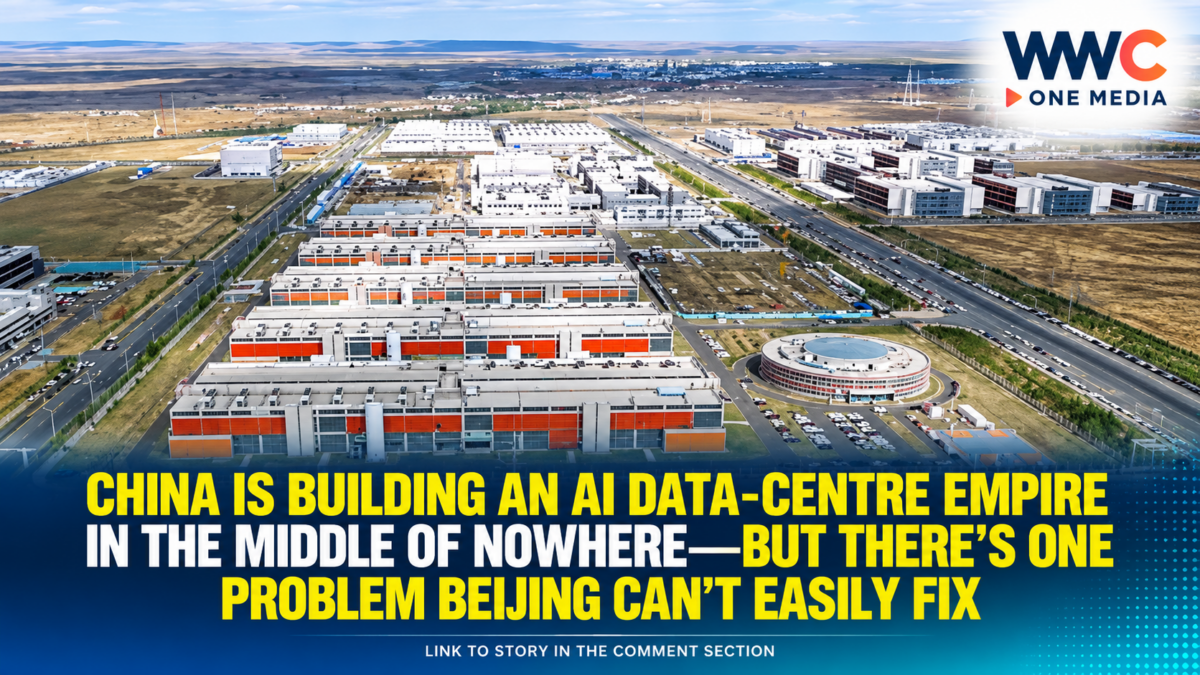
BEIJING — China is building one of the world’s fastest-growing artificial-intelligence infrastructure networks far from its traditional technology centres, transforming the windswept plains of Inner Mongolia into a giant computing hub for the country’s AI ambitions.
At the centre of the build-out is Ulanqab, a remote city better known for agriculture, potatoes and grasslands than cutting-edge technology.
Now, dozens of enormous data centres are being built or planned across the region.
The transformation reflects a much bigger strategy: China is trying to turn cheap electricity, abundant land, cold weather and rapid construction into an advantage in the global AI race.
But there is a catch that could determine whether Beijing’s infrastructure gamble succeeds.
China can build the buildings. It can generate the electricity. It can connect the networks.
The harder question is whether it can obtain enough advanced AI processors to fill them.
Ulanqab Is Becoming China’s AI Powerhouse
Ulanqab has emerged as one of Asia’s fastest-growing data-centre locations.
The Financial Times reported that 89 data centres are either operational or planned in the city, with roughly 15 gigawatts of computing capacity committed according to a regional data-centre executive.
That scale is extraordinary.
China already has about 24GW of operational data-centre capacity, according to semiconductor research firm SemiAnalysis, compared with about 56GW in the United States.
Another 50GW of capacity has been announced or is under construction in China, highlighting the speed at which Beijing is expanding its computing infrastructure.
The numbers illustrate the central shift taking place in the AI economy.
The AI race is no longer only about who develops the smartest model.
It is increasingly about who controls the electricity, land, chips and physical infrastructure required to run those models.
Why Inner Mongolia?
At first glance, Inner Mongolia seems like an unlikely place to build the infrastructure powering China’s AI ambitions.
But its disadvantages as a population centre are becoming advantages for data centres.
The region has enormous amounts of land, relatively cheap electricity and a naturally cold climate that can reduce cooling requirements for energy-intensive computing facilities.
Inner Mongolia had about 117GW of installed wind capacity by June 2026, the largest wind-power fleet in China, according to the FT. It also had roughly 130GW of fossil-fuel generation capacity, mostly coal-fired.
That combination gives the region an enormous energy base.
And for AI data centres, electricity is not simply another operating expense.
It is the fuel that makes artificial intelligence possible.
China’s regional authorities have also been aggressively promoting the area as a centre for green computing.
Official regional media reported that Inner Mongolia’s computing capacity reached 315,000 petaflops by May 2026, including 297,000 petaflops of intelligent-computing capacity. The Horinger data-centre cluster around Hohhot and Ulanqab accounted for a substantial share of that capacity.
Electricity Is the Secret Weapon
One of Ulanqab’s biggest advantages is its unusually cheap electricity.
The FT reported that data centres in the city pay around 0.358 yuan per kilowatt-hour, compared with industrial electricity prices above 0.60 yuan per kWh in many Chinese cities and around 0.80 yuan in Beijing.
That difference becomes enormous when multiplied across facilities consuming hundreds of megawatts or even gigawatts.
The region also has a unique power-grid structure.
Western Inner Mongolia is served by the Mengxi Power Grid, which operates independently of China’s national State Grid system. That has given some data-centre developers more flexibility in connecting generation directly to computing facilities.
The FT reported that some projects can build dedicated power generation connected directly to their data centres, potentially reducing transmission costs and avoiding some grid bottlenecks.
For AI infrastructure developers facing electricity constraints elsewhere, that is a major advantage.
Cold Weather Is Another Hidden Advantage
AI processors generate enormous amounts of heat.
Cooling thousands—or eventually millions—of high-performance chips requires substantial energy and sophisticated infrastructure.
Ulanqab’s climate helps.
The city has an average annual temperature of roughly 4.3°C, according to the FT, reducing the cooling burden for data-centre operators.
That is particularly valuable as AI servers become increasingly power-dense.
The economics are therefore unusually attractive:
Cheap land + cheap power + cold weather + rapid construction + proximity to Beijing.
Together, those factors have turned a remote agricultural region into an emerging AI infrastructure capital.
China’s Tech Giants Are Moving In
The expansion is not being driven by unknown developers alone.
Major Chinese technology companies are becoming increasingly involved.
The FT identified Alibaba and Huawei among companies with data-centre operations in the region, while ByteDance has emerged as one of the largest sources of demand for rented computing capacity. AI companies including DeepSeek and Z.ai are also developing infrastructure in Ulanqab.
Huawei’s rotating chair Eric Xu has said the company considered numerous locations before selecting Ulanqab, citing the area’s cheap electricity and its relatively easy access to Beijing.
The South China Morning Post separately reported that ByteDance is seeking to expand its Inner Mongolia computing capacity by another 5GW to 6GW, potentially making the company’s regional expansion one of the largest AI infrastructure projects in China.
That planned expansion would underline just how aggressively China’s biggest technology companies are preparing for an AI-driven computing boom.
DeepSeek Is Also Betting Big
DeepSeek has become one of the most closely watched Chinese AI companies internationally.
The company is also linked to the Inner Mongolia build-out.
Data-centre industry reporting, citing Bloomberg, says DeepSeek is planning a 1GW data centre in Ulanqab, while also looking to lease additional capacity from other operators.
The development would give DeepSeek substantially more computing capacity to train and operate increasingly sophisticated AI systems.
Other Chinese AI companies are making similar moves.
Z.ai, formerly known as Zhipu, has also been reported to be planning a 1GW data centre using Chinese-made chips, underscoring Beijing’s broader objective of developing AI infrastructure that is less dependent on U.S. technology.
Beijing Wants More Than Just Data Centres
There is a larger strategic objective behind the construction boom.
China wants to reduce its dependence on foreign technology throughout the AI supply chain.
That includes processors, servers, networking equipment and other components.
The FT reported that Beijing is using incentives to encourage data centres to use domestically produced AI processors rather than Nvidia chips, including better tax treatment and discounts on electricity and water bills for facilities meeting certain requirements.
That strategy has become increasingly important as U.S. restrictions limit China’s access to the world’s most advanced AI processors.
Reuters recently reported that Chinese authorities have also been examining the use of foreign networking equipment in state-run data centres as Beijing intensifies its push for technological self-sufficiency.
The message from Beijing is becoming increasingly clear:
If China cannot guarantee access to foreign AI hardware, it wants to build an ecosystem that can eventually operate without it.
The United States Has a Different Problem
China’s rapid build-out contrasts sharply with one of the biggest constraints facing U.S. AI infrastructure: electricity and grid connections.
U.S. data-centre developers are increasingly struggling to secure sufficient power for enormous AI campuses.
Reuters reported in October that Morgan Stanley estimated U.S. data-centre developers could face a 34% net power shortfall through 2028, equivalent to about 32GW, after accounting for measures such as behind-the-meter generation and fuel cells.
That creates an unusual strategic contrast.
The United States has many of the world’s most advanced AI chips and technology companies.
China has enormous industrial capacity, energy resources and the ability to build physical infrastructure at extraordinary speed.
The AI race is therefore becoming a race between different kinds of advantages.
China Can Build Fast
Construction speed is another area where China is trying to gain an edge.
The FT reported that construction costs in Ulanqab can be around 20% lower than in China’s larger cities, while facilities can be completed in roughly 12 to 18 months.
U.S. projects can typically take longer, with the FT citing construction periods of around 18 to 24 months.
Chinese developers are also making extensive use of prefabricated modules—essentially standardized components that can be assembled rapidly at the site.
The approach has been described by SemiAnalysis as “Lego data centres.”
The result is an infrastructure machine capable of turning investment into physical computing capacity remarkably quickly.
But There Is a Major Weakness
This is where China’s AI strategy encounters its biggest potential bottleneck.
A data centre without advanced processors is just an expensive building.
The FT reported that China’s infrastructure expansion is moving faster than its ability to secure the most advanced chips.
U.S. restrictions on exports of sophisticated AI processors to China, combined with limited domestic production of comparable chips, have made advanced processors one of Beijing’s most important constraints.
This creates a strange situation.
China can build enormous AI campuses.
It can supply them with electricity.
It can provide the land.
It can even manufacture many of the components needed to operate them.
But if there are not enough high-performance processors to fill the racks, the capacity remains stranded.
As Jefferies analyst Edison Lee told the FT, the critical question is whether China’s data centres can secure enough chips to actually populate the buildings.
Is China Building Too Much?
Ordinarily, an infrastructure boom of this size would raise concerns about overbuilding.
But analysts quoted by the FT say the immediate demand for computing power is strong enough that they see little evidence of a major oversupply problem.
AI companies are consuming enormous amounts of computing power, while demand for rented capacity is increasing.
The rapid adoption of AI agents could push demand even higher because agents can require substantially more computing resources than simpler chatbot interactions.
WIRED’s reporting similarly described Ulanqab as one of the fastest-growing AI computing clusters in Asia, noting that nearly 100 data centres have opened or begun construction there since 2016.
That suggests the build-out is not simply a government infrastructure project waiting for customers.
There is already a rapidly expanding technology industry looking for computing power.
But Water Could Become a Problem
The region’s advantages come with their own limits.
Inner Mongolia is not rich in water.
That matters because conventional data centres can require significant amounts of water for cooling, while AI systems are becoming increasingly power-dense.
The FT reported that one data-centre executive warned that water availability could become a problem as the industry expands.
That could eventually force operators to invest more heavily in liquid cooling and other technologies designed to reduce water consumption.
In other words, China’s AI infrastructure race may eventually run into the same resource constraints confronting data-centre developers elsewhere:
power, water, chips and networks.
The Bigger Battle Is No Longer Just About AI Models
The rise of Ulanqab illustrates how the global AI competition is changing.
The first phase of the AI race focused heavily on models.
Who had the best large language model?
Who had the most capable AI assistant?
Who could develop the most advanced algorithm?
The next phase is increasingly physical.
Who has enough electricity?
Who can build data centres fastest?
Who controls semiconductor manufacturing?
Who can secure AI processors?
Who has the land and power infrastructure required to operate them?
And perhaps most importantly:
Who can build an entire AI ecosystem without depending on a geopolitical rival?
China is attempting to answer those questions simultaneously.
Inner Mongolia Could Become a Test of China’s AI Strategy
The transformation of Ulanqab is therefore much bigger than the construction of another collection of server farms.
It is a test of whether China can turn its traditional industrial strengths—energy, manufacturing capacity, land and construction speed—into an advantage in artificial intelligence.
The region already has an extraordinary combination of wind power, coal generation, cheap electricity, cold weather and rapidly expanding infrastructure.
China is betting that those advantages can compensate for its weaker position in the most advanced AI processors.
And the stakes are enormous.
If Beijing succeeds, Inner Mongolia could become one of the physical foundations of China’s AI economy—and demonstrate that winning the AI race is not only about inventing better models.
It is about controlling the infrastructure that makes those models possible.
But there is one unresolved question hanging over the entire construction boom:
Can China fill all those new buildings with enough advanced chips?
That answer could determine whether Inner Mongolia becomes the engine room of China’s AI revolution—or one of the world’s most impressive examples of infrastructure built faster than technology can keep up.