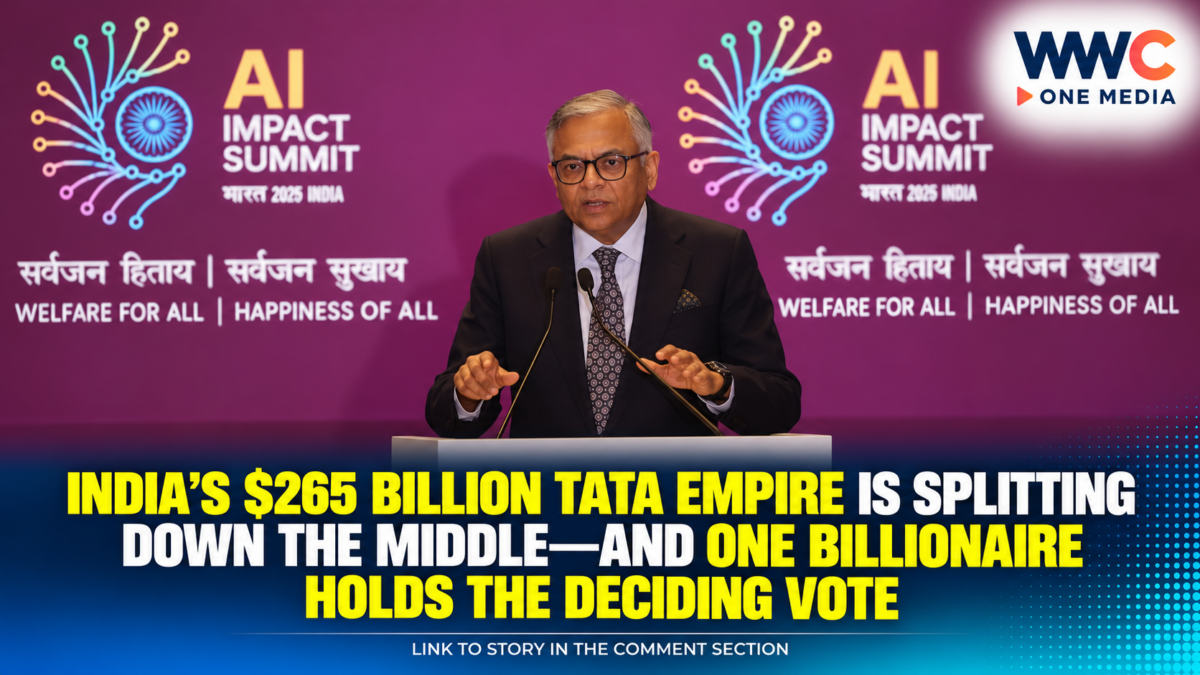
MUMBAI — One of India’s most powerful business empires is locked in an extraordinary boardroom battle—and the future of the Tata Group may now hinge on a billionaire who is neither a Tata family member nor the group’s chairman.
His name is Venu Srinivasan.
The 73-year-old industrialist, chairman emeritus of the TVS Group, has emerged as the pivotal figure in the confrontation between Tata Trusts chairman Noel Tata and Tata Sons chairman N. Chandrasekaran.
Srinivasan sits on the Tata Sons board as one of two nominees representing Tata Trusts, which controls roughly 66% of Tata Sons, the holding company at the centre of the sprawling conglomerate.
And unlike Noel Tata, Srinivasan has backed Chandrasekaran’s reappointment and supported moving ahead with a Tata Sons public listing.
That has transformed him from a behind-the-scenes figure into perhaps the most important independent power broker in the Tata empire.
The stakes extend across Tata Consultancy Services, Tata Motors, Air India, Jaguar Land Rover, Tata Electronics, Tata Steel and dozens of other businesses.
The question is no longer simply who will run Tata Sons.
It is:
Who ultimately controls Tata?
The Billionaire at the Centre of the Storm
Srinivasan is not a conventional corporate director.
He built his own business legacy at TVS, one of India’s most prominent automotive groups, and has been closely associated with its transformation into a professionally managed global manufacturer.
The FT estimates his personal fortune at roughly $7 billion, making him a major industrialist in his own right.
He also has deep connections to the Tata Group.
Former Tata chairman Ratan Tata appointed Srinivasan to the Tata Sons board in 2016 and later brought him into Tata Trusts. Srinivasan subsequently became a vice-chairman of the trusts.
That history is now particularly important.
Because the man Ratan Tata once trusted has ended up on the opposite side of several major questions from Noel Tata, Ratan’s half-brother and current chairman of Tata Trusts.
The Vote That Changed Everything
The immediate explosion came at a September 17 Tata Sons board meeting.
Chandrasekaran had announced in August that he would not seek another term as chairman after his current tenure expires on February 20, 2027.
That position changed after the board’s nomination and remuneration committee recommended that he reconsider.
On September 17, Chandrasekaran agreed to continue, and the Tata Sons board voted to give him another five-year term.
Four directors supported the resolution:
- Venu Srinivasan
- Harish Manwani
- Anita Marangoly George
- Saurabh Agrawal
Noel Tata voted against it.
Chandrasekaran did not vote.
The board therefore approved the reappointment by a 4-1 vote.
But that did not end the matter.
It opened an entirely new legal and governance battle.
Why Noel Tata Says the Vote Was Invalid
Tata Trusts controls about two-thirds of Tata Sons and has two nominee directors on its six-member board: Noel Tata and Venu Srinivasan.
Noel voted against Chandrasekaran.
Srinivasan voted for him.
The Tata Sons meeting chairman then exercised a casting vote, allowing the resolution to pass.
Tata Trusts argues that this was not legally sufficient.
Its position is that Tata Sons’ Articles of Association require the affirmative support of a majority of the Tata Trusts’ nominee directors for certain strategic decisions.
With Noel and Srinivasan split 1-1, the Trusts argue that the necessary condition was not satisfied.
Tata Sons, however, has relied on a different legal interpretation under the company’s Articles, arguing that the casting vote could resolve the deadlock. Legal experts have also disagreed over the meaning of the relevant provisions.
So the fight has moved beyond personalities.
It is now a fight over what Tata’s own constitution actually means.
And Then Came the IPO
The chairman’s reappointment was not the only explosive decision.
The Tata Sons board also approved steps toward listing Tata Sons on the stock market.
That puts the board directly against Noel Tata’s position.
Noel and Tata Trusts have historically opposed a public listing of Tata Sons, while Chandrasekaran and Srinivasan have supported moving toward a listing following regulatory pressure.
This matters because Tata Sons is the central holding company through which the Tata Trusts exercise influence over the wider group.
A public listing would fundamentally change the company’s ownership structure, transparency requirements and relationship with outside shareholders.
It could also unlock substantial value for existing shareholders.
But for the Trusts, the issue is about more than valuation.
It is about control.
The RBI Changed the Equation
The dispute intensified after India’s central bank rejected Tata Sons’ request to surrender its registration as a Core Investment Company (CIC).
That decision effectively put Tata Sons on a path toward complying with listing requirements.
Tata Sons had been seeking an exemption from the requirement to list.
The Reserve Bank of India’s decision removed much of the room for avoiding the issue through the previous route.
That is why the Tata Sons board’s September decision to move ahead with a listing was so significant.
The board was responding to a regulatory reality.
The Trusts, meanwhile, were still fighting to preserve an unlisted structure.
Now the Trusts Are Turning on Srinivasan
The latest escalation came this week.
Four trustees—Noel Tata, Neville Tata, Darius Khambata and Bhaskar Bhat—sent a letter accusing Srinivasan and fellow trustee Vijay Singh of abandoning previously agreed positions concerning Tata Sons’ listing. Reuters reported that the letter argued the Trusts had repeatedly endorsed efforts to keep Tata Sons unlisted.
The four trustees also challenged Srinivasan’s support for Chandrasekaran’s reappointment.
Indian Express reported that the trustees accused Srinivasan and Singh of changing their positions without bringing those changes back to the Trusts for collective consideration and described the conduct as potentially breaching their fiduciary duties.
That is a remarkable development.
The man who may hold the key vote on Tata Sons is now being challenged by members of the very Trust structure he represents.
Srinivasan Says the System Needs to Work Differently
Srinivasan’s position reflects a fundamentally different philosophy about Tata’s future.
He has argued that a public listing could unlock value for minority shareholders and provide Tata Sons with additional capital to finance growth.
He has also supported greater institutionalization and professional governance.
The Indian Express reported that Srinivasan has long been associated with professionally managed corporate structures through his stewardship of TVS and has increasingly positioned himself on the side of institutional processes rather than family control.
That creates a deeper ideological divide.
Noel Tata represents continuity with the Trusts’ traditional stewardship model.
Srinivasan is increasingly associated with a more market-oriented and institutional model.
And Chandrasekaran sits directly in the middle of that confrontation.
Why Venu’s Background Matters
Srinivasan’s influence is not based solely on his Tata board seat.
He has spent decades building TVS into a major automotive business.
He is also deeply connected to India’s industrial and political establishment.
The FT reported that Srinivasan has charitable activities in Tamil Nadu and significant connections with political and business circles. He was awarded the Padma Bhushan, India’s third-highest civilian award, in 2020 for contributions to trade and industry.
Those relationships give him influence well beyond the Tata boardroom.
But they also make his position more closely scrutinized.
As the battle intensifies, every decision he makes can potentially shift the balance between Tata Trusts and Tata Sons.
The Conflict-of-Interest Question Adds Another Layer
The Tata battle has also been complicated by questions surrounding a business relationship involving the Chandrasekaran family and TVS Motor.
Indian Express reported in September that Tata Trusts said it had not been informed of a business arrangement involving Hanno One Warehousing/Hanno Infra and TVS Motor, where Srinivasan is chairman emeritus and part of the promoter family.
The Trusts said it would consider an appropriate response after examining the matter.
The report also said a Tata official indicated that Chandrasekaran had told his son not to conduct business with Tata Group companies and that the venture was private.
The existence of the arrangement has nevertheless created another layer of scrutiny because it involves individuals linked to both sides of the current power struggle.
It is important to distinguish questions about disclosure or potential conflicts from proof of wrongdoing.
The reporting establishes that the issue has been raised and is being examined—not that a violation has been established.
The Trusts Are Now Under Regulatory Pressure Too
The dispute has escaped the boardroom and entered India’s regulatory system.
Venu Srinivasan and Vijay Singh filed complaints concerning the administration and governance of the Sir Dorabji Tata Trust.
The Maharashtra Charity Commissioner has asked the Trust to respond, with a deadline of October 12, according to Indian Express and LiveMint.
That means the internal Tata dispute is now being examined from several directions simultaneously:
Tata Sons’ board.
Tata Trusts’ trustees.
The Reserve Bank of India.
The Maharashtra Charity Commissioner.
And potentially, eventually, the courts.
The more institutions become involved, the harder it becomes for either side to resolve the dispute privately.
The Listing Could Change Tata Forever
Why does the Tata Sons IPO matter so much?
Because Tata Sons is not simply another Tata company.
It is the holding company at the centre of the group, owning stakes in 26 publicly listed Tata companies, according to Reuters.
Those businesses span:
- Technology
- Automobiles
- Steel
- Airlines
- Consumer products
- Hotels
- Energy
- Electronics
- Infrastructure
- Financial services
A listing would give outside investors a direct stake in the company sitting above much of that empire.
It could also make Tata Sons subject to much greater disclosure and market scrutiny.
For supporters, that means transparency and capital.
For opponents, it risks changing the special structure through which the Tata Trusts have historically preserved the group’s long-term philanthropic mission.
Tata Trusts’ Argument Is About More Than Control
The Trusts have rejected the idea that opposing a listing means they are simply protecting family control.
In their latest letter, Noel Tata and the other trustees argued that Tata Sons is the principal asset generating income for the charitable Trusts.
Protecting that asset, they said, is part of their fiduciary responsibility.
The Trusts have also proposed a restructuring involving the merger of Tata Electronics Systems Solutions and Tata Consulting Engineers with Tata Sons as a possible route to maintaining an unlisted structure.
That proposal has itself become controversial.
Srinivasan and Singh said they had not been consulted before the restructuring proposal was put forward, according to reporting by Telegraph India and other outlets.
So the dispute is now operating on two parallel tracks:
Should Tata Sons list?
And:
Who gets to decide whether Tata Sons lists?
The Stakes Extend to Air India and Tata’s Newest Businesses
This is where the dispute stops being an internal corporate drama.
Tata is investing heavily in businesses considered strategically important to India’s economy.
That includes semiconductor manufacturing, electronics, batteries and other advanced industrial projects.
It also owns Air India, which is undergoing a massive restructuring and modernization effort.
Reuters Breakingviews warned that a prolonged governance deadlock could make it harder for Tata’s businesses to secure approvals and capital for major projects.
Air India is an obvious example.
The airline needs significant investment as Tata attempts to rebuild it into a globally competitive carrier.
Meanwhile, Tata’s semiconductor and electronics ambitions require billions of dollars of capital.
A prolonged dispute at the holding-company level could therefore have consequences far beyond the ownership structure.
The Bigger Problem: Who Speaks for Tata?
For decades, the Tata Group’s governance model depended heavily on an unusual relationship.
The Trusts owned the controlling stake.
Professional executives ran the businesses.
The Tata family remained deeply associated with the philanthropic institutions that ultimately controlled Tata Sons.
The system worked partly because the major players generally reached consensus.
Now that consensus has fractured.
Noel Tata and Chandrasekaran are on opposite sides of critical questions.
Venu Srinivasan has sided with Chandrasekaran on the two biggest issues.
Other trustees are challenging Srinivasan.
The RBI has added regulatory pressure.
And the Charity Commissioner is examining complaints involving the Trusts.
The old informal balance is no longer holding.
This Is Bigger Than Noel vs. Chandra
It would be tempting to reduce the story to a personal feud between Noel Tata and N. Chandrasekaran.
That would miss the bigger issue.
The fundamental question is whether Tata remains governed through a philanthropic trust-controlled structure or moves toward a more conventional corporate model dominated by public shareholders and market institutions.
Chandrasekaran has spent almost a decade leading Tata Sons.
Noel Tata now leads the Trusts that control it.
Srinivasan sits between those two power centres.
And because the Tata governance structure gives Trust nominees special importance, his position can determine whether the two sides reach consensus—or remain locked in deadlock.
The Billionaire “Swing Vote” Could Decide the Next Chapter
That is why Srinivasan has become the most closely watched figure in India’s biggest corporate power struggle.
He is not the Tata family’s representative.
He is not Tata Sons’ chairman.
He does not control Tata Trusts.
Yet he may have something more valuable right now:
the vote needed to break the deadlock.
The FT described him as the pivotal figure in the fight because his support has aligned with Chandrasekaran on both the listing and chairman reappointment questions.
But there is a catch.
The current dispute has created questions over whether the Trusts’ nominees can act independently of collective Trust decisions.
That means Srinivasan’s influence could ultimately depend not only on how he votes, but on whether the legal structure allows that vote to determine the outcome.
What Happens Next?
Several deadlines and decisions now matter.
First, the Maharashtra Charity Commissioner is awaiting the Sir Dorabji Tata Trust’s response to complaints from Srinivasan and Singh by October 12.
Second, the dispute over Chandrasekaran’s reappointment will eventually have to confront the shareholder level.
Third, Tata Sons’ plan to pursue a listing will face additional regulatory and shareholder hurdles.
And fourth, the internal dispute within Tata Trusts itself could determine whether the organization can provide the unified shareholder position needed to govern Tata Sons effectively.
The clock is therefore running.
Chandrasekaran’s current term ends in February 2027.
But the battle over what happens after that has already begun.
The Bottom Line
The Tata Group is facing one of the most serious governance crises in its modern history.
At the centre is Venu Srinivasan, the TVS industrialist and Tata Trusts nominee whose vote backed both N. Chandrasekaran’s proposed five-year continuation as Tata Sons chairman and the company’s move toward a public listing.
Noel Tata opposes both moves.
The Trusts have challenged the legality of the September 17 board vote, while four trustees have now accused Srinivasan and Vijay Singh of breaking with previously agreed positions on Tata Sons’ listing.
At the same time, regulatory proceedings involving Tata Trusts are adding another layer of uncertainty.
The result is an extraordinary power struggle at the top of a conglomerate valued at more than $265 billion, with consequences potentially reaching from TCS and Tata Motors to Air India, Jaguar Land Rover and India’s emerging semiconductor industry.
For Tata, the ultimate question is no longer simply who sits in the chairman’s chair.
It is whether the group’s century-old governance model can survive its biggest internal fracture yet.
And everything may now depend on one man.
Venu Srinivasan has the vote—but the real question is whether that vote can still determine Tata’s future.